
TEVAR: Endovascular Repair of Thoracic Aortic Aneurysm — Procedure, Risks & Recovery

Updated: 6 days ago
Written and medically reviewed by Dr. Baraa Alnahhal, MD · Last reviewed: October 2026 · How we review
Quick Answer: What is TEVAR?
Thoracic endovascular aortic repair (TEVAR) is a minimally invasive procedure that places a stent graft, a fabric tube supported by metal mesh, inside the chest aorta through a small groin incision. It treats descending thoracic aortic aneurysms, dissections and traumatic tears. In suitable candidates, it offers a faster recovery and fewer serious complications than open surgery. [1]
What the research says
TEVAR cut early deaths and complications in nearly 50,000 patients. A meta-analysis of 29 studies (49,972 patients) found lower post-procedure mortality with endovascular repair (odds ratio 0.57) plus shorter ICU and hospital stays. Trade-offs: more repeat aortic procedures (hazard ratio 2.10), and open repair showed better all-cause survival beyond 16 months. (Liu J et al., Int J Surg, 2025) [4]
Shorter intensive care and hospital stays. Across 13 studies (14,580 patients), ICU stay averaged 4.5 vs 8.5 days and total hospital stay 5.7 vs 9.5 days for TEVAR vs open repair. Paraplegia, kidney failure and heart complications were more common after open repair; artery-access complications were more common after TEVAR (5.29% vs 1.17%). Operative mortality was slightly higher after TEVAR in this analysis (4.4% vs 3.2%), while 1- and 5-year mortality did not differ. (Harky A et al., Ann Vasc Surg, 2019) [5]
In ruptured descending aortas, TEVAR lowered in-hospital death. Among 10,466 patients, endovascular repair reduced in-hospital mortality (risk ratio 0.63) and paraplegia (risk ratio 0.70), with no significant difference in late mortality. (Salsano A et al., Cardiovasc Intervent Radiol, 2021) [6]
Key takeaways
TEVAR repairs the descending thoracic aorta from the inside, using a catheter-delivered stent graft. [1]
The procedure usually takes about two hours; most people go home within one day to one week. [1]
About 98% of people survive TEVAR, compared with about 88% to 94% for open surgery. [1]
Risks include endoleak, graft movement, infection, spinal cord injury (leg paralysis), heart attack and stroke. [1]
Imaging follow-up is lifelong: at 1 month, 12 months and every year after. [1][3]
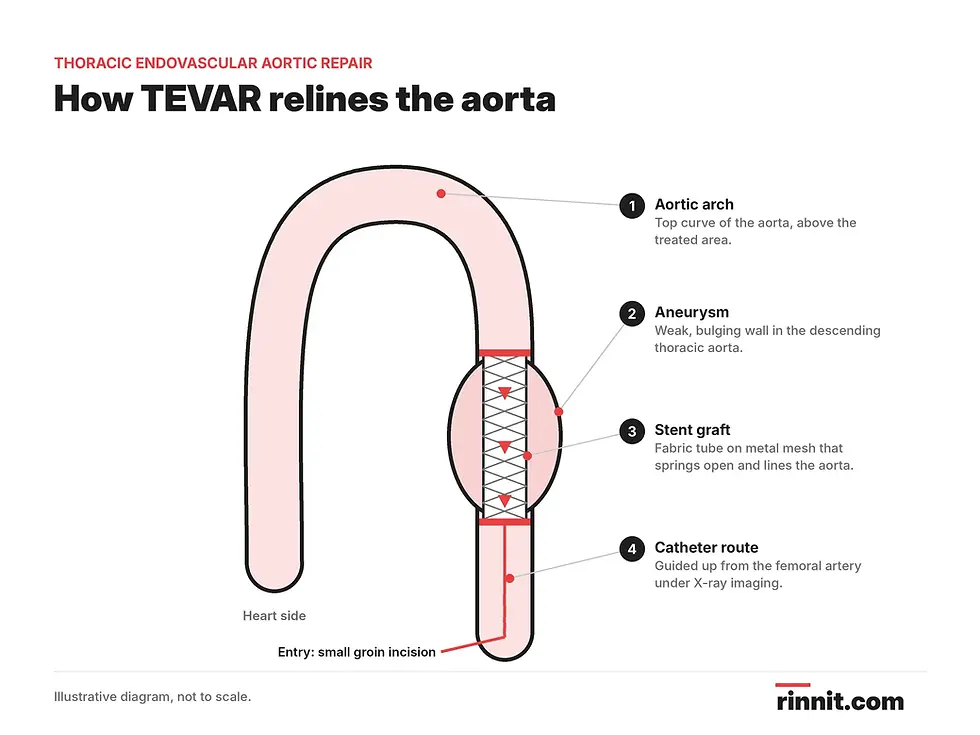
What is thoracic endovascular aortic repair (TEVAR)?
Thoracic endovascular aortic repair (TEVAR) is a minimally invasive procedure that repairs damage to the aorta inside the chest. [1]
The aorta is the body's largest artery. Its branches carry blood to every organ and tissue. [1]
Two common problems affect it:
Aneurysm — an abnormal bulge in a weakened part of the artery wall. [1]
Dissection — a tear in the lining of the artery wall. [1]
Without treatment, aneurysms and dissections of the descending thoracic aorta can be deadly. [1]
Open surgery was once the standard repair. Surgeons now prefer TEVAR in many cases because it has an easier recovery and a lower risk of serious complications in appropriate candidates. [1][3]
What conditions does TEVAR treat?
TEVAR treats three types of damage to the descending thoracic aorta — the section that curves down through the chest into the belly. [1]
Condition | What it means |
A bulge in the descending part of the chest aorta | |
A tear in the inner lining of the aortic wall | |
Aortic transection | A tear or severe damage from a car accident or other chest trauma |
Your vascular team decides if you are a candidate based on the shape and size of your blood vessels and other factors. [1]
How do you prepare for a TEVAR procedure?
Preparing for TEVAR usually means controlling blood pressure and cholesterol, stopping tobacco, adjusting medicines, and having imaging tests to plan the repair. [1]
Your care team may ask you to:
Take medicines to manage blood pressure and/or cholesterol.
Stop smoking or using any tobacco products.
Change your usual medication schedule.
Complete preoperative tests. [1]
Which tests are done before TEVAR?
A CT angiogram is the most common test before TEVAR. It shows the size and health of the arteries the team will travel through. [1]
The catheter usually enters through the femoral artery (upper thigh) or the iliac artery (pelvis). If these arteries are too narrow from plaque, or otherwise unusable, the team must plan another route. [1]
Imaging also helps choose the right size and type of stent graft:
For an aneurysm, the graft seals off the enlarged section from blood flow, removing the risk of growth or rupture.
For a dissection or transection, the graft relines the artery and covers the tear. [1]
What is a fenestrated stent graft?
A fenestrated stent graft has openings that let blood keep flowing into arteries branching off the aorta. It may be needed for more complex aneurysms that: [1]
Involve the aortic arch (the curved top of the aorta)
Extend through the chest and belly (thoracoabdominal aneurysms)
Involve branches leading to the intestines, brain or arms
What happens during a TEVAR procedure?
During TEVAR, the surgical team threads a stent graft through an artery in the groin and opens it inside the aorta to reline the weakened section. [1]
The main steps are:
Anesthesia — general anesthesia, or local anesthesia with a sedative.
Spine protection — the team may place a lumbar (spinal) drain to remove some cerebrospinal fluid, lowering the risk of spinal cord damage. This is decided case by case.
Small groin incision — made near the femoral artery.
Guide wire — threaded through the arteries past the damaged area.
Catheter — passed over the wire using live X-ray guidance (fluoroscopy). It carries the stent graft.
Graft placement — the stent graft is guided to the damaged area.
Graft release — the catheter is withdrawn; the graft expands like a spring against the aortic wall and becomes its new lining.
Closing — the groin incision is stitched and bandaged. [1]
How long does TEVAR take?
TEVAR typically takes about two hours. [1]
What is a hybrid repair?
A hybrid repair combines endovascular techniques with open surgery. It may be used when an aneurysm affects a large portion of the aorta. [1]
What are the benefits of TEVAR compared with open surgery?
TEVAR fixes the problem as well as open surgery while avoiding a chest incision, shortening recovery and lowering the risk of serious complications. [1]
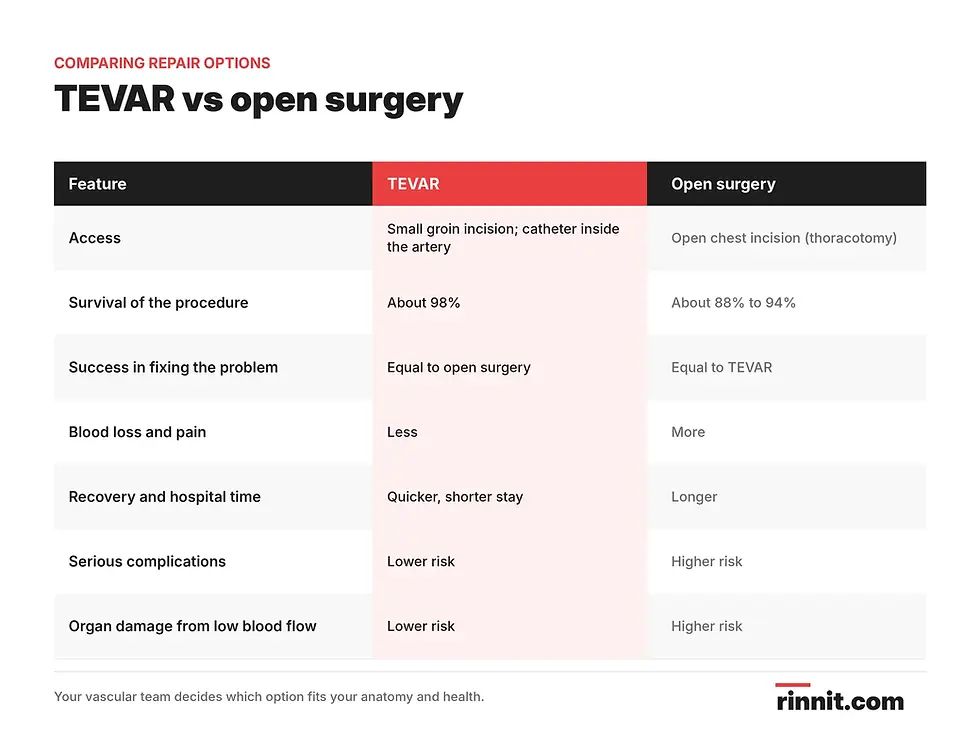
Feature | TEVAR | Open surgery |
Access | Small groin incision; catheter inside the artery | Open chest incision (thoracotomy) |
Success in fixing the problem | Equal | Equal |
Survival of the procedure | About 98% | About 88% to 94% |
Blood loss and pain | Less | More |
Recovery and hospital time | Quicker, shorter stay | Longer |
Risk of serious complications or death | Lower | Higher |
Organ damage from low blood flow (end-organ ischemia) | Lower risk | Higher risk |
Source for table: [1]
How successful is TEVAR?
About 98% of people survive the TEVAR procedure, compared with about 88% to 94% for open surgery. [1]
Outcomes are best at aorta centers that specialize in treating aortic disease. [1]
What are the risks and complications of TEVAR?
The main risks of TEVAR are endoleak, infection, graft movement, leg paralysis from reduced blood flow to the spine, heart attack and stroke. [1]
Endoleak
Infection
Movement of the stent graft
Leg paralysis (paraplegia) from too little blood flow to the spinal cord (spinal ischemia)
Ask your surgeon what they will do to lower each of these risks. [1]
How long is recovery after TEVAR?
Most people go home within one day to one week after TEVAR and return to normal activities over the following one to two weeks. [1]
You may spend one or two days in the intensive care unit (ICU), depending on the area treated, before moving to a regular room. [1]

Activity | General guidance |
Driving | Wait 1 to 2 weeks |
Lifting | Nothing over 10 lb (about 4.5 kg) for 1 to 2 weeks |
Bathing | No baths until groin incisions heal; showers and sponge baths are fine |
Diet | Follow a heart-healthy diet |
Exercise | Get more exercise as your care team advises |
Always follow your own surgeon's timeline. [1]
What follow-up is needed after TEVAR?
Follow-up after TEVAR is lifelong and relies on regular imaging to check the graft's position and look for endoleaks or other problems. [1][3]
When | Imaging visit |
1 month | First scan |
6 months | Only if the 1-month scan raised concerns |
12 months | One-year scan |
Every year after | Annual scan for life |
If a problem appears, your care team will recommend treatment. [1]
When should you call a doctor after TEVAR?
Call your care team whenever you have questions or concerns about your treatment or recovery. [1]
Go to the emergency room or call your local emergency number right away if you have signs of a heart attack or stroke. Both are life-threatening emergencies. [1]
Is TEVAR open-heart surgery?
No — TEVAR is not open-heart surgery. It is an endovascular procedure, done from inside the aorta with thin, long tubes (catheters), like relining the artery from within. [1]
The stent graft diverts blood away from the weak artery wall and relieves pressure on it. This lowers the risk of aneurysm rupture or aortic dissection. [1]
Conclusion
TEVAR has changed how thoracic aortic aneurysms are treated. A two-hour procedure through a small groin incision can now do the job that once required opening the chest, with higher survival, less pain and a faster return home for people whose anatomy allows it. [1]
The trade-off is commitment: imaging checks continue for life to make sure the graft stays in place and stays sealed. [1][3]
Your next step: If you or a family member has a thoracic aortic aneurysm, ask your vascular surgeon whether you are a TEVAR candidate, what type of stent graft fits your anatomy, and how the follow-up scans will be scheduled. To understand the condition behind the procedure, read our Thoracic Aortic Aneurysm guide and our Aortic Dissection guide next.
FAQ
What is TEVAR?
TEVAR (thoracic endovascular aortic repair) is a minimally invasive procedure that places a stent graft inside the chest aorta to repair an aneurysm, dissection or traumatic tear. The graft is delivered by catheter through a small groin incision. [1]
Is TEVAR open-heart surgery?
No. TEVAR is an endovascular procedure performed from inside the aorta with catheters, so it does not require opening the chest. [1]
How long does the TEVAR procedure take?
TEVAR typically takes about two hours. [1]
How long will I stay in the hospital after TEVAR?
Most people go home within one day to one week. Some spend one or two days in the ICU first, depending on the area treated. [1]
What are the main risks of TEVAR?
The main risks are endoleak, infection, graft movement, leg paralysis from reduced spinal blood flow, heart attack and stroke. Your surgeon can explain how they lower each risk. [1]
How successful is TEVAR compared with open surgery?
About 98% of people survive TEVAR, compared with about 88% to 94% for open surgery. Both approaches have equal success in fixing the aorta. [1]
How often will I need scans after TEVAR?
Imaging is usually done at 1 month, at 12 months and then every year for life, with an extra scan at 6 months if the first one shows concerns. [1][3]
When should I go to the emergency room after TEVAR?
Go to the emergency room or call your local emergency number right away if you have symptoms of a heart attack or stroke. [1]
Will I be asleep during TEVAR?
TEVAR is done under general anesthesia or local numbing medicine with a sedative. Your care team will explain which option is right for you.
What is an endoleak after TEVAR?
An endoleak is blood leaking around the stent graft into the aneurysm sac. It is usually found on follow-up scans, and some endoleaks need another procedure to fix.
Related Reading
Thoracic Aortic Aneurysm: Symptoms, Causes, Treatment & Complete Guide explains thoracic aortic aneurysm symptoms, causes and treatment.
Aortic Dissection: Emergency Warning Signs, Types, Diagnosis & Treatment covers a tear in the aorta wall and emergency warning signs.
Endovascular Aneurysm Repair (EVAR): Procedure, Recovery, Risks and Benefits describes the similar stent graft repair for abdominal aneurysms.
Thoracic Aortic Aneurysm Surgery: Open Repair vs. TEVAR, Risks and Recovery compares open repair and TEVAR for chest aortic aneurysms.
References
Cleveland Clinic. Thoracic Endovascular Aortic Repair (TEVAR). Cleveland Clinic. Last updated June 29, 2023. https://my.clevelandclinic.org/health/treatments/16962-endovascular-repair-of-thoracic-aortic-aneurysms
Nation DA, Wang GJ. TEVAR: Endovascular Repair of the Thoracic Aorta. Semin Intervent Radiol. 2015;32(3):265-271. PMID 26327745. https://doi.org/10.1055/s-0035-1558824
Upchurch GR Jr, Escobar GA, Azizzadeh A, et al. Society for Vascular Surgery clinical practice guidelines of thoracic endovascular aortic repair for descending thoracic aortic aneurysms. J Vasc Surg. 2021;73(1S):55S-83S. PMID 32628988. https://doi.org/10.1016/j.jvs.2020.05.076
Liu J, Gou D, Xu K, et al. Comparison of short- and long-term outcomes between endovascular and open repair for descending thoracic aortic aneurysm: a systematic review and meta-analysis. Int J Surg. 2025;111(3):2662-2674. PMID 39869368. https://doi.org/10.1097/JS9.0000000000002230
Harky A, Kai Chan JS, Ming Wong CH, et al. Open versus endovascular repair of descending thoracic aortic aneurysm disease: a systematic review and meta-analysis. Ann Vasc Surg. 2019;54:304-315.e5. PMID 30081163. https://doi.org/10.1016/j.avsg.2018.05.043
Salsano A, Salsano G, Spinella G, et al. Endovascular versus open surgical repair for ruptured descending aortic pathologies: a systematic review and meta-analysis of observational studies. Cardiovasc Intervent Radiol. 2021;44(11):1709-1719. PMID 34173045. https://doi.org/10.1007/s00270-021-02893-3
Society for Vascular Surgery. Thoracic Endovascular Aortic Repair. Vascular.org. Accessed October 31, 2026. https://vascular.org/your-vascular-health/your-care-journey/treatments/thoracic-endovascular-aortic-repair
Medical disclaimer
This article is for educational purposes only and does not replace professional medical advice, diagnosis or treatment. Always consult a qualified healthcare provider about your own condition and treatment options. If you think you are having a medical emergency, call your local emergency number immediately.



Comments