Tetracyclines: Uses, Side Effects and Safety

Updated: 2 days ago
Written and medically reviewed by Dr. Baraa Alnahhal, MD · Last reviewed: November 2026 · How we review
Quick Answer
Tetracyclines are a group of antibiotics that stop bacteria from growing and spreading. The best known are doxycycline, minocycline and tetracycline. They treat many infections, including acne, chlamydia, pneumonia and early Lyme disease. They make you sunburn easily and can stain developing teeth, so they're usually avoided in pregnancy and in children under 8.
What the research says
One dose of doxycycline after sex cut STIs by two-thirds: in a trial of 501 men who have sex with men and transgender women, taking 200 mg of doxycycline within 72 hours after condomless sex lowered new bacterial STI diagnoses from about 32% to 11% per quarter (Luetkemeyer AF et al., N Engl J Med, 2023) [2]
A single dose can prevent Lyme disease after a tick bite: in 482 people bitten by a deer tick, one 200 mg dose of doxycycline within 72 hours lowered Lyme disease rash from 3.2% to 0.4%, an 87% reduction, though nausea was more common (Nadelman RB et al., N Engl J Med, 2001) [3]
Key takeaways
Tetracyclines are antibiotics that include doxycycline and minocycline.
They treat acne, chlamydia, Lyme disease, pneumonia and more.
Calcium, iron, magnesium and antacids can make them less effective.
They make your skin sunburn easily.
They're usually avoided in pregnancy and in children under 8.
What are tetracyclines?
Tetracyclines are broad-spectrum antibiotics that work against two major kinds of bacteria. They stop bacteria from making the proteins they need to grow. Like all antibiotics, they don't work against viruses such as colds or the flu. Sources: [1]
Medicine | Common brands |
Doxycycline | Vibramycin, Doryx, Acticlate |
Minocycline | Solodyn, Ximino, Amzeeq (foam) |
Tetracycline | Generic |
Sarecycline | Seysara (acne) |
Omadacycline | Nuzyra |
Eravacycline | Xerava (IV) |
Sources: [1]
What tetracyclines treat

Tetracyclines don't work against viruses.
Pneumonia and other respiratory infections.
Early-stage Lyme disease.
Traveler's diarrhea and tularemia.
Anthrax and some food poisoning, when penicillin can't be used.
Inflammatory conditions such as hidradenitis suppurativa, sarcoidosis and pyoderma gangrenosum. Sources: [1]
How to take them
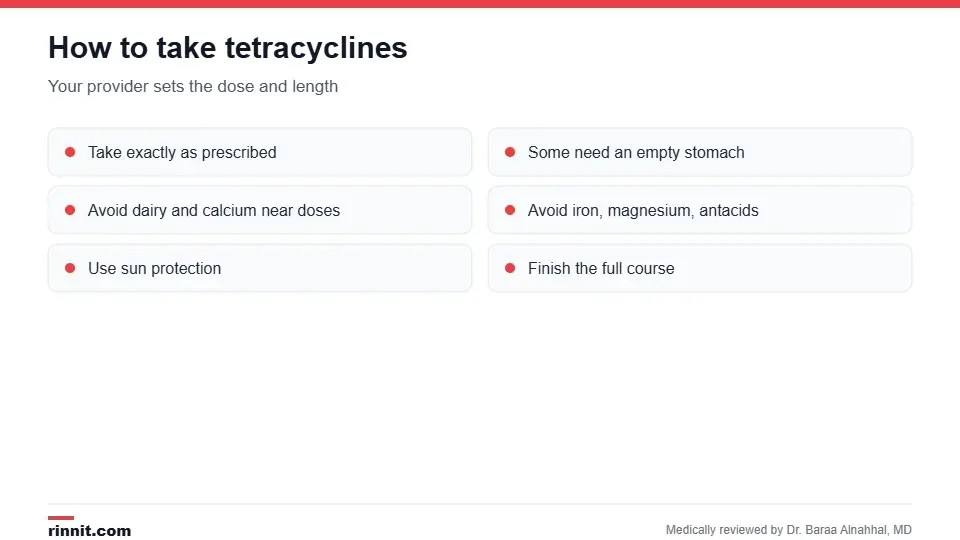
Your provider sets the dose and how long you take it.
Take them exactly as prescribed and finish the full course, even if you feel better.
Some must be taken on an empty stomach; check your label.
Separate them from dairy, calcium, iron, magnesium, antacids, laxatives and some multivitamins, which can block absorption.
Most come as pills; some are creams or foams, and some are given as a shot or IV. Sources: [1]
Side effects
Type | Examples |
Common | Stomach upset, nausea, vomiting, diarrhea, lower appetite |
Sun sensitivity | Severe sunburn with blistering; use sunscreen and cover up |
Rare | Liver problems, worsening kidney failure, sores or narrowing of the esophagus, raised pressure around the brain |
Like all antibiotics | C. diff diarrhea and antibiotic resistance |
Sources: [1, 3]
Who should avoid them
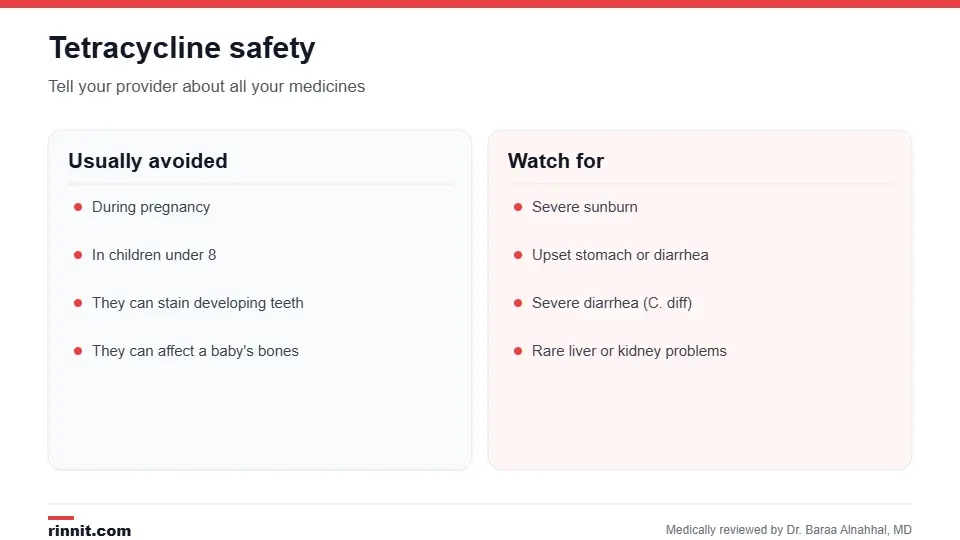
Tell your provider about all your medicines and supplements.
Tetracyclines cross the placenta and can affect a baby's bones and teeth, and they can permanently discolor teeth in children under 8. Providers usually avoid them in these groups unless they're clearly needed. Sources: [1]
How well they work
Tetracyclines are common, generally safe antibiotics with many uses. In studies, a single dose of doxycycline after a tick bite or after sex can prevent some infections. Your provider will choose the right drug, dose and length of treatment for your infection. Sources: [1, 2, 3]
When to call your provider
Your infection isn't improving.
Side effects bother you or don't go away.
You have severe diarrhea, which can be a sign of C. diff.
You have questions about your medicine. Sources: [1]
Conclusion
Tetracyclines like doxycycline treat a wide range of infections and skin conditions. Taking them correctly, protecting your skin from the sun and avoiding them in pregnancy and young children keeps them safe and effective.
Keep learning: read about antibiotics and macrolide antibiotics.
Frequently asked questions
What are tetracyclines?
A group of antibiotics that includes doxycycline and minocycline.
What do tetracyclines treat?
Acne, chlamydia, syphilis, pneumonia, Lyme disease and other infections.
Is doxycycline a tetracycline?
Yes. It's the most commonly used one.
Can I take tetracyclines with milk?
Dairy and calcium can block them; separate them from your dose.
Do tetracyclines cause sunburn?
Yes. They make your skin very sensitive to the sun.
Can children take tetracyclines?
They're usually avoided under age 8 because they can stain teeth.
Can I take them while pregnant?
They're usually avoided in pregnancy.
What are common side effects?
Upset stomach, nausea, vomiting and diarrhea.
Do tetracyclines work for colds?
No. They don't work against viruses.
Should I finish the whole course?
Yes, even if you feel better.
Related Reading
Antibiotics: Types, Uses, Side Effects and Resistance how antibiotics work and how to use them.
Acne: Complete Guide to Symptoms, Causes, Diagnosis, and Treatment a common reason to take tetracyclines.
Chlamydia: Symptoms, Causes, Treatment, and How to Protect Yourself an infection treated with doxycycline.
Understanding Rosacea: Symptoms, Types, and Management Strategies a skin condition treated with tetracyclines.
Macrolides: Antibiotic List, Uses, Side Effects & Safety another antibiotic group.
References
Cleveland Clinic. Tetracyclines: Uses & Side Effects. Cleveland Clinic. Last updated August 28, 2023. https://my.clevelandclinic.org/health/treatments/25214-tetracyclines
Luetkemeyer AF, Donnell D, Dombrowski JC, et al. Postexposure doxycycline to prevent bacterial sexually transmitted infections. N Engl J Med. 2023;388(14):1296-1306. PMID 37018493. https://doi.org/10.1056/NEJMoa2211934
Nadelman RB, Nowakowski J, Fish D, et al. Prophylaxis with single-dose doxycycline for the prevention of Lyme disease after an Ixodes scapularis tick bite. N Engl J Med. 2001;345(2):79-84. PMID 11450675. https://doi.org/10.1056/NEJM200107123450201
Medical disclaimer
This article is for general education only and does not replace advice from a qualified healthcare professional. Talk to your doctor about your own diagnosis and treatment, and seek emergency care right away for severe or sudden symptoms.



Comments