Septal Myectomy: Relieving Hypertrophic Cardiomyopathy Symptoms

Updated: 3 days ago
Medically reviewed by Dr. Baraa Alnahhal, MD · Last reviewed: October 2026
Septal myectomy is an open-heart surgery that treats hypertrophic cardiomyopathy by removing part of the thickened septum, the muscle wall between the heart's lower chambers, so blood flows out of the heart more easily. [1] It is usually recommended when medicines have not controlled symptoms such as chest pain, shortness of breath or fainting. [1] The operation takes about three to four hours, most people leave the hospital in under five days, and in one study 94% had symptom improvement. [1]
Quick Answer
Septal myectomy is an open-heart surgery that treats hypertrophic cardiomyopathy (HCM), a condition in which the heart muscle thickens. The surgeon removes part of the thickened septum between the lower chambers so blood flows out of the heart more easily. [1] It is usually recommended when medicines fail, and in one study, 94% of people had symptom improvement. [1]
What the research says
Symptom relief and survival were strong at an experienced center. In the first 507 myectomies at the Tufts HCM program, resting outflow gradients fell from 56 mmHg to 1.2 mmHg, 94% of patients improved to NYHA functional class I or II, 30-day mortality was 0.8%, and survival was 94% at 5 years and 91% at 10 years, not different from the age- and sex-matched general U.S. population (a single-center report) (Rastegar et al., Annals of Cardiothoracic Surgery, 2017) [2].
Surgery and alcohol septal ablation have similar mortality, but surgery lowers the gradient more. A meta-analysis of 27 observational studies (15,968 patients) found similar all-cause mortality (hazard ratio 1.24, 95% CI 0.88 to 1.76), but alcohol septal ablation reduced the outflow pressure gradient less and was linked to a higher rate of reoperation (hazard ratio 9.14, 95% CI 6.55 to 12.75) (Yokoyama et al., European Journal of Cardio-Thoracic Surgery, 2023) [3].
Surgery has more early complications but fewer repeat procedures and pacemakers. In a pooled analysis of 20 studies (4,547 patients), peri-procedural complications were 10.5% after myectomy versus 5.57% after alcohol septal ablation, while re-intervention (0.27% vs 10.1%) and pacemaker dependency (4.31% vs 12.4%) were lower after myectomy (Bytyçi et al., Journal of Clinical Medicine, 2020) [4].
How does septal myectomy work?
Your heart has four chambers: two upper chambers (atria) and two lower chambers (ventricles). A band of muscle called the septum separates the two ventricles. [1] In hypertrophic cardiomyopathy, the septum thickens and may bulge into the left ventricle. This bulging blocks blood flow, so your heart has to work harder to pump blood through your body. [1] HCM can be congenital, meaning you are born with it, or it can develop later in life. [1]
During a septal myectomy, the surgeon removes a portion of the thickened tissue. This lets blood move through the heart more easily. [1]

Who Is a Candidate for Septal Myectomy?
Healthcare providers usually recommend septal myectomy for people with hypertrophic cardiomyopathy whose symptoms, such as chest pain or fainting, have not improved with medicines. [1] They may also recommend it for:
The surgery relieves symptoms such as chest pain (angina), shortness of breath (dyspnea) and fainting (syncope). [1]
How should you prepare for septal myectomy?
Your healthcare provider will give you instructions for preparing. Most people do not need to do anything special, but you may need to stop certain medicines, such as blood thinners, before the operation. [1] If you smoke, your provider may ask you to try to stop before surgery. [1]
Before surgery you will have tests to check your heart health, such as blood tests, cardiac catheterization, cardiac MRI, a chest X-ray, an echocardiogram and an electrocardiogram (EKG). [1]
What happens during septal myectomy surgery?
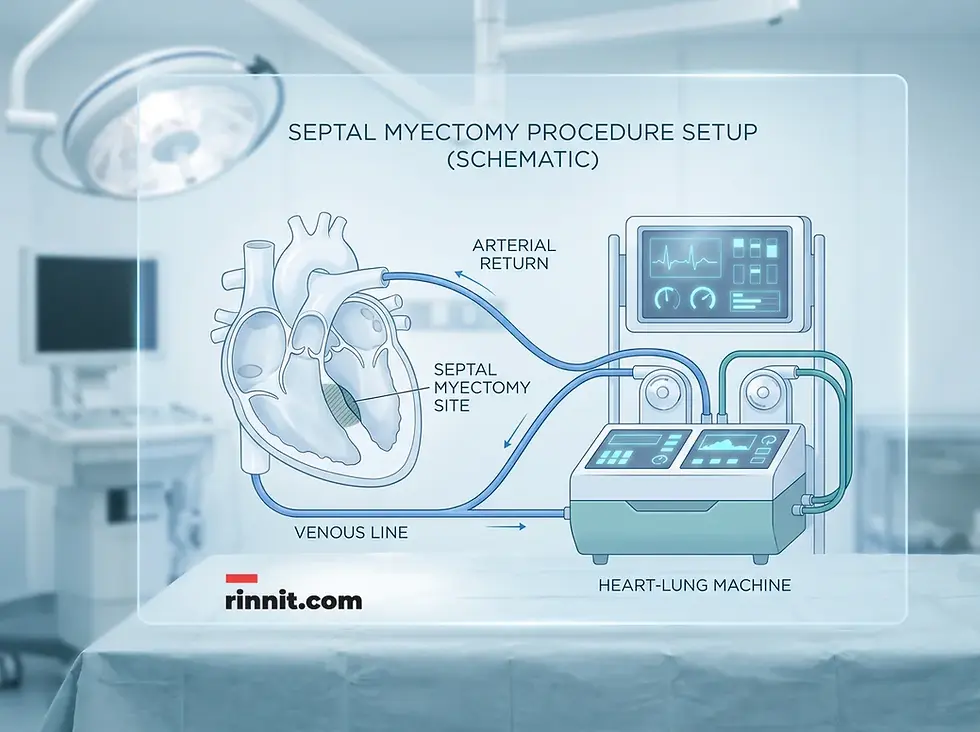
During septal myectomy, a surgeon opens the chest under general anesthesia and removes the thickened part of the septum while a heart-lung machine does the work of the heart and lungs. [1]
You receive general anesthesia so you stay in a deep sleep and feel no pain.
The surgeon makes a large incision down the middle of your chest and separates the breastbone (sternum) to reach your heart. [1]
You are connected to a heart-lung machine that takes over the work of your heart and lungs during surgery.
The surgeon removes the thickened portion of your septum.
The heart-lung machine is disconnected, the breastbone is put back together and the incision is closed with absorbable sutures. [1]
A septal myectomy usually takes between three and four hours. [1]
What are recovery and the outlook like after septal myectomy?
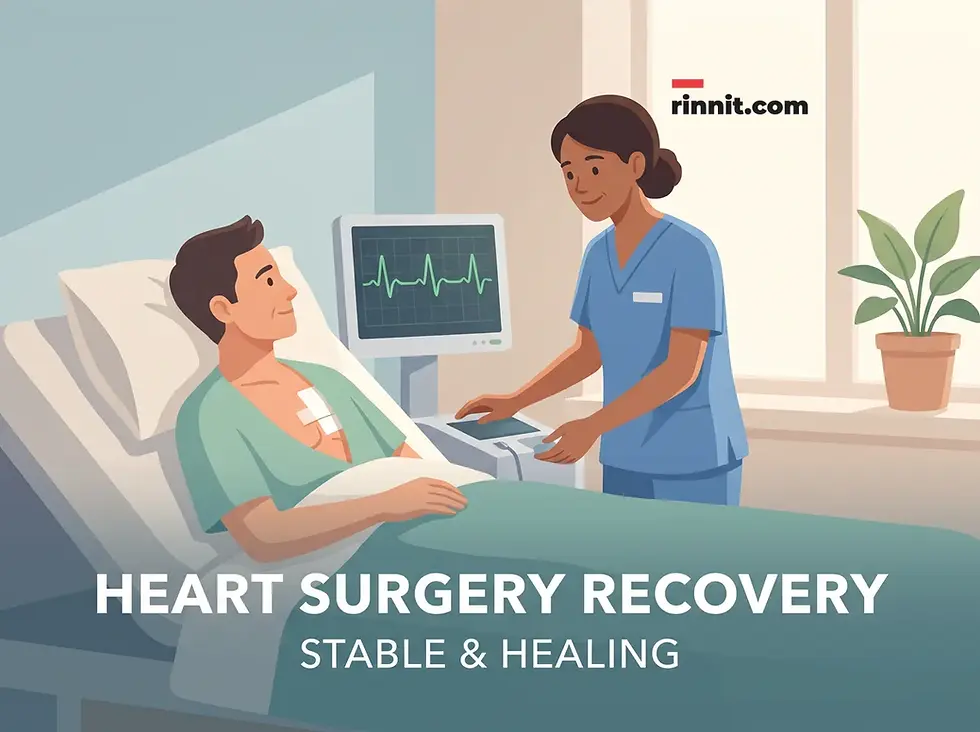
You recover in the intensive care unit (ICU) right after surgery. [1] You may have a urine catheter or chest drainage tube in place for 24 to 48 hours, and you will start walking with help from a physical therapist after about 48 hours. [1] Most people recover in the hospital for fewer than five days. [1]
Most people notice symptom relief days to weeks after surgery. [1] You may have minor chest soreness but should not have severe pain, and you may run out of energy more quickly than usual. Most people are back to their typical energy levels in a few weeks. [1]
Phase | Typical timing | What happens |
Before surgery | Varies | Heart tests, medicine changes (such as stopping blood thinners) and, if you smoke, trying to quit |
Surgery | 3 to 4 hours | General anesthesia, removal of thickened septum tissue and heart-lung machine support |
ICU and early recovery | First 24 to 48 hours | Close monitoring; a urine catheter or chest drainage tube may stay in place; walking with a physical therapist starts after about 48 hours |
Hospital stay | Fewer than 5 days for most people | Continued recovery and physical therapy |
Return to usual energy | A few weeks | Symptom relief days to weeks after surgery; minor chest soreness is common |
Long-term results are good. In one study, 94% of people had symptom improvement after surgery, and long-term survival after septal myectomy was the same as the general population. [1] [2]
What are the risks and complications of septal myectomy?
Septal myectomy is generally a low-risk procedure [1], but it can cause complications such as:
These complications are more common in people who have multiple other heart conditions, who smoke or use tobacco, or who are over age 65. [1] Because septal myectomy is an open-heart operation, it involves several weeks of recovery. [1]
When should you call your provider after septal myectomy?
After a septal myectomy, call your provider if you have symptoms that could point to a complication, such as:
Conclusion
Septal myectomy removes a portion of thickened heart muscle so blood can flow through the heart more easily. It is a serious open-heart operation, but it treats hypertrophic cardiomyopathy successfully in most people, relieving symptoms such as chest pain, shortness of breath and fainting.
Next step: If you still have chest pain, shortness of breath or fainting despite medicines, ask a cardiologist whether you are a candidate for septal myectomy.
Frequently Asked Questions
What is the primary goal of a septal myectomy?
The goal is to remove a portion of the thickened septum so blood flows through the heart more easily and the symptoms of hypertrophic cardiomyopathy improve.
How successful is septal myectomy at relieving symptoms?
Septal myectomy treats hypertrophic cardiomyopathy successfully in most people. In one study, 94% of people had symptom improvement after surgery, and long-term survival matched that of the general population. Individual results vary.
Is septal myectomy open-heart surgery?
Yes. The surgeon makes an incision down the middle of the chest and separates the breastbone, and a heart-lung machine takes over the work of the heart and lungs during the operation.
How long will I stay in the hospital after the surgery?
Most people recover in the hospital for fewer than five days. You recover in the intensive care unit (ICU) right after surgery, and you may have a urine catheter or chest drainage tube for 24 to 48 hours.
When can I return to my normal energy levels?
Most people are back to their typical energy levels in a few weeks. Minor chest soreness and running out of energy more quickly than usual are common early on.
What are the main risks of this surgery?
Possible complications include fluid around the heart or lungs, atrial fibrillation, and heart block, which disrupts the heart's electrical signals. These are more common in people with other heart conditions, people who smoke or use tobacco, and people over age 65.
Will I be awake during the septal myectomy?
No. The operation is done under general anesthesia, so you stay in a deep sleep and feel no pain.
Who is a candidate for septal myectomy?
Septal myectomy is usually recommended for people with hypertrophic cardiomyopathy whose symptoms have not improved with medicines, and for people with severe thickening into the left ventricle. It may also be recommended for people with the condition who want to become pregnant, even without severe symptoms.
Does age affect the risk of the surgery?
Complications such as fluid around the heart or lungs, atrial fibrillation and heart block are more common in people over 65, especially if they also smoke or have other heart conditions. Your surgical team will assess your individual risk.
What symptoms does septal myectomy help relieve?
Septal myectomy relieves chest pain (angina), shortness of breath (dyspnea) and fainting (syncope) caused by the thickened heart muscle.
Related Reading
Alcohol Septal Ablation: A Minimally Invasive Treatment for HCM explains a catheter-based alternative to septal myectomy.
Heart Failure: Symptoms, Causes & Treatment Guide covers heart failure, which thickened heart muscle can cause.
Echocardiogram: Types, What to Expect, Results and Risks describes the heart ultrasound used to diagnose and track HCM.
Open-Heart Surgery: Procedure, Preparation, and Recovery explains how to prepare for and recover from open-heart surgery.
References
Cleveland Clinic. Septal Myectomy. Cleveland Clinic. Last updated May 16, 2022. https://my.clevelandclinic.org/health/treatments/17461-septal-myectomy
Rastegar H, Boll G, Rowin EJ, et al. Results of surgical septal myectomy for obstructive hypertrophic cardiomyopathy: the Tufts experience. Annals of Cardiothoracic Surgery. 2017;6(4):353-363. PMID 28944176. https://doi.org/10.21037/acs.2017.07.07
Yokoyama Y, Shimoda T, Shimada YJ, et al. Alcohol septal ablation versus surgical septal myectomy of obstructive hypertrophic cardiomyopathy: systematic review and meta-analysis. European Journal of Cardio-Thoracic Surgery. 2023;63(3):ezad043. PMID 36782361. https://doi.org/10.1093/ejcts/ezad043
Bytyçi I, Nistri S, Mörner S, et al. Alcohol septal ablation versus septal myectomy treatment of obstructive hypertrophic cardiomyopathy: a systematic review and meta-analysis. Journal of Clinical Medicine. 2020;9(10):3062. PMID 32977442. https://doi.org/10.3390/jcm9103062
Medical disclaimer
The information provided in this article is for educational purposes only and should not be used as a substitute for professional medical advice, diagnosis, or treatment. Always seek the advice of your physician or other qualified health provider with any questions you may have regarding a medical condition.



Comments