Scoliometer: How It Screens for Scoliosis and What Readings Mean

Updated: 3 days ago
Written and medically reviewed by Dr. Baraa Alnahhal, MD · Last reviewed: November 2026 · How we review
Quick Answer
A scoliometer is a small handheld tool that measures how much the trunk is rotated when you bend forward, helping providers screen for and track scoliosis. A reading of 0 degrees means no sign of scoliosis, while more than 10 degrees suggests scoliosis. It's painless and takes just minutes. An X-ray is often used to confirm the curve.
What the research says
A 7-degree reading is a sensible referral point: in a study of 1,000 high school students screened with the scoliometer, 80% had at least 3 degrees of trunk rotation; using 7 degrees as the referral cutoff predicted a referral rate of about 3%, versus 12% at 5 degrees (Bunnell WP, Spine, 1993) [2]
Objective criteria help avoid over-referral: a review of scoliosis screening noted that low rates of significant scoliosis and a poor match between visible deformity and X-ray findings lead to over-referral, and recommended objective referral criteria and re-screening borderline cases (Bunnell WP, Clinical Orthopaedics and Related Research, 2005) [3]
Key takeaways
A scoliometer measures trunk rotation in degrees.
It's used during the Adams forward bend test.
0 degrees means no sign of scoliosis; over 10 degrees suggests scoliosis.
It's quick, painless and needs no preparation.
An X-ray usually confirms the diagnosis and measures the curve.
What is a scoliometer?
Scoliosis is a sideways curve of the spine that usually comes with some twisting. When you bend forward, this twist makes one side of your back sit higher than the other. A scoliometer has a fluid-filled chamber with a bubble, like a level, and shows that tilt as an angle in degrees. It's part of a physical exam, not a diagnosis on its own. Sources: [1]
How it's used
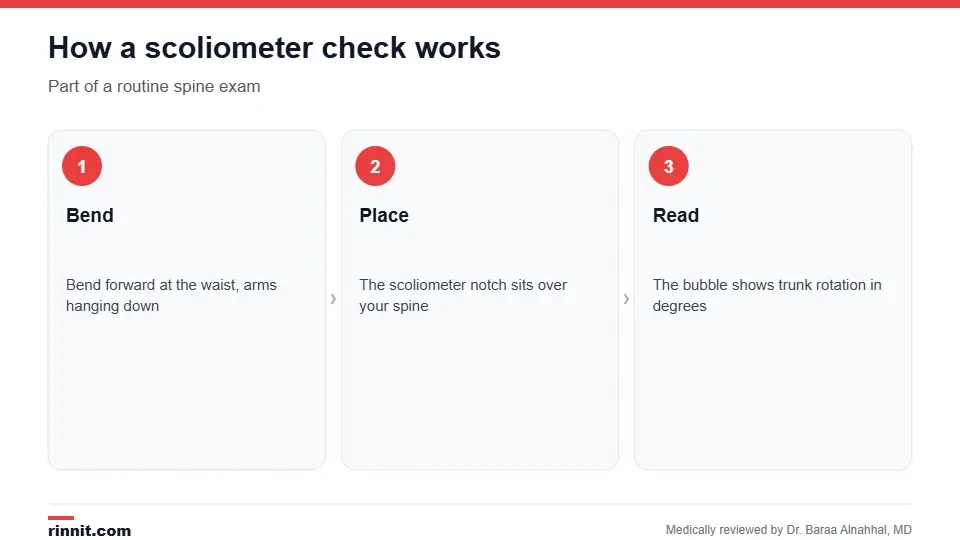
The check takes only a few minutes.
You stand with your feet together and bend forward at the waist, arms hanging down. This is the Adams forward bend test.
The provider places the scoliometer's notch over your spine, often at several levels from the upper back to the lower back.
The bubble shows the angle of trunk rotation in degrees, and the highest reading is recorded. Sources: [1]
Any healthcare provider can use a scoliometer, and it's sometimes part of school screenings. Phone apps exist, but only a provider can diagnose scoliosis. Sources: [1, 3]
Understanding results

Higher angles make treatment more likely.
Reading | What it may mean |
0 degrees | No sign of scoliosis |
A few degrees | Mild rotation that may be watched |
More than 10 degrees | Suggests scoliosis; usually an X-ray is next |
The higher the angle, the more likely treatment such as a back brace will be needed. Screening programs often use a cutoff of about 7 degrees to decide who needs an X-ray. Sources: [1, 2]
What happens next

Most people with scoliosis don't need treatment.
A spine X-ray confirms the curve, measures the Cobb angle and checks for other causes.
Most people with scoliosis need spine checks every 4 to 6 months.
Most people don't need treatment, and some children outgrow it.
See a provider if you notice uneven shoulders or hips or a change in posture. Sources: [1]
Conclusion
A scoliometer is a quick, painless way to measure the twist in the spine that comes with scoliosis. It helps decide who needs an X-ray and tracks curves over time.
Keep learning: read about idiopathic scoliosis and scoliosis bracing.
Frequently asked questions
What does a scoliometer measure?
The angle of trunk rotation, in degrees, when you bend forward.
What is the Adams forward bend test?
A check where you bend at the waist so the spine's curve shows.
What scoliometer reading suggests scoliosis?
More than 10 degrees.
Does it hurt?
No. It simply rests on your back.
Do I need to prepare?
No preparation is needed.
Is a scoliometer reading the same as the Cobb angle?
They're related, but the Cobb angle is usually measured on an X-ray.
Can I use a phone app at home?
Apps exist, but only a provider can diagnose scoliosis.
Will I need an X-ray?
Often, to confirm the curve and its size.
How often are checks needed?
Usually every 4 to 6 months if you have scoliosis.
Does scoliosis always need treatment?
No. Most people don't need treatment.
Related Reading
Scoliosis Guide: Symptoms, Causes, Diagnosis, and Treatment a full guide to scoliosis.
Idiopathic Scoliosis: Symptoms, Causes, and Modern Treatment Options the most common type of scoliosis.
Scoliosis Bracing: A Comprehensive Guide for Families when a brace may be needed.
Congenital Scoliosis: What It Is, How It's Treated, and What to Expect scoliosis that's present from birth.
Neuromuscular Scoliosis: Understanding Spine Curves in Complex Health Conditions scoliosis caused by nerve or muscle conditions.
References
Cleveland Clinic. Scoliometer: What It Is & How It's Used. Cleveland Clinic. Last updated September 27, 2022. https://my.clevelandclinic.org/health/diagnostics/24251-scoliometer
Bunnell WP. Outcome of spinal screening. Spine. 1993;18(12):1572-1580. PMID 8235833. https://doi.org/10.1097/00007632-199309000-00001
Bunnell WP. Selective screening for scoliosis. Clinical Orthopaedics and Related Research. 2005;(434):40-45. PMID 15864030. https://doi.org/10.1097/01.blo.0000163242.92733.66
Medical disclaimer
This article is for general education only and does not replace advice from a qualified healthcare professional. Talk to your doctor about your own diagnosis and treatment, and seek emergency care right away for severe or sudden symptoms.



Comments