Neuromuscular Scoliosis: Understanding Spine Curves in Complex Health Conditions

Updated: 2 days ago
Medically reviewed by Dr. Baraa Alnahhal, MD · Last reviewed: October 2026
Quick Answer: Key Facts About Neuromuscular Scoliosis
Neuromuscular scoliosis is a sideways C- or S-shaped spine curve that occurs with muscle or nerve conditions such as cerebral palsy, Duchenne muscular dystrophy and spina bifida. [1] Signs include uneven shoulders, tilted hips and slouching in a wheelchair. [1] It is diagnosed with an exam and spine X-ray. Treatment includes wheelchair adjustments, physical therapy and surgery such as spinal fusion. [1]
Feature | Details |
What it is | A sideways spine curve (C or S shape) that happens with muscle or nerve conditions. [1] |
Primary causes | Cerebral palsy, Duchenne muscular dystrophy, spina bifida, and spinal muscular atrophy (SMA). [1] |
Common signs | Uneven shoulders, tilted hips or waist, ribs that stick out, slouching in a wheelchair, and pressure sores. [1] |
Risk factors | Having a neuromuscular condition and using a wheelchair regularly. [1] |
Diagnosis | Physical exam, scoliometer measurement, spine X-ray, and sometimes MRI. |
Treatment | Wheelchair adjustments, physical therapy, and surgery such as spinal fusion or growing rods. [1] |
What the research says
Long spinal fusion to the pelvis corrects the curve, but complications are common. A meta-analysis of 29 studies covering 1,595 patients with neuromuscular scoliosis found that surgery with pelvic fixation reduced the average curve (Cobb angle) by about 47.6° and pelvic tilt by about 13.7°. Among 1,489 patients with complication data, 17.6% had implant-related complications, 15.1% developed infections, and 5.8% needed revision surgery. (Li et al., Spine Deform, 2025 [2])
In Duchenne muscular dystrophy, smaller curves may be watched carefully. In a small retrospective study of 31 patients, early correction (curves of 45° or less) and later correction had no significant difference in complication grades, lung function, or heart function at final follow-up. The authors suggest that watchful waiting is reasonable for curves under 45° while heart and lung function are maintained. They also noted that patients treated with steroids had a higher overall complication rate (61.9% vs 10.0%). (Asma et al., Spine Deform, 2022 [3])
What Is Neuromuscular Scoliosis?
Neuromuscular scoliosis is a sideways curve of the spine that develops alongside conditions that affect a child’s nerves and muscles. In a healthy spine, the vertebrae line up straight down the middle of the back. In neuromuscular scoliosis, they rotate slightly off-center, so the spine forms a “C” or “S” shape. [1]
This is very different from poor posture or slouching. A child with neuromuscular scoliosis is not acting up or ignoring reminders to sit up straight. [1] Sitting upright is a constant challenge, and it can be uncomfortable, because the muscles that support the spine lack the strength or control they need. The condition is also progressive, which means the curve usually gets worse over time, especially during growth spurts in childhood and adolescence. [1]

What causes neuromuscular scoliosis, and who is at risk?
The main driver is an underlying health condition that weakens the muscles around the spine. When those muscles cannot give enough support, the spine gradually pulls out of alignment.
Associated Medical Conditions
Other conditions linked to neuromuscular scoliosis include spina bifida and paralysis. [1] A child is more likely to develop a curve if they have one of these neuromuscular conditions, use a wheelchair regularly, or both. [1]
What are the signs and symptoms of neuromuscular scoliosis?
Signs of neuromuscular scoliosis often appear earlier than other types of scoliosis, sometimes well before adolescence. [1] Parents and caregivers may first notice that clothes do not fit right. A sleeve may look longer on one side, or buttons may not line up with the buttonholes. [1]
Physical Signs
Uneven body shape: uneven shoulders, a tilted waist, or hips that look slanted. [1]
Rib prominence: ribs that stick out more on one side of the body. [1]
Posture changes: a noticeable lean to one side, especially when seated.
Other spine curves: kyphosis (a front-to-back hump) or lordosis (an exaggerated swayback) can also develop. [1]
Signs in Wheelchair Users
Children who use a wheelchair may lean to one side, have a slanted pelvis, need to use their hands or arms for support just to stay upright, or develop pressure sores from uneven weight distribution. [1] As the curve gets worse, a child may also have back pain, discomfort when sitting, muscle weakness, and limited range of motion. [1]

What complications can neuromuscular scoliosis cause?
Severe curves can cause health problems beyond posture. These include breathing problems such as thoracic insufficiency syndrome, in which the curved spine keeps the lungs from expanding fully. Other possible problems include nerve damage, heart and circulation problems, mobility challenges, and loss of independence in daily activities such as eating or getting dressed. The strain of living with more than one health condition can also raise a child’s risk of low self-esteem, depression, or anxiety, so emotional support matters too. [1]
How is neuromuscular scoliosis diagnosed?
Healthcare providers diagnose neuromuscular scoliosis with a physical exam and, when needed, imaging. During the exam, the provider reviews the child’s medical history and looks closely at the spine, posture, balance, and skin (to check for pressure sores). [1]
Common Diagnostic Tools
Scoliometer: a simple tool placed on the back to measure how much the spine is rotated.
Spine X-ray: the main way to see the curve and measure its angle.
MRI scan: gives a detailed look at the spinal cord and nearby tissues.
How is neuromuscular scoliosis treated and managed?
Treatment aims to stabilize the spine, slow or stop the curve from getting worse, and keep the child comfortable and as mobile and independent as possible. The best plan depends on the child’s overall health, the underlying condition, and how severe the curve is. [1]
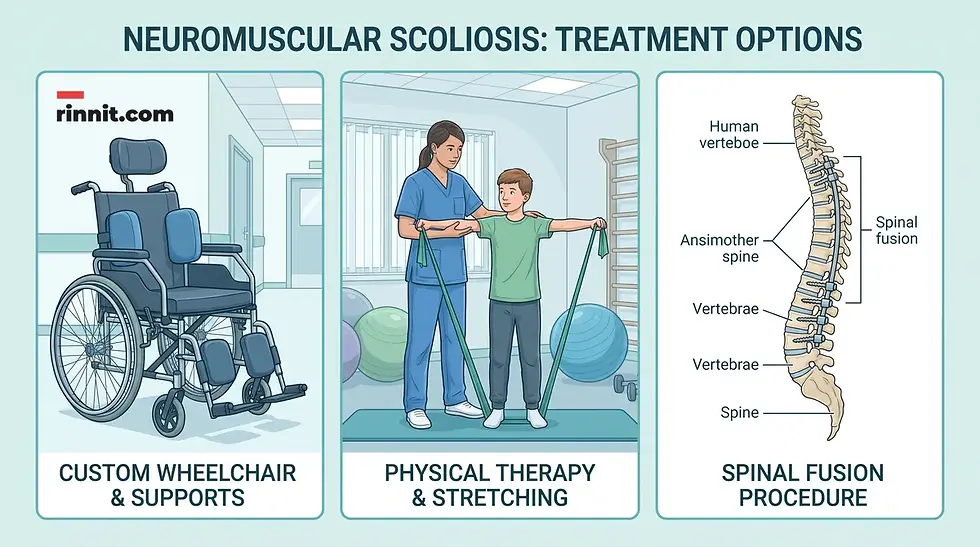
Nonsurgical Management
Nonsurgical options are often tried first. They may delay or slow the curve, but they do not correct it. [1]
Wheelchair adjustments: a custom seat back and lateral supports (side positioners) help a child balance and sit comfortably. [1]
Physical therapy: exercises strengthen the affected muscles, improve balance, and support independence.
Bracing: used with care. A brace around the torso may help a child who uses a wheelchair balance while seated, but it does not stop the curve from getting worse. [1] A brace is usually not safe for children who walk, because it can raise the risk of falls.
Surgical Treatment
Surgery can stop the curve from progressing and stabilize the spine. A healthcare provider may consider it when a child has a curve greater than 40 degrees that keeps getting worse, pain or discomfort, or problems that affect lung or heart function. [1]
Spinal fusion: a surgeon realigns the spine and fuses the affected vertebrae into one solid bone using bone grafts, metal rods, and screws. [1] The fused bones can no longer grow, which may result in shorter stature. [1]
Growing rods: for children who are still growing, a rod placed along the spine stabilizes it and corrects the curve. The rod is lengthened about every six to eight months, with a minor procedure or magnetically in the office, to keep up with growth. [1] When the child reaches skeletal maturity, the surgeon removes the rod and performs a spinal fusion. [1]
Because these children are also managing an underlying condition, they have a higher risk of surgical complications such as infection or nerve damage. [1] The care team will weigh the benefits and risks with the family before recommending surgery.
What is the bottom line on neuromuscular scoliosis?
Neuromuscular scoliosis is a progressive spine curve that comes with conditions affecting the nerves and muscles. It often starts early in childhood, and it can affect sitting comfort, mobility, and breathing as it worsens. Regular check-ups, early recognition of the signs, and a treatment plan built around the child, from wheelchair supports and therapy to surgery when needed, can protect comfort, function, and quality of life.
Support your child’s spinal health. For more resources on navigating complex neuromuscular conditions and finding specialized orthopedic care, visit Rinnit.com.
Frequently Asked Questions
Can neuromuscular scoliosis be prevented?
No. Because it is caused by an underlying nerve or muscle condition, it cannot be prevented. With early diagnosis and treatment, healthcare providers may be able to slow the curve or correct it with surgery.
Does neuromuscular scoliosis cause pain?
It can. As the curve progresses, a child may have back pain and discomfort, especially when sitting for long periods.
Will my child always need a wheelchair?
Wheelchair use depends mainly on the underlying neuromuscular condition, not on the scoliosis alone. Regular wheelchair use does raise the chance of a spine curve, though, and a severe curve can make sitting and mobility harder. Treatment that stops the curve from getting worse can help protect comfort and function.
Is surgery the only way to fix the curve?
Surgery is the treatment that can stabilize the spine and stop the curve from progressing, and it may correct the curve. Nonsurgical treatments may delay or slow the curve, but they do not correct it.
At what age does neuromuscular scoliosis start?
Unlike idiopathic scoliosis, which usually becomes noticeable in the teen years, neuromuscular scoliosis can show up in early childhood, well before adolescence.
How long is recovery after spinal fusion?
Recovery depends on the child, the underlying condition, and how much of the spine was treated. The surgical team will explain what to expect in the hospital and at home before the operation.
Can a child still grow after spinal fusion?
Spinal fusion stops the fused part of the spine from growing, which may result in shorter stature. That is why growing rods are often used for younger children: they allow as much growth as possible before a final fusion.
What are growing rods?
They are adjustable rods that support the spine while it keeps growing. They are lengthened about every six to eight months to match the child’s growth, either with a minor procedure or magnetically in the office.
Are there risks to the surgery?
Yes. Children with neuromuscular conditions have a higher risk of complications such as infection or nerve damage, which is why care from a specialized team is important.
Can physical therapy cure scoliosis?
No. Physical therapy cannot straighten the spine, but it strengthens the muscles that support it, helps with balance, and supports independence.
What is a scoliometer?
It is a simple tool a provider places on a child’s back to measure how much the spine is rotated during a physical exam.
How often does my child need check-ups?
Because neuromuscular scoliosis is progressive, children usually need more regular visits with their care team. At these visits the provider measures the curve. How often depends on the child’s condition and growth, so ask the care team for a schedule.
Can scoliosis affect breathing?
Yes. A severe curve can compress the chest, which keeps the lungs from expanding fully and can lead to breathing problems.
What are lateral supports in a wheelchair?
They are padded cushions or plates attached to the sides of a wheelchair seat (side positioners) that help a child with weak trunk control stay upright and centered.
Is neuromuscular scoliosis hereditary?
The scoliosis itself is not directly inherited, but many of the conditions that cause it, such as muscular dystrophy and SMA, are genetic.
Related Reading
Scoliometer: How It Screens for Scoliosis and What Readings Mean explains the handheld tool used to screen for scoliosis.
References
Cleveland Clinic. Neuromuscular scoliosis. Cleveland Clinic. Last updated July 2, 2024. https://my.clevelandclinic.org/health/diseases/neuromuscular-scoliosis
Li Z, Sun D, Han B, et al. Safety and efficacy of long spinal fusion to the pelvis for the treatment of neuromuscular scoliosis: single-arm meta-analysis and systematic review. Spine Deform. 2025;14(2):375-388. PMID 41219676. https://doi.org/10.1007/s43390-025-01226-5
Asma A, Ulusaloglu AC, Shrader MW, et al. No difference in postoperative complication rates or cardiopulmonary function for early versus late scoliosis correction in Duchenne muscular dystrophy. Spine Deform. 2022;10(6):1429-1436. PMID 35691977. https://doi.org/10.1007/s43390-022-00532-6
Medical disclaimer
This article is for educational purposes only and is not a substitute for professional medical advice. Always consult a healthcare provider for diagnosis and treatment of spinal conditions.



Comments