Congenital Scoliosis: What It Is, How It's Treated, and What to Expect

Updated: 3 days ago
Medically reviewed by Dr. Baraa Alnahhal, MD · Last reviewed: October 2026
Quick Answer
Congenital scoliosis is a birth condition in which the spine curves side to side because the vertebrae did not form as expected during fetal development [1]. It makes up about 10% of scoliosis cases [1]. Signs include slanted shoulders, an uneven ribcage and tilting hips [1]. Braces and casts may help, but many children need surgery in their first few years [1].
What the research says
About 1 in 3 children with congenital scoliosis has an abnormality inside the spinal canal. A meta-analysis of 10 articles found that 671 of 1,863 patients with congenital scoliosis who had an MRI scan had intraspinal abnormalities, an overall incidence of 37% (95% CI 29% to 45%). The most common was diastematomyelia (split spinal cord), found in 45.6% of those with an abnormality, and neither the patient's sex nor the type of congenital scoliosis changed the incidence (PubMed: Wang et al., J Orthop Surg Res, 2020) [2].
Kidney and urinary tract anomalies are common alongside the curve. A meta-analysis of 8 cohort studies covering 2,781 patients with congenital scoliosis found that 22.91% (95% CI 13.39% to 32.43%) had genitourinary anomalies, and 13.92% of patients had anomalies that were treated surgically. A single (unilateral) kidney was the most frequent finding, and the pooled incidence of associated cardiac anomalies was 17.60% (PubMed: Lorente et al., Eur Spine J, 2023) [3].
A posterior-only approach to removing a hemivertebra took less time and lost less blood. In a meta-analysis of 37 studies, posterior-only hemivertebrectomy had a mean operative time of 227 minutes (95% CI 205 to 250) versus 316 minutes (95% CI 291 to 341) for a combined anterior-posterior approach, and mean blood loss of 522 mL versus 888 mL. Correction was not significantly different between the two approaches (pooled mean correction 66%, 95% CI 61% to 72%), and age at surgery was significantly correlated with the need for revision surgery. The included studies were mostly observational (PubMed: Barik et al., Eur Spine J, 2021) [4].
What Is Congenital Scoliosis?
Congenital scoliosis is a side-to-side curvature of the spine caused by vertebrae — the bones of the spine — not forming as expected during fetal development. It is not a common type of scoliosis. It accounts for only about 10% of diagnosed scoliosis cases [1].
The affected vertebrae may fuse together, connecting when they should stay separate. They can also take on an abnormal shape, such as forming like triangles instead of rectangles.
The spine may try to compensate for these bone growth abnormalities. It curves above or below the affected vertebrae to keep the torso upright.
Key Fact | Detail |
Definition | Side-to-side spinal curvature caused by vertebrae that formed abnormally in fetal development |
Share of scoliosis cases | About 10% |
Present at birth | Yes |
Typical trajectory | May progressively worsen as the child grows |
First notice | Clothing clues (mismatched buttons, twisting shirt) |
Standard care | Regular monitoring, with surgery common in early childhood |

Spotting the First Signs in Everyday Life
Parents often first notice congenital scoliosis when dressing their child. A few everyday clues can point to a curved spine. The buttons on a shirt may not match evenly from left to right. A shirt may twist around the torso. One pant leg can look longer than the other [1]. It may seem as if the clothing was manufactured incorrectly or went through the wash the wrong way.
This condition is present at birth and can progressively get worse as the child grows. Children with congenital scoliosis face a higher risk of severe curves than those with other types of scoliosis [1]. This means a child will likely need surgery in the first few years of life to prevent complications.
What are the types of congenital scoliosis?
The types of congenital scoliosis, based on how the vertebrae formed, are incomplete vertebrae formation, failure of vertebrae separation and a combination of both, which is usually the most severe [1].
Type | What Happens | Typical Severity |
Incomplete vertebrae formation (hemivertebrae) | Part of a vertebra did not form completely, making the spine grow at an angle; can affect one vertebra or many | Varies |
Failure of vertebrae separation (segmentation) | The early spine, one column of tissue meant to separate into individual vertebrae, stays fused instead | Varies |
Combination (hemivertebrae and bars) | Groups of fused bone that did not separate alongside bones that did not form as expected | Usually the most severe |
Incomplete vertebrae formation (hemivertebrae) means part of a vertebra did not form completely. This makes the spine grow at an angle. It can affect one vertebra or many.
Failure of vertebrae separation (segmentation) starts with an important step in early development. The spine forms as one column of tissue that should separate into the different bones that become the vertebrae. In segmentation scoliosis, the vertebrae do not separate from that original column and fuse together correctly.
Combination (hemivertebrae and bars) involves both problems. There are groups of fused bone that did not separate and bones that did not form as expected. This type is usually the most severe [1].
What are the signs and symptoms of congenital scoliosis?
The physical signs of congenital scoliosis relate to how the body lines up as the spine curves [1].
Sign or Symptom | What It Looks Like |
Slanted shoulders | One shoulder sits lower than the other |
Uneven ribcage | Ribs protrude or sit differently on each side |
Tilting hips | One hip higher than the other |
Posture | Difficulty standing up straight |
Severe curves may cause nerve or spinal cord damage. These can produce neurological symptoms, which are listed below [1].
Neurological Symptom | Description |
Muscle weakness | Reduced strength in the limbs |
Numbness | Loss of feeling in the arms or legs |
Coordination problems | Loss of coordination or difficulty walking |
Some children experience pain or discomfort, depending on how severe the spinal curves are. Mild curves usually do not cause any pain [1].
What Causes Congenital Scoliosis?
A bone growth abnormality in the spine causes congenital scoliosis. This happens before the child is born, usually in the first six weeks of embryonic development [1].
Experts are not sure exactly what causes this abnormal bone growth. Research suggests it may happen due to environmental or genetic factors [1].
What are the complications of congenital scoliosis?
It is common for children diagnosed with congenital scoliosis to experience heart, lung, or kidney problems in addition to a curved spine. These problems may be life-threatening [1].
Complication Area | Possible Effects |
Internal organs | Heart, lung, or kidney problems that may be life-threatening |
Breathing | Difficulty breathing and other respiratory problems |
Mobility | Limited range of motion and difficulty performing certain activities |
Nerves | Paralysis |
Emotional health | Self-esteem and confidence issues affecting mental health |
Many children diagnosed with scoliosis experience self-esteem and confidence issues. The curve in their spine can make a child feel and look different. This can significantly impact their mental health and emotional well-being. For example, a child might not want to wear a bathing suit or tight clothes. This might keep them from taking part in activities they would otherwise enjoy.

How is congenital scoliosis diagnosed?
A healthcare provider can see signs of congenital scoliosis during a pregnancy ultrasound [1]. An official diagnosis usually happens during the child's newborn examination.
Although congenital scoliosis is present at birth, a child might not receive a diagnosis until symptoms become more apparent as they grow. This usually happens before adolescence and growth spurts [1].
Diagnostic Step | Purpose |
Physical exam | Checks posture, shoulders, ribs, and hips |
X-ray | Gives a clear view of the bones |
CT scan | Shows detailed bone structure |
MRI | Evaluates bones and checks for additional complications |
Ultrasound | Non-invasive imaging of the bones |
Scoliometer | Measures the size of the curve |
The provider performs a physical exam and orders imaging tests — an X-ray, CT scan, MRI, or ultrasound — to get a better view of the child's bones and to check for additional complications. They may use a measuring tool called a scoliometer to measure the size of the curve [1].
How is congenital scoliosis treated?
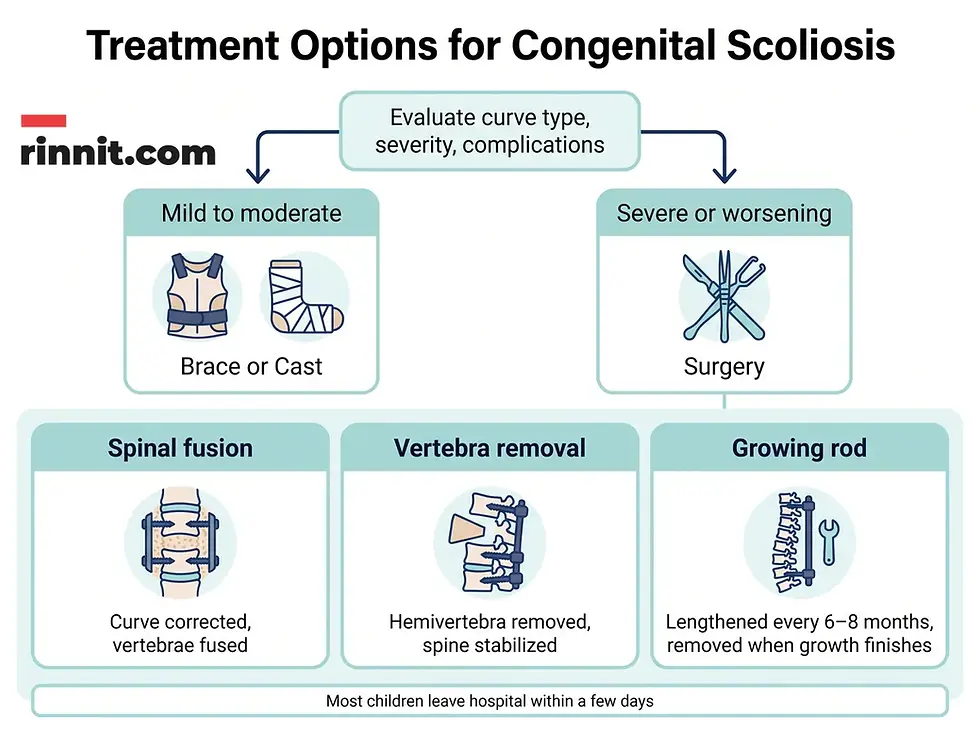
Congenital scoliosis treatment can help straighten and stabilize the spine using a brace, a cast or surgery, tailored to the type, the severity of the curve and any complications.
Can Congenital Scoliosis Be Corrected?
Treatment for congenital scoliosis can help straighten and stabilize the spine. A child's provider may recommend wearing a brace or a cast, or proceeding to surgery [1].
The provider monitors and evaluates the type of congenital scoliosis, the severity of the curve, and whether complications are present. Treatment options are tailored to the child's specific situation.
Treatment | What It Involves |
Brace | Supports and guides the spine as the child grows |
Cast | Holds the spine in place to straighten and stabilize it |
Surgery | Corrects severe curves and prevents them from worsening |
When Is Surgery Needed?
Not all cases of congenital scoliosis need surgery, but many do. Because the child is still growing, the curve could get worse with age. Severe curves require surgery [1].
A provider may suggest surgery if the curve in the child's spine does any of the following [1].
Surgical Trigger | Explanation |
Curve gets worse | The curvature increases over time |
Severe angle | The curve reaches a severe angle |
Neurological symptoms, pain, or discomfort | The curve harms nerves or causes ongoing pain |
Growth and development affected | The curve interferes with normal growth |
Surgical Options
Procedure | What Happens |
Spinal fusion | Surgeon connects abnormally shaped or curved vertebrae into a single bone, correcting the curve and preventing worsening |
Vertebra removal | Surgeon removes a hemivertebra (malformed spinal bone), then stabilizes the spine with implants or spinal fusion |
Rod surgery | A "growing" rod is added to the spine and lengthened every six to eight months with minor surgery; once the child finishes growing, the rod is removed and the spine is stabilized with spinal fusion |
Surgeons choose the safest and most effective procedure to improve the child's quality of life. Many children experience a good outcome after surgery. Most children can leave the hospital within a few days after surgery [1]. They rarely need to wear a brace for a short period of time following the procedure.
What is the outlook and life expectancy for congenital scoliosis?
The outlook for congenital scoliosis varies, as growing bones create a high risk that the curve worsens, and severe cases may affect life expectancy if complications involve the heart, lungs or kidneys.
What Can Parents Expect?
Congenital scoliosis is a challenging condition to manage. Because the spine curve happens so early in a child's life, their bones still need to grow. This creates a high risk that the curve will become more severe as the child gets older, which often leads to surgery [1].
Providers cannot predict exactly how a spine will handle growth. Regular appointments let the provider measure and monitor the curve for complications.
Outcome Consideration | What to Know |
Growth after fusion | It is normal for children who had spinal fusion to be shorter than their peers; fusion can stop growth in that portion of the spine |
Emotional well-being | Consider talking to a mental health professional if the child struggles emotionally |
Monitoring | Regular appointments to measure and monitor for complications |
Individual outlook | Every case is unique; no two cases are the same |
What Is the Life Expectancy for Congenital Scoliosis?
A severe spine curve associated with congenital scoliosis may affect a child's life expectancy if they experience complications that affect their heart, lungs, or kidneys [1]. However, not all congenital scoliosis cases are severe.
A child's outlook is as unique as they are. The healthcare provider will give the most current information about their situation, because no two cases are the same.
Can Congenital Scoliosis Be Prevented?
Congenital scoliosis cannot be prevented [1], but a healthcare provider or surgeon may suggest treatment options to keep the curve in the child's spine from getting worse. A healthcare provider and/or surgeon may suggest ways to prevent the curve in the child's spine from getting worse through different treatment options.
How can children live well with congenital scoliosis?
Living with congenital scoliosis involves regular appointments to measure the curve, and after treatment and recovery, children can still play and enjoy childhood activities.
When to See a Healthcare Provider
If a child did not receive a congenital scoliosis diagnosis as a newborn but you notice symptoms of scoliosis, visit their pediatrician for an evaluation [1].
If you know your child has congenital scoliosis, regular appointments are essential. During these visits, the provider observes and measures the curve and explains which treatments the child will need. Let the provider know right away if the child mentions discomfort or pain [1].
Questions to Ask Your Child's Healthcare Provider
Question | Why It Helps |
What type of congenital scoliosis does my child have? | Determines whether the type is likely to progress |
Does my child need surgery? | Clarifies the treatment plan |
What will my child's recovery look like? | Sets expectations for healing |
How do I take care of my child after surgery? | Guides day-to-day post-operative care |
Will my child be able to play sports or participate in physical activities? | Shows what activities remain possible with scoliosis |
Moving Forward
Since providers cannot predict exactly how scoliosis will affect a specific child, regular checkups track how the curve changes as the child grows older. There is some chance a child will need surgery, since the curve appeared early and the child is still growing. The care team is available to answer questions before and after any procedure.
After a little downtime for treatment and recovery, children with scoliosis can still play and enjoy childhood activities with their friends and classmates.
Conclusion
Congenital scoliosis forms before birth and accounts for about 10% of scoliosis cases. Slanted shoulders, an uneven ribcage, and tilting hips are the everyday signs to watch for, and even clothing clues like a twisting shirt can point to the condition early.
Because the spine continues to grow, curves can worsen as children get older — which is why regular checkups and timely surgery matter so much. Many children have a good outcome after treatment and go on to play, learn, and enjoy childhood like their classmates.
Monitoring Today, Protecting Tomorrow
If you notice signs of a curved spine in your child — or have questions after a newborn diagnosis — talk to your pediatrician about an evaluation and a monitoring plan.
Related reading: scoliosis guide
Frequently Asked Questions
1. What is congenital scoliosis?
Congenital scoliosis is a side-to-side curvature of the spine caused by vertebrae that did not form as expected during fetal development. It accounts for only about 10% of diagnosed scoliosis cases.
2. What causes congenital scoliosis?
A bone growth abnormality in the spine that occurs before birth, usually in the first six weeks of embryonic development, causes congenital scoliosis. Research suggests environmental or genetic factors may be involved, but the exact cause is unknown.
3. What are the signs of congenital scoliosis?
The main signs are slanted shoulders, an uneven ribcage, tilting hips, and difficulty standing up straight. Everyday clues include a shirt that twists on the torso or pant legs that seem uneven.
4. Is congenital scoliosis present at birth?
Yes. The condition is present at birth, though a formal diagnosis may not come until symptoms become more apparent as the child grows, usually before adolescence and growth spurts.
5. What are the types of congenital scoliosis?
The three types are incomplete vertebrae formation (hemivertebrae), failure of vertebrae separation (segmentation), and a combination of both (hemivertebrae and bars). The combination type is usually the most severe.
6. Does congenital scoliosis cause pain?
It depends on the severity of the curves. Mild curves usually do not cause pain. Severe curves may cause pain, discomfort, or neurological symptoms such as muscle weakness and numbness.
7. What complications can congenital scoliosis cause?
Children commonly experience heart, lung, or kidney problems alongside the curved spine, which may be life-threatening. Other complications include difficulty breathing, limited mobility, paralysis, and self-esteem issues.
8. How is congenital scoliosis diagnosed?
Signs can appear on a pregnancy ultrasound, and official diagnosis usually happens at the newborn examination. Providers use a physical exam, imaging tests (X-ray, CT scan, MRI, or ultrasound), and a scoliometer to measure the curve.
9. Does congenital scoliosis always require surgery?
No, but many cases do. Surgery is typically recommended when the curve worsens, reaches a severe angle, causes neurological symptoms or pain, or affects growth and development. Braces or casts are options for other cases.
10. Can a child be shorter after scoliosis surgery?
Yes, it is normal for children who had spinal fusion surgery to be shorter than their peers. Spinal fusion connects vertebrae together and can stop growth in that portion of the spine.
11. Can congenital scoliosis be prevented?
No. There is no way to prevent congenital scoliosis, though treatment options can help prevent the curve from getting worse.
Related Reading
Scoliometer: How It Screens for Scoliosis and What Readings Mean explains the handheld tool used to screen for scoliosis.
References
Cleveland Clinic. Congenital Scoliosis. Cleveland Clinic. July 23, 2024. https://my.clevelandclinic.org/health/diseases/congenital-scoliosis
Wang X, Yu Y, Yang N, Xia L. Incidence of intraspinal abnormalities in congenital scoliosis: a systematic review and meta-analysis. J Orthop Surg Res. 2020;15(1):485. doi:10.1186/s13018-020-02015-8. PMID: 33087139.
Lorente R, Mariscal G, Lorente A. Incidence of genitourinary anomalies in congenital scoliosis: systematic review and meta-analysis. Eur Spine J. 2023;32(11):3961-3969. doi:10.1007/s00586-023-07889-w. PMID: 37572143.
Barik S, Mishra D, Gupta T, Yadav G, Kandwal P. Surgical outcomes following hemivertebrectomy in congenital scoliosis: a systematic review and observational meta-analysis. Eur Spine J. 2021;30(7):1835-1847. doi:10.1007/s00586-021-06812-5. PMID: 33742234.
Medical Disclaimer
This article is for informational purposes only and does not constitute medical advice. Always seek the advice of your physician or other qualified health provider with any questions you may have regarding a medical condition. Never disregard professional medical advice or delay in seeking it because of something you have read here.



Comments