Saphenous Nerve: Function, Anatomy, Symptoms and Care

Updated: 3 days ago
Medically reviewed by Dr. Baraa Alnahhal, MD · Last reviewed: October 2026
Quick Answer: What is the saphenous nerve?
The saphenous nerve is a sensory nerve that lies deep within the leg and carries information about what the leg is feeling to the spinal cord. It detects leg position, pain, temperature and touch, and provides sensation to the inner lower leg, including the inner calf and the inside of the ankle. [1]
Question | Short answer |
What does it detect? | Leg position, pain, temperature and touch. |
Where does it provide sensation? | The inner lower leg, including the lower knee, inner calf, inside of the ankle and inside arch of the foot. |
Can it cause muscle weakness? | It is described as a sensory nerve, not a motor nerve. Do not use this article to interpret weakness or diagnose the cause of a movement problem. |
How is it tested? | A healthcare professional may refer you to a specialist or order electromyography (EMG). |

What the research says
The saphenous nerve’s knee branch is the nerve most often involved in infrapatellar pain syndrome. A systematic review and meta-analysis of 8 case series (261 patients) found that the infrapatellar branch of the saphenous nerve was affected in 96.6% of patients, and that total knee replacement (primary or revision) preceded 54.0% of cases. After selective neurectomy, pain scores fell significantly (mean difference −5.6 points, 95% CI −7.4 to −3.9), with low complication (1%) and revision (2%) rates. The evidence comes from retrospective series, and a positive response to a diagnostic local anesthetic block predicted a good result (Liechti et al., Injury, 2026). [2]
Nerve injury after knee replacement is uncommon, mostly involves other nerves and usually recovers. A meta-analysis of 8 studies covering more than 1.5 million knee replacements found that the common peroneal nerve accounted for most injuries, while saphenous nerve injuries were less frequent. Tourniquet use was the only significant modifiable risk factor, about 73% of patients recovered, and time to full recovery ranged from roughly 10 to 22 months. Reported incidence varied widely between studies (Alturki et al., Orthop Rev, 2026). [3]
The choice of vein-ablation technique may affect nerve injury risk. A meta-analysis of 8 randomized trials (1,956 patients) comparing thermal and non-thermal endovenous ablation for varicose veins found similar vein-closure rates, with non-thermal ablation tolerated better and carrying less risk of nerve injury (moderate-quality evidence) (Shahzad et al., Eur J Vasc Endovasc Surg, 2023). [4]
What is the saphenous nerve?
The saphenous nerve is a sensory nerve that lies deep within the leg. It is part of the peripheral nervous system, which helps the brain interpret, or “feel,” stimuli from the body and the environment. [1]
A sensory nerve carries information toward the spinal cord and brain. In the case of the saphenous nerve, that information includes sensations from the inner knee, calf, ankle and foot arch. [1]
What does the saphenous nerve do?
The saphenous nerve carries information about what the leg is feeling from the body and environment up to the spinal cord. It enables detection of leg position, pain, temperature and touch. [1]
This means symptoms involving the saphenous nerve are usually sensory experiences. People may notice aching, burning, shooting pain, tingling or numbness in the nerve’s sensory territory. Similar symptoms can have different causes, so a symptom alone does not establish that the saphenous nerve is involved.
Sensory information | What it means in plain language |
Leg position | Awareness of where the leg is positioned. |
Pain | Detection of painful stimuli. |
Temperature | Detection of hot and cold sensations. |
Touch | Detection of contact or pressure. |
Where does the saphenous nerve provide sensation?
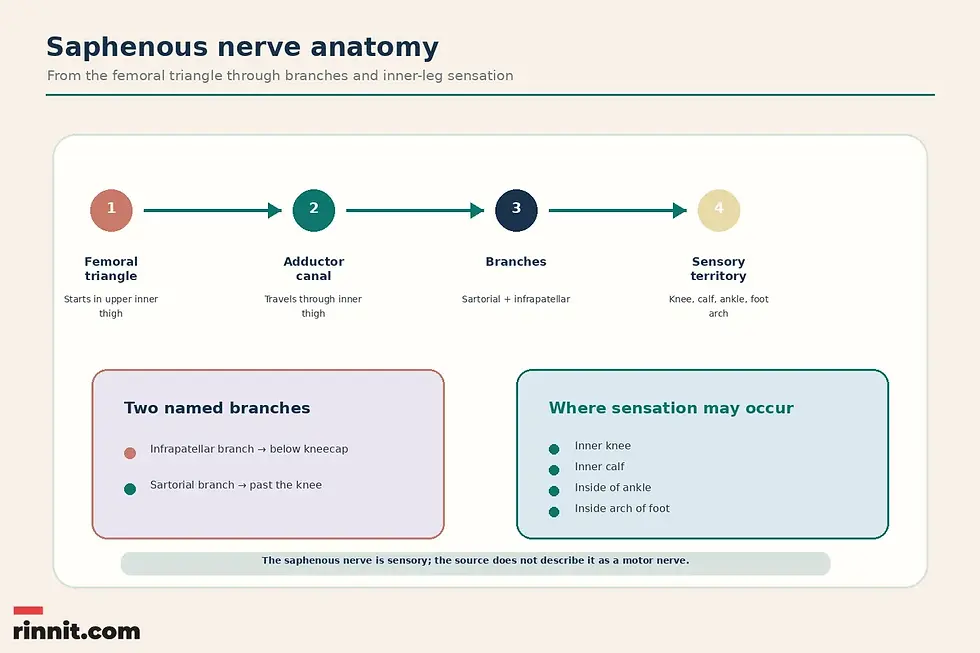
Each leg has one saphenous nerve, which supplies sensation to an area of the inner lower leg rather than a single point. It provides sensation to the inner lower leg, including the lower knee, inner calf, inside of the ankle and inside arch of the foot. [1]
The nerve’s sensory territory is an area rather than a single pinpoint location, so symptoms may be felt in more than one part of the inner leg.
Area | Sensation supplied |
Lower knee | Sensation below and around the lower knee region. |
Inner calf | Sensation along the inside of the calf. |
Inside of ankle | Sensation on the inner ankle. |
Inside arch of foot | Sensation along the inner foot arch. |
What is the anatomy and route of the saphenous nerve?
The saphenous nerve starts in the femoral triangle, a hollow area in the upper inner thigh that allows important veins and nerves to travel down the leg. It passes through structures in the inner thigh called the adductor canal. For a neighboring nerve, see our guide to the femoral nerve. [1]
After leaving the adductor canal, the nerve divides into the sartorial and infrapatellar branches. The infrapatellar branch supplies sensation to the area below the kneecap. The sartorial branch continues beyond the knee and divides again farther down the leg, providing sensation to the lower leg, ankle and foot. [1]
Anatomical segment | Description |
Femoral triangle | Starting area in the upper inner thigh. |
Adductor canal | Inner-thigh passage through which the nerve travels. |
Infrapatellar branch | Provides sensation below the kneecap. |
Sartorial branch | Continues past the knee and divides farther down the leg. |
Lower branches | Provide sensation to the lower leg, ankle and foot. |
How is the saphenous nerve related to the saphenous vein?
In some areas, the saphenous nerve runs parallel to the saphenous vein. A portion of this vein can be surgically transferred to the heart to restore blood flow in people who have coronary artery disease. This is done during coronary artery bypass graft surgery. Learn more in our guides to the saphenous vein and to vein harvesting. [1]
This relationship is one reason the nerve can be relevant during procedures involving the leg, knee, ankle, groin or nearby blood vessels. Surgical complications are the most common cause of saphenous nerve injuries.
What conditions can affect the saphenous nerve?
The nerve’s deep location helps protect it, so injuries are uncommon. Entrapment, trauma and complications of certain surgeries are possible causes of saphenous nerve pain or damage. [1]
Entrapment
Entrapment, sometimes called a pinched nerve, occurs when abnormal pressure affects a nerve. In the saphenous nerve’s sensory territory, this may be associated with pain, burning, tingling or numbness. [1]
Trauma
Trauma can affect the saphenous nerve. Deep cuts on the leg are one example. [1]
Surgery-related nerve damage
Saphenous nerve damage can occur as a complication of certain procedures. These include ACL reconstruction, ankle surgery, cardiac catheterization, coronary artery bypass graft surgery, knee arthroscopy, meniscus repair and varicose-vein stripping.
Possible contributor | Why it may be relevant |
Entrapment | Abnormal pressure on the nerve. |
Deep cut or other trauma | Direct injury to the nerve or nearby tissue. |
ACL reconstruction | Procedure near the knee and inner leg. |
Ankle surgery | Procedure involving structures near the nerve’s lower sensory territory. |
Cardiac catheterization | Uses an incision in the groin. |
Coronary artery bypass graft surgery | May use part of the saphenous vein from the leg. |
Knee arthroscopy | Procedure involving the knee. |
Meniscus repair | Procedure involving torn cartilage in the knee. |
Varicose-vein stripping | Removes veins that are not functioning properly. |
What are the symptoms of saphenous nerve irritation or injury?
Contact a healthcare professional if you develop signs of saphenous nerve entrapment or injury. Symptoms in the inner knee, calf or ankle include dull aching pain, burning, muscle tightness, shooting pain, tingling and numbness.
Symptom | How it may feel |
Dull, achy pain | A persistent or low-grade ache. |
Burning | A hot, burning or irritated sensation. |
Muscle tightness | A feeling of tension or tightness in the area. |
Shooting pain | Pain that travels or feels sudden and sharp. |
Tingling | Pins-and-needles or prickling. |
Numbness | Reduced or absent sensation. |
The location and character of symptoms can help a professional decide whether the saphenous nerve should be considered. They cannot confirm the cause by themselves.
How are saphenous nerve problems evaluated?
A healthcare professional may refer you to a specialist or order electromyography, known as EMG, to test the saphenous nerve. The evaluation is guided by your symptoms, history, examination and any recent injury or procedure. [1]
If symptoms began after surgery, tell the treating team when the symptoms started and where they are located. The procedure name and the timing of pain, burning, tingling or numbness can help the professional plan the next evaluation step.
Evaluation element | Role |
Symptom review | Identifies pain, burning, tightness, shooting pain, tingling or numbness. |
Sensory location | Considers the inner knee, calf and ankle region. |
Procedure or injury history | Helps identify trauma or surgery-related risk. |
Specialist referral | May be recommended when further evaluation is needed. |
EMG | A possible test of the saphenous nerve. |
What is a saphenous nerve block?
A saphenous nerve block is a procedure that delivers pain medication around the nerve. It may be used to halt pain in an emergency, numb the lower leg for a procedure or treat lingering pain. See our overview of nerve blocks.
A nerve block is a professional procedure, not a self-care technique. Whether it is appropriate depends on the reason for the pain, the planned procedure and the professional’s assessment.

How can surgical risk be discussed?
Seeking care from an experienced surgeon can lower the risk of saphenous nerve injury. Look for a surgeon who specializes in the needed procedure, takes time to understand your medical history, explains why surgery is necessary and how it can help, and regularly performs the recommended procedure. [1]
These points support an informed discussion rather than a guarantee about outcomes. Ask the surgical team which nerves and nearby structures may be relevant to the procedure, what symptoms should be reported afterward and how follow-up will work.
Pre-procedure discussion point | Question to consider |
Procedure experience | Does the surgeon regularly perform this procedure? |
Specialization | Does the surgeon specialize in the type of procedure needed? |
Medical history | Has the surgeon taken time to understand your history? |
Rationale and benefit | Has the surgeon explained why the procedure is needed and how it may help? |
When should you call a healthcare professional?
Contact a healthcare professional if you notice dull aching pain, burning, muscle tightness, shooting pain, tingling or numbness in the inner knee, calf or ankle. This is especially important after a deep cut, injury or procedure involving the knee, ankle, groin, leg veins or nearby structures.
Seek prompt professional assessment for new or worsening sensory symptoms. Do not assume that every inner-leg symptom comes from the saphenous nerve, because the same area can be affected by other nerves, muscles, joints, blood vessels or skin conditions.
Conclusion: a deep sensory nerve of the inner leg
The saphenous nerve is a deep sensory nerve, with one nerve in each leg. It carries information about leg position, pain, temperature and touch to the spinal cord. Its sensory territory includes the lower knee, inner calf, inside of the ankle and inside arch of the foot. [1]
Entrapment, deep cuts and complications of certain surgeries can affect the nerve. Symptoms may include aching, burning, tightness, shooting pain, tingling or numbness. A professional may refer you to a specialist or order EMG testing, and a saphenous nerve block may be used in selected professional-care situations. [1]
If you notice new pain, burning, tingling or numbness along the inner leg, write down when it began, which areas are affected and whether it followed trauma or a procedure. Share that information with a healthcare professional instead of trying to identify the nerve or cause on your own. [1]
Frequently Asked Questions
Is the saphenous nerve sensory or motor?
The saphenous nerve is described as a sensory nerve. It carries information about leg position, pain, temperature and touch toward the spinal cord. This article should not be used to interpret weakness or diagnose a motor-nerve problem.
Where is saphenous nerve pain felt?
Symptoms may occur in the inner knee, calf or ankle. The nerve also provides sensation to the inside arch of the foot.
Can a saphenous nerve problem cause numbness in the foot?
The saphenous nerve provides sensation to the inside arch of the foot, so symptoms may involve that region. Numbness elsewhere in the foot can have other causes and should be assessed professionally.
What causes saphenous nerve pain?
Entrapment, trauma such as deep cuts and complications of certain surgeries. Procedures include ACL reconstruction, ankle surgery, cardiac catheterization, coronary artery bypass graft surgery, knee arthroscopy, meniscus repair and varicose-vein stripping.
What is saphenous nerve entrapment?
Entrapment is abnormal pressure on a nerve. When the saphenous nerve is affected, symptoms may include dull aching pain, burning, shooting pain, tingling or numbness in the inner knee, calf or ankle.
How is the saphenous nerve tested?
A healthcare professional may order electromyography, or EMG, to test the saphenous nerve or refer you to a specialist.
What is a saphenous nerve block used for?
A saphenous nerve block delivers pain medication around the nerve. It may halt pain in an emergency, numb the lower leg for a procedure or treat lingering pain.
Can the saphenous nerve heal after surgery?
Surgery-related damage is a possible cause of symptoms, but there is no general recovery timeline for every case. In studies of nerve injury after knee replacement, most patients recovered, though recovery could take many months. A qualified professional should evaluate the symptoms and explain expected follow-up for the specific procedure.
Should I worry about inner-leg tingling after knee surgery?
New tingling after a knee procedure should be discussed with the treating healthcare professional. Knee-related procedures are among those that can be associated with saphenous nerve damage, and symptoms deserve professional evaluation.
How can I reduce the risk of saphenous nerve injury during surgery?
Choose an experienced surgeon who specializes in the needed procedure, understands your medical history, explains the rationale and expected benefit and regularly performs the procedure.
Related reading
Understanding the Femoral Nerve: Anatomy, Function, and Clinical Importance
Understanding the Saphenous Vein: The Longest Path to Heart Health
Pinched Nerve (Radiculopathy): Symptoms, Causes, and the Full Treatment Pathway
Understanding Nerve Blocks: A Comprehensive Guide to Targeted Pain Relief
ACL Injury: Complete Guide to Symptoms, Causes, Diagnosis, and Treatment
Knee Arthroscopy: A Minimally Invasive Approach to Joint Health
Torn Meniscus: Symptoms, Causes, Treatment, and Recovery — Complete Guide
References
Cleveland Clinic. What Is the Saphenous Nerve? Cleveland Clinic. Updated January 18, 2022. https://my.clevelandclinic.org/health/body/22331-saphenous-nerve
Liechti R, Muhammad I, Sinisi M, et al. Selective neurectomy as surgical treatment for infrapatellar pain syndrome: A systematic review and meta-analysis. Injury. 2026;57(7):113371. PMID 42176450. https://doi.org/10.1016/j.injury.2026.113371
Alturki AA, Almugren TS, Alhandi AA, et al. Nerve Injuries After Total Knee Arthroplasty: A Systematic Review and Meta-Analysis. Orthop Rev (Pavia). 2026;18:160847. PMID 42305570. https://doi.org/10.52965/001c.160847
Shahzad N, Elsherif M, Obaidat I, et al. A Systematic Review and Meta-Analysis of Randomised Controlled Trials Comparing Thermal Versus Non-Thermal Endovenous Ablation in Superficial Venous Incompetence. Eur J Vasc Endovasc Surg. 2023;66(5):687-695. PMID 37295602. https://doi.org/10.1016/j.ejvs.2023.06.002
Medical disclaimer
This article is for general educational purposes and is not a substitute for professional medical advice, diagnosis or treatment. Always seek the advice of a qualified healthcare professional with any questions about a medical condition or treatment.



Comments