Understanding the Femoral Nerve: Anatomy, Function, and Clinical Importance

Updated: 3 days ago
Medically reviewed by Dr. Baraa Alnahhal, MD | Last reviewed: October 17, 2026
Quick Answer: What is the femoral nerve?
The femoral nerve is a major peripheral nerve arising from the L2 to L4 nerve roots [1] [3] that runs through the groin and down the front of the thigh. It powers the muscles that bend the hip and straighten the knee [1] and carries sensation from the thigh, lower leg and foot [1], making it essential for walking and climbing stairs.
What the research says
Compression and surgery are the leading causes. A Mayo Clinic review of 159 patients with isolated femoral neuropathy found compressive causes in 40% and perioperative stretch in 35%. At presentation, 96% had weakness, 73% had sensory loss and 53% had pain [2]. (Santilli et al., Muscle & Nerve, 2024)
Recovery is common but slow. In the same study, 83% improved, but mean time to recovery at final follow-up was 14.8 months and only 48% had nearly complete or complete recovery. Physical therapy was part of treatment in 89% [2]. (Santilli et al., 2024)
Anatomy and causes. A clinical neurology chapter describes the femoral nerve as arising from L2–L4, with knee extension and hip flexion as its main functions, and notes that many injuries are iatrogenic (medical-procedure related). (Chalk and Zaloum, Handbook of Clinical Neurology, 2024) [3]
A separate thigh nerve can mimic the problem. Meralgia paresthetica involves the lateral femoral cutaneous nerve, not the femoral nerve. A 2023 review estimated about 32 new cases per 100,000 people per year, rising with obesity and diabetes, and noted that evidence for treatments is limited. (Scholz et al., Dtsch Arztebl Int, 2023) [4]
Based on articles retrieved from PubMed.
Anatomical Path and Structure
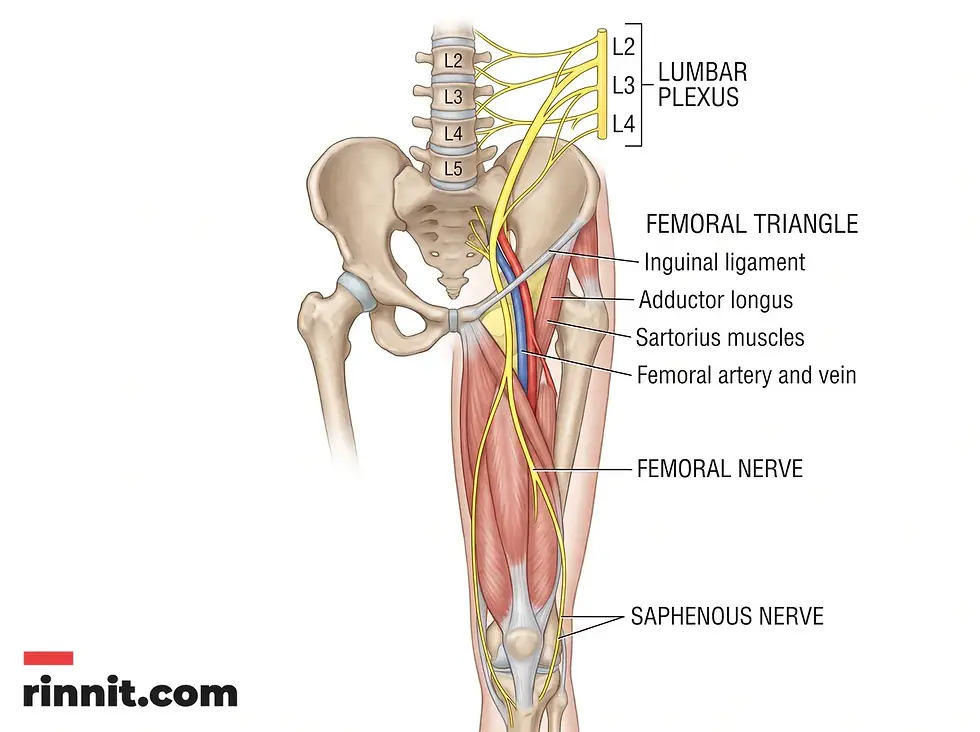
The femoral nerve begins in the lumbar plexus, from the L2, L3 and L4 nerve roots [1]. From the lower spine it descends through the pelvis and enters the femoral triangle, a hollow, wedge-shaped area between the groin and the upper thigh [1]. Within this triangle the nerve travels alongside the femoral artery, the femoral vein and lymphatic vessels, which makes it a key anatomical landmark.
As it passes beneath the inguinal ligament, it divides into an anterior (superficial) division and a posterior (deep) division [1]. The posterior division continues as the saphenous nerve through the adductor canal in the thigh, supplying sensation to the knee, lower leg, ankle and foot [1].

Motor and Sensory Functions
The femoral nerve is a mixed nerve, carrying both motor and sensory fibers. Its motor role centers on the front of the leg, working in opposition to the sciatic nerve, which serves the back of the leg [1]. By supplying the psoas major and iliacus muscles, and the quadriceps, it enables hip flexion and knee straightening [1], movements that are fundamental to walking, climbing stairs and standing up.
For sensation, the anterior branch serves the front and middle of the thigh [1]. The posterior branch, through the saphenous nerve, serves the lower leg and foot. This lets the brain register touch, pain and temperature across much of the lower limb [1].
Clinical Conditions and Disorders
Several conditions can compromise the femoral nerve. Femoral neuropathy is damage or dysfunction of the nerve, and when it affects a single femoral nerve it is called mononeuropathy [1]. It can result from injury, prolonged pressure or underlying systemic health problems.
Nerve compression syndromes also affect this region. Meralgia paresthetica occurs when excessive pressure falls on the lateral femoral cutaneous nerve in the thigh [1] [4], causing pain and tingling. Swollen tissues can also cause a "pinched nerve" (nerve entrapment), where the nerve is squeezed along its path [1]. These problems often show up as radicular pain that radiates from the back and hips down into the legs [1].
Signs of Nerve Dysfunction
Spotting early signs helps prevent long-term damage. People often have trouble straightening the knee, which can lead to frequent tripping or an unstable gait. Sensory changes are common too, including numbness, tingling or a "pins and needles" feeling in the leg, ankle or foot. In severe cases, the thigh muscles can waste away (atrophy) because they are not getting proper nerve signals.
The Bottom Line: What You Need to Know About the Femoral Nerve
The femoral nerve provides the motor and sensory supply for the front of the leg, from its origin in the lumbar plexus to the foot. Knowing its anatomy and the symptoms of dysfunction is the first step toward maintaining lifelong mobility and neurological health.
If you have persistent numbness, weakness or radiating pain in your legs, see a healthcare professional promptly. Early evaluation can identify the source of nerve dysfunction and lead to effective symptom relief and recovery.
Frequently Asked Questions
What is the largest nerve in the leg?
The femoral nerve is one of the largest nerves in the leg and the largest branch of the lumbar plexus.
Where does the femoral nerve start?
The femoral nerve originates from the L2, L3 and L4 nerve roots in the lower spine (lumbar plexus).
What is the difference between the femoral and sciatic nerves?
The femoral nerve controls the front of the leg, while the sciatic nerve serves the back of the leg.
What muscles does the femoral nerve control?
The femoral nerve supplies the hip flexors (psoas major and iliacus) and the quadriceps.
What is the saphenous nerve?
The saphenous nerve is the continuation of the posterior division of the femoral nerve and provides sensation to the lower leg and foot.
What does "neuropathy" mean in relation to the femoral nerve?
Neuropathy is a general term for nerve damage or dysfunction.
What is meralgia paresthetica?
Meralgia paresthetica is a painful condition caused by pressure on the lateral femoral cutaneous nerve in the thigh.
Can a pinched nerve cause leg weakness?
Yes. Nerve entrapment or a pinched nerve can cause significant weakness and difficulty moving the leg.
What is radicular pain?
Radicular pain is pain that radiates from the back and hips down into the legs, often a sign of nerve irritation or damage.
Where is the femoral triangle located?
The femoral triangle is a hollow area between the upper thigh and the groin.
Does the femoral nerve help with knee movement?
Yes. It is essential for straightening the knee by controlling the quadriceps muscles.
Can the femoral nerve cause foot pain?
Yes. Through its saphenous branch, it provides sensory information to the foot.
What causes muscle loss in the legs?
Chronic nerve damage can lead to muscle atrophy because the muscles are no longer receiving proper signals.
How do I know if my femoral nerve is damaged?
Common signs include difficulty straightening the knee, numbness in the thigh and radiating pain.
When should I see a doctor for leg pain?
Seek medical advice if you have difficulty straightening or bending your knee, trouble walking or persistent numbness.
Related reading on Rinnit
Meralgia Paresthetica: Symptoms, Causes, and Management Strategies
Peripheral Nerve Injuries: Symptoms, Causes & Treatment — Why Numbness Needs Early Care
Pinched Nerve (Radiculopathy): Symptoms, Causes, and the Full Treatment Pathway
Sciatica: Complete Guide to Symptoms, Causes, Diagnosis, and Treatment
Sources
Cleveland Clinic. Femoral Nerve: What Is It, Branches, Anatomy & Function. Cleveland Clinic. Last updated April 6, 2025. https://my.clevelandclinic.org/health/body/21786-femoral-nerve
Santilli AR, Martinez-Thompson JM, Speelziek SJA, et al. Femoral neuropathy: A clinical and electrodiagnostic review. Muscle Nerve. 2024;69(1):64-71. PMID 37941415. https://doi.org/10.1002/mus.27994
Chalk C, Zaloum A. Femoral and obturator neuropathies. Handb Clin Neurol. 2024;201:183-194. PMID 38697739. https://doi.org/10.1016/B978-0-323-90108-6.00007-7
Scholz C, Hohenhaus M, Pedro MT, et al. Meralgia Paresthetica: Relevance, Diagnosis, and Treatment. Dtsch Arztebl Int. 2023;120(39):655-661. PMID 37534445. https://doi.org/10.3238/arztebl.m2023.0170
Medical disclaimer
This article is provided for general educational purposes only and is not a substitute for professional medical advice, diagnosis or treatment. Always seek the advice of a qualified health provider with any questions regarding a medical condition.



Comments