Rezum Water Vapor Therapy

Updated: 2 days ago
Medically reviewed by Dr. Baraa Alnahhal, MD · Last reviewed: October 2026
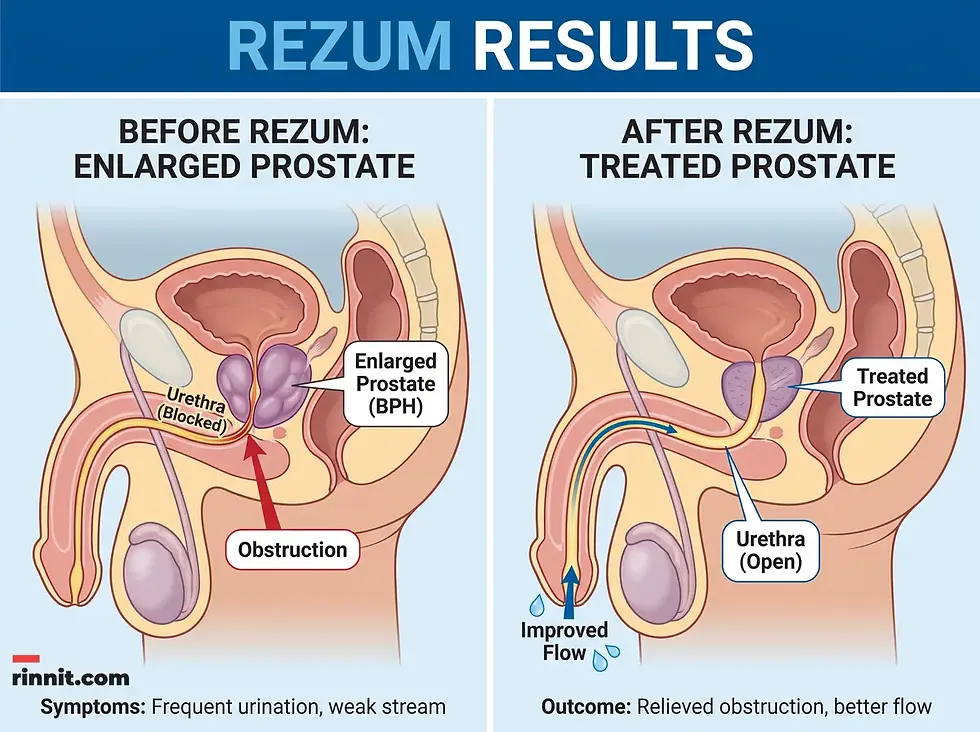
Rezum water vapor therapy is a minimally invasive, nonsurgical treatment designed to relieve the symptoms of benign prostatic hyperplasia (BPH). [1] By using sterile steam to shrink enlarged prostate tissue, this office-based procedure helps restore normal urinary flow without the need for major surgery or general anesthesia. Most patients experience significant symptom relief within a few weeks, all while preserving sexual function. It is a safe and effective option for those looking to move away from daily BPH medications.
Quick Answer
Rezum therapy is a 30-minute outpatient procedure that uses water vapor to treat an enlarged prostate. [1] A urologist delivers precise bursts of steam through the urethra to destroy excess prostate cells, which the body absorbs over several weeks, shrinking the gland and opening the urinary channel. It suits men over 50 seeking quick recovery without long-term medication.
What the research says
Rezum works in everyday patients, not only in trial-selected ones. In a prospective multicenter series of 426 men treated with Rezum at eight institutions, 232 met the randomized trial's inclusion criteria and 194 did not; urinary and sexual outcomes improved in both groups with no difference between them, and reintervention rates were 2.6% and 3.1% (Cindolo et al., Journal of Endourology, 2023) [2].
Five-year progression is low, but the edge over daily medication fades with time. In a propensity-weighted comparison of the Rezūm trial with the MTOPS medication arms, the symptom score (IPSS) improved by 11.1 points at 3 months and 9.5 points at 5 years, and 4.6% of Rezūm patients had clinical progression by 5 years; symptom improvement at 5 years was similar to finasteride and combination therapy and better than doxazosin, but the advantage over medication waned over time (Long et al., Urology, 2025) [3].
What is Rezum water vapor therapy?
The Rezum procedure represents a significant advancement in the management of BPH. Unlike more invasive surgeries that require an operating room and general anesthesia, Rezum can be performed comfortably in a doctor's office using local numbing agents. [1] The use of natural water vapor makes it a gentle yet powerful tool for targeting only the obstructive tissue, minimizing the risk of damage to surrounding structures.
For many men, the greatest advantage of Rezum is the preservation of quality of life. Traditional BPH surgeries often carry risks of sexual dysfunction, but Rezum is specifically designed to protect these functions. [1] With a recovery period that typically lasts only a few days, patients can return to their normal routines quickly, enjoying a long-term solution that has been shown to last for at least five years. [1]
Feature | Rezum Therapy | Traditional Surgery (TURP) |
Setting | Doctor's Office (Outpatient) | Operating Room (Inpatient) |
Anesthesia | Local Anesthetic | General or Spinal Anesthesia |
Procedure Time | Approximately 30 Minutes | 60 to 90 Minutes |
Recovery | A few days of rest | Several weeks of limited activity |
Sexual Function | Highly preserved | Higher risk of side effects |

What happens during the Rezum procedure?
During the Rezum procedure, a urologist uses a specialized handheld device to deliver small amounts of steam into the prostate. [1] Each steam treatment lasts only about 10 seconds [1], and multiple treatments may be administered depending on the size of the gland. Because the procedure is performed through the natural opening of the urethra, there are no incisions or stitches required [1], which significantly reduces the risk of infection and shortens healing time.
After the procedure, a temporary urinary catheter is usually placed for a few days to manage initial swelling. [1] While some patients may notice their symptoms worsen slightly in the first two weeks [1] as the body begins the healing process, this is a normal part of the recovery. Significant improvements in urinary flow and frequency are typically noticed within a few weeks, with full results achieved by the three-month mark.
What is recovery like after Rezum therapy, and what is the long-term outlook?
Recovery from Rezum is generally straightforward, focusing on rest and hydration. Patients are advised to spend at least one full day resting at home and to avoid strenuous activities like heavy lifting or cycling for a few weeks. [1] Drinking plenty of water is essential to flush the system, while avoiding bladder irritants like caffeine and carbonated drinks can help minimize discomfort during the initial healing phase. [1]
The long-term success of Rezum is well-documented, with studies indicating that less than 5% of patients require additional surgical intervention within five years. [1] Furthermore, many men find they no longer need to take daily BPH medications [1], which can have their own set of side effects. If symptoms were to return in the future, the Rezum procedure can safely be repeated [1], providing a flexible and durable solution for prostate health.

What are the risks of Rezum water vapor therapy?
Rezum water vapor therapy is considered very safe, but like any medical procedure it carries some potential risks. These may include temporary blood in the urine or semen, urinary tract infections, or a temporary increase in the urgency to urinate. [1] In rare cases, some men may experience "dry ejaculation," [1] where semen is not released during climax, though this is less common than with traditional surgical methods.
It is also important to note that not everyone is an ideal candidate for Rezum. Men with very large prostates (over 80 grams) or those with existing kidney complications may be better suited for alternative treatments like Aquablation or TURP. [1] A thorough consultation with a urologist is necessary to determine if Rezum is the right choice based on the specific size and shape of the prostate gland.
Potential Risk | Description | Management |
Urinary Urgency | Increased need to pee | Usually resolves in 2-3 weeks |
Hematuria | Blood in the urine | Increase water intake to flush |
Discomfort | Pain during urination | Managed with rest and hydration |
UTI | Urinary tract infection | Treated with standard antibiotics |
Conclusion
Rezum water vapor therapy offers a modern, effective, and minimally invasive solution for men struggling with the symptoms of BPH. By harnessing the power of steam, it provides significant relief from urinary issues while maintaining a high safety profile and protecting sexual health. For those seeking an alternative to daily medication or invasive surgery, Rezum represents a balanced and durable path toward better prostate health.
What are the next steps if you are considering Rezum therapy?
If BPH symptoms are affecting your daily life, speak with a urologist to see if Rezum water vapor therapy is right for you. Taking action now can lead to long-term relief and a significant improvement in your overall quality of life.
Frequently Asked Questions
Is the Rezum procedure painful?
The procedure is performed using local anesthesia to numb the prostate and urethra, which helps minimize discomfort. Most patients describe a sensation of pressure rather than sharp pain. Your doctor may also provide a mild sedative to help you relax during the 30-minute session.
How soon can I return to work after Rezum?
Most men can return to sedentary work within a few days. However, if your job involves heavy lifting or strenuous physical activity, you may need to wait two to three weeks to ensure the area is fully healed and to avoid complications.
Will Rezum affect my sexual drive?
Rezum is specifically designed to preserve sexual function, including erectile function and sex drive. Unlike some other BPH treatments, it has a very low risk of causing permanent sexual side effects, which is one of its primary benefits.
How long does a Rezum treatment last?
Clinical data shows that the results of Rezum therapy are durable, with most patients enjoying significant symptom relief for at least five years. If symptoms return as the prostate continues to grow with age, the procedure can be repeated.
What is the difference between Rezum and a laser procedure?
Laser procedures (like GreenLight) typically involve removing or vaporizing tissue in an operating room under general anesthesia. Rezum uses steam in a doctor's office setting, which is generally less invasive and has a faster recovery time for many patients.
Do I need to stay in the hospital overnight?
No, Rezum is an outpatient procedure. You will be able to go home the same day, usually within an hour or two after the treatment is completed. It is recommended to have someone drive you home.
Can Rezum treat a very large prostate?
Rezum is typically recommended for prostates between 30 and 80 grams. If your prostate is significantly larger than 80 grams, your urologist might recommend a different procedure, such as Aquablation or a simple prostatectomy, for better results.
Will I need a catheter after the procedure?
Yes, most patients require a urinary catheter for three to seven days after the procedure. This is necessary because the steam causes temporary swelling in the prostate that could otherwise make it difficult to urinate initially.
When will I notice an improvement in my symptoms?
While some men notice a difference in as little as two weeks, most see significant improvement after four to six weeks. Your urinary flow will continue to improve for up to three months as the body absorbs the treated tissue.
Is Rezum covered by insurance?
Yes, Rezum is widely covered by most private insurance plans as well as Medicare. However, coverage can vary based on your specific plan and provider, so it is always best to verify with your insurance company beforehand.
Related Reading
Benign Prostatic Hyperplasia (BPH): Symptoms, Causes, and Treatment explains an enlarged prostate and the full range of treatments.
Prostatic Urethral Lift (PUL) describes another minimally invasive option for an enlarged prostate.
Transurethral Resection of the Prostate (TURP): Procedure, Risks, and Recovery covers the standard surgery for an enlarged prostate.
Aquablation: Minimally Invasive Water Jet Therapy for BPH explains a water jet treatment that removes prostate tissue.
References
Cleveland Clinic. Rezūm Procedure. Cleveland Clinic. November 8, 2023. https://my.clevelandclinic.org/health/treatments/rezum
Cindolo L, Campobasso D, Conti E, et al. Do patients treated with water vapor therapy and meeting randomized clinical trial criteria have better urinary and sexual outcomes than an unselected cohort? Journal of Endourology. 2023;37(3):323-329. PMID 36453237. https://doi.org/10.1089/end.2022.0637
Long B, Cheema A, Copelan O, et al. Five-year outcomes of water vapor therapy vs doxazosin, finasteride, and combination therapy for lower urinary tract symptoms secondary to benign prostatic hyperplasia: cohort data from the Medical Therapy of Prostatic Symptoms trial. Urology. 2025;206:142-149. PMID 40683564. https://doi.org/10.1016/j.urology.2025.07.016
Medical disclaimer
The information provided in this article is for educational purposes only and should not be used as a substitute for professional medical advice, diagnosis, or treatment. Always seek the advice of your physician or other qualified health provider with any questions you may have regarding a medical condition.



Comments