Reactive Arthritis: Symptoms, Causes, Diagnosis & Treatment — Complete Guide

Updated: 2 days ago
Medically reviewed by Dr. Baraa Alnahhal, MD · Last reviewed: October 17, 2026
Quick Answer
Reactive arthritis is joint pain and swelling that begins after an infection elsewhere in the body, usually in the gut, genitals or urinary tract. Symptoms typically appear 1 to 4 weeks after the infection and most often affect the knees, ankles and feet, but can involve the eyes and skin. For most people, symptoms disappear within a year.
What the research says
Reactive arthritis after a Clostridioides difficile infection usually settles quickly. A scoping review of 61 published cases (mean age 38.8 years, 61% male) found that arthritis began about 8.5 days after the infection, 87% of patients reached remission within 21 days, 9% relapsed, and only 10% needed treatment escalation to disease-modifying drugs; 64% of those tested were HLA-B27 positive (30 of 47). (Deligeorgakis et al., Autoimmun Rev, 2025) [3]
Antibiotics do not generally shorten the joint disease itself. A review reports that antibiotic treatment of reactive arthritis does not, in general, shorten the duration of the disease, and that persistent arthritis is treated with immunomodulating drugs such as sulfasalazine or methotrexate; it estimates prevalence at 40 per 100,000 and incidence at 5 per 100,000, with HLA-B27 associated in about half of cases. (Rihl & Kuipers, Z Rheumatol, 2025) [4]
Experts agree on a step-up approach when anti-inflammatory medicines are not enough. A 2026 Ibero-American consensus built from a systematic review and a Delphi process produced 54 recommendations; experts gave 100% agreement to using conventional disease-modifying drugs after NSAIDs and/or corticosteroids fail, and 91% agreement that sulfasalazine is the preferred one, while noting that the evidence for treating reactive arthritis is limited. (Benegas et al., Clin Rheumatol, 2026) [5]
At a Glance
Topic | Key Facts |
What it is | Joint pain and swelling after an infection in another body site — a form of spondyloarthritis (SpA) |
Old name | Reiter syndrome |
Typical onset | 1–4 weeks after the triggering infection |
Joints most affected | Knees, ankles, and feet; also heels, lower back, and buttocks |
Other body sites | Eyes (redness, blurred vision), urethra (burning, frequency), skin, mouth |
Common triggers | Chlamydia (sexual contact); gut bacteria — C. difficile, E. coli, campylobacter, salmonella, shigella, yersinia |
Key risk factors | Ages 20–40, male sex after sexually transmitted infection, HLA-B27 gene marker, HIV |
Contagious? | No — but the bacteria behind it can spread through food or sexual contact |
Diagnosis | Physical exam, blood tests, joint fluid test, X-rays |
Treatment | Antibiotics, NSAIDs, steroids, rheumatoid arthritis medicines, physical therapy |
Outlook | Symptoms come and go; usually disappear within a year |
What Is Reactive Arthritis?
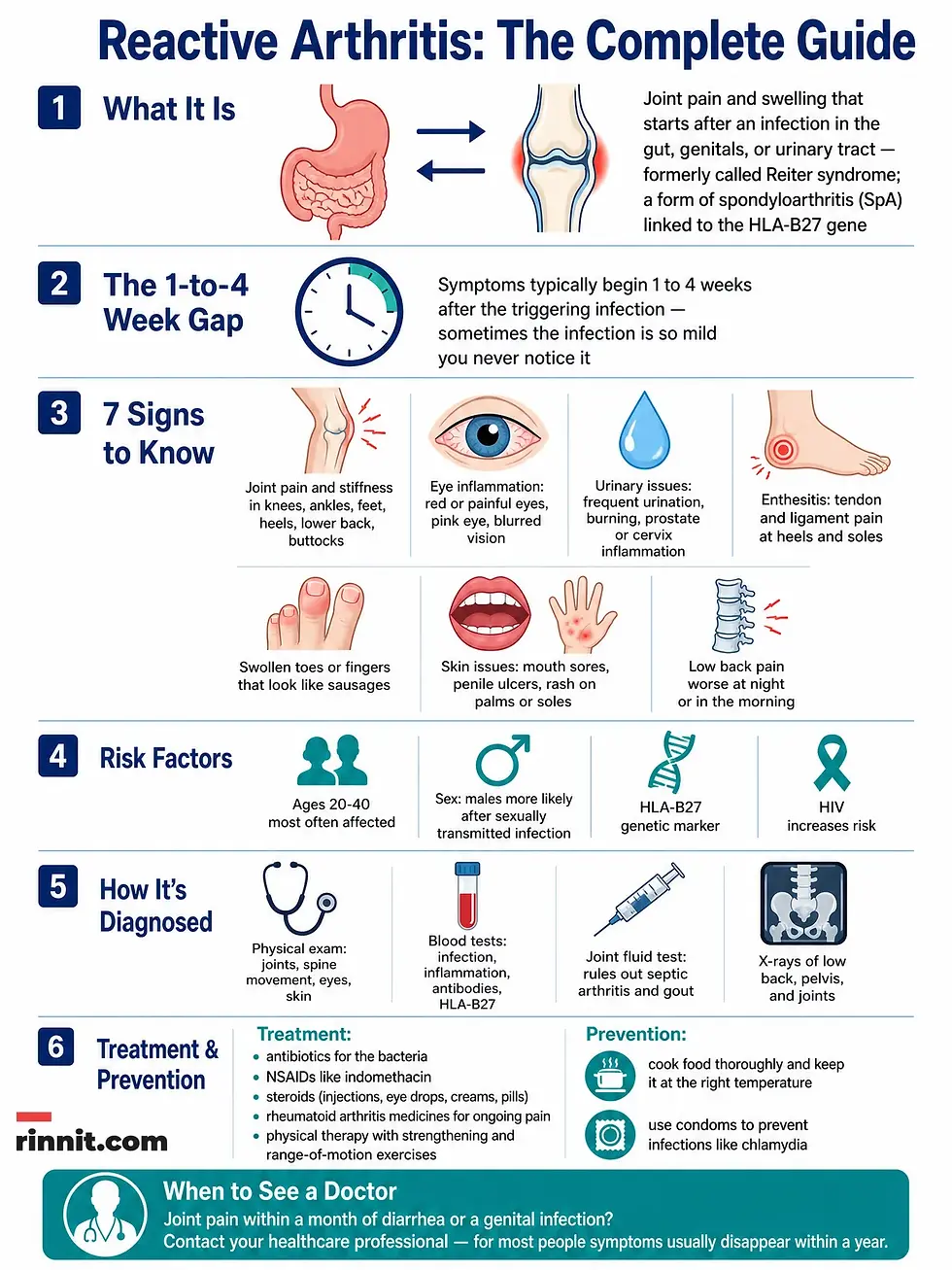
Reactive arthritis is a condition that causes joint pain and swelling, also called inflammation, after an infection in another part of the body. The infection typically starts in the gut, genitals, or urinary tract.
It most often affects the knees, ankles, and feet, but it can also inflame the eyes, the skin, and the tube that carries urine out of the body, called the urethra. In the past, this condition was sometimes called Reiter syndrome.
Reactive arthritis is generally regarded as a form of spondyloarthritis (SpA). SpA is a group of inflammatory diseases that mainly affect the spine, the joints, and the places where tendons and ligaments attach to bones. The word comes from spondylo (spine) and arthritis (joint inflammation). These conditions share similar symptoms and genetic links — especially a gene called HLA-B27.
Reactive arthritis isn't common, and it typically lasts for a limited time. For most people, symptoms come and go and usually disappear within a year.

What is the 1-to-4 week warning sign of reactive arthritis?
The defining feature of reactive arthritis is its delayed timing. The symptoms typically start 1 to 4 weeks after a triggering infection — and sometimes that infection is so mild you may not even know you had it.
This is the detail that helps doctors connect the dots: if your joints start hurting within a month of a bout of diarrhea or a genital infection, tell your doctor about it. It's the single most useful clue in piecing together the diagnosis.
When to see a doctor: If you develop joint pain within a month of having diarrhea or a genital infection, contact your healthcare professional. See an eye doctor promptly for eye pain, light sensitivity or blurred vision, because reactive arthritis can cause uveitis, which can harm vision.
What are the seven signs of reactive arthritis?
The joint problems usually target the knees, ankles, and feet, but reactive arthritis can involve several other body systems at once. Here are the common symptoms:
# | Symptom | What to Look For |
1 | Pain and stiffness | Often affects the knees, ankles, and feet; may also affect the heels, lower back, or buttocks |
2 | Eye inflammation | Red, irritated, or painful eyes — possible signs of conjunctivitis (pink eye); blurred vision can occur |
3 | Urinary issues | Needing to urinate more often; burning or discomfort when urinating; sometimes inflammation of the prostate gland or the cervix |
4 | Enthesitis | Inflammation of tendons and ligaments where they attach to bone — most often in the heels and the soles of the feet |
5 | Swollen toes or fingers | Swelling so pronounced the digits can look like sausages |
6 | Skin issues | Mouth sores, painless ulcers on the penis, or a rash on the palms of the hands or soles of the feet |
7 | Low back pain | Pain that tends to be worse at night or in the morning |
The combination matters. A person with sore heels, a red eye, and a sausage-like toe in the weeks after a stomach bug has a classic picture — and that pattern is exactly what doctors look for.
Causes: What Triggers Reactive Arthritis?
Reactive arthritis happens when the immune system reacts to an infection somewhere else in the body — usually in the intestines, genitals, or urinary tract. One important point of reassurance: reactive arthritis itself is not contagious. But the bacteria that cause it can spread through sex or food.
Two groups of bacteria are the usual triggers:
Trigger Group | How It Spreads | Examples |
Sexually transmitted | Sexual contact; infection typically starts in the urethra, bladder, or vagina | Chlamydia trachomatis |
Foodborne (gut bacteria) | Usually contaminated food (C. difficile usually follows antibiotic use); causes diarrhea or other stomach and intestinal symptoms | Clostridium difficile (C. difficile), Escherichia coli (E. coli), campylobacter, salmonella, shigella, yersinia |
Only a small number of people exposed to these bacteria go on to develop reactive arthritis — which is why genetics play an important supporting role.
What are the risk factors for reactive arthritis?
Reactive arthritis risk is shaped by age, sex assigned at birth, the HLA-B27 genetic marker and HIV infection, and it most often affects adults aged 20 to 40.
Age. It most often affects adults between 20 and 40 years old.
Sex assigned at birth. People are equally likely to get reactive arthritis from foodborne infections, but people assigned male at birth are more likely to develop it after a sexually transmitted infection.
Genetics. Having the HLA-B27 genetic marker increases the risk — though most people with this marker never get reactive arthritis.
Infection. Having HIV increases the risk of developing reactive arthritis.
How is reactive arthritis diagnosed?
Reactive arthritis has no single test, so diagnosis starts with a physical exam of the joints, spine, eyes and skin. Diagnosis starts with a physical exam: your healthcare professional checks your joints for swelling, warmth, and tenderness, tests how well you can move your spine and affected joints, looks at your eyes for signs of inflammation, and examines your skin for rashes.
From there, the workup branches into three areas:
Test | What It Looks For |
Blood tests | A current or past infection; inflammation in the body; antibodies that could point to other types of arthritis; the HLA-B27 genetic marker |
Joint fluid test | A needle draws fluid from an affected joint to rule out other conditions — white blood cells (inflammation or infection), bacteria (which could mean septic arthritis, a joint infection that can cause serious damage), and crystals (uric acid crystals may indicate gout) |
Imaging tests | X-rays of the low back, pelvis, and joints to show typical signs of reactive arthritis or rule out other forms of arthritis |
The joint fluid test deserves special mention: distinguishing reactive arthritis from septic arthritis (an active infection inside the joint) and gout (crystal-related arthritis) is a critical step, because each condition needs completely different treatment.
How is reactive arthritis treated?
Treatment has two main goals: relieve your symptoms and treat any infection that may still be present. Because reactive arthritis can affect different parts of the body, more than one doctor or healthcare professional may be involved in your care.
Medicines
Antibiotics. If your reactive arthritis was caused by a bacterial infection, your healthcare professional may prescribe an antibiotic to treat it. Which antibiotic you take depends on the type of bacteria found.
Nonsteroidal anti-inflammatory drugs (NSAIDs). Prescription NSAIDs, such as indomethacin (Indocin), can relieve the inflammation and pain of reactive arthritis.
Steroids. Options include a steroid injection into a painful joint, steroid eye drops for eye symptoms, steroid creams for skin rashes, and steroids in pill form.
Rheumatoid arthritis medicines. For ongoing pain and stiffness, medicines such as sulfasalazine (Azulfidine), methotrexate (Trexall), or etanercept (Enbrel) may help some people. (Etanercept is typically used to treat rheumatoid arthritis.)
Physical Therapy
A physical therapist can teach you exercises to strengthen the muscles around affected joints and improve flexibility:
Strengthening exercises support the joints and reduce strain.
Range-of-motion exercises help you stay flexible and prevent stiffness.
Can Reactive Arthritis Be Prevented?
You can't change your genes, but you can lower your risk by reducing exposure to the bacteria that cause the triggering infections:
Practice food safety. Keep food at the right temperature and cook it thoroughly to avoid the bacteria that can trigger reactive arthritis.
Prevent sexually transmitted infections. Use condoms to help protect you from bacteria such as chlamydia.
How should you prepare for a reactive arthritis appointment?
You'll likely start by seeing your primary healthcare professional, who may refer you to a doctor who specializes in arthritis, called a rheumatologist, for further testing or treatment.
What You Can Do
When you make the appointment, ask if there's anything you need to do in advance — such as fasting before a specific test.
Make a list of your symptoms, even ones that don't seem related to the reason for your appointment.
Note your medical and family history.
List all medicines, vitamins, or supplements you take, including doses.
Bring a family member or friend if possible — they can help you remember information and ask questions.
Good questions to ask:
What is likely causing my symptoms or condition?
What are other possible causes?
What tests do I need?
What treatment approach do you recommend?
When should I expect to feel better?
Is there anything I can do to lessen my joint pain now?
Am I at risk of long-term complications?
How can I manage this along with my other health conditions?
Don't hesitate to ask about anything else that concerns you.
What Your Doctor May Ask You
When did your symptoms start?
Do they come and go, or happen all the time?
How serious is your pain or stiffness?
What makes your symptoms better or worse?
Have you had any recent infections?
Frequently Asked Questions (FAQ)
What is reactive arthritis and why does it happen after an infection?
Reactive arthritis is joint pain and swelling caused when your immune system reacts to an infection that occurred in another part of the body — usually the intestines, genitals, or urinary tract. It's the immune system's delayed overreaction, not the infection itself inside the joint.
Is reactive arthritis the same as Reiter syndrome?
Yes. Reiter syndrome is the older name for the same condition. It's also considered a form of spondyloarthritis (SpA) because it shares features with other inflammatory spine and joint diseases, including a genetic link to the HLA-B27 marker.
What bacteria trigger reactive arthritis?
Two groups are the usual culprits: chlamydia, which spreads through sexual contact, and foodborne gut bacteria — including C. difficile, E. coli, campylobacter, salmonella, shigella, and yersinia. Only a small number of people exposed to these bacteria develop reactive arthritis.
Is reactive arthritis contagious?
No — reactive arthritis itself is not contagious. However, the bacteria that trigger it can spread through food or sexual contact, which is why prevention focuses on food safety and STI protection.
Can reactive arthritis cause swollen fingers, red eyes, and back pain at the same time?
Yes. Along with joint pain in the knees, ankles, and feet, reactive arthritis can cause red or painful eyes (sometimes blurred vision), urinary burning and frequency, sausage-like swollen toes or fingers, mouth sores and rashes on the palms or soles, and low back pain that worsens at night or in the morning.
How long does reactive arthritis last, and how is it treated?
For most people, symptoms come and go and usually disappear within a year. Treatment aims to relieve symptoms and clear any lingering infection: antibiotics for the bacteria, prescription NSAIDs like indomethacin, steroids (injections, eye drops, creams, or pills), and rheumatoid arthritis medicines for ongoing pain — plus physical therapy with strengthening and range-of-motion exercises.
How soon after an infection does reactive arthritis start?
Symptoms usually start 1 to 4 weeks after the triggering infection. The infection can be so mild that you may not remember having it, so mention any recent diarrhea or genital symptoms to your provider.
Is there a single test for reactive arthritis?
No. Diagnosis is based on a physical exam plus tests such as blood work, a joint fluid test and X-rays. These help find a past infection, check for the HLA-B27 marker and rule out gout or a joint infection.
Who is most likely to get reactive arthritis?
It most often affects adults between 20 and 40. Having the HLA-B27 gene marker or HIV raises the risk, and people assigned male at birth are more likely to get it after a sexually transmitted infection.
Can reactive arthritis harm the eyes?
Yes. It can cause pink eye and a deeper eye inflammation called uveitis, which can harm vision if not treated. See an eye doctor promptly for eye pain, light sensitivity or blurred vision.
Conclusion
Reactive arthritis is a reminder that joint pain doesn't always start in the joint. The three lessons worth keeping:
Timing is the clue. Joint pain that arrives 1 to 4 weeks after diarrhea or a genital infection is reactive arthritis' signature pattern — report it to your doctor.
It hits more than the joints. Eyes, skin, the urinary tract, and the lower back can all be involved, especially in people with the HLA-B27 gene marker.
The outlook is usually good. For most people, symptoms come and go and typically fade within a year with the right treatment.
This guide covered the seven signs, the two bacterial trigger groups, the risk factors, the diagnostic workup, and the full treatment ladder — everything you need to recognize and respond to reactive arthritis early.
If you've been exploring joint conditions, our related guides on psoriatic arthritis and gout explain two other inflammatory joint conditions worth comparing, and rinnit.com has the full health library.
What are your next steps after learning about reactive arthritis?
Read a related guide: Explore our psoriatic arthritis complete guide and gout complete guide.
Share your thoughts: Have questions or a story to add? Leave a comment on this article.
Disclaimer: This article is for general informational purposes only and is not a substitute for professional medical advice, diagnosis, or treatment. Always seek the guidance of a qualified healthcare provider with any questions about a medical condition.
Related Reading
Chlamydia: Symptoms, Causes, Treatment, and How to Protect Yourself explains a common infection that can trigger reactive arthritis.
Ankylosing Spondylitis: Symptoms, Causes, Treatment & Complete Guide covers a related spondyloarthritis that also affects the spine.
Uveitis: Symptoms, Causes, and Treatment — What Eye Inflammation Means for Your Vision explains eye inflammation that can occur with reactive arthritis.
Arthrocentesis (Joint Aspiration): Uses, Procedure and Risks describes how fluid is drawn from a joint for testing.
References
Mayo Clinic Staff. Reactive arthritis - Symptoms & causes. Mayo Clinic. December 22, 2025. https://www.mayoclinic.org/diseases-conditions/reactive-arthritis/symptoms-causes/syc-20354838
Mayo Clinic Staff. Reactive arthritis - Diagnosis & treatment. Mayo Clinic. December 22, 2025. https://www.mayoclinic.org/diseases-conditions/reactive-arthritis/diagnosis-treatment/drc-20354843
Deligeorgakis D, et al. Clostridioides difficile-related reactive arthritis: A scoping review of the literature. Autoimmun Rev. 2025;24(8):103842. PMID 40484294. https://doi.org/10.1016/j.autrev.2025.103842
Rihl M, et al. [Reactive arthritis]. Z Rheumatol. 2025;84(4):259-267. PMID 39621046. https://doi.org/10.1007/s00393-024-01594-9
Benegas M, et al. Ibero-American consensus on reactive arthritis: definition, diagnosis, and management. Clin Rheumatol. 2026. PMID 42700296. https://doi.org/10.1007/s10067-026-08400-8
Medical disclaimer
The information provided in this article is for educational purposes only and should not be used as a substitute for professional medical advice, diagnosis, or treatment. Always seek the advice of your physician or other qualified health provider with any questions you may have regarding a medical condition.



Comments