Probiotics: Benefits, Types, Foods and Side Effects

Updated: 2 days ago
Written and medically reviewed by Dr. Baraa Alnahhal, MD · Last reviewed: November 2026 · How we review
Quick Answer
Probiotics are live bacteria and yeasts that have health benefits when you take them. They add to the helpful microbes already living in the gut and help keep the microbiome in balance. You can get them from supplements or fermented foods such as yogurt, kefir, kimchi and sauerkraut. They're best known for helping prevent diarrhea caused by antibiotics.
What the research says
Probiotics cut antibiotic diarrhea by 42%: in 63 randomized trials with 11,811 people, probiotics lowered the risk of diarrhea caused by antibiotics by 42%, with about 13 people needing to take them to prevent one case (Hempel S et al., JAMA, 2012) [2]
They also protect children: in 33 trials with 6,352 children, diarrhea after antibiotics affected 8% of those taking probiotics versus 19% without them, with no serious side effects linked to probiotics (Guo Q et al., Cochrane Database Syst Rev, 2019) [3]
Key takeaways
Probiotics are live microbes that support your body's natural microbiome.
Common types are Lactobacillus and Bifidobacterium.
They come in supplements and fermented foods.
They can help prevent diarrhea caused by antibiotics.
Gas and bloating may happen at first and usually pass in a few days.
What are probiotics?
Your body is home to trillions of microorganisms, together called your microbiome. When the balance of helpful and harmful microbes is off, it's called dysbiosis. Probiotics add helpful microbes to restore balance. Prebiotics are different: they're fibers that feed the helpful microbes already in your gut. Learn more in our gut microbiome guide. Sources: [1]
How probiotics work
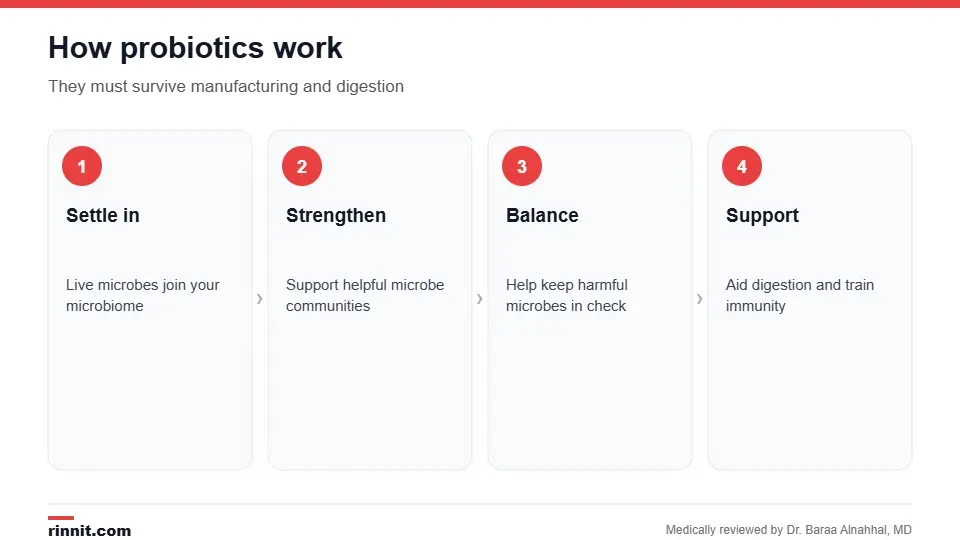
Probiotics must survive manufacturing and digestion to work.
They settle in and strengthen the helpful microbe communities already there.
They help keep harmful microbes in check.
A healthy gut microbiome helps break down food, absorb nutrients and medicines, and train your immune system.
Many probiotics make short-chain fatty acids that feed the gut lining. Sources: [1]
What probiotics may help
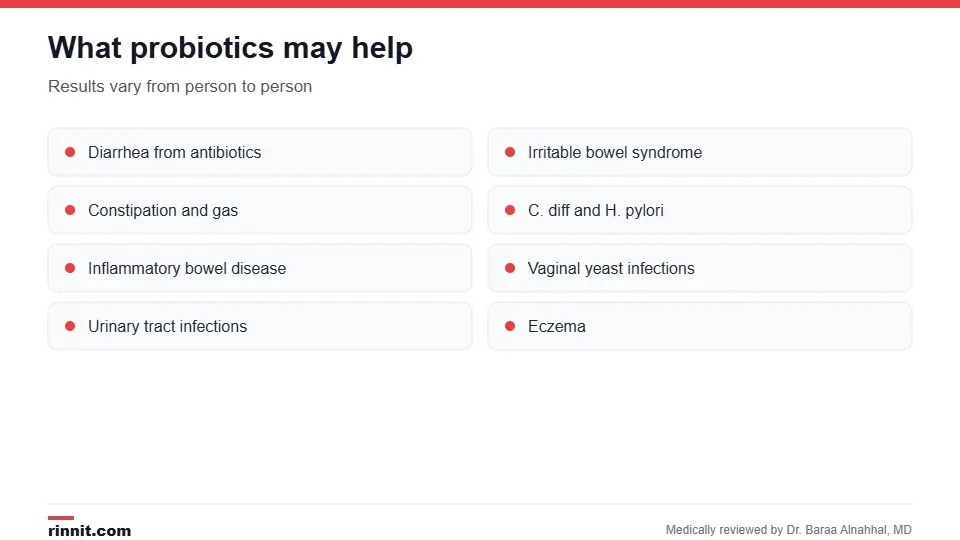
Results vary from person to person.
Irritable bowel syndrome (IBS), constipation and gas, though results vary.
C. difficile and H. pylori infections, and small intestinal bacterial overgrowth (SIBO).
Inflammatory bowel disease, such as ulcerative colitis and Crohn's disease.
Vaginal yeast infections and urinary tract infections.
Skin and mouth problems such as eczema (atopic dermatitis), acne, cavities and gum disease. Sources: [1, 2, 3]
Research on mood, pain, energy, metabolism and immune health is promising but not yet strong enough to draw firm conclusions. Sources: [1]
Types and sources of probiotics
Group | Common strains |
Lactobacillus | L. acidophilus, L. rhamnosus, L. casei, L. plantarum |
Bifidobacterium | B. longum, B. breve |
Source | Examples | Notes |
Supplements | Capsules, liquids, powders | Higher doses |
Fermented foods | Yogurt, kefir, cottage cheese, miso, kombucha, sauerkraut, kimchi, pickles | Broader mix of microbes, but less concentrated |
Topical products | Lotions and creams | For skin or mucous membranes |
Sources: [1]
How to take probiotics
Follow the label. Some are taken with food, others on an empty stomach.
Take them every day at the recommended dose for best results.
Look for "live and active cultures" on food labels, since processing can destroy them.
For a specific health problem, ask your provider which product to use. Sources: [1]
Side effects and safety
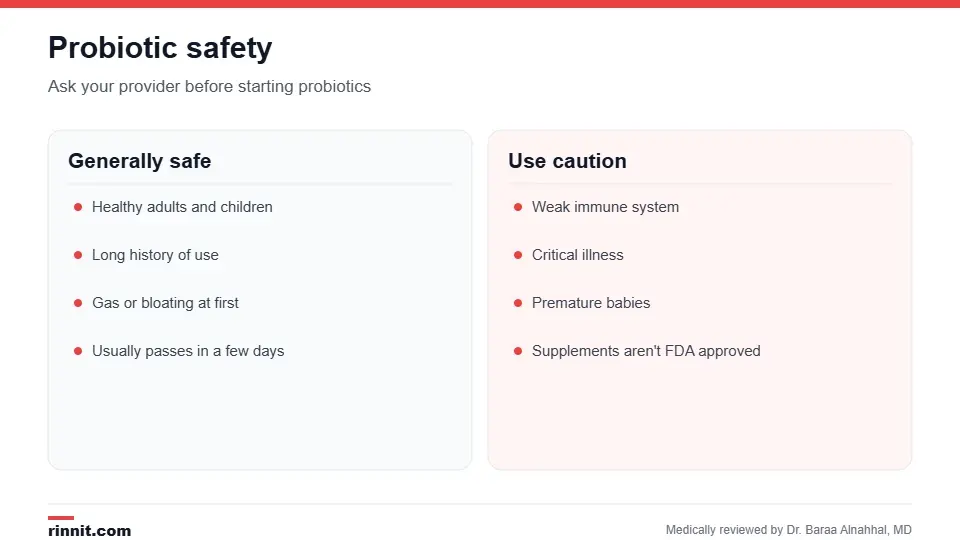
Ask your provider before starting probiotics.
Concern | Details |
Gas, bloating, loose stools | Common at first, especially with large doses; usually pass within a few days |
Weak immune system | Small risk of serious infection; ask your provider first |
Product quality | The FDA doesn't approve supplements for safety or effectiveness before they're sold, so quality varies |
People who take medicines that weaken the immune system, are critically ill or are premature babies should only take probiotics with a provider's guidance. Sources: [1, 3]
Signs they're working
More regular bowel movements if you had constipation or diarrhea.
Fewer symptoms of an infection or overgrowth.
Benefits from preventive use are harder to notice. Sources: [1]
Conclusion
Probiotics can support a healthy gut, especially during and after antibiotics. They're safe for most healthy people, but choose a product with your provider's help, since supplement quality varies.
Keep learning: read about fecal microbiota transplantation and antibiotics.
Frequently asked questions
What are probiotics?
Live bacteria and yeasts that have health benefits.
What do probiotics do?
They help keep the microbes in your body in healthy balance.
What foods have probiotics?
Yogurt, kefir, cottage cheese, miso, kombucha, sauerkraut, kimchi and pickles.
What's the difference between probiotics and prebiotics?
Probiotics are live microbes; prebiotics are fibers that feed them.
Should I take probiotics with antibiotics?
They can help prevent antibiotic diarrhea; ask your provider first.
Do probiotics help IBS?
They may, but results vary.
Are probiotics safe?
They appear safe for healthy people.
What are the side effects?
Gas, bloating and loose stools that usually pass in a few days.
Who should avoid probiotics?
People with weak immune systems should ask a provider first.
How long do probiotics take to work?
It varies; take them daily and watch for more regular digestion.
Related Reading
Creatine: Benefits, How It Works, Side Effects and Safety explains how creatine supplements work and their safety.
Antibiotic-Associated Diarrhea: Symptoms, Causes, Treatment & Complete Guide a common problem probiotics help prevent.
The Gut Microbiome: A Guide to Your Internal Ecosystem how your gut microbes work.
Irritable Bowel Syndrome: Symptoms, Causes, and Treatment a gut condition probiotics may ease.
Fecal Microbiota Transplantation (FMT): Restoring Gut Health a treatment that restores gut bacteria.
Antibiotics: Types, Uses, Side Effects and Resistance medicines that can upset your microbiome.
References
Cleveland Clinic. Probiotics: What They Are, Benefits & Side Effects. Cleveland Clinic. Last updated October 30, 2023. https://my.clevelandclinic.org/health/treatments/14598-probiotics
Hempel S, Newberry SJ, Maher AR, et al. Probiotics for the prevention and treatment of antibiotic-associated diarrhea: a systematic review and meta-analysis. JAMA. 2012;307(18):1959-1969. PMID 22570464. https://doi.org/10.1001/jama.2012.3507
Guo Q, Goldenberg JZ, Humphrey C, et al. Probiotics for the prevention of pediatric antibiotic-associated diarrhea. Cochrane Database Syst Rev. 2019;4(4):CD004827. PMID 31039287. https://doi.org/10.1002/14651858.CD004827.pub5
Medical disclaimer
This article is for general education only and does not replace advice from a qualified healthcare professional. Talk to your doctor about your own diagnosis and treatment, and seek emergency care right away for severe or sudden symptoms.



Comments