Potassium Iodide (KI): Uses, Radiation Protection and Side Effects

Updated: 2 days ago
Written and medically reviewed by Dr. Baraa Alnahhal, MD · Last reviewed: November 2026 · How we review
Quick Answer
Potassium iodide (KI) is a salt of potassium and iodine best known as a medicine that protects the thyroid during a radiation emergency. It fills the thyroid with stable iodine so it can't absorb radioactive iodine. One dose protects for about 24 hours. Never take KI without talking to a provider first, since too much can be dangerous.
What the research says
KI lowered thyroid cancer risk after Chernobyl: in a study of 276 thyroid cancer cases and 1,300 controls exposed to radiation as children, radiation-related thyroid cancer risk was 3.2 times higher in iodine-deficient areas, and taking potassium iodide cut that risk by about a factor of 3 (Cardis E et al., Journal of the National Cancer Institute, 2005) [2]
Mass use had few side effects: after Chernobyl, 16 million people in Poland received single doses of potassium iodide with only rare side effects and a probable 40% reduction in projected thyroid radiation dose (Becker DV et al., Thyroid, 1997) [3]
Key takeaways
KI protects the thyroid from radioactive iodine in an emergency.
It doesn't protect other organs or replace sheltering indoors.
One dose protects for about 24 hours.
Children and adults under 40 benefit most.
Never take KI without a provider's or official's guidance.
What is potassium iodide?
Potassium iodide combines potassium (K) and iodine (I). It's a "thyroid blocker." Stable iodine-127 is found in fish and table salt, while iodine-129 and iodine-131 are radioactive. Learn about your thyroid gland. Sources: [1]
What it's used for
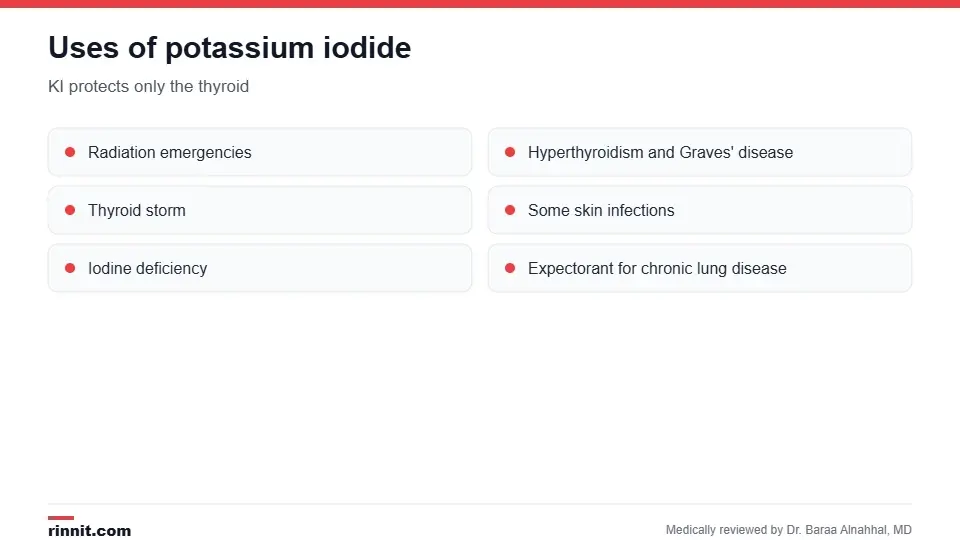
KI protects only the thyroid.
Protecting the thyroid in a radiation emergency or during some tests, such as MIBG scans.
Hyperthyroidism, especially Graves' disease.
Thyroid storm.
Some skin conditions, such as the fungal infection sporotrichosis.
Iodine deficiency.
A prescription-strength expectorant for chronic lung disease. Sources: [1]
How it protects your thyroid

Babies, children and pregnant people are at greatest risk.
During radiation exposure, your thyroid absorbs iodine without telling the difference between stable and radioactive types. KI "fills up" the thyroid so it stops absorbing radioactive iodine. Babies and children are at greatest risk, and pregnant people are at higher risk because their thyroid is more active. Sources: [1]
What KI can't do
It protects only the thyroid, not other body parts.
It doesn't protect against other radioactive materials.
It doesn't prevent radiation sickness.
After a nuclear bomb, it won't fully protect you; seek indoor shelter. Sources: [1]
How to take it
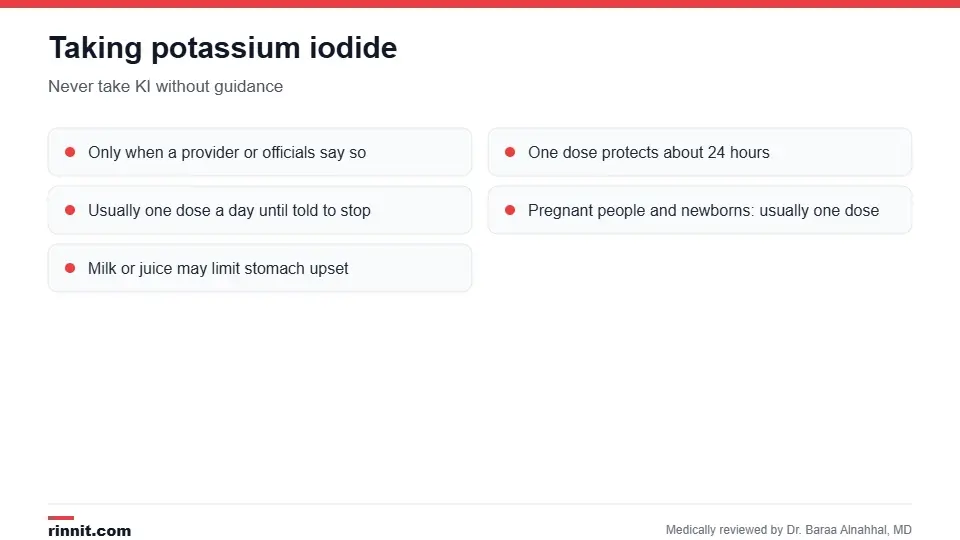
Doses depend on age and the reason you're taking it.
Take KI only when your provider or public health officials tell you to.
Doses depend on your condition and, in emergencies, your age.
One dose protects for about 24 hours; most people take one dose a day until told to stop.
Pregnant people and newborns usually get only one dose unless told otherwise.
Taking it with milk or juice may limit stomach upset. Sources: [1]
Side effects
Type | Examples |
Common | Rash, swollen salivary glands, metallic taste, burning mouth or throat, sore teeth and gums |
Stomach | Upset stomach, nausea, diarrhea |
Other | Headache, cold-like symptoms such as runny nose |
Allergic reaction | Fever, joint pain, swelling of the face or throat, wheezing, trouble swallowing |
Newborns given more than one dose risk hypothyroidism. Taking more than recommended can make you very sick or be fatal. Sources: [1, 3]
Who should be careful
People with thyroid nodules and heart disease.
People taking medicines that affect the thyroid.
People with an iodine allergy.
People with chronic kidney failure, tuberculosis, acute bronchitis or Addison's disease.
People who are pregnant or breastfeeding, though benefits may outweigh risks in an emergency. Sources: [1]
Benefits
In a radiation emergency, KI can lower your risk of thyroid cancer later. Children and adults under 40 benefit most. Sources: [1, 2]
When to talk to a provider
Before taking KI, including to prepare for emergencies, such as if you live within 10 miles of a nuclear power plant.
Right away for signs of an allergic reaction.
Call 911 for trouble breathing, speaking or swallowing. Sources: [1]
Conclusion
Potassium iodide can protect your thyroid in a radiation emergency and treat some thyroid conditions. Because it only protects the thyroid and can be harmful in excess, take it only when a provider or officials advise.
Keep learning: read about radiation sickness and hyperthyroidism.
Frequently asked questions
What is potassium iodide?
A salt of potassium and iodine used as a medicine.
How does KI protect against radiation?
It fills the thyroid so it can't absorb radioactive iodine.
Does KI protect the whole body?
No. It protects only the thyroid.
How long does one dose last?
About 24 hours.
Who benefits most from KI?
Children and adults under 40.
Can I take KI on my own?
No. Take it only when a provider or officials say so.
What are the side effects?
Rash, metallic taste, stomach upset and swollen salivary glands.
Can pregnant people take KI?
Usually one dose only, unless told otherwise.
Is KI used for other conditions?
Yes, including hyperthyroidism and some skin infections.
Does KI replace sheltering indoors?
No.
Related Reading
What Is Radiation Sickness? A Plain-Language Guide to the Illness Caused by a Large Dose of Radiation illness from high radiation doses.
Understanding the Thyroid Gland how the thyroid works.
Hyperthyroidism: Symptoms, Causes & Treatment an overactive thyroid.
Thyroid Cancer: Symptoms, Causes, Diagnosis and Treatment — What You Need to Know a cancer KI helps prevent after exposure.
Radioactive Iodine Therapy: A Targeted Treatment for Thyroid Conditions using radioactive iodine as treatment.
References
Cleveland Clinic. Potassium Iodide (KI) Types, Benefits & Side Effects. Cleveland Clinic. Last updated May 15, 2024. https://my.clevelandclinic.org/health/treatments/potassium-iodide-ki
Cardis E, Kesminiene A, Ivanov V, et al. Risk of thyroid cancer after exposure to 131I in childhood. J Natl Cancer Inst. 2005;97(10):724-732. PMID 15900042. https://doi.org/10.1093/jnci/dji129
Becker DV, Zanzonico P. Potassium iodide for thyroid blockade in a reactor accident: administrative policies that govern its use. Thyroid. 1997;7(2):193-197. PMID 9133683. https://doi.org/10.1089/thy.1997.7.193
Medical disclaimer
This article is for general education only and does not replace advice from a qualified healthcare professional. Talk to your doctor about your own diagnosis and treatment, and seek emergency care right away for severe or sudden symptoms.



Comments