What Is Radiation Sickness? A Plain-Language Guide to the Illness Caused by a Large Dose of Radiation

Updated: 2 days ago
Medically reviewed by Dr. Baraa Alnahhal, MD · Last reviewed: October 2026
Quick Answer: Radiation Sickness at a Glance
Radiation sickness, also called acute radiation sickness or radiation poisoning, is damage to the body from a large dose of radiation received over a short time [1], such as from a nuclear accident or weapon. It is never caused by routine X-rays or CT scans [1]. Nausea and vomiting come first [1]. It is rare but often fatal in severe cases [1].
Feature | Details |
What it is | Damage to the body caused by a large dose of radiation received over a short time, called acute radiation sickness or radiation poisoning [1]. |
What causes it | |
What it feels like | Nausea and vomiting first (often the earliest clue), then a symptom-free window, then more serious symptoms such as diarrhea, fever, hair loss, infections, and low blood pressure [1]. |
How serious it is | |
How it is treated | Removing clothing and washing decontaminates the body. Special medicines (potassium iodide, Prussian blue, DTPA, filgrastim and related drugs) protect the bone marrow or remove radioactive material, along with blood transfusions and supportive care [2]. |
What the research says
The bone-marrow medicines named in this guide are approved for the blood-forming form of radiation sickness. A review of US Food and Drug Administration (FDA) approvals found four drugs approved for hematopoietic acute radiation syndrome: granulocyte colony-stimulating factor (G-CSF), granulocyte/macrophage colony-stimulating factor, pegylated G-CSF, and romiplostim. The authors note that a national stockpile system gives communities access to these agents. (Bennett et al., Expert Opin Drug Saf, 2023) [3]
Most other countermeasures are still being studied. A review of radiation countermeasures noted that two G-CSF-based treatments are already approved for acute radiation syndrome, while a wide range of other substances, including immunomodulators, prostaglandins, flavonoids, and vitamins, has been studied. The review concentrated mainly on experimental results, so these are not yet standard treatments. (Hofer, Cas Lek Cesk, 2020) [4]
What Is Radiation Sickness, in Plain Language?
Radiation sickness is damage to the body caused by a large dose of radiation often received over a short time [1]. This is called acute radiation sickness.
It is also known as acute radiation syndrome or radiation poisoning. The amount of radiation absorbed by the body, called the absorbed dose, determines how bad the illness will be [1].
An important reassurance: radiation sickness is not caused by common medical imaging tests that use low-dose radiation, such as X-rays, CT scans, and nuclear medicine scans [1].

Although radiation sickness is serious and often fatal, it is rare [1]. Since the atomic bombings of Hiroshima and Nagasaki, Japan, during World War II, most cases have occurred after nuclear industrial accidents, such as the 1986 fire that damaged the nuclear power plant at Chernobyl, Ukraine [1].
What Does Radiation Sickness Feel Like?
The severity of symptoms depends on how much radiation you have absorbed [1]. That depends on the strength of the radiated energy, the time of your exposures, and the distance between you and the source of radiation [1]. Symptoms are also affected by the type of exposure, such as total or partial body, and by how sensitive the affected tissue is [1]. The gastrointestinal system and bone marrow, for instance, are highly sensitive to radiation [1].
The first symptoms of treatable radiation sickness are usually nausea and vomiting [1]. The time between exposure and when these symptoms develop is a clue to how much radiation a person has absorbed [1]. After the first round of symptoms, a person may have a brief period with no noticeable illness, followed by the onset of new, more serious symptoms [1].
Symptom | What it looks like |
Nausea and vomiting | Usually the first signs [1]. The timing hints at the size of the dose. |
Diarrhea [1] | Loose stools from damage to the intestinal tract. |
Headache [1] | Pain or pressure in the head. |
Fever [1] | Elevated body temperature. |
Dizziness and disorientation [1] | Feeling unsteady or confused. |
Weakness and fatigue [1] | Unusual tiredness and low energy. |
Hair loss [1] | Hair falling out as cells are damaged. |
Bloody vomit and stools | Caused by internal bleeding [1]. |
Infections [1] | The body can’t fight germs as well. |
Low blood pressure [1] | Blood pressure drops below normal. |
How Soon Do Symptoms Begin?
The timing depends on the size of the exposure. After a mild exposure, it may take hours to weeks before symptoms begin [1]. After a high exposure, symptoms can begin minutes to days after exposure [1].
When Should I See a Doctor?
An accident or attack that causes radiation sickness would lead to a lot of attention and public concern. If such an event happens, listen to radio, television, or online reports to learn about emergency instructions for your area [1]. If you know you have been overexposed to radiation, seek emergency medical care [1].
What Causes Radiation Sickness?
Radiation sickness is caused by being exposed to a high dose of radiation [1]. Radiation is the energy released from atoms as either a wave or a tiny particle of matter [1]. It happens when high-energy radiation damages or destroys certain cells in the body [1]. The areas most at risk are the bone marrow cells and the lining of the intestinal tract [1].
Who Is at Higher Risk?
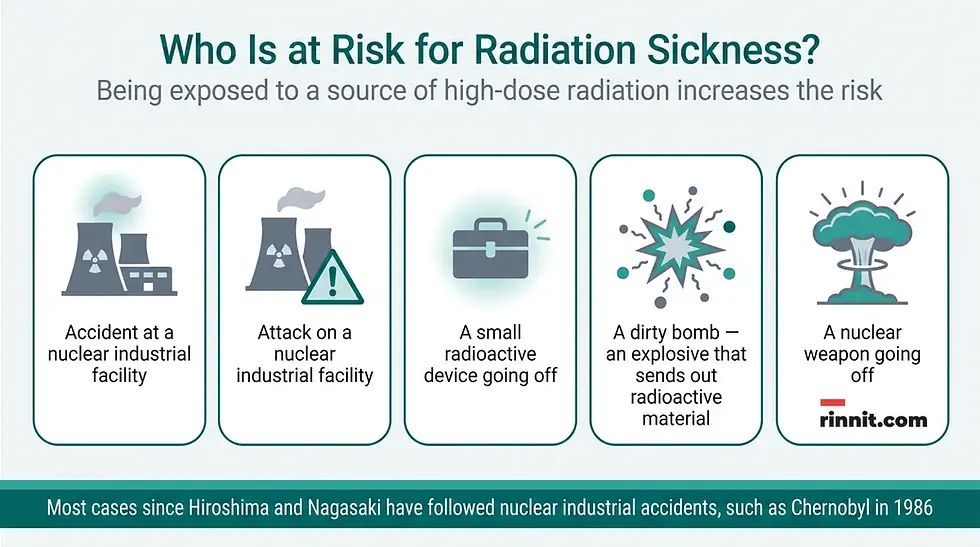
The main risk factor for radiation sickness is exposure to a source of high-dose radiation [1]. Sources include:
Risk factor | What it is |
Accident at a nuclear industrial facility [1] | An industrial incident that releases radiation. |
Attack on a nuclear industrial facility [1] | A deliberate attack on a radiation source. |
A small radioactive device going off [1] | A compact device that releases radiation. |
A dirty bomb [1] | An explosive device that sends out radioactive material. |
A nuclear weapon going off [1] | An atomic-level explosion that releases massive radiation. |
Can Radiation Sickness Affect Mental Health?
Yes. Radiation sickness can contribute to short-term and long-term mental health problems, such as grief, fear, and anxiety about experiencing a radioactive accident or attack, mourning friends or family who haven’t survived, dealing with the uncertainty of a mysterious and potentially fatal illness, and worrying about the eventual risk of cancer due to radiation exposure [1].
How Is the Absorbed Dose Determined?
When a person has experienced known or probable exposure to a high dose of radiation from an accident or attack, medical personnel take a number of steps to determine the absorbed dose. This information is essential for determining how serious the illness is likely to be, which treatments to use, and whether a person is likely to survive [2].
How doctors estimate the dose | What it tells them |
Known exposure details | Distance from the radiation source and the duration of exposure give a rough estimate of severity [2]. |
Vomiting and other symptoms | |
Blood tests | Frequent blood tests over several days look for drops in disease-fighting white blood cells and unusual changes in the DNA of blood cells, which show the degree of bone marrow damage [2]. |
Dosimeter | A device that can measure the absorbed dose, but only if it was exposed to the same radiation event as the person [2]. |
Survey meter | A device such as a Geiger counter can test people to see where in the body radioactive particles are located [2]. |
Type of radiation | Identifying the type of exposure guides some treatment decisions [2]. |
How Is Radiation Sickness Treated?
The treatment goals are to prevent further radioactive contamination, treat life-threatening injuries such as burns and trauma, reduce symptoms, and manage pain [2].

How Do Doctors Remove Radioactive Particles?
Decontamination involves removing external radioactive particles. Removing clothing and shoes eliminates about 90% of external contamination [2], and gently washing with water and soap removes additional radiation particles from the skin [2]. Decontamination prevents radioactive materials from spreading more and lowers the risk of internal contamination from inhalation, ingestion, or open wounds [2].
How Is the Bone Marrow Protected?
A protein called granulocyte colony-stimulating factor, which promotes the growth of white blood cells, may counter the effect of radiation sickness on bone marrow [2]. Treatment with this protein-based medicine, which includes filgrastim (Neupogen), sargramostim (Leukine), and pegfilgrastim (Neulasta), may increase white blood cell production and help prevent later infections [2]. If you have severe damage to the bone marrow, you may also receive transfusions of red blood cells or blood platelets [2].
How Is Radioactive Material Removed From Inside the Body?
Some treatments may reduce damage to internal organs caused by radioactive particles. Medical personnel would use these treatments only if you have been exposed to a specific type of radiation [2].
Medicine | What it does and how it leaves the body |
Potassium iodide | |
Prussian blue (Radiogardase) | |
DTPA (diethylenetriamine pentaacetic acid) |
What Other Supportive Care Is Given?
You may receive additional medicines or interventions to treat bacterial infections, headache, fever, diarrhea, nausea and vomiting, dehydration, burns, and sores or ulcers [2].
What Happens in a Severe Case?
A person who has absorbed very large doses of radiation has little chance of recovery [2]. Depending on the severity of illness, death can occur within two days or two weeks [2]. People with a lethal radiation dose receive medicine to control pain, nausea, vomiting, and diarrhea, and they may also benefit from psychological or pastoral care [2].
What Should I Do During a Radiation Emergency?
In a radiation emergency, listen to the radio or watch television to hear what protective actions local, state, and federal authorities recommend [1]. Those actions depend on the situation, but you will be told to either stay in place or evacuate your area [1].
If You’re Told to Shelter in Place
Close and lock all doors and windows [1].
Turn off fans, air conditioners, and heating units that bring air in from outside [1].
Close fireplace dampers [1].
Bring pets indoors [1].
Move to an inner room or basement [1].
Stay tuned to your emergency response network or local news [1].
Stay put for at least 24 hours [1].
If You’re Told to Evacuate
Follow the instructions provided by your local authorities. Try to stay calm and move quickly and in an orderly manner [1]. Travel lightly, but take supplies, including a flashlight, portable radio, batteries, a first-aid kit, necessary medicines, sealed food such as canned foods, bottled water, a manual can opener, cash and credit cards, and extra clothes [1]. Most emergency vehicles and shelters won’t accept pets [1]. Take them only if you are driving your own vehicle and going someplace other than a shelter [1].
What is the bottom line on radiation sickness?
Radiation sickness is rare, serious, and caused only by a large dose of radiation received over a short time. Routine medical imaging such as X-rays and CT scans does not cause it [1]. The absorbed dose sets the course: mild exposures may take hours to weeks to show symptoms, while high exposures can begin within minutes or days, usually with nausea and vomiting [1]. The bone marrow and intestinal lining take the hardest hit, which is why infections and digestive symptoms dominate the illness. Medicine does have real responses: removing contaminated clothing eliminates most external radiation [2], protein-based medicines help the bone marrow rebuild white blood cells, and drugs such as potassium iodide, Prussian blue, and DTPA help remove specific radioactive particles from the body [2]. In an emergency, following official guidance, either sheltering in place or evacuating, is the first and most important protective step.
In a radiation emergency, time matters. If you know you have been overexposed to radiation, seek emergency medical care right away. Follow official instructions to shelter in place or evacuate, and remember that removing clothing and washing with soap and water removes most external contamination before it can spread further.
Frequently Asked Questions
What is radiation sickness in simple terms?
Radiation sickness is damage to the body caused by a large dose of radiation, often received over a short time. It is also called acute radiation syndrome or radiation poisoning [1]. The amount of radiation the body absorbs (the absorbed dose) determines how bad the illness will be [1].
Can medical imaging tests like X-rays cause radiation sickness?
No. Radiation sickness is not caused by common medical imaging tests that use low-dose radiation, such as X-rays, CT scans, and nuclear medicine scans [1].
What causes radiation sickness?
Exposure to a high dose of radiation. It happens when high-energy radiation damages or destroys certain cells in the body, especially the bone marrow cells and the lining of the intestinal tract [1].
What are the first symptoms of radiation sickness?
The first symptoms of treatable radiation sickness are usually nausea and vomiting [1]. The time between exposure and when these symptoms start is a clue to how much radiation a person has absorbed [1]. The shorter the time, the higher the dose [2].
How soon do symptoms appear?
After a mild exposure, it may take hours to weeks before symptoms begin [1]. After a high exposure, symptoms can begin minutes to days after exposure [1].
How is radiation sickness diagnosed?
Medical personnel estimate the absorbed dose using known exposure details (distance from the source and duration), the timing of vomiting and other symptoms, frequent blood tests over several days, a dosimeter if it was exposed to the same event, and a survey meter such as a Geiger counter [2]. This information shows how serious the illness is likely to be, which treatments to use, and whether a person is likely to survive [2].
What treatments are available for radiation sickness?
The goals are to prevent further contamination, treat life-threatening injuries, reduce symptoms, and manage pain [2]. Removing clothing and shoes eliminates about 90% of external contamination [2], and gently washing with water and soap removes more. Potassium iodide, Prussian blue, and DTPA help remove specific radioactive particles [2]. Protein-based medicines such as filgrastim support the bone marrow, and supportive care treats infections, pain, fever, diarrhea, nausea, dehydration, burns, and ulcers [2].
What should I do if a radiation emergency happens?
Listen to the radio, television, or online reports for emergency instructions for your area [1]. Depending on the situation, you will be told to shelter in place or evacuate. If you know you have been overexposed to radiation, seek emergency medical care [1].
Related Reading
Potassium Iodide (KI): Uses, Radiation Protection and Side Effects explains how potassium iodide protects the thyroid.
References
Mayo Clinic Staff. Radiation sickness - Symptoms and causes. Mayo Clinic. Published February 13, 2024. https://www.mayoclinic.org/diseases-conditions/radiation-sickness/symptoms-causes/syc-20377058
Mayo Clinic Staff. Radiation sickness - Diagnosis and treatment. Mayo Clinic. Published February 13, 2024. https://www.mayoclinic.org/diseases-conditions/radiation-sickness/diagnosis-treatment/drc-20377061
Bennett CL, et al. United States' regulatory approved pharmacotherapies for nuclear reactor explosions and anthrax-associated bioterrorism. Expert Opin Drug Saf. 2023;22(9):783-788. PMID 37594915. https://doi.org/10.1080/14740338.2023.2245748
Hofer M. Trends in pharmacological stimulation of regeneration of ionizing radiation-damaged mammalian organism. Cas Lek Cesk. 2020;159(7-8):275-280. PMID 33445933. https://pubmed.ncbi.nlm.nih.gov/33445933/
Medical disclaimer
This article is for informational purposes only and does not constitute medical advice. Always seek the advice of your physician or other qualified health provider with any questions you may have regarding a medical condition.



Comments