Physical Therapy for Cerebral Palsy: Goals, Exercises and Benefits

Updated: 2 days ago
Written and medically reviewed by Dr. Baraa Alnahhal, MD · Last reviewed: November 2026 · How we review
Quick Answer
Physical therapy (PT) for cerebral palsy is a program of customized exercises and stretches that helps a child manage CP symptoms like muscle stiffness and spasms. A physical therapist builds a plan to strengthen muscles, improve flexibility and ease pain. It can't cure CP, but it's an important part of lifelong management and has very few risks.
What the research says
Backward walking training improved walking speed: a meta-analysis of 8 trials with 156 children with CP found backward walking training improved walking speed by 0.10 m/s more than forward walking alone, and adding it to forward walking raised speed by 0.20 m/s (Menezes KKP et al., International Journal of Rehabilitation Research, 2023) [2]
Pool therapy gave a small boost in motor skills: a meta-analysis of 15 trials with 369 children ages 2 to 18 with CP found pool exercise worked about as well as land-based exercise overall; only aquatic physical therapy, in 4 small trials, gave a small gain in gross motor function, with low-quality evidence (Pauluka E et al., Child: Care, Health and Development, 2025) [3]
Key takeaways
PT helps children with CP move more safely and confidently.
Exercises build strength, flexibility and range of motion.
Therapy may include pool work and walking aids.
PT can't cure CP but is a key part of lifelong care.
Soreness at first is common.
What is physical therapy for cerebral palsy?
Cerebral palsy affects the ability to move and control muscles. PT is also called physiotherapy. It's goal-setting work, not a fitness contest, and it takes encouragement. Sources: [1]
Goals of PT

PT is one part of ongoing CP care.
Strengthen muscles.
Increase flexibility and range of motion.
Manage muscle pain and stiffness.
Help your child move more safely and confidently.
Possibly prevent some movement problems from getting worse.
Support mental health by helping your child enjoy favorite activities. Sources: [1]
Types of exercises
Occupational therapy may be added for daily tasks.
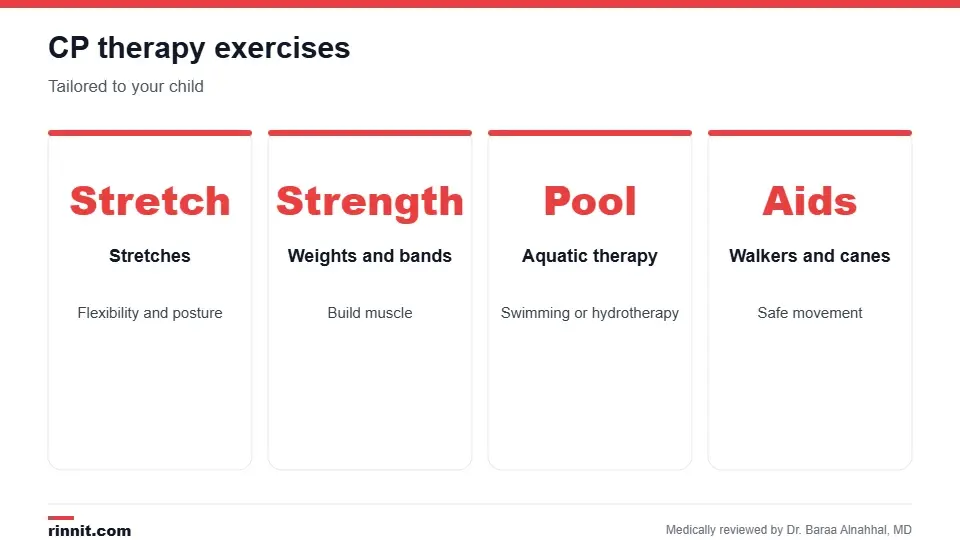
Type | Purpose |
Stretches and exercises | Build flexibility and strength |
Posture work | Improve body control |
Weights, machines and resistance bands | Strengthen muscles |
Pool therapy | Swimming or hydrotherapy |
Assistive device training | Learn to use a cane or walker |
Your provider may also suggest pediatric occupational therapy for daily tasks. Sources: [1, 3]
Getting started
Ask whether the clinic has experience with CP.
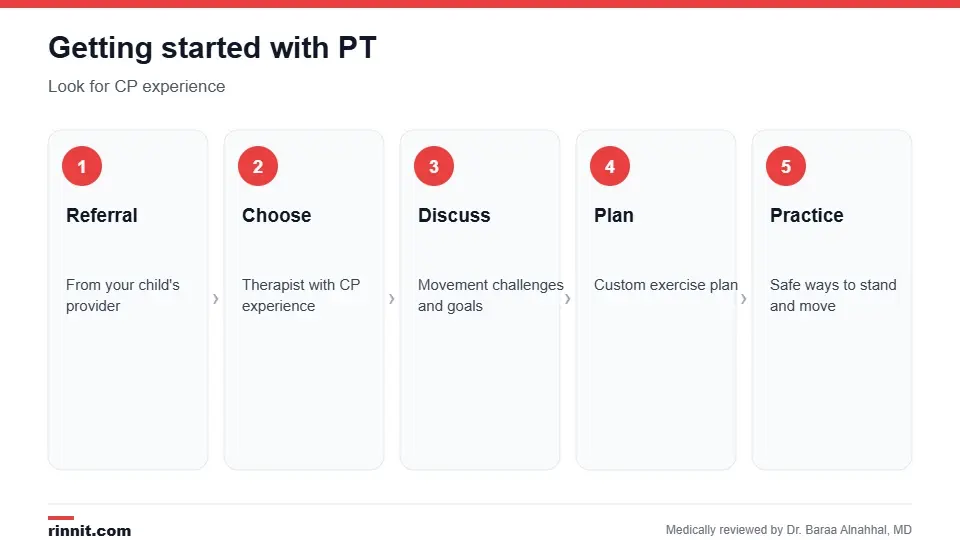
Get a referral from your child's provider or search online.
Ask whether the therapist or clinic has experience with CP.
Talk about how CP affects your child's movement and what activities they want to do.
The therapist creates a custom plan.
Your child learns the best ways to stand and move, with assistive tools if needed. Sources: [1]
Risks
PT has very few risks. There's a small chance of falls or other injuries, as with any exercise. Soreness is common, especially at first, and the therapist can help tell normal soreness from injury. The plan can be changed if your child feels unsafe. Sources: [1]
Outlook
PT can improve strength, symptoms and movement, and build confidence, self-esteem and independence. It's not a cure, and other treatments may still be needed. CP management is lifelong, and your child keeps learning new ways to move over time. Sources: [1, 2]
When to contact a provider
Tell the therapist if soreness worries you or your child feels unsafe.
Contact your child's provider if CP symptoms change or get worse. Sources: [1]
Conclusion
Physical therapy helps children with cerebral palsy build strength, move more safely and take part in activities they love. Finding an experienced therapist and staying consistent make a real difference.
Keep learning: read about cerebral palsy and pediatric occupational therapy.
Frequently asked questions
What is physical therapy for cerebral palsy?
Custom exercises and stretches to help a child manage CP symptoms.
Can physical therapy cure cerebral palsy?
No, but it helps manage symptoms.
What does PT help with?
Strength, flexibility, stiffness, pain and safe movement.
What exercises are used?
Stretches, posture work, weights, resistance bands and pool therapy.
Does pool therapy help?
Studies suggest it works about as well as land-based exercise, with a small benefit in some trials.
Will my child use a walker?
Some children train with canes or walkers.
Is PT safe for children with CP?
Yes. Risks are very low.
Will PT hurt?
Soreness is common at first.
How do I find a therapist?
Ask your child's provider or look for a clinic with CP experience.
How long will my child need PT?
CP management is lifelong.
Related Reading
Selective Dorsal Rhizotomy (SDR): Surgery for Cerebral Palsy explains selective dorsal rhizotomy.
Cerebral Palsy: Symptoms, Causes, Diagnosis, and Treatment Explained an overview of cerebral palsy.
Pediatric Occupational Therapy: A Guide to Developmental Milestones help with daily tasks.
What Is Hydrotherapy? Types, Benefits, Risks, and Who It Can Help water-based therapy.
Physical Therapy: Enhancing Mobility, Strength, and Recovery an overview of physical therapy.
Baclofen Pump: How It Works, Who It Helps, Risks and Recovery a treatment for spasticity.
References
Cleveland Clinic. Cerebral Palsy Physical Therapy: What It Is & Effectiveness. Cleveland Clinic. Last updated May 8, 2026. https://my.clevelandclinic.org/health/treatments/physical-therapy-treatment-cerebral-palsy
Menezes KKP, Avelino PR, Nascimento LR. Addition of backward walking training to forward walking training improves walking speed in children with cerebral palsy: a systematic review with meta-analysis. Int J Rehabil Res. 2023;46(4):300-307. PMID 37581293. https://doi.org/10.1097/MRR.0000000000000598
Pauluka E, Ceolin LS, Fontanela LC, et al. Aquatic compared with land-based exercises on gross motor function of children/adolescents with cerebral palsy: a systematic review with meta-analysis. Child Care Health Dev. 2025;51(1):e70023. PMID 39688349. https://doi.org/10.1111/cch.70023
Medical disclaimer
This article is for general education only and does not replace advice from a qualified healthcare professional. Talk to your doctor about your own diagnosis and treatment, and seek emergency care right away for severe or sudden symptoms.



Comments