Selective Dorsal Rhizotomy (SDR): Surgery for Cerebral Palsy

Updated: 2 days ago
Written and medically reviewed by Dr. Baraa Alnahhal, MD · Last reviewed: November 2026 · How we review
Quick Answer
Selective dorsal rhizotomy (SDR) is surgery that permanently reduces spasticity (muscle tightness) in the legs of children with cerebral palsy. A neurosurgeon cuts some overactive sensory nerve fibers in the lower spinal cord while protecting the motor nerves. It's followed by months of intensive physical therapy. Not every child is a candidate, and few hospitals offer it.
What the research says
SDR plus therapy reduced spasticity more than therapy alone: pooling 3 randomized trials with 90 children with spastic diplegia, SDR plus physical therapy reduced spasticity more than therapy alone and gave a small extra gain in motor function (McLaughlin J et al., Developmental Medicine and Child Neurology, 2002) [2]
SDR helped children who can't walk: in 274 children with severe spastic cerebral palsy who couldn't walk, SDR reduced spasticity in all studies; motor scores improved in 72%, bladder function in 78%, and 92% of families were satisfied, with wound infection in 2.7% (Licci M et al., Neurosurgical Focus, 2024) [3]
Key takeaways
SDR permanently reduces leg spasticity in cerebral palsy.
It cuts overactive sensory nerve fibers, not motor nerves.
It's mainly for children with spastic diplegia.
Surgery takes four to five hours.
Months of intensive therapy are essential for success.
What is selective dorsal rhizotomy?
In cerebral palsy, the brain can't fully control a spinal reflex loop, so leg muscles stay contracted. Cutting overactive sensory rootlets breaks this loop. It may help muscles work more normally and prevent joint and bone problems. Learn about other types of rhizotomy. Sources: [1]
Who it's for
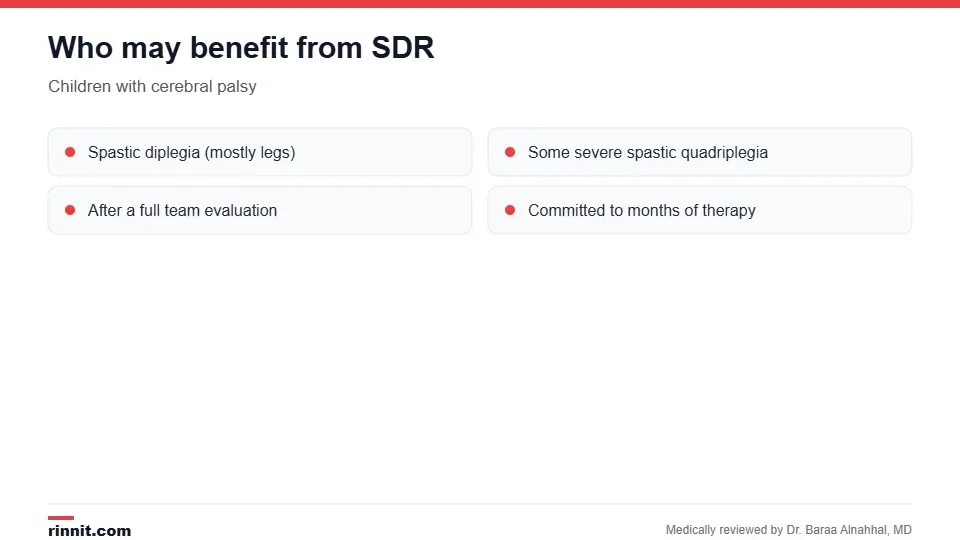
Children with diplegia tend to have the best results.
Children with spastic diplegic cerebral palsy.
Some children with severe spastic quadriplegic cerebral palsy. Sources: [1]
A team including a pediatric neurosurgeon, orthopaedic surgeon, physiatrist and physical and occupational therapists evaluates each child. Tests may include video gait assessments and a brain MRI. Sources: [1]
What happens during surgery
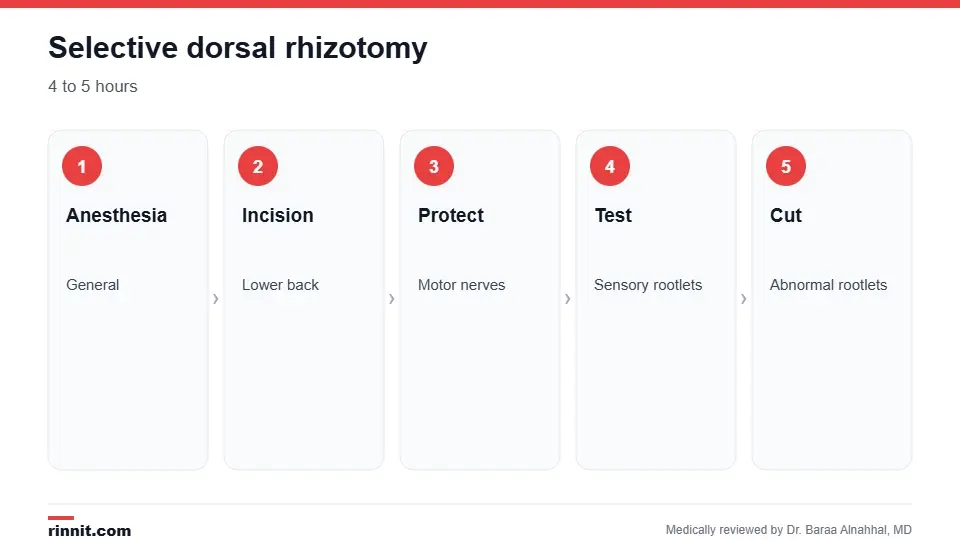
Surgery takes about four to five hours.
Your child gets general anesthesia.
An incision is made in the middle of the lower back.
A small window is opened to reach the nerves.
Motor nerves are separated and protected.
Dozens of sensory rootlets are tested with electrical stimulation.
A portion of the abnormal rootlets is cut, and the incision is closed. Sources: [1]
Risks
Type | Examples |
Short-term | Infection, bleeding, spinal fluid leak |
Rare and permanent | Increased touch sensitivity, loss of bladder or bowel control, weakness or loss of walking ability |
Sources: [1, 3]
Recovery
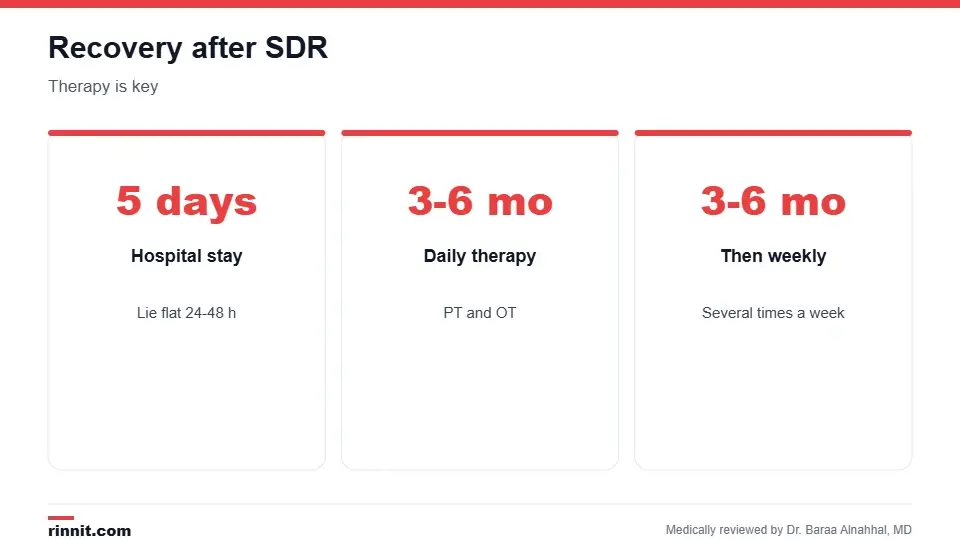
Committed therapy is key to good results.
Your child stays about five days, often starting in the ICU.
They lie flat for the first 24 to 48 hours.
Physical therapy and occupational therapy start within a few days.
Therapy continues most days for three to six months, then several times a week for another three to six months. Sources: [1]
Results
Type of CP | Possible benefits |
Spastic diplegia | Better walking and mobility, more stamina, better balance, fewer falls, better posture, less pain |
Spastic quadriplegia | More comfortable sitting, easier potty-seat use, independent wheelchair use, easier caregiving |
Success depends on intensive therapy and varies by child. Sources: [1, 2, 3]
Other options
For some children, a baclofen pump or other treatments may be considered for spasticity. Sources: [1]
When to call your provider
Call right away for signs of complications, such as an infected incision or loss of bladder function. Sources: [1]
Conclusion
Selective dorsal rhizotomy can permanently ease leg stiffness and help children with cerebral palsy move more freely. A dedicated team and months of therapy make the biggest difference.
Keep learning: read about cerebral palsy and physical therapy for cerebral palsy.
Frequently asked questions
What is selective dorsal rhizotomy?
Surgery that cuts overactive sensory nerves to reduce leg spasticity.
Who is it for?
Mainly children with spastic diplegic cerebral palsy.
Is the result permanent?
Yes. It's meant to permanently reduce spasticity.
Does it cause paralysis?
No. Motor nerves are protected.
How long does surgery take?
About four to five hours.
How long is the hospital stay?
About five days.
How much therapy is needed?
Most days for three to six months, then several times a week.
What are the risks?
Infection, bleeding, spinal fluid leak and rare permanent problems.
Can it help children who can't walk?
Yes. It can make sitting and caregiving easier.
Is SDR widely available?
No. Few hospitals perform it.
Related Reading
Cerebral Palsy: Symptoms, Causes, Diagnosis, and Treatment Explained an overview of cerebral palsy.
Physical Therapy for Cerebral Palsy: Goals, Exercises and Benefits therapy after SDR.
Baclofen Pump: How It Works, Who It Helps, Risks and Recovery another spasticity treatment.
Rhizotomy: A Comprehensive Guide to Managing Chronic Pain and Spasticity other types of rhizotomy.
Hereditary Spastic Paraplegia: What It Is, Why It Happens, and How It's Treated another cause of spasticity.
References
Cleveland Clinic. Selective Dorsal Rhizotomy: What It Is, Purpose & Procedure. Cleveland Clinic. Last updated January 24, 2023. https://my.clevelandclinic.org/health/treatments/17458-selective-dorsal-rhizotomy
McLaughlin J, Bjornson K, Temkin N, et al. Selective dorsal rhizotomy: meta-analysis of three randomized controlled trials. Developmental Medicine and Child Neurology. 2002;44(1):17-25. PMID 11811645. https://doi.org/10.1017/s0012162201001608
Licci M, Frank NA, Greuter L, et al. Palliative single-level selective dorsal rhizotomy for children with spastic cerebral palsy Gross Motor Function Classification System level IV and V: a case series and systematic review of the literature. Neurosurgical Focus. 2024;56(6):E6. PMID 38823044. https://doi.org/10.3171/2024.3.FOCUS2478
Medical disclaimer
This article is for general education only and does not replace advice from a qualified healthcare professional. Talk to your doctor about your own diagnosis and treatment, and seek emergency care right away for severe or sudden symptoms.



Comments