Onychomycosis: Nail Fungus Symptoms, Diagnosis and Treatment

Updated: 2 days ago
Medically reviewed by Dr. Baraa Alnahhal, MD · Last reviewed: October 2026
Quick Answer: what does nail fungus look like?
Onychomycosis, or nail fungus, is a fungal nail infection that can make a nail whitish, yellowish or brownish, cracked, crumbly, thickened or separated from the nail bed. Laboratory testing is essential to confirm it. Treatment includes oral or topical antifungals or, in severe cases, nail removal, and visible recovery may take several months or up to a year.

What the research says
Continuous oral antifungals outperformed topical treatments for toenail onychomycosis in a network meta-analysis. Across 26 randomized trials (8,136 patients), the odds of mycological cure with continuous oral terbinafine or continuous oral itraconazole were significantly greater than with topical treatments, while pulse regimens, fluconazole and topical treatments did not differ significantly from one another. Adverse events were not significantly different between oral and topical treatments. Choosing among them remains a decision for the treating clinician (Gupta et al., Br J Dermatol, 2020). [2]
Nail fungus is common in people with diabetes, and testing is recommended over appearance alone. A systematic review of 10 studies (5,664 patients with diabetes) found onychomycosis in 29.18%, mainly caused by Trichophyton rubrum. It was significantly associated with diabetic neuropathy (p = 0.012) and elevated glycosylated hemoglobin (p = 0.039), and the authors called for diagnostic testing rather than relying on clinical diagnosis alone (Navarro-Pérez et al., Mycoses, 2023). [3]
Nail psoriasis and nail fungus can occur together. A systematic review of 10 studies found an average onychomycosis prevalence of 18.0% in people with psoriasis, which appeared higher than in control groups, though the evidence was limited by heterogeneity. The authors suggested ruling out onychomycosis in people with suspected nail psoriasis (Klaassen et al., J Eur Acad Dermatol Venereol, 2014). [4]
What is onychomycosis?
Onychomycosis is a fungal infection that affects a toenail or fingernail. It is one possible cause of nail dystrophy, a broad term for abnormal changes in the nail's appearance or structure.
Fungal nail infections are usually not dangerous, but they can be unpleasant, difficult to clear and emotionally distressing. Some people feel anxious or embarrassed about visible nail changes and may avoid activities that expose their hands or feet. [1]
What are the symptoms of nail fungus (onychomycosis)?
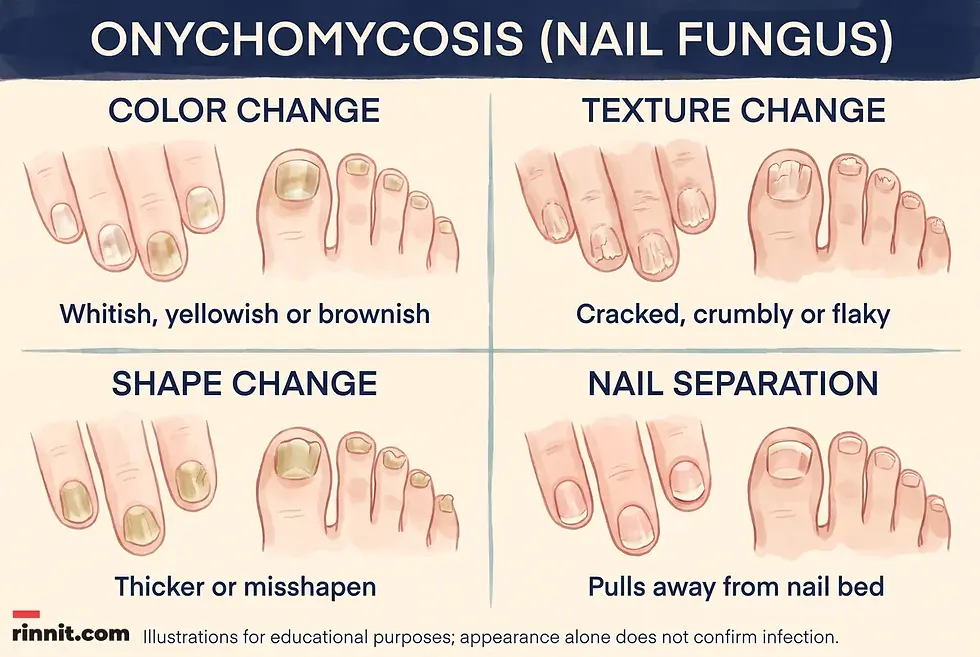
Nail fungus does not look exactly the same in every person. The changes may affect one nail or several nails, and they can involve toenails, fingernails or both.
Nail change | What it may look like |
Color change | Whitish, yellowish or brownish; cloudy or spotty. |
Texture change | Cracked, crumbly or flaky. |
Shape change | Thicker or misshapen. |
Nail separation | Nail lifting or separating from the nail bed. |
Pain | Not usually present, but possible as a complication. |
Is pain a typical symptom?
Pain is not usually one of the symptoms of nail fungus. However, pain can occur as a complication, particularly when the nail becomes thick, damaged or associated with surrounding tissue problems. Painful nail changes should be evaluated rather than assumed to be fungal. Laboratory confirmation can help prevent treatment for the wrong condition. [1]
What causes nail fungus?
Several types of fungi can cause nail infections. They are grouped into dermatophytes, molds and yeasts. [1]
Fungal group | Description |
Dermatophytes | Cause at least half of nail fungus cases and possibly as many as four out of five; common species include Trichophyton, Epidermophyton and Microsporum. |
Molds | Account for about one in ten cases; examples include Aspergillus, Scopulariopsis and Fusarium. |
Yeasts | Uncommon; when present, often involve Candida species and are more likely to affect fingernails. |
The appearance of a nail alone cannot reliably identify the fungus or confirm that fungus is the cause. Testing helps determine whether treatment is appropriate and which organism may be involved.
Who is more likely to develop nail fungus?
Nail fungus can affect people with excellent hygiene. Risk is influenced by age, health conditions, exposure, nail injury and the environment. [1]
Risk factor | Why it may matter |
Older age | Nail fungus becomes more common with age; it occurs in about one in five people over 60 and up to half of people over 70. |
Weakened immune system | Makes it harder for the body to keep infections out. |
Diabetes | Can affect immunity and circulation, increasing concern about nearby tissue infections. |
Circulation problems | Conditions affecting blood flow to the limbs can increase risk or severity. |
Shared wet spaces | Locker rooms, bathrooms and shared living spaces can create exposure opportunities. |
Family history | Living with a family member who has nail fungus may increase risk. |
Smoking | Listed as a risk factor. |
Hyperhidrosis | Excessive sweating can create a moisture-rich environment. |
Psoriasis | Can raise the risk of nail fungus and can also cause nail changes that look similar. |
Athlete's foot | Another fungal infection that can be associated with nail fungus. |
Nail damage | Breaks or injury can make it easier for fungus to live in the nail. |
Moisture and tight shoes | Can create a foot environment where fungi live more easily. |
Tropical climate or frequent swimming | Increases exposure to warm or wet environments. |
A risk factor does not prove that a nail change is fungal. It helps a clinician decide what questions to ask and whether testing is useful.
Can nail fungus affect fingernails?
Yes. Onychomycosis can affect fingernails or toenails. Yeast infections are uncommon overall but are more likely to affect fingernails when they occur. Fingernail changes can also be caused by trauma, psoriasis and other conditions, so persistent changes should be assessed rather than diagnosed from appearance alone. [1]
How is nail fungus diagnosed?
A healthcare provider usually begins by looking at the nail and asking about the timing and pattern of changes. The provider may ask about pain, exposure to shared wet spaces, athlete's foot, nail injury, medical conditions, medicines and whether other nails are affected.
Laboratory testing is essential for confirming the diagnosis and determining which type of fungus is responsible. A provider may collect nail clippings or scrape nail tissue for analysis. [1]
Test | What it may involve or show |
Microscopy with immunostaining | Examining a tissue sample under a microscope and using staining to help identify fungal material. |
PCR | Looking for fungal genetic material in the sample. |
ELISA testing | A laboratory method that may help identify a relevant fungal signal. |
Fungal culture | Trying to grow fungus from a nail tissue sample. |
Testing is important because nail dystrophy has more than one possible cause. A nail that looks thick, yellow or crumbly is not automatically a fungal infection.
Why does testing matter before treating nail fungus?
Nail fungus treatment can last for months and may involve medicines or procedures. Confirming the diagnosis helps a healthcare provider choose an appropriate plan and avoid treating a different nail condition as if it were fungal. Testing can also help identify the type of fungus, which may matter when a provider considers oral treatment, topical treatment or another approach.
How is onychomycosis treated?
Treatment depends on the extent of the infection, the nail or nails involved, the suspected fungus, the person's health history and the provider's assessment.
Treatment category | Description |
Oral medication | Systemic antifungal medicine taken by mouth. |
Topical medication | Antifungal medicine applied directly to the nail. |
Nail procedure | In severe cases, the affected nail may be removed so a healthy nail can regrow. |
Other approaches | Laser, chemical or other treatments may be considered as alternatives. |
Combination approach | In many cases, more than one treatment approach may be used. |
Do not start, stop or combine antifungal medicines without a healthcare provider's guidance. Treatment decisions can depend on other health conditions, medicines, nail involvement and the confirmed diagnosis.
How long does treatment take?
Treatment commonly lasts for months. Visible improvement can take several months or even a year because the affected nail must grow out and be replaced by healthy nail tissue. The nail may not return completely to its previous appearance even when treatment clears the infection, because changes to the nail bed or nail matrix can cause lasting appearance changes.
What complications can nail fungus cause?
Nail fungus can cause pain, cellulitis in nearby tissue, or spread to other nails or parts of the body. It may be a greater concern in people with diabetes or a weakened immune system because nearby tissue infections can be more serious. Peripheral artery disease and chronic venous insufficiency can also make a case more serious. [1]
Possible complication or concern | Why it matters |
Pain | May develop even though pain is not usually an initial symptom. |
Cellulitis | Infection in the surrounding tissue. |
Spread | Infection may involve other nails or body areas. |
Emotional distress | Anxiety, embarrassment, fear or avoidance of activities may occur. |
Greater risk with certain conditions | Diabetes, weakened immunity and circulation disorders can raise concern about serious nearby infections. |
Seek prompt evaluation for spreading redness, warmth, swelling, drainage, increasing pain or other signs of infection around the nail, especially if diabetes, weakened immunity or circulation disease is present.
Does nail fungus come back?
Yes. Recurrence is common. A healthcare provider can explain ways to reduce the risk and what to expect after treatment. Recurrence does not mean poor hygiene or personal failure. Nail fungus can occur despite good hygiene, and environmental exposure, nail damage, moisture, health conditions and other factors can contribute. [1]
How can nail fungus be prevented?
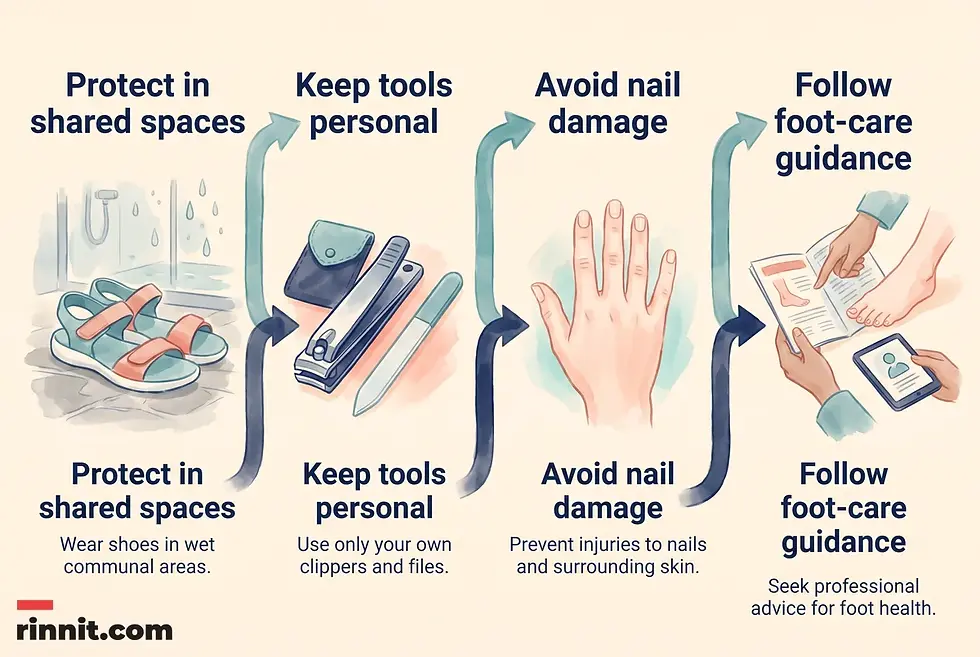
Nail fungus cannot be prevented with certainty, but several habits can reduce exposure and help protect nails and surrounding skin.
Prevention step | Practical meaning |
Wear shoes in shared wet spaces | Use footwear in locker rooms and communal areas; if someone in the household has nail fungus, wear shoes in the shared bathroom. |
Do not share nail tools | Keep clippers, trimmers and other nail-care items personal. |
Sanitize tools | Clean and sanitize clippers or trimmers before use. |
Choose disposable emery boards | Avoid reusing nail files when possible. |
Protect the nail | Do not tear or rip nails. |
Wear properly fitting shoes | Reduce pressure, friction and nail damage. |
Follow diabetes foot-care guidance | Follow the plan from the healthcare provider and attend annual foot exams if recommended. |
How do nail hygiene and stigma relate to nail fungus?
People sometimes assume that nail fungus reflects poor hygiene. That is not accurate: people can develop nail fungus even with excellent hygiene. A supportive approach avoids blame and focuses on testing, treatment adherence, nail protection and reducing exposure. Visible nail changes can affect confidence and activities, so emotional distress is also worth mentioning to a healthcare provider. [1]
When should I see a healthcare provider?
Arrange a medical evaluation for persistent nail discoloration, thickening, cracking, crumbling, misshaping or separation from the nail bed. Pain or signs of infection also warrant evaluation. Earlier assessment can improve the chance of an appropriate diagnosis and treatment plan. This is particularly important for people with diabetes, weakened immunity, peripheral artery disease or chronic venous insufficiency.
When is nail fungus more urgent?
Contact a healthcare provider promptly if nail changes occur with increasing pain, spreading redness, warmth, swelling, drainage or other signs of infection in nearby skin. People with diabetes, weakened immunity or circulation disease should follow their provider's foot-care instructions and seek care promptly for new or worsening foot or nail problems.
If you have severe pain, rapidly spreading redness or swelling, fever, confusion or feel seriously unwell, seek urgent medical attention.
What should you record before a nail fungus appointment?
A short record can help the clinician understand the pattern.
Track | Example information |
Nail changes | Color, cloudiness, spots, thickening, cracking, crumbling, misshaping or separation. |
Timing | When the change began and whether it is spreading. |
Pain | Whether pain is absent, intermittent or increasing. |
Other nails | Whether fingernails, toenails or multiple nails are involved. |
Skin symptoms | Athlete's foot, redness, warmth, swelling, drainage or tenderness. |
Exposure | Shared locker rooms, communal bathrooms, frequent swimming or household contact. |
Health history | Diabetes, weakened immunity, psoriasis, hyperhidrosis or circulation disease. |
Nail care | Recent injury, manicure, pedicure, clipping or filing. |
Medicines | Current medicines and supplements. |
Bring questions about whether laboratory testing is needed, which treatment categories fit the confirmed diagnosis, how long treatment may take and how recurrence risk can be reduced.
Conclusion: confirm the cause, then protect the nail
Onychomycosis can change nail color, texture and shape. Affected nails may become cloudy, yellowish, brownish, cracked, crumbly, thick or separated from the nail bed. Pain is not usually an initial symptom, but it can develop as a complication.
Because several nail conditions can look alike, laboratory testing is essential for confirmation. Treatment may involve oral or topical medicines, a nail procedure or another clinician-directed approach. Treatment can last months, and visible nail recovery may take several months or up to a year. If a nail change is persistent, worsening, painful or associated with surrounding skin symptoms, arrange an evaluation with a qualified healthcare provider.
Frequently Asked Questions
What is onychomycosis?
Onychomycosis is a fungal infection of a toenail or fingernail. It commonly causes nail dystrophy, including color, texture and shape changes.
What are the first signs of nail fungus?
Possible signs include a cloudy or spotty whitish, yellowish or brownish nail, cracking, crumbling, flaking, thickening, misshaping or separation from the nail bed.
Is nail fungus painful?
Pain is not usually a symptom at first, but it can develop as a complication. Persistent or increasing pain should be evaluated.
Can nail fungus affect fingernails?
Yes. Nail fungus can affect fingernails or toenails. Yeasts are uncommon causes overall but are more likely to affect fingernails when they occur.
Is nail fungus caused by poor hygiene?
No. People can develop nail fungus even with excellent hygiene. Exposure, moisture, nail damage, health conditions and other factors can contribute.
What causes nail fungus?
Dermatophytes, molds and yeasts can cause nail infections. Dermatophytes are the most common group, molds account for about one in ten cases and yeasts are uncommon.
Can athlete's foot lead to nail fungus?
Athlete's foot is listed as a risk factor for nail fungus. A healthcare provider can assess both the skin and nails.
Does diabetes make nail fungus more serious?
Diabetes is associated with higher concern because it can affect immunity and circulation, and nearby tissue infections may be more serious. People with diabetes should follow their provider's foot-care instructions.
How is nail fungus confirmed?
A healthcare provider examines the nail and asks about the changes, but laboratory testing is essential for confirmation and for identifying the fungus. Testing may include microscopy with immunostaining, PCR, ELISA testing or fungal culture.
Why can't a clinician diagnose nail fungus by appearance alone?
Other conditions can cause similar nail dystrophy. Testing helps determine whether fungus is present before a months-long treatment plan is chosen.
What treatments are available for nail fungus?
Treatment may include oral systemic medicine, topical medicine, removal of the affected nail in severe cases, or laser, chemical or other approaches. A combination approach may be used.
How long does nail fungus treatment take?
Treatment commonly lasts for months. Visible recovery may take several months or up to a year because healthy nail must grow in and replace the affected tissue.
Will my nail look normal after treatment?
Not always. The nail may not fully return to its former appearance if the nail bed or nail matrix was changed.
Can nail fungus come back?
Yes. Recurrence is common. A healthcare provider can advise on ways to reduce risk and what to expect.
How can I prevent nail fungus?
Wear shoes in shared wet areas, do not share nail tools, sanitize clippers and trimmers, use disposable emery boards, avoid tearing or ripping nails, wear properly fitting shoes and follow clinician-directed foot care if you have diabetes.
When should I see a doctor about nail changes?
Seek evaluation for persistent discoloration, thickening, cracking, crumbling, misshaping, separation from the nail bed, pain or signs of infection. Seek prompt care for increasing pain, spreading redness, warmth, swelling or drainage, particularly with diabetes, weakened immunity or circulation disease.
Can nail fungus spread to other nails or the skin?
Yes. Spread to other nails or parts of the body is a possible complication, as is cellulitis in the surrounding tissue.
Related reading
References
Cleveland Clinic. Onychomycosis (Toenail/Nail Fungus) Causes & Treatment. Cleveland Clinic. Updated May 12, 2026. https://my.clevelandclinic.org/health/diseases/onychomyscosis-nail-fungus
Gupta AK, Foley KA, Mays RR, et al. Monotherapy for toenail onychomycosis: a systematic review and network meta-analysis. Br J Dermatol. 2020;182(2):287-299. PMID 31120134. https://doi.org/10.1111/bjd.18155
Navarro-Pérez D, Tardáguila-García A, García-Oreja S, et al. Onychomycosis associated with diabetic foot syndrome: A systematic review. Mycoses. 2023;66(6):459-466. PMID 36790078. https://doi.org/10.1111/myc.13577
Klaassen KM, Dulak MG, van de Kerkhof PC, et al. The prevalence of onychomycosis in psoriatic patients: a systematic review. J Eur Acad Dermatol Venereol. 2014;28(5):533-541. PMID 24033871. https://doi.org/10.1111/jdv.12239
Disclaimer
This article is for general educational purposes and is not a substitute for professional medical advice, diagnosis or treatment. Always seek the advice of a qualified healthcare professional with any questions about a medical condition or treatment.



Comments