Hyperhidrosis: Symptoms, Causes & Treatment — A Complete Guide

Updated: 2 days ago
Medically reviewed by Dr. Baraa Alnahhal, MD · Last reviewed: September 2026

What Is Hyperhidrosis?
Hyperhidrosis (pronounced hi-pur-hi-DROE-sis) is excessive sweating that is not always related to heat or exercise. People with the condition may sweat so heavily that it soaks through clothing or drips off their hands.
Heavy sweating can disrupt daily life. It is a common cause of social anxiety and embarrassment, and some people begin avoiding activities because of it.
The encouraging news is that treatment usually helps. Care often begins with antiperspirants. If those are not enough, other medications and therapies are available, and surgery is an option in severe cases.
Sometimes the sweating points to an underlying medical condition. When that is the case, finding and treating the root cause can resolve the problem.
What Does Hyperhidrosis Look Like?
The main symptom is heavy sweating that goes beyond normal sweating from a hot environment, exercise, or anxiety.
The form that typically affects the hands, feet, underarms, or face causes at least one heavy-sweating episode a week while you are awake. The sweating usually happens on both sides of the body.
Sweat does not happen only when you are hot. The nervous system automatically triggers sweat glands when body temperature rises, and it also triggers sweating — especially on the palms — when you feel nervous. In hyperhidrosis, those signals fire too often or too strongly.
Sweat volume: Soaks through clothes; drips from hands.
Timing: At least one heavy episode per week while awake.
Pattern: Usually occurs on both sides of the body.
Trigger mismatch: Happens without heat, exercise, or stress.
Emotional impact: Embarrassment, social anxiety, activity avoidance.
When Sweating Becomes an Emergency
Excessive sweating is usually not dangerous by itself, but it can be the first sign of a serious problem.
Seek immediate medical attention if you have heavy sweating along with dizziness, pain in the chest, throat, jaw, arms, or shoulders, or if your skin feels cold with a rapid pulse.
This combination can signal a heart emergency such as a heart attack. Do not wait and see — call 911.
Heavy sweating + chest pain: Possible heart attack — call 911.
Heavy sweating + jaw, arm, or shoulder pain: Possible heart attack — call 911.
Heavy sweating + dizziness: Circulation or heart problem — urgent care.
Cold, clammy skin + rapid pulse: Shock or cardiac emergency — call 911.
When to schedule a doctor's visit
Even without an emergency, arrange an appointment if any of the following applies to you: sweating disrupts your daily routine, sweating causes emotional distress or social withdrawal, you suddenly begin to sweat more than usual, or you experience night sweats for no apparent reason.

What Causes Hyperhidrosis?
Sweating is your body's built-in cooling system. Two kinds of sweat glands are involved in how the skin produces sweat.
Eccrine glands: Open directly onto the skin surface; grow over most of the body; the main glands involved in hyperhidrosis.
Apocrine glands: Open into hair follicles; grow on the scalp, armpits, and groin; may also play a role.
The key insight: the glands themselves are often normal. The problem is usually the nervous system signaling that drives them.
Primary hyperhidrosis
Primary hyperhidrosis is caused by faulty nerve signals that trigger the eccrine sweat glands to become overactive. It usually affects the palms, soles, underarms, and sometimes the face.
There is no underlying medical cause for this type. It can run in families.
Secondary hyperhidrosis
Secondary hyperhidrosis is caused by an underlying medical condition or by certain medications. This type may cause sweating all over the body rather than in isolated spots.
Common triggers include the medications and conditions listed below.
Medical conditions: Diabetes; thyroid problems; menopause hot flashes; some types of cancer; nervous system disorders; infections.
Medications: Pain relievers; antidepressants; some diabetes medications; some hormonal medications.
If your sweating is new, generalized, or began alongside other symptoms, finding and treating the underlying cause is the first step.
What Raises Your Risk?
Three factors make hyperhidrosis more likely.
Family history: A parent, sibling, or grandparent who sweats heavily.
Medications or supplements: Drugs known to cause sweating as a side effect.
Underlying medical condition: Any condition whose symptoms include sweating.
It is worth stating plainly: hyperhidrosis is not contagious and it is not a hygiene problem. People with the condition cannot catch it from anyone, and no amount of cleanliness changes the nerve signaling behind it.
What Problems Can It Cause?
Untreated hyperhidrosis does more than leave stains. It can lead to real medical and emotional complications.
Skin infections: Constantly damp skin is more prone to infection.
Emotional distress: Clammy or dripping hands and sweat-soaked clothes cause embarrassment.
Social withdrawal: People avoid handshakes, social events, and activities.
Life impact: The condition can interfere with work and educational goals.
If sweating is changing how you live — not just what you wear — that is exactly the moment to seek treatment.
How Is Hyperhidrosis Diagnosed?
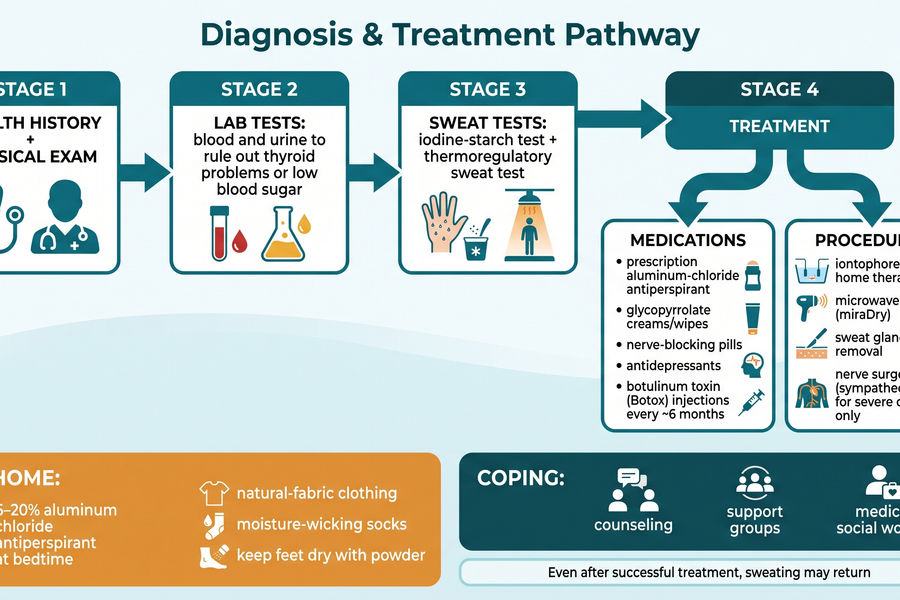
Diagnosis usually begins with a review of your medical history and symptoms, plus a physical exam. The provider's main job is to determine whether a treatable underlying condition is driving the sweating.
Blood and urine labs: Check whether another condition (such as hyperthyroidism or low blood sugar) is causing the sweating.
Iodine-starch test: Pinpoints the exact areas of heavy sweating.
Thermoregulatory sweat test: Evaluates how severe the sweating is across the body using moisture-sensitive powder.
If you sweat heavily at night, or the sweating is sudden and whole-body, expect a more thorough workup — those patterns point toward secondary hyperhidrosis and deserve investigation.
What Treatment Options Actually Help?
Treatment may start by addressing the condition causing the sweating. If no cause is found, care focuses on controlling the heavy sweating.
One important expectation to set: even when treatment improves sweating, it can recur.
Prescription antiperspirant
A prescription antiperspirant containing aluminum chloride (such as Drysol or Xerac AC) is often the first treatment tried. It temporarily blocks sweat pores.
How to use it: apply to dry skin before going to bed; wash it off when you wake up, avoiding contact with the eyes; use it daily for a few days until results appear; then scale back to once or twice a week to maintain the effect.
It can cause skin and eye irritation, so a concentration of 6% to 20% aluminum chloride is used, and a provider can suggest ways to reduce side effects. This approach may be enough for minor hyperhidrosis.
Creams, wipes, and pills
Glycopyrrolate creams: Best for face and head sweating; possible mild skin irritation, dry mouth.
Glycopyrronium tosylate wipes (Qbrexza): Best for hands, feet, underarms; mild skin irritation and dry mouth possible.
Nerve-blocking pills: Best for sweating driven by overactive nerve signals; may cause dry mouth, blurred vision, bladder problems.
Antidepressants: Best for sweating plus anxiety; some antidepressants reduce both sweating and anxiety.
Botulinum toxin injections
Botulinum toxin (Botox) injections block the nerves that trigger the sweat glands. Most people feel little pain during the procedure, though the skin can be numbed beforehand with topical anesthesia, ice, or massage.
Each affected area needs several injections, and results may take a few days to appear. To keep the effect, repeat treatments about every six months are usually needed. A possible side effect is short-term muscle weakness in the treated area.
Iontophoresis (home water-and-current therapy)
Iontophoresis is a home treatment for hands and feet. You soak the affected areas in a pan of water while a device passes a mild electric current through the water, blocking the nerves that trigger sweating. The device can be purchased with a prescription.
Typical routine: soak for 20 to 40 minutes per session, repeat 2 to 3 times a week until symptoms improve, then reduce to once a week or once a month to maintain results.
Microwave therapy
A handheld device (miraDry) delivers microwave energy to destroy sweat glands in the armpits. Treatment involves two sessions of 20 to 30 minutes, spaced three months apart. Possible side effects include changed skin sensation and some discomfort; long-term side effects are still unknown.
Sweat gland removal
If heavy sweating is limited to the armpits, a provider may suggest removing the sweat glands directly. This can be done by scraping them away (curettage), suctioning them out (liposuction), or combining both techniques (suction curettage).
Nerve surgery (sympathectomy)
Nerve surgery is a last-resort option. During a sympathectomy, the surgeon removes a small section of the spinal nerves that control sweating in the hands.
Major risk: Permanent heavy sweating in other body areas (compensatory sweating).
Not suitable for: Isolated head and neck sweating.
Alternative: Sympathotomy — interrupts nerve signals without removing the nerve; treats the palms with lower compensatory-sweating risk.
Candidacy: Usually only after many other treatments have failed.
Procedures may be performed under general anesthesia or local anesthesia with sedation.
What Can You Do at Home?
Four lifestyle habits can help control sweating and body odor between medical treatments.
Over-the-counter antiperspirant (6–20% aluminum chloride): Temporarily blocks sweat pores, reducing sweat that reaches the skin.
Natural-material shoes and socks: Leather shoes let feet breathe; moisture-wicking athletic socks handle activity.
Keep feet dry: Change socks one or two times a day, dry feet each time, use insoles and foot powder, wear sandals when possible.
Activity-appropriate clothing: Cotton, wool, and silk let skin breathe; moisture-wicking fabrics suit intense activity.
How Do People Cope Emotionally?
The emotional weight of hyperhidrosis is real and deserves care of its own.
Wet hands and feet, sweat stains on clothing, and strangers' reactions can make people anxious, self-conscious, and withdrawn. The condition can interfere with work, recreation, and personal goals.
Talking helps. Your health care provider, a counselor, or a medical social worker can support you, and many people find it valuable to talk with others who have hyperhidrosis.
Preparing for Your Appointment
You will likely start with your primary care provider. From there, you may be referred to a dermatologist (a specialist in hair and skin conditions). If treatment is not working, referrals to a neurologist (nervous system specialist) or a surgeon may follow.
Before the visit, write down answers to these questions: Has anyone in your immediate family ever had similar symptoms? Does your sweating stop when you are asleep? What medications and supplements do you take regularly? Have your symptoms caused you to avoid social situations or activities?
Expect your provider to ask about timing and patterns: When did the heavy sweating begin? Where on your body does it occur? Have your symptoms been continuous or occasional? What seems to improve your symptoms? What appears to worsen your symptoms?
Conclusion: Heavy Sweating Is Treatable
Hyperhidrosis is more than an inconvenience. It is a medical condition with real physical and emotional costs — and real solutions.
Most people find meaningful relief starting with a prescription antiperspirant. When that is not enough, topical medicines, pills, botulinum toxin injections, iontophoresis, and specialized procedures offer a progression of options, with surgery reserved for the most severe cases.
If your sweating disrupts your routine, causes distress, appears suddenly, or wakes you up at night, make an appointment. If it arrives alongside chest pain, dizziness, or a rapid pulse, treat it as an emergency and call 911.
Talk to your doctor about hyperhidrosis today — you do not have to sweat through life.
Frequently Asked Questions
Can hyperhidrosis go away on its own?
Hyperhidrosis often persists without treatment, and even after successful treatment sweating may return. However, treating an underlying condition (such as a thyroid problem) can resolve secondary hyperhidrosis.
Is hyperhidrosis a sign of a serious disease?
Usually not — most cases are primary hyperhidrosis with no medical cause. But sudden, whole-body, or nighttime sweating can signal conditions such as thyroid problems, diabetes, infections, or some cancers, which is why a medical evaluation matters.
What is the difference between primary and secondary hyperhidrosis?
Primary hyperhidrosis has no underlying medical cause — faulty nerve signals over-activate sweat glands, often on both sides of the body in the palms, soles, underarms, or face. Secondary hyperhidrosis is caused by a medical condition or medication and often involves sweating all over.
Is hyperhidrosis inherited?
Primary hyperhidrosis can run in families. Having a parent, sibling, or grandparent who sweats heavily is a known risk factor.
What is the first treatment for hyperhidrosis?
Treatment usually begins with a prescription antiperspirant containing 6% to 20% aluminum chloride, applied to dry skin at bedtime and washed off in the morning.
How often do Botox injections for sweating need to be repeated?
Results from botulinum toxin injections typically last about six months, after which repeat treatments are needed to maintain the effect.
Is sweat gland surgery worth it?
Surgery is generally reserved for severe cases that have not responded to other treatments, because it carries risks — most notably permanent compensatory sweating in other body areas.
Why should I be concerned about sweating at night?
Night sweats for no apparent reason can indicate an underlying medical condition. They are one of the four situations where a doctor's evaluation is recommended.
Can anxiety cause hyperhidrosis?
Anxiety triggers normal sweating, especially on the palms, but hyperhidrosis itself is caused by overactive nerve signals, not anxiety. That said, some antidepressants can reduce both sweating and anxiety, and the condition frequently causes social anxiety of its own.
References
Health information, not medical advice. This article is for general education and is not a substitute for professional diagnosis or treatment. Always consult a qualified healthcare provider about your own health, and seek emergency care for urgent symptoms.
Comments