Stellate Ganglion Block: Uses, Procedure and Side Effects

Updated: 2 days ago
Written and medically reviewed by Dr. Baraa Alnahhal, MD · Last reviewed: November 2026 · How we review
Quick Answer
A stellate ganglion block (SGB) is an injection of numbing medicine into the stellate ganglion, a bundle of nerves in the neck that controls sympathetic nerve signals. It relieves pain such as complex regional pain syndrome and is used off-label for PTSD. Relief may last hours to weeks, and many people need a series of injections.
What the research says
SGB eased PTSD symptoms: in a sham-controlled trial of 113 service members, two stellate ganglion blocks 2 weeks apart cut PTSD symptom scores by 12.6 points versus 6.1 points with a sham procedure over 8 weeks (Rae Olmsted KL et al., JAMA Psychiatry, 2020) [2]
SGB helped calm dangerous heart rhythms: in 15 observational studies of 542 people with electrical storm, stellate ganglion block cut treated arrhythmia episodes from a median of 3.5 to 0 and fully resolved the storm in 64.6% (Motazedian P et al., Scientific Reports, 2024) [3]
Key takeaways
An SGB injects numbing medicine into nerves in the neck.
It treats pain in the head, neck, arms and upper chest.
It's also used for sweating, Raynaud's and off-label for PTSD.
The injection takes less than 30 minutes.
A series of injections is often needed.
What is a stellate ganglion block?
The stellate ganglion sits on both sides of your voice box, near your first ribs. "Stellate" means star. Only about 80% of people have a stellate ganglion; in others, the nerve bundles don't fuse. Blocking it can also help diagnose pain that comes from sympathetic nerves. Sources: [1]
What it treats

It can also improve blood flow to the arm.
Shingles nerve pain and chronic pain after surgery.
Raynaud's syndrome and peripheral artery disease.
Cluster headaches, chest pain and some heart rhythm problems. Sources: [1]
SGB for PTSD
Research on SGB for PTSD dates back to 1990, with mixed results. It isn't FDA-approved for PTSD, but providers may use it off-label when other treatments haven't worked. It may work by lowering stress-related nerve activity. Sources: [1, 2]
How to prepare
Arrange for someone to drive you home.
You may get IV medicine to help you relax. Sources: [1]
What happens during the injection
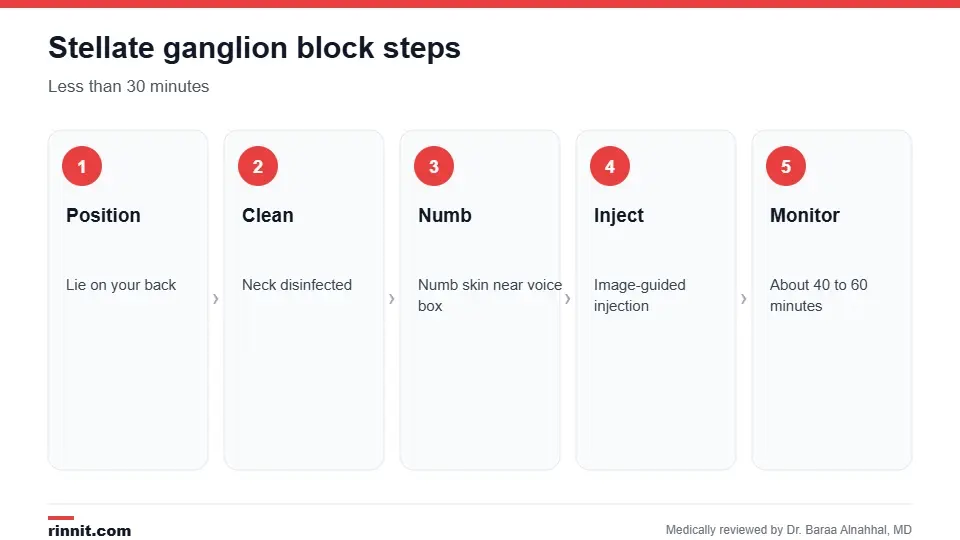
You'll be monitored for about 40 to 60 minutes afterward.
You lie on your back on a procedure table.
Your neck is cleaned and disinfected.
A thin needle numbs the skin near your voice box.
Using ultrasound or X-ray, a second needle injects numbing medicine near the stellate ganglion. Sources: [1]
The procedure usually takes less than 30 minutes. Sources: [1]
Side effects
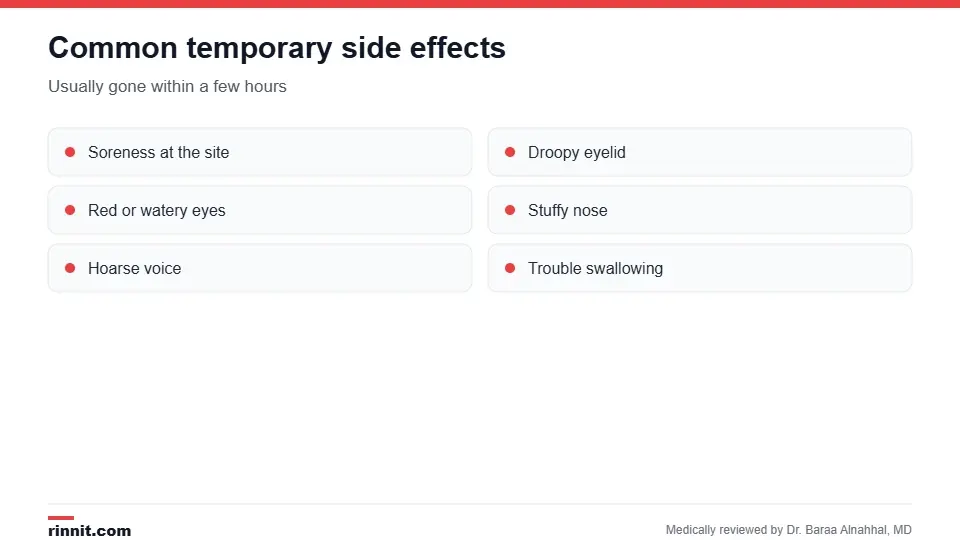
These usually go away within a few hours.
Type | Examples |
Common, temporary | Soreness, droopy eyelid, red or watery eyes, stuffy nose, hoarse voice, lump-in-throat feeling, trouble swallowing, warm or tingly arm |
Rare but serious | Infection, bleeding, nerve damage, collapsed lung, injury to the thyroid, esophagus or windpipe |
Common side effects usually go away within a few hours. A temporary Horner syndrome can also happen. Sources: [1]
After the injection
You'll be monitored for about 40 to 60 minutes, then go home with a driver. Sources: [1]
Results
Relief may start right away but can fade within a few hours. Some people get relief for days or weeks, which can reduce the need for medicine and make physical therapy easier. You may need a series of injections, from two to more than 10, and relief tends to last longer with each one. Sources: [1, 3]
When to call your provider
Call 911 for trouble breathing, growing neck swelling, chest pain or a seizure.
Don't eat or drink until swallowing feels normal.
Any new symptoms or complications.
Signs of infection.
Trouble swallowing that doesn't go away. Sources: [1]
Conclusion
A stellate ganglion block can ease stubborn pain and other conditions by calming overactive nerves in the neck. Results vary, so a series of injections and close follow-up help you find out how well it works for you.
Keep learning: read about CRPS and hyperhidrosis.
Frequently asked questions
What is a stellate ganglion block?
An injection of numbing medicine into nerves in the neck.
What does a stellate ganglion block treat?
Pain in the head, neck, arms and chest, plus sweating, Raynaud's and more.
Is SGB approved for PTSD?
No. It's used off-label when other treatments haven't worked.
Does the injection hurt?
Your skin is numbed first.
How long does it take?
Less than 30 minutes.
How long does relief last?
From hours to days or weeks.
How many injections will I need?
Often a series, from two to more than 10.
Why does my eyelid droop afterward?
It's a common, temporary side effect.
Can I drive home?
No. You'll need a driver.
Are there serious risks?
Rarely, infection, bleeding or nerve damage.
Related Reading
What Is Complex Regional Pain Syndrome (CRPS)? Symptoms, Causes, Diagnosis, Treatment & Outlook a common reason for SGB.
Understanding Phantom Limb Pain: Causes, Symptoms, and Management pain after amputation.
Hyperhidrosis: Symptoms, Causes & Treatment — A Complete Guide excessive sweating.
Horner Syndrome: Symptoms, Causes, and How It Is Diagnosed a temporary side effect of SGB.
Complex PTSD (C-PTSD): Symptoms, Causes, and Treatment Guide PTSD and its treatment.
References
Cleveland Clinic. Stellate Ganglion Block: What It Is, Uses, Side Effects & Risks. Cleveland Clinic. Last updated February 21, 2023. https://my.clevelandclinic.org/health/treatments/17507-stellate-ganglion-block
Rae Olmsted KL, Bartoszek M, Mulvaney S, et al. Effect of stellate ganglion block treatment on posttraumatic stress disorder symptoms: a randomized clinical trial. JAMA Psychiatry. 2020;77(2):130-138. PMID 31693083. https://doi.org/10.1001/jamapsychiatry.2019.3474
Motazedian P, Quinn N, Wells GA, et al. Efficacy of stellate ganglion block in treatment of electrical storm: a systematic review and meta-analysis. Sci Rep. 2024;14(1):24719. PMID 39433834. https://doi.org/10.1038/s41598-024-76663-9
Medical disclaimer
This article is for general education only and does not replace advice from a qualified healthcare professional. Talk to your doctor about your own diagnosis and treatment, and seek emergency care right away for severe or sudden symptoms.



Comments