Nipple Shields: When and How to Use Them

Updated: 2 days ago
Written and medically reviewed by Dr. Baraa Alnahhal, MD · Last reviewed: November 2026 · How we review
Quick Answer
A nipple shield is a flexible silicone cover worn over the nipple during breastfeeding to help a baby latch. It may help with flat or inverted nipples or sore, cracked nipples from a poor latch. Downsides include lower milk transfer and slower weight gain, so use it only with a lactation provider's guidance and for a short time.
What the research says
Shields helped mothers with nipple pain: in a study of 48 breastfeeding pairs, a shield cut nipple pain by about 25% without reducing milk transfer in mothers with pain, but halved milk transfer in pairs without breastfeeding problems (Coentro VS et al., European Journal of Pediatrics, 2021) [2]
Shield use was linked to less exclusive breastfeeding: in a Danish study of 1,407 preterm babies, 54% of mother-baby pairs used a nipple shield, and shield use was linked to lower rates of exclusive breastfeeding at hospital discharge (Maastrup R et al., PLOS ONE, 2019) [3]
Key takeaways
A nipple shield is a silicone cover that helps a baby latch.
It may help with flat nipples, sore nipples or moving from bottle to breast.
It can lower milk transfer and slow weight gain.
Use it only with a lactation provider's advice.
Plan to wean off it as soon as possible.
What is a nipple shield?
A nipple shield acts like a longer, firmer nipple that's easier for a baby to grasp. Some have a cutout so more of your skin touches your baby. It's meant to be a temporary tool while your baby learns to nurse directly from the breast. Sources: [1]
When it may help

It's usually not helpful for tongue-tie, low milk supply or mastitis.
A baby who needs more stimulation to start sucking.
Sore or cracked nipples from a poor latch, to allow healing.
Moving a baby from bottle to breast. Sources: [1]
It isn't usually effective for premature babies, tongue-tie, low milk supply or mastitis. If engorgement makes your nipples look flat, try gently pressing around the areola first. Sources: [1]
How to use one

Your nipple should fit in the cone without touching the sides.
Choose the right size; your nipple should fit inside the cone without rubbing the sides.
Flip the shield halfway inside out, leaving a small dimple.
Place your nipple in the dimple and stretch the base over your areola.
Dab water or nipple cream around the edge to help it stick.
Check that your baby's lips are wide around the base, not just the tip. Sources: [1]
Cleaning
Boil it for 15 minutes before the first use.
Wash it in hot, soapy water after each use, or on the top rack of a hot dishwasher.
Let it dry completely. Sources: [1]
Signs it's working
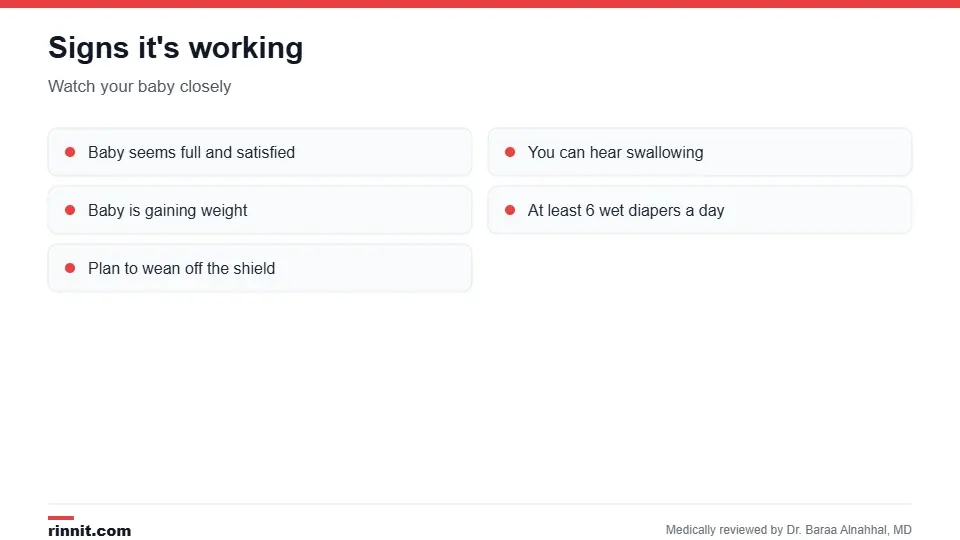
Your provider may suggest pumping after feeds.
Your baby seems full and satisfied after feeding.
You can hear your baby swallowing.
Your baby is gaining weight.
Your baby has at least 6 wet diapers a day. Sources: [1]
Risks
Risk | Notes |
Less milk transfer | Can slow weight gain and lower your supply |
Dependence | Some babies have trouble weaning off |
Less skin-to-skin contact | A cutout design may help |
Pumping after nursing may help protect your milk supply. Providers usually recommend shields only when needed, since the drawbacks often outweigh the benefits. Sources: [1, 2, 3]
Weaning off the shield
Make a weaning plan with your lactation provider from the start.
Try nursing without it when your baby is calm or sleepy.
Pump until your milk lets down before latching.
Offer skin-to-skin time.
Nurse before your baby gets too hungry.
Remove the shield partway through a feed. Sources: [1]
When to call your provider
Pain while nursing, or cracked, sore or bleeding nipples.
Your baby is fussy, refuses to latch or has a shallow latch.
Your baby has fewer than 6 wet diapers in a day.
Questions about using or weaning from a shield. Sources: [1]
Conclusion
A nipple shield can be a helpful short-term bridge when latching is hard, but it works best with close guidance from a lactation provider. Watching your baby's diapers and weight and planning to wean early help protect breastfeeding.
Keep learning: read about flat or inverted nipples and cracked nipples.
Frequently asked questions
What is a nipple shield?
A thin silicone cover worn over the nipple to help a baby latch.
When should I use a nipple shield?
For latch problems such as flat nipples, only with a provider's advice.
Does a nipple shield reduce milk supply?
It can lower milk transfer, so pumping may be recommended.
How do I know what size to get?
Your nipple should fit inside the cone without touching the sides.
How do I clean a nipple shield?
Boil it before first use, then wash it in hot, soapy water after each use.
How long should I use a nipple shield?
As briefly as possible, with a plan to wean off it.
Can a nipple shield help sore nipples?
It may help them heal if the baby latches correctly.
Does it help with tongue-tie?
Usually not.
How do I know my baby is getting enough milk?
Look for swallowing, weight gain and at least 6 wet diapers a day.
How do I stop using a nipple shield?
Remove it gradually, often when your baby is calm or sleepy.
Related Reading
Flat and Inverted Nipples: Causes, Breastfeeding, and Care a common reason for nipple shields.
Cracked Nipples (Nipple Fissures): Symptoms, Causes, Treatment and Healing — What You Need to Know nipple pain from a poor latch.
Frenotomy (Infant Tongue-Tie Procedure) a treatment for tongue-tie.
Mastitis: Symptoms, Causes, and Treatment breast infection during breastfeeding.
Managing Hyperlactation Syndrome: Symptoms, Causes, and Solutions making too much breast milk.
References
Cleveland Clinic. Nipple Shields: When & How To Use Them. Cleveland Clinic. Last updated March 13, 2024. https://my.clevelandclinic.org/health/treatments/22130-nipple-shield
Coentro VS, Perrella SL, Lai CT, et al. Nipple shield use does not impact sucking dynamics in breastfeeding infants of mothers with nipple pain. European Journal of Pediatrics. 2021;180(5):1537-1543. PMID 33443588. https://doi.org/10.1007/s00431-020-03901-3
Maastrup R, Walloee S, Kronborg H. Nipple shield use in preterm infants: prevalence, motives for use and association with exclusive breastfeeding: results from a national cohort study. PLOS ONE. 2019;14(9):e0222811. PMID 31539900. https://doi.org/10.1371/journal.pone.0222811
Medical disclaimer
This article is for general education only and does not replace advice from a qualified healthcare professional. Talk to your doctor about your own diagnosis and treatment, and seek emergency care right away for severe or sudden symptoms.



Comments