Flat and Inverted Nipples: Causes, Breastfeeding, and Care

Updated: 3 days ago
Medically reviewed by Dr. Baraa Alnahhal, MD · Last reviewed: October 2026
Source currency note: This guide reflects medical information reviewed in July 2023. Always confirm current guidance with your healthcare professional.
Quick Answer: What are flat and inverted nipples?
Flat and inverted nipples are usually harmless variations of breast anatomy; flat nipples lie even with the breast, while inverted nipples point inward. About 10% to 20% of people have them, mostly from birth. Sudden inversion or change can signal infection or breast cancer, so tell a provider. Breastfeeding is still possible with techniques and support. [4]
What the research says
Retracted nipples make early direct breastfeeding harder, but most mothers can still breastfeed exclusively with support. In a prospective study, 12.5% of 439 mothers (55) had retracted nipples. Compared with 47 matched mothers without nipple deformity, they had lower LATCH scores (6.6 vs 8.5) and lower direct breastfeeding rates (53.2% vs 89.4%) in the first days after birth, but similar exclusive breastfeeding rates and breastfeeding problems once they had lactation support (Yadav et al., Breastfeeding Medicine, 2025).
A breast pump worked about as well as a syringe technique to draw out inverted nipples. In a randomized trial of 60 mothers with inverted nipples, breastfeeding was established by day 3 in 60% of the syringe group and 56.7% of the electric breast pump group (no significant difference). By day 3, 28 of 30 mothers in the pump group had no or mild pain, compared with 22 of 30 in the syringe group (Chowdhry et al., Cureus, 2024).
Paget's disease of the breast is easy to miss. A systematic review of 32 cases found every one was first misdiagnosed, most often as melanoma (44.4%) or atopic dermatitis (25.0%), with an average diagnostic delay of 2.3 years. Most cases were on one side only (93.8%), which is why a one-sided nipple or skin change that does not clear up should be checked with a biopsy (Volfson et al., Journal of Cutaneous Medicine and Surgery, 2025).
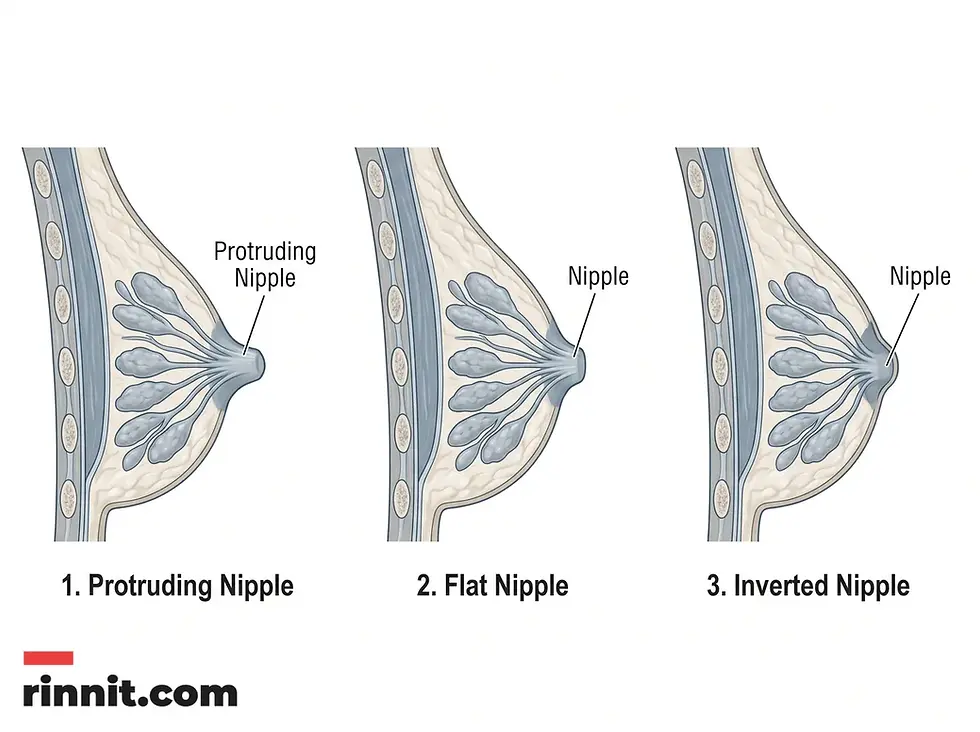
Understanding Nipple Anatomy
Breast anatomy varies significantly from person to person, and nipples are no exception. There are three main ways a nipple can look in relation to the surrounding breast tissue.
Nipple type | Description |
Protruding | The nipple sticks out clearly from the surrounding breast tissue |
Flat | The nipple sits even and flush with the surrounding areola |
Inverted | The nipple pulls inward, appearing tucked inside the breast tissue |
For most people, flat or inverted nipples are a natural part of healthy anatomy. These variations affect about 10% to 20% of the general population and are typically present from birth, because of how the nipple base and milk ducts developed before birth.
Causes of Flat and Inverted Nipples
Most cases are present from birth, but several factors can cause a nipple to flatten or invert later in life.
Natural and benign causes
Fetal development: a small nipple base or milk ducts that did not fully form before birth.
Age-related changes: leading up to menopause, the milk ducts may shorten and pull the nipple inward or make it lay flat.
Pregnancy and breast engorgement: as the breasts fill with milk, the nipples may flatten or look inverted. This usually resolves once the swelling goes down.
Breast injuries: scarring from breast surgery or breastfeeding can change the nipple's tissue.
Medical conditions that need attention
Infections: an abscess or mammary duct ectasia (clogged milk ducts) can lead to flat or inverted nipples.
Benign breast disease: flat or inverted nipples are a common symptom of this noncancerous condition, which causes breast lumps.
Breast cancer: a tumor that invades a milk duct can cause a nipple to flatten or invert.
Paget's disease of the breast: a rare type of breast cancer that develops in the skin of the nipple. It is sometimes mistaken for eczema and can cause a rash, inflammation, or a flat or inverted nipple.
Breastfeeding With Flat or Inverted Nipples
A main concern for many people with flat or inverted nipples is breastfeeding. It can be more challenging for a baby to latch at first, but successful breastfeeding is possible. Your baby is often the best tool to draw the nipple out, and getting a deeper latch onto the areola, not only the nipple, can often solve these problems.
Latching techniques
Hoffman technique: place your thumbs on either side of the nipple, then press down while pulling your thumbs apart to encourage the nipple to pop up so your baby can latch.
Manual stimulation: gently roll the nipple between your thumb and forefinger, or apply something cold, to encourage it outward.
Positioning: feeding in the side-lying position (you and your baby lie facing each other) can make latching easier.
Support tools
Suction devices: an inverted nipple corrector or a breast pump can be used before a feeding to draw the nipple out.
Nipple shields: thin silicone covers that can help your baby latch. If other methods do not work, a lactation consultant may recommend them, so talk through the pros and cons with your healthcare provider first.
Tool or technique | Purpose |
Hoffman technique | Manual stimulation to coax the nipple outward |
Breast pump | Uses suction to draw the nipple out before feeding |
Nipple shield | Gives the baby a firm surface to latch onto |

Diagnosis and Clinical Care
If you notice a sudden change in your nipples, see a healthcare provider to rule out an underlying condition.
Diagnostic tests
Physical examination: your provider checks for lumps, skin changes, or unusual discharge.
Imaging: a mammogram, breast ultrasound, or MRI may be used to see the structure inside the breast.
Biopsy: if a suspicious lump is found, a needle biopsy can test for cancer cells.
Treatment options
Flat or inverted nipples do not always need treatment. Treatment is usually needed only if a condition causes the change or you want to change how your nipples look.
Antibiotics: prescribed if an infection is the cause. A provider can also drain or surgically remove an abscess.
Cancer treatment: if breast cancer is the cause, treatment may include surgery, chemotherapy, radiation therapy, or hormone therapy.
Cosmetic surgery: plastic surgery can make the nipples more protruded for people who feel self-conscious about them.

Outlook and Prevention
Most flat or inverted nipples are harmless anatomical variations that do not need prevention or medical treatment. Inverted nipples do not usually go away on their own, but a provider can discuss training techniques such as the Hoffman technique, or surgical options if you are concerned about how they look.
Because most people are born with flat or inverted nipples, there is nothing you can do to prevent them in those cases. Two habits still help protect your breast health:
Don't smoke: most people who have periductal mastitis, a chronic breast infection that can cause nipple inversion, use tobacco products, and not smoking lowers your risk of infection.
Report sudden changes: tell a provider promptly about any sudden change in breast shape, size, or nipple appearance.
Conclusion
Having flat or inverted nipples does not mean anything is wrong with you. Healthy nipples come in many shapes and sizes. What matters is a change: a nipple that suddenly inverts or flattens, especially with a lump, rash, or discharge, deserves a prompt check.
Next step: If your nipples have suddenly changed shape, or you are struggling with breastfeeding, reach out to your healthcare provider or a lactation consultant for guidance, testing, and support.
Frequently Asked Questions
Are inverted nipples normal?
Yes. Inverted and flat nipples are common variations that affect about 10% to 20% of people, and most people are born with them.
Can I breastfeed with flat nipples?
Yes. It may take more practice, but techniques such as manual stimulation and tools such as breast pumps or nipple shields (with a lactation consultant's advice) can help your baby latch.
Should I worry if my nipple suddenly turns inward?
Yes. A sudden change in nipple shape in an adult should be evaluated by a healthcare provider to rule out an infection or breast cancer.
What is the Hoffman technique?
The Hoffman technique is a manual method in which you place your thumbs on either side of the nipple and press down while pulling them apart, to help the nipple protrude so your baby can latch.
Can nipple piercings fix inverted nipples?
Some people use piercings to keep the nipple erect, but this does not work for everyone, can be painful, and can make infections more likely. You should not get your nipples pierced if you plan to breastfeed. Talk with your provider about the risks first.
What causes a nipple to become flat during pregnancy?
As the breasts fill with milk, the nipple may flatten and sit flush with the surrounding tissue. Engorgement can have the same effect and usually resolves once the swelling goes down.
Is surgery the only way to fix inverted nipples?
No. Manual techniques and suction devices can often help, but surgery is an option for people who want a more permanent cosmetic change.
What is Paget's disease of the breast?
Paget's disease of the breast is a rare type of breast cancer that develops in the skin of the nipple. It is sometimes mistaken for eczema and can cause a rash, inflammation, or a flat or inverted nipple.
Do inverted nipples go away on their own?
Usually not. Inverted nipples don't typically go away on their own, but they can often be trained outward with techniques such as the Hoffman technique, or corrected with surgery.
Can smoking cause nipple inversion?
Smoking raises the risk of infections such as periductal mastitis, a chronic breast infection that can cause the milk ducts to scar and the nipple to invert.
Related Reading
Nipple Shields: When and How to Use Them explains when nipple shields help with breastfeeding.
References
Yadav R, Deshwali A, Priyadarshi M, et al. Breastfeeding outcomes in mothers with retracted nipples in the immediate postnatal period: a prospective observational study. Breastfeeding Medicine. 2025. PMID 41027664. https://doi.org/10.1177/15568253251384964
Chowdhry BK, Nair A, Jha S, et al. Breastfeeding success with use of electric breast pump versus inverted syringe technique in lactating women with inverted nipple: open labelled randomized control trial. Cureus. 2024;16(8):e68153. PMID 39347235. https://doi.org/10.7759/cureus.68153
Volfson E, Moshkovich M, Yakubov R, et al. Dermatologic mimickers of Paget's disease of the breast: a systematic review. Journal of Cutaneous Medicine and Surgery. 2025;30(2):125-131. PMID 40814164. https://doi.org/10.1177/12034754251364870
Cleveland Clinic. Flat and inverted nipples. Cleveland Clinic. July 6, 2023. https://my.clevelandclinic.org/health/diseases/25118-flat-and-inverted-nipples
Medical disclaimer
This article was prepared for general information only and is not a substitute for professional medical advice.



Comments