MR-Guided Focused Ultrasound for Tremor: How It Works, Results, and Risks

Updated: 6 days ago
Written and medically reviewed by Dr. Baraa Alnahhal, MD · Last reviewed: October 2026 · How we review
Quick Answer: What is MR-guided focused ultrasound for tremor?
MR-guided focused ultrasound is a no-incision treatment that combines MRI guidance with more than 1,000 focused ultrasound beams to create a tiny heat lesion in the thalamus, easing tremor. It is approved for medication-resistant essential tremor and tremor-dominant Parkinson's disease, takes about 3 to 4 hours, and relieves symptoms without curing the underlying disease. [1]
What the research says
Focused ultrasound clearly beat a sham procedure for essential tremor. In a randomized trial of 76 patients, hand-tremor scores fell from 18.1 to 9.6 points at 3 months after treatment, compared with almost no change (16.0 to 15.8) after a sham procedure; the benefit held at 12 months. Walking unsteadiness (36%) and numbness or tingling (38%) were common early on and persisted at 1 year in 9% and 14% of patients. (Elias et al., N Engl J Med, 2016) [2]
Tremor-dominant Parkinson's disease also responded. In a randomized trial of 27 patients, median on-medication tremor scores improved 62% after focused ultrasound versus 22% after a sham procedure. (Bond et al., JAMA Neurol, 2017) [3]
The benefit lasts for years in many people. Among 40 patients followed for 5 years after one-sided treatment for essential tremor, postural tremor in the treated hand stayed 73.1% better than before treatment, with no new or delayed side effects reported. (Cosgrove et al., J Neurosurg, 2023) [4]
Key takeaways
MR-guided focused ultrasound treats tremor without cuts, holes in the skull, implants, radiation, or general anesthesia. [1]
MR-guided focused ultrasound is for people whose essential tremor or tremor-dominant Parkinson's disease is not controlled by medicines. [1]
Most people notice improvement during the procedure itself. [1]
Side effects such as numbness, tingling, or unsteady walking are usually temporary but can become permanent in about 10% to 15% of people. [1]
MR-guided focused ultrasound eases tremor but does not stop the disease from progressing. [1]
What is MR-guided focused ultrasound?
MR-guided focused ultrasound is a treatment that joins two technologies: magnetic resonance imaging (MRI) and highly focused ultrasound. [1]
MRI acts as the "eyes" of the procedure. Its detailed pictures help the medical team find the exact spot to treat and watch the treatment as it happens. [1]
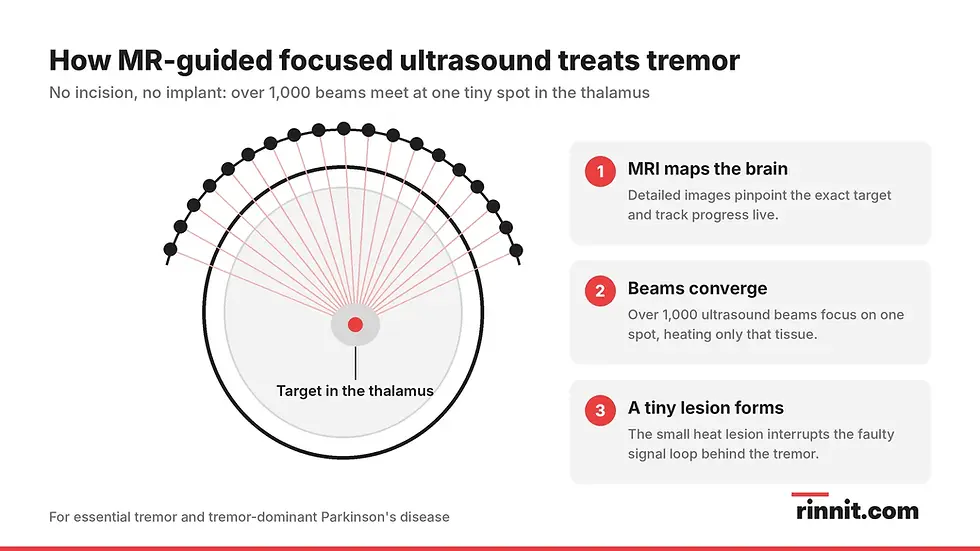
Ultrasound is a form of sound-wave energy that can pass through skin, fat, muscle, and bone. Guided by the MRI images, more than 1,000 ultrasound beams are concentrated on one small target. The beams heat that spot until the tissue is destroyed, while the surrounding tissue is spared. [1]
How does focused ultrasound reduce tremor?
Focused ultrasound reduces tremor by creating a tiny heat lesion in the thalamus, a deep brain structure that relays movement and sensory signals. [1]
In essential tremor and Parkinson's disease, the circuits running through the thalamus become abnormal, and that faulty activity produces the shaking. The small lesion interrupts the abnormal signals, which relieves the tremor. [1]
Which conditions can MR-guided focused ultrasound treat?
MR-guided focused ultrasound is approved by the U.S. Food and Drug Administration for two tremor conditions. [1]
Condition | Who it is approved for | Minimum age |
Essential tremor | Tremor not controlled with medication; approval covers tremor on both sides of the body | 22 years |
Tremor-dominant Parkinson's disease | People with Parkinson's disease whose main symptom is tremor | 30 years |
Source: [1]
Researchers are also studying focused ultrasound for tremor linked to multiple sclerosis, seizures that do not respond to other treatment, other movement disorders, stroke, brain tumors, and nerve pain. These uses are still experimental. [1]
Who is a good candidate for focused ultrasound for tremor?
A good candidate for focused ultrasound usually has a confirmed diagnosis of essential tremor or tremor-dominant Parkinson's disease, tremor that medicines have not relieved, and tremor that limits everyday activities. [1]
If you are already taking Parkinson's disease medications and your tremor still gets in the way, that is a reason to ask your neurologist about procedure-based options.
Who should not have MR-guided focused ultrasound?
MR-guided focused ultrasound may not be suitable if you: [1]
Have a metal implant that is not MRI-compatible, such as a pacemaker, neurostimulator, spine or bone fixation device, or joint replacement
Have extensive scarring on your scalp
Have a tumor inside the skull
Are on dialysis
Have an active infection or a severe blood, brain, or other uncontrolled disease
Cannot lie still on a table for up to 4 hours
Cannot stop blood-thinning (antiplatelet or anticoagulant) medicines
How is MR-guided focused ultrasound performed?
MR-guided focused ultrasound is performed inside an MRI scanner while you are awake, in a series of carefully checked stages. [1]
Preparation. Your head is shaved on the morning of the procedure so the ultrasound device makes good contact. A urinary catheter may be placed, and your heart rate, blood pressure, and oxygen level are monitored. [1]
Head frame. A frame keeps your head completely still. You receive medicine through an IV to stay comfortable while it is fitted. [1]
Cooling membrane. A silicone membrane is placed on your head. Cold water circulates between your scalp and the ultrasound helmet to keep your scalp cool and ensure good contact. [1]
Planning scans. You lie on the MRI bed, the frame is locked in place, and brain scans identify the exact target. [1]
Tremor check. You may draw spirals, write your name, or do hand and finger movements so the team can measure your tremor. You repeat these tasks throughout. [1]
Test pulses. Short, low-energy pulses confirm the aim before any treatment-level energy is used. [1]
Treatment. The energy is raised in stages. At each stage, the team checks the tissue temperature on MRI, asks how you feel, and rechecks your tremor. Once the tremor improves, the energy is increased until a small lesion forms. [1]
Finishing. Final MRI images are taken, and the catheter, IV, and head gear are removed. [1]
You can talk with your medical team the whole time and hold an emergency stop button you can press at any moment. [1]

How long does focused ultrasound for tremor take, and what happens after?
Focused ultrasound for tremor takes about 3 to 4 hours, from preparation until you get off the table. [1]
Afterward, you move to a recovery room for observation. Some people go home the same day; others stay in the hospital for 24 to 48 hours. Your doctor will tell you when you can leave and when to return for follow-up. [1]
How well does focused ultrasound work for tremor?
Focused ultrasound works well for many people, with improvement often noticed during the procedure itself. [1]
Condition | Result reported in the trials that led to approval |
Essential tremor | About 50% improvement in tremor and motor function at 3 months; about 40% improvement maintained at 1 year |
Tremor-dominant Parkinson's disease | 62% median improvement in hand tremor at 3 months |
Source: [1]
Longer follow-up is encouraging too: in people treated for essential tremor on one side, the treated hand's postural tremor remained about 73% better after 5 years. [4]

What are the benefits of MR-guided focused ultrasound?
The main benefit of MR-guided focused ultrasound is that it treats tremor without surgery-style access to the brain. [1]
MR-guided focused ultrasound at a glance
Feature | What to expect |
Incisions or holes in the skull | None |
Implanted hardware | None |
Radiation | None |
General anesthesia | Not used |
Infection or bleeding risk from an incision | None, because there is no incision |
Real-time feedback | The team can see if it is working and stop if side effects appear |
Time on the table | About 3 to 4 hours |
Return to normal activities | Usually within a few days |
Source: [1]
What are the side effects and risks of focused ultrasound for tremor?
The most common side effects of focused ultrasound for tremor are nausea, headache during the procedure, temporary numbness or tingling, unsteady walking, and short-term speech or swallowing problems. [1]
Type | Possible effects |
Common and usually temporary | Nausea; headache during the procedure; mild-to-moderate numbness or tingling in the fingertips or lips; unsteady walking or balance problems; speech or swallowing problems |
Longer-term (3 months or more) or permanent | Muscle weakness, unsteadiness, loss of sensation, or numbness and tingling in the fingers or other areas; permanent in about 10% to 15% of patients |
Treatment may fall short | Tremor may not improve, or it may return months or years later |
Source: [1]
Side effects can start several days or even weeks after treatment, so report any new symptoms to your care team. [1]
Does focused ultrasound cure essential tremor or Parkinson's disease?
Focused ultrasound does not cure essential tremor or Parkinson's disease. The procedure eases the tremor but does not treat the underlying condition or stop it from progressing. [1]
Ongoing care with your neurologist continues after the procedure. To learn how Parkinson's disease can change over time, see our guide to Parkinson's disease dementia.
How soon can you return to normal activities after focused ultrasound?
Most people return to normal activities within a few days of focused ultrasound. [1]
Is MR-guided focused ultrasound covered by insurance?
Insurance coverage for MR-guided focused ultrasound varies, so the best step is to ask your doctors and contact your insurance company directly. [1]
How do doctors decide if focused ultrasound is the right option?
Doctors decide whether focused ultrasound is right for you after a complete assessment of your condition and any extra tests that are needed. Your team will then discuss whether you are a candidate for focused ultrasound or for other options, such as deep brain stimulation. [1]
Because tremor has several possible causes, getting the diagnosis right comes first. Our overview of parkinsonism explains how different movement disorders can look alike.
Conclusion
MR-guided focused ultrasound gives people with stubborn essential tremor or tremor-dominant Parkinson's disease a way to calm the shaking without incisions, implants, or general anesthesia. Many people see results on the table, and for some the benefit lasts for years. The trade-offs are real, though: numbness, tingling, or balance problems can linger, the tremor can return, and the underlying disease keeps its own course.
Next step: If tremor is making it hard to eat, write, or dress despite medication, ask your neurologist or a movement disorders specialist whether you are a candidate for focused ultrasound. For more clear, evidence-based guides on brain and nerve health, explore our health library.
FAQ
Is MR-guided focused ultrasound painful?
MR-guided focused ultrasound does not involve incisions, and you receive IV medicine to stay comfortable while the head frame is fitted. Headache during the procedure is one of the most common side effects, and you can tell the team how you feel at any point.
Are you awake during focused ultrasound for tremor?
You are awake during the entire focused ultrasound procedure and can speak with your medical team. Being awake lets the team check your tremor and how you feel as the energy is increased.
How long do the results of focused ultrasound last?
The results of focused ultrasound often last for years: in essential tremor, about 40% improvement was still seen at 1 year in the approval trial, and treated-hand postural tremor stayed about 73% better at 5 years in long-term follow-up. Tremor can still return months or years later in some people.
Can focused ultrasound treat both hands?
Focused ultrasound approval for essential tremor covers treatment of tremor on both sides of the body. Your medical team will advise whether and when treating the second side makes sense for you.
Who cannot have MR-guided focused ultrasound?
People who cannot have MR-guided focused ultrasound include those with non-MRI-compatible metal implants, extensive scalp scarring, tumors inside the skull, dialysis, active infection or severe uncontrolled disease, inability to lie still for up to 4 hours, or inability to stop blood thinners.
What are the most common side effects of focused ultrasound?
The most common side effects of focused ultrasound are nausea, headache during the procedure, temporary numbness or tingling in the fingertips or lips, unsteady walking, and short-term speech or swallowing problems. Longer-lasting weakness, unsteadiness, or numbness can occur, becoming permanent in about 10% to 15% of patients.
Do you need to stay in the hospital after focused ultrasound?
A hospital stay after focused ultrasound is not always needed: some people go home the same day, while others stay 24 to 48 hours for observation.
Does focused ultrasound replace tremor medication?
Focused ultrasound is meant for tremor that medication has not controlled, and it does not treat the underlying disease. Keep following your doctor's medication plan unless they tell you otherwise.
Is focused ultrasound FDA approved for tremor?
Yes. The FDA has approved MR-guided focused ultrasound for essential tremor and tremor-dominant Parkinson's disease when medicines have not controlled the tremor.
Do you have to shave your head for focused ultrasound?
Yes. Your scalp is fully shaved before the procedure so the ultrasound beams can pass through the skin and skull without interference.
Related Reading
Deep Brain Stimulation (DBS): Uses, Procedure and Recovery explains how implanted brain electrodes ease tremor and other movement symptoms.
Parkinson's Disease: Symptoms, Causes, and Treatment — A Clear Guide to Understanding and Managing the Condition covers the symptoms of Parkinson's disease and current treatment options.
Parkinson's Disease Medications: A Comprehensive Guide to Treatment Options compares the medicines used to control Parkinson's symptoms.
Parkinsonism: Understanding the Umbrella of Movement Disorders explains the movement disorders that cause tremor, stiffness and slowness.
References
Cleveland Clinic. MR-Guided Focused Ultrasound for Tremor. Cleveland Clinic. Last updated March 12, 2019. https://my.clevelandclinic.org/health/treatments/21087-mr-guided-focused-ultrasound-for-treatment-of-tremor
Elias WJ, Lipsman N, Ondo WG, et al. A Randomized Trial of Focused Ultrasound Thalamotomy for Essential Tremor. N Engl J Med. 2016;375(8):730-739. PMID 27557301. https://doi.org/10.1056/NEJMoa1600159
Bond AE, Shah BB, Huss DS, et al. Safety and Efficacy of Focused Ultrasound Thalamotomy for Patients With Medication-Refractory, Tremor-Dominant Parkinson Disease: A Randomized Clinical Trial. JAMA Neurol. 2017;74(12):1412-1418. PMID 29084313. https://doi.org/10.1001/jamaneurol.2017.3098
Cosgrove GR, Lipsman N, Lozano AM, et al. Magnetic resonance imaging-guided focused ultrasound thalamotomy for essential tremor: 5-year follow-up results. J Neurosurg. 2023;138(4):1028-1033. PMID 35932269. https://doi.org/10.3171/2022.6.JNS212483
Further reading: InSightec. ExAblate Transcranial MR Guided Focused Ultrasound for the Treatment of Essential Tremors (NCT01827904). ClinicalTrials.gov. Last updated August 27, 2024. https://clinicaltrials.gov/study/NCT01827904
Medical disclaimer
This article is for general educational purposes only and is not a substitute for professional medical advice, diagnosis, or treatment. Always talk with your doctor or a qualified health professional about your symptoms and treatment options, and seek urgent care for any sudden or severe new symptom.



Comments