Monteggia Fracture: Symptoms, Causes, and Recovery

Updated: 2 days ago
Medically reviewed by Dr. Baraa Alnahhal, MD · Last reviewed: October 2026
A Monteggia fracture is a forearm injury in which a break in the ulna near the elbow forces the radius out of the elbow joint. Both injuries need to be recognized and fixed together, or the elbow can stay unstable [1].
Quick Answer: What is a Monteggia fracture?
A Monteggia fracture is a complex injury in which the ulna breaks near the elbow and the radius dislocates, usually from a fall on an outstretched hand or a direct blow. It causes elbow pain, swelling and limited movement and can be missed in children. Most children need no surgery while most adults do; recovery takes eight to twelve weeks. [1]
What the research says
Surgically treated Monteggia-type injuries do reasonably well, but complications are not rare. In a systematic review of 16 studies covering 296 trans-ulnar fracture-dislocations of the elbow, the 82 Monteggia-variant injuries had a complication rate of 25% and a reoperation rate of 13%, with a mean flexion-extension arc of 117° and a mean Mayo Elbow Performance Score of 91; injuries in which the base of the coronoid was also broken fared worse (complications 40%, reoperations 25%) (Nieboer et al., J Shoulder Elbow Surg, 2024 [2]).
Adults with posterior Monteggia-type injuries often keep good function but develop joint changes. A systematic review of 117 adults with posterior olecranon fracture dislocations, once classed as posterior Monteggia lesions, found good or excellent Broberg/Morrey ratings in 66%, arthrosis in 28.2%, and reoperation in 16%, with almost no instability of the elbow joint after surgery (Xiong et al., Orthop Surg, 2023 [3]).
Fixing the ulna usually stabilizes the radial head, but delay makes treatment harder. A review of Monteggia injuries notes that reducing and fixing the ulnar fracture is usually enough to stabilize the radial head, that a radial head that cannot be reduced early may point to tissue blocking the joint and need open surgery, and that the radial head becomes irreducible after 2 to 3 weeks, so chronic cases are harder to treat with more variable results (Delpont et al., Orthop Traumatol Surg Res, 2018 [4]).
What is a Monteggia fracture?
A Monteggia fracture is a type of forearm fracture that happens close to the elbow joint, where the two forearm bones meet. The ulna runs down the outer (pinky) side of the forearm and the radius runs down the inner (thumb) side. When a strong force fractures the ulna near the elbow, it destabilizes the joint and the radius bone dislocates [1].
Because it involves both a break and a dislocation, it is a more complex injury than a typical fracture. It leaves the elbow joint unstable and needs treatment to heal correctly. If possible, a provider will manually move the bones back into position, but surgery is needed if that cannot be done or if there is serious damage to a ligament, blood vessel, or nerve [1].
How is a Monteggia fracture different from other forearm fractures?
A Galeazzi fracture is the mirror-image injury, so it helps to know the difference [1].
Feature | Monteggia fracture | Galeazzi fracture |
Fractured bone | Ulna, near the elbow | Radius, near the wrist |
Dislocated bone | Radius, at the elbow joint | Ulna, at the wrist joint |
Location | Upper forearm and elbow | Lower forearm and wrist |
Mnemonic | Monteggia is the fractured ulna | FROG: Fractured Radius of Galeazzi |

A Monteggia fracture breaks the ulna and dislocates the radius at the elbow, while a Galeazzi fracture breaks the radius and dislocates the ulna at the wrist.
What are the symptoms and warning signs of a Monteggia fracture?
Most people with a Monteggia fracture complain of elbow pain, and the fracture is felt in the upper third of the forearm. The area is likely to be swollen, and you may or may not be able to see that the bones are out of place. A dislocated radius is also painful, and you may notice limited movement at the elbow. Sometimes the radius spontaneously moves back into place [1].
A provider will also check for signs of nerve injury, which may include [1].
The injury can affect the radial nerve or the median nerve. The most common nerve injury is to the posterior interosseous nerve (PIN), a branch of the radial nerve, which can make it difficult to extend the fingers and thumb. Most of the time this nerve injury is mild and heals by itself within several months, and if it does not, surgery can help [1].
What causes a Monteggia fracture?
A Monteggia fracture is a traumatic injury. Common causes include [1].

The three most common causes: an outstretched fall, a direct elbow impact, and a fall from height.
How is a Monteggia fracture diagnosed and treated?
A Monteggia fracture is diagnosed with a physical exam and X-rays of both the forearm and the elbow, since both injuries can be subtle and easy to miss.
Diagnostic Imaging
A provider begins with a physical examination and then orders X-rays. The key to recognizing a Monteggia fracture is to X-ray both the forearm and the elbow: the forearm series shows the ulnar fracture, and the elbow series shows the radial head dislocation. Both injuries can be subtle and easy to miss, especially in children, where the fracture may be so minor that it is hard to see or may be more of a bend than a break. Because the radius sometimes moves back into place before it can be seen, providers must check carefully for evidence of a previous dislocation [1].
Management Pathways
When a bone dislocates, it stretches or tears the tissues that hold it in place, and those tissues need time to repair. Successful treatment must put the ulna back in its correct position, put the radius back in its correct position, and stabilize the bones until healing is complete. Providers usually begin with conservative treatment and turn to surgery if necessary. Most children will not need surgery and most adults will, because children's bones and tissues are still growing and are more adjustable and quicker to heal [1].
Closed reduction: a manual, nonsurgical adjustment done under anesthesia to move the bones back into place. Providers always attempt this first if possible, and afterward you wear a cast or splint [1].
Open reduction and internal fixation (ORIF): when closed reduction is not possible, surgery puts the bones back in their correct positions and holds them there. Sometimes the ulna must be repaired before the radius can be reduced, and other damaged tissues may need treatment [1].
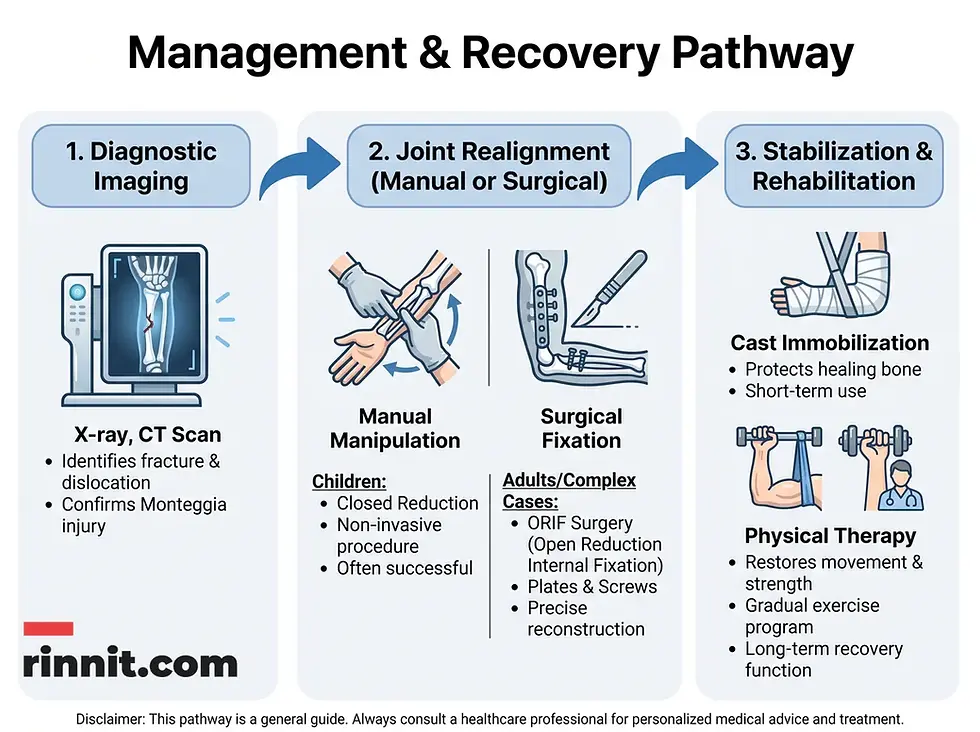
Treatment moves from imaging to realignment, then to cast immobilization and physical therapy.
Recovery
Most people can start to return to normal activities eight to twelve weeks after treatment, and athletes or people with physically demanding jobs may need a little longer. You may wear a cast for six to eight weeks after a closed reduction or three weeks after surgery, followed by a few weeks of occupational or physical therapy to restore flexibility and range of motion [1].
What is the long-term outlook after a Monteggia fracture?
With timely diagnosis and treatment, most people recover without major complications, but this is a serious injury. Elbow stiffness, persistent pain, and weakness are not uncommon after treatment, and around 10% of people have temporary nerve damage lasting a few months. Monteggia fractures that go undiagnosed and untreated for several weeks are harder to treat effectively and may cause lasting damage [1].
What is the bottom line on Monteggia fractures?
A Monteggia fracture is a serious two-part injury that needs prompt medical attention to protect elbow function. Most patients recover well when both the fracture and the dislocation are realigned in time, whether by manual adjustment or surgery, followed by dedicated therapy. If you have injured your forearm and have persistent elbow pain or limited movement, seek orthopaedic evaluation without delay, and do not dismiss symptoms that keep nagging after treatment.
Frequently Asked Questions
What is a Monteggia fracture?
A Monteggia fracture is a fracture of the ulna near the elbow combined with a dislocation of the radius at the elbow joint.
How does it differ from a Galeazzi fracture?
A Monteggia fracture involves a broken ulna near the elbow with a dislocated radius, while a Galeazzi fracture involves a broken radius near the wrist with a dislocated ulna.
What is the FROG mnemonic?
FROG stands for Fractured Radius of Galeazzi. If you remember that Galeazzi is the fractured radius, you will remember that Monteggia is the fractured ulna.
What causes a Monteggia fracture?
Common causes include falling onto an outstretched hand, falling from a height onto the elbow, and a direct blow to the back of the elbow.
Can a Monteggia fracture cause nerve damage?
Yes. It can injure the radial or median nerve. Most nerve injuries are mild and heal by themselves within several months, and around 10% of people have temporary nerve damage.
What is a PIN injury?
The posterior interosseous nerve (PIN) is a branch of the radial nerve. It is the most commonly injured nerve in a Monteggia fracture, and damage can make it difficult to extend the fingers and thumb.
Is surgery always required?
No. Most children will not need surgery and are treated with a closed reduction (a manual adjustment) followed by a cast or splint, while most adults will need surgery. Providers always try closed reduction first if possible.
How long does recovery take?
Most people can start returning to normal activities eight to twelve weeks after treatment. Athletes and people with physically demanding jobs may need more time, and therapy follows the cast to restore motion.
Why is it easily missed in children?
The fracture may be so minor that it is hard to see, or more of a bend than a break, and the dislocated radius sometimes moves back into place before the provider can see it.
What happens if it goes untreated?
A Monteggia fracture that goes undiagnosed and untreated for several weeks is harder to treat effectively and may cause lasting damage. Elbow stiffness, persistent pain, and weakness can occur even after treatment.
Related Reading
Broken Arm: Symptoms, Causes, and Treatment explains arm fractures, how they are treated and how they heal.
Dislocated Elbow: An Injury That Needs the Emergency Room — What Happens, the 3 Severity Types, Symptoms, Treatment and Recovery Time — What You Need to Know covers elbow dislocations, emergency care and recovery time.
Elbow X-Ray: What It Shows, Views Taken and What to Expect explains the imaging test used to diagnose elbow and forearm fractures.
The Ulna Bone: Anatomy, Function, and Common Conditions explains the forearm bone that breaks in a Monteggia fracture.
References
Cleveland Clinic. Monteggia Fracture. Cleveland Clinic. September 23, 2024. https://my.clevelandclinic.org/health/diseases/monteggia-fracture
Nieboer MJ, Cancio-Bello A, Mallett KE, et al. Trans-ulnar fracture dislocations of the elbow: a systematic review and clarification of classification systems. J Shoulder Elbow Surg. 2024;33(4):975-983. PMID 38036255. https://doi.org/10.1016/j.jse.2023.10.014
Xiong J, Yang J, Luo L, Gong M. Posterior olecranon fracture dislocations in adults: a systematic review. Orthop Surg. 2023;15(9):2235-2243. PMID 37461239. https://doi.org/10.1111/os.13820
Delpont M, Louahem D, Cottalorda J. Monteggia injuries. Orthop Traumatol Surg Res. 2018;104(1S):S113-S120. PMID 29174872. https://doi.org/10.1016/j.otsr.2017.04.014
Medical disclaimer
This article is for informational purposes only and is not a substitute for professional medical advice, diagnosis, or treatment. The clinical information in this guide reflects source material last reviewed in September 2024.



Comments