Broken Arm: Symptoms, Causes, and Treatment

Updated: 3 days ago
Medically reviewed by Dr. Baraa Alnahhal, MD · Last reviewed: October 2026

Quick Answer: What is a broken arm?
A broken arm is a fracture of the humerus, radius or ulna, the three bones that make up the arm. It causes intense pain that worsens with movement, swelling, bruising and sometimes a visible bend. An exam and X-ray confirm the break, and treatment may include realigning the bone, a splint or cast, and sometimes surgery. [1] [2]
What the research says
According to PubMed:
Children's buckle fractures heal well whatever the treatment. A Cochrane review of 30 studies (2,930 children) with wrist fractures found reassuring evidence of a full return to previous function with no serious adverse events, including refracture, for correctly diagnosed buckle fractures, whatever treatment was used; the evidence quality was low or very low. (Handoll et al., DOI).
Long-term NSAID use may slow bone healing. A meta-analysis found NSAID exposure increased delayed union or nonunion (OR 2.07, 95% CI 1.19–3.61), with no significant effect in children (OR 0.58) or with low-dose, short-duration use (OR 1.68, 95% CI 0.63–4.46). (Wheatley et al., DOI).
Most children's upper-arm fractures are treated without surgery. In a meta-analysis of 8 studies (587 children) with proximal humerus fractures, 33% had surgery and 67% did not; the operative rate rose to 60% in severely displaced fractures, and older age was also linked to surgery. (Song and Song, DOI).
Study details are from PubMed abstracts.
Key facts at a glance
Question | Answer |
What is it? | A fracture of the humerus, radius, or ulna [1] |
Most common cause | Falling onto an outstretched hand [1] |
Key symptoms | Severe pain, swelling, bruising, limited movement [1] |
Typical diagnosis | Physical exam plus X-ray [2] |
First-line treatment | Pain relief, immobilization with splint, sling, or cast [2] |
When is surgery needed? | Severe, displaced, or multi-piece fractures [2] |
Outlook with early care | Most broken arms heal well [1] |
What are the symptoms of a broken arm?
Sometimes a broken arm is easy to spot, such as when the arm looks crooked. Other times it is harder to tell, so knowing the common signs helps you decide when to get care [1].
The main symptoms include:
Symptom | What it looks like |
Intense pain | Pain that worsens with movement [1] |
Swelling | Visible swelling around the injured area [1] |
Bruising | Discoloration around the injury [1] |
Limited movement | Difficulty bending the elbow or raising the arm [1] |
Rotation trouble | Hard to turn the forearm, making it hard to turn the palm up or down [1] |
Visible change | A bent or twisted arm or wrist [1] |
When to see a doctor
If your arm hurts so much that you can't use it the way you normally do, see a healthcare professional right away. Prompt care matters especially for children, because children heal faster than adults, and waiting to get treatment can lead to poor healing [1].
Get emergency medical care right away if you notice any of the following [1]:
What causes a broken arm?
A broken arm happens when one or more of the three arm bones break. Falls onto an outstretched hand or elbow are the most common cause [1].
Risk factors
Some medical conditions and activities increase the chance of breaking an arm [1].
Playing contact sports or activities with a high risk of falling raises the odds. Examples include football, soccer, gymnastics, skiing, and skateboarding [1].
Conditions that weaken bones, such as osteoporosis and bone tumors, also increase risk. A break caused by an underlying condition is called a pathological fracture [1].
What are the types of broken arm fractures?
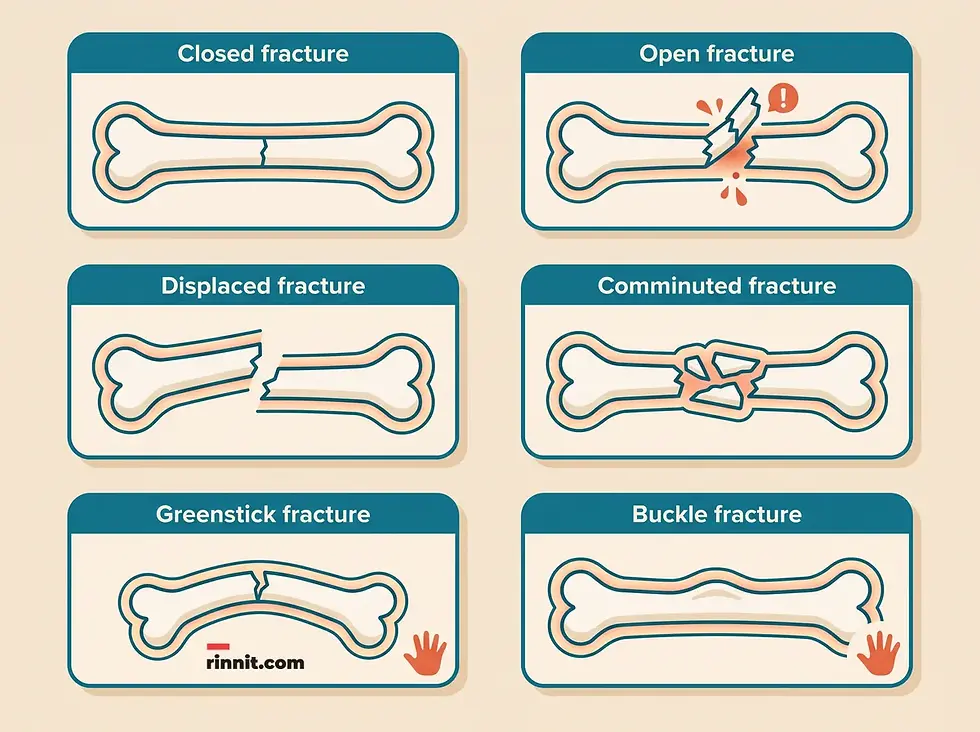
Understanding the fracture type helps explain your treatment plan. Doctors describe breaks by how the bone fragments sit, whether the skin is broken, and how many pieces are involved [2].
Fracture type | What it means |
Open (compound) | The bone pierces the skin; serious infection risk, needs immediate treatment [2] |
Closed | The bone is broken but the skin remains intact [2] |
Displaced | Bone fragments are not aligned; surgery may be needed [2] |
Comminuted | The bone breaks into multiple pieces; often requires surgery [2] |
Greenstick | The bone cracks without breaking all the way; common in children [2] |
Buckle (torus) | One side compresses, the other bends or buckles; more common in children [2] |
Children's bones are softer and more flexible, which is why greenstick and buckle fractures show up more often in kids [2].
What complications can a broken arm cause?
With early treatment, most broken arms heal well. But complications can happen, and some are emergencies that need attention right away [1].
Complication | What happens |
Uneven bone growth | A fracture near a growth plate in children can affect bone development [1] |
Osteoarthritis | A fracture that extends into a joint raises arthritis risk later in life [1] |
Stiffness | A splint, sling, brace, or cast can lead to stiffness in the wrist, elbow, or shoulder [1] |
Bone infection | Bacteria can enter if the broken bone pierces the skin [1] |
Nerve or blood vessel injury | Sharp, jagged edges of a severe humerus fracture can damage nearby nerves and vessels [1] |
Compartment syndrome | Swelling cuts off blood supply, causing pain, burning, tingling, and numbness, typically within 24 to 48 hours [1] |
Growth plates sit at the end of a long bone where growth occurs. A fracture near one of them can disturb how the bone develops [1].
Casts that are too tight, or that become too tight as swelling builds, can cause compartment syndrome. It is a medical emergency that requires surgery [1].
How is a broken arm diagnosed?
A healthcare professional examines your arm for tenderness, swelling, unusual positioning, and open wounds. You will be asked about your symptoms and how the injury happened [2].
An X-ray is the typical test to confirm the break and assess severity. Sometimes a CT scan, an MRI, or another imaging study is used for more detailed images [2].
How is a broken arm treated?
Treatment depends on the type of fracture. Healing time varies based on factors such as the severity of the break, age, overall health, and nutrition. Smoking and alcohol use may slow healing [2].
Realignment and immobilization
If bone fragments are out of place, a healthcare professional may need to move them back into position. This process is called reduction. Depending on your pain and swelling, you may receive numbing medicine at the fracture site, a muscle relaxant, a sedative, or general anesthesia [2].
To heal properly, the bone must not move. This is done with a splint, sling, brace, or cast. Before applying a cast, your care team may wait 5 to 7 days for swelling to go down, during which you will likely wear a splint at all times. You typically return for X-rays during healing to make sure the bone stays in the correct position [2].
Medicines
Over-the-counter pain relievers are often enough to reduce pain and inflammation. If pain is severe, a prescription pain medicine may be used for a few days [2].
Nonsteroidal anti-inflammatory drugs (NSAIDs) can help with pain, but they may slow bone healing, especially with long-term use. Ask your healthcare professional whether they are right for you [2].
If the bone pierced the skin, antibiotics may be needed to prevent infection from spreading to the bone [2].
Therapy
Rehabilitation begins soon after treatment. If possible, gentle movement should start early to prevent stiffness in your arm, hand, and shoulder while you wear a cast or sling [2].
Once the cast or sling comes off, your care team may recommend rehabilitation exercises or physical therapy to regain muscle strength, improve joint movement, and restore flexibility [2].
Surgery
Some fractures need surgery to keep the bones stable while they heal. If the bone did not break through the skin, doctors may wait until swelling goes down before operating. Keeping your arm still and raised helps reduce swelling, and gently moving your fingers prevents stiffness in those joints [2].
Wires, plates, screws, or nails hold the bones in place. Complications are rare but include infection and slow bone healing [2].

How should you prepare for a broken arm appointment?
Depending on the severity of the break, your emergency room team may refer you or your child to an orthopedic surgeon, a doctor who specializes in injuries affecting bones, joints, muscles, ligaments, and tendons [2].
Before your visit, make a list that includes [2]:
Questions worth asking include: What tests are needed? What is the best course of action? Is surgery necessary? What restrictions will I need to follow? Do you recommend seeing a specialist? What pain medicines do you recommend [2]?
Expect your doctor to ask what caused the symptoms, whether an injury triggered them, how severe they are, and what seems to improve or worsen them [2].
How can you prevent a broken arm?
Accidents can't always be prevented, but these steps may help protect your bones [1].
Eat for strong bones. Include calcium-rich foods such as milk, yogurt, and cheese, along with vitamin D, which helps your body absorb calcium. Good sources of vitamin D include fatty fish such as salmon, and fortified foods such as milk and orange juice. Sunlight also helps your body produce vitamin D [1].
Stay active. Weight-bearing exercises and activities that improve balance and posture strengthen bones and reduce the risk of fractures. The more active and fit you are as you age, the less likely you are to fall and break a bone [1].
Prevent falls. Wear supportive shoes and remove tripping hazards such as loose rugs. Keep your home well lit and install grab bars or handrails where needed, such as in bathrooms and stairways [1].
Use protective gear. Wear wrist guards and other safety equipment during high-risk activities such as inline skating, snowboarding, rugby, and football [1].
Don't smoke. Smoking weakens bones, increasing fracture risk, and slows the healing process if a break occurs [1].
Conclusion and next steps
A broken arm is painful, but it is one of the most common injuries in medicine, and most fractures heal well with early, proper care. Knowing the warning signs — intense pain that worsens with movement, swelling, bruising, and a visible bend — helps you act fast when it counts.
The type of fracture guides the treatment. Simple breaks may heal with a sling and rest, many cases heal in a cast, and more serious breaks may need realignment or surgery. Starting gentle movement early and following through with rehabilitation helps you get your full range of motion back.
If you or your child falls on an outstretched arm and the pain is severe, don't wait it out. Seek medical care right away, especially if there is numbness, skin color change, bleeding, or a break in the skin.
Next steps: If you suspect a broken arm, seek medical care right away. Go to the emergency room for numbness or weakness in the hand, a change in hand color, or bleeding or a break in the skin.
Frequently asked questions
What are the symptoms of a broken arm?
The main symptoms are intense pain that worsens with movement, swelling, bruising, difficulty bending the elbow or raising the arm, trouble turning the palm up or down, and a visible bend or twist in the arm or wrist [1].
Can you still move a broken arm?
Yes, some movement is often still possible. The key warning signs are pain that worsens with movement and loss of normal use. Only an X-ray can confirm whether the arm is actually broken [1] [2].
What is the difference between a greenstick fracture and a buckle fracture?
Both are common in children because their bones are softer and more flexible. In a greenstick fracture, the bone cracks without breaking all the way through, like bending a green twig. In a buckle fracture, one side of the bone compresses while the other side bends or buckles [2].
How long does a broken arm take to heal?
Healing time varies based on the severity of the break, age, overall health, and nutrition. Smoking and alcohol use may slow healing. Before a cast is applied, care teams often wait 5 to 7 days for swelling to go down [2].
What are the complications of a broken arm?
Possible complications include uneven bone growth in children when a fracture occurs near a growth plate, osteoarthritis if the break extends into a joint, stiffness from immobilization, bone infection if the skin is pierced, nerve or blood vessel injury, and compartment syndrome, a medical emergency requiring surgery [1].
This article is for general education and is not a substitute for professional medical advice, diagnosis, or treatment. Always consult a qualified healthcare professional about your individual situation.
References
Mayo Clinic Staff. Broken arm - Symptoms and causes. Mayo Clinic. May 2, 2026. https://www.mayoclinic.org/diseases-conditions/broken-arm/symptoms-causes/syc-20353260
Mayo Clinic Staff. Broken arm - Diagnosis and treatment. Mayo Clinic. May 2, 2026. https://www.mayoclinic.org/diseases-conditions/broken-arm/diagnosis-treatment/drc-20353266
American Academy of Orthopaedic Surgeons. Adult Forearm Fractures. OrthoInfo. Accessed October 15, 2026. https://www.orthoinfo.org/diseases--conditions/adult-forearm-fractures
Cleveland Clinic. Broken Arm (Fractured Arm). Cleveland Clinic. Last updated January 16, 2024. https://my.clevelandclinic.org/health/diseases/broken-arm-fractured-arm
Handoll HH, et al. Interventions for treating wrist fractures in children. Cochrane Database Syst Rev. 2018;12(12):CD012470. PMID 30566764. https://doi.org/10.1002/14651858.CD012470.pub2
Wheatley BM, et al. Effect of NSAIDs on Bone Healing Rates: A Meta-analysis. J Am Acad Orthop Surg. 2019;27(7):e330-e336. PMID 30260913. https://doi.org/10.5435/JAAOS-D-17-00727
Song HR, et al. Operative Versus Nonoperative Management of Pediatric Proximal Humerus Fractures: A Meta-Analysis and Systematic Review. Clin Orthop Surg. 2023;15(6):1022-1028. PMID 38045578. https://doi.org/10.4055/cios23077



Comments