Dislocated Elbow: An Injury That Needs the Emergency Room — What Happens, the 3 Severity Types, Symptoms, Treatment and Recovery Time — What You Need to Know

Updated: 3 days ago
Medically reviewed by Dr. Baraa Alnahhal, MD | Last reviewed: October 7, 2026
EMERGENCY: Call 911 or go to the nearest emergency room now If you think your elbow is dislocated after a fall, sports injury or accident, go to the emergency room right away. Never try to push the joint back in yourself, and do not let anyone but a trained healthcare provider touch it. Hold the elbow as still as possible and do not use it. |
Quick Answer
A dislocated elbow is an injury in which one of the joint's three bones (the humerus, ulna or radius) is pushed out of place. It is extremely painful and hard to move. It is an emergency: go to the ER, never push it back yourself, and let a trained provider reset it. [1] Most dislocated elbows heal within several weeks. [1]
What the research says
For a simple dislocation, early movement beats prolonged immobilization. A systematic review of 17 randomized-trial studies in adults found that conservative treatment with early functional training remains first-line therapy. Early mobilization gave better range of motion than immobilization (extension deficit about 16° vs 19.5°), and surgery gave similar outcomes for slightly unstable elbows. People with red flags for persistent instability (severe ligament injuries on both sides, or moderate-to-severe instability on exam) should be considered for primary surgery (Breulmann et al., BMC Musculoskeletal Disorders, 2024) [6].
Athletes almost always return to sport, usually within about 10 weeks. A systematic review of 9 studies covering 970 athletes found that 99.3% (272 of 274 with reported data) returned to some sporting activity after a mean of 11.4 weeks; those treated without surgery returned sooner (about 9 weeks) than those treated surgically (about 16 weeks), and complications occurred in 11.2% of dislocations. The evidence level was low (level 4) (Albright et al., Orthopaedic Journal of Sports Medicine, 2026) [7].
In children, associated fractures are the rule, and longer casts cost motion. In a retrospective review of 145 children and teenagers with elbow dislocations, 80% had a fracture at the same time, and 90% had good or excellent outcomes. Immobilization for more than 2 weeks was linked to loss of elbow extension, and multiple fractures, surgery and longer immobilization were associated with poorer results (Murphy et al., Journal of Pediatric Orthopaedics, 2017) [8].
What is a dislocated elbow?
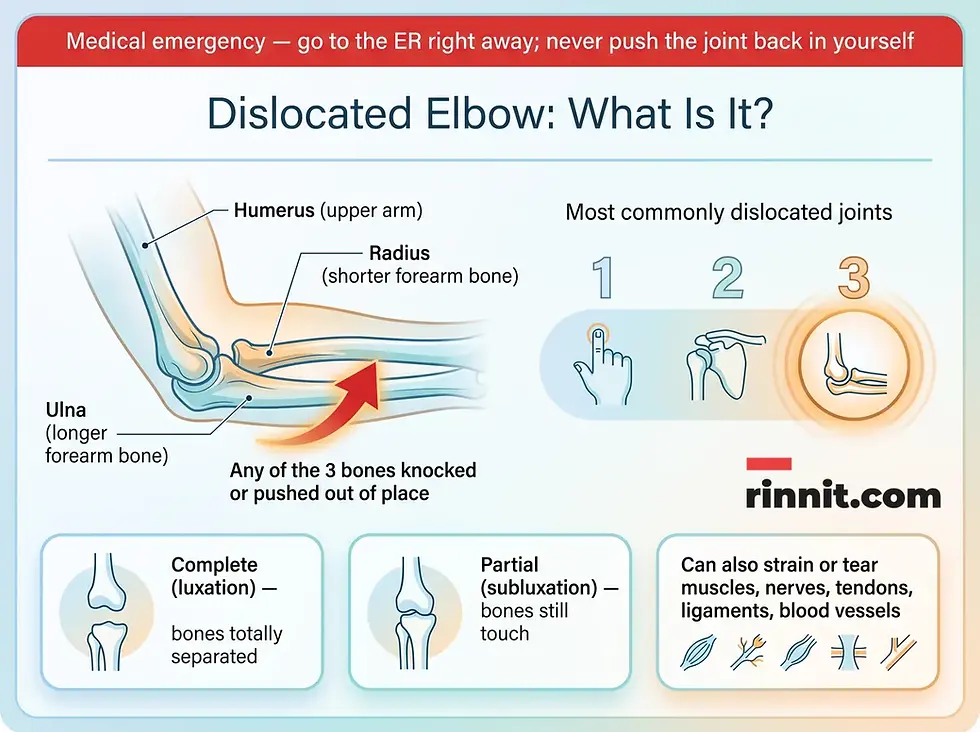
A dislocated elbow happens when any of the three bones in your elbow joint are knocked or pushed out of place. Dislocating your elbow can be very painful and make it hard, or impossible, to move your elbow. [1]
A joint is any place in your body where two bones meet. Your elbow joint is where three bones in your arm come together: the humerus (your upper arm bone), the ulna (the longer bone in your forearm) and the radius (the shorter bone in your forearm). [1] [2]
A dislocated elbow can also strain or tear the tissues around your joint, including your muscles, nerves, tendons, ligaments and blood vessels. [1]
How are dislocated elbows classified?
Healthcare providers classify dislocations based on how far the bones in your joints were moved, and also based on the damage to your joint and surrounding tissue. [1]
Classification | What it means |
Complete dislocation (luxation) | The bones in your joint are totally separated and pushed out of place |
Subluxation (partial dislocation) | Something pulls your joint apart and the bones still touch, just not as completely as usual |
Simple elbow dislocation | Injury to the ligaments that support your elbow, but no injury to the bones that form the joint |
Complex elbow dislocation | Severe injuries to your ligaments and tendons, plus broken bones (fractures) |
Severe elbow dislocation | Damage to the nerves and blood vessels around your elbow |
How common are dislocated elbows?
Elbows are one of the most commonly dislocated joints each year. Only shoulders and fingers are dislocated more often. [1]
What are the symptoms of a dislocated elbow?
The most common symptoms of a dislocated elbow include bruising, your elbow looking noticeably different or out of place, pain, swelling, being unable to move or use your elbow, and a feeling of instability or like your elbow is weaker than usual. [1]
Symptom | What you will notice |
Bruising | Discoloration around the elbow |
Visible deformity | Elbow looking noticeably different or out of place |
Pain | Significant pain at the joint |
Swelling | Inflammation around the elbow |
Immobility | Being unable to move or use your elbow |
Instability | A feeling your elbow is weaker than usual |
What causes a dislocated elbow?
Any force that is strong enough to push your elbow joint out of place can cause a dislocation. The most common causes include falls (especially catching yourself or bracing for an impact with your arms stretched out in front of you), car accidents and sports injuries. [1] [2]
Grabbing or lifting a child by the arm can dislocate their elbow. This type of partial dislocation is sometimes called nursemaid elbow. [1]
Who is at higher risk?
Anyone can dislocate an elbow, but some people are more likely to experience a dislocation: athletes who play a contact sport; people older than 65; children younger than 16; people with health conditions that weaken their joint ligaments, like Ehlers-Danlos syndrome and joint hypermobility syndrome; and people who overuse their elbows, especially doing repetitive motions at work or throwing for a sport. [1]
Risk factor | Detail |
Contact sport athletes | Higher exposure to collision force |
Age over 65 | Increased risk, including fall risk |
Children under 16 | Including nursemaid elbow from being lifted by the arm |
Weakened ligaments | Conditions like Ehlers-Danlos syndrome and joint hypermobility syndrome |
Elbow overuse | Repetitive motions at work or throwing for a sport |

What are the complications of a dislocated elbow?
The most common complications of dislocations are damage to the bones and tissues around your elbow, including bone fractures, ligament and tendon sprains, nerve damage, damaged blood vessels and muscle strains. [1]
How is a dislocated elbow diagnosed?
A healthcare provider will diagnose a dislocated elbow with a physical exam. [1] They will look at your elbow and the rest of your arm. Tell your provider about any symptoms you are experiencing and what you were doing right before you injured your elbow.
Your provider might also need imaging tests to diagnose damage inside your body after a dislocation. [1]
Test | Purpose |
X-ray | Basic imaging of bones and joint position |
MRI (magnetic resonance imaging) | Detailed view of soft tissue damage |
CT (computed tomography) scan | Cross-sectional imaging of bone and tissue |
Ultrasound | Imaging of surrounding soft tissues |
How is a dislocated elbow treated?
The most important treatment for a dislocated elbow is putting your joint back in its correct place. Your healthcare provider might call this manipulation or a closed reduction. [1]
Don't try to push your joint back in place by yourself. Don't let anyone who is not a trained, professional healthcare provider move or touch your injured elbow. Try to hold your elbow as still as possible and don't force yourself to use it. If you try to force a dislocated elbow back in place on your own, you can make your injury worse and damage the tissue around it. [1]
After your provider puts your joint back in place, you might need other treatments.
Treatment | What it involves |
Immobilization | Wearing a splint or sling to hold your elbow in place while it heals |
Medication | Medication to reduce pain and inflammation. Do not take over-the-counter pain relievers for more than 10 days in a row without talking to your provider |
Rest | Avoiding any physical activity that uses or puts stress on your elbow |

Do I need surgery for a dislocated elbow?
Most people don't need surgery after dislocating their elbow. You may need surgery if the injury that dislocated your elbow caused other damage inside your body; if a closed reduction doesn't work or isn't possible (in which case you will need surgery to reset your elbow joint); or if you experience a severe or complex dislocation. [1]
What is the recovery time for a dislocated elbow?
It usually takes several weeks to recover from a simple elbow dislocation. You will need to keep your elbow immobilized for a week or two to heal. After your elbow has healed enough to use it, you will need physical therapy for a few weeks. Your physical therapist will help you regain your range of motion, which is how far you can move your elbow. [1]
Complex and severe elbow dislocations take longer to heal. [1] Your provider will explain what to expect.
Ask your provider how long you need to wait before you resume physical activities. If you return to playing sports or working out before your elbow has fully healed, you have an increased risk of reinjuring it, including dislocating it again. [1]
What is the outlook for a dislocated elbow?
Most dislocated elbows heal completely. You should start to feel better as soon as your joint is back in its place. You might not be able to extend your elbow as far as you could before dislocating it, but this won't affect your ability to use it. [1] [2]
As long as your job or schoolwork doesn't require you to put extra pressure on your elbow, you shouldn't have to miss work or school. But you won't be able to drive while wearing an elbow brace or splint. [1] Ask your provider when you can return to sports, doing chores or lifting heavy objects.
Can a dislocated elbow heal itself?
A dislocated elbow won't heal on its own, and it won't heal properly unless a healthcare provider diagnoses and treats it. [1] Go to the emergency room if you have any symptoms of a dislocation after a fall, sports injury or accident.
How serious is a dislocated elbow?
All types of dislocations are serious injuries that need treatment right away. Even though most people recover in a few weeks, a dislocated elbow is an emergency that needs to be treated like one. [1] Go to the emergency room if you think you might have dislocated your elbow. Don't try to use your elbow until a healthcare provider evaluates and treats it.
Can I prevent a dislocated elbow?
You can't always prevent a dislocated elbow, because it usually happens because of an accident or trauma. But there are steps you can take to reduce your risk. [1]
Safety step | Detail |
Protective equipment | Wear the right protective equipment during sports or physical activities |
Don't play through pain | Stop if your elbow hurts during or after physical activity |
Rest and recover | Give your body time to recover after intense activity |
Warm up | Stretch and warm up before playing sports or working out |
Cool down | Cool down and stretch after physical activity |
Clear your space | Keep your home and workspace free from clutter that could trip you |
Reach safely | Always use proper tools or equipment to reach things; never stand on chairs, tables or countertops |
Fall prevention | Use a cane or walker if you have difficulty walking or an increased risk of falls |
What questions should I ask my doctor?
You may want to ask which type of dislocation you have, which treatments you will need, which type of immobilization you will need, whether you will need surgery, how long your recovery will take, and when you can return to playing sports or doing physical activities.
“A dislocated elbow happens when something pushes the parts of your elbow joint out of their usual places. Dislocations can be scary injuries, especially because you might not be able to use your arm. Never try to push your joint back into place on your own. Don't let anyone who's not a trained healthcare provider try either. A coach or loved one might have your best intentions in mind, but they can make the dislocation worse or cause other complications if they try to reset your joint. Go to the emergency room right away if you think your elbow is dislocated.” — Cleveland Clinic
When should I go to the emergency room?
Call 911 or go to the nearest emergency room immediately if you experience a trauma and think your elbow is dislocated, especially if the elbow looks out of place, you cannot move it, or there is significant pain, swelling or bruising. Never try to reposition a dislocated elbow on your own, and do not let anyone other than a healthcare provider push your joint back into place. A well-meaning coach or family member who tries to reset the joint can make the dislocation worse or cause other complications. |
The Bottom Line: What You Need to Know About a Dislocated Elbow
A dislocated elbow occurs when one of the joint's three bones (humerus, ulna or radius) is pushed out of place, and the injury can also damage the surrounding muscles, nerves, tendons, ligaments and blood vessels. Elbows are among the most commonly dislocated joints, exceeded only by shoulders and fingers. Falls with outstretched arms, car accidents and sports injuries are the usual causes, and grabbing a child by the arm can cause the partial dislocation known as nursemaid elbow. [1]
This is an emergency, full stop. Go to the ER right away, keep the elbow as still as possible, and never, under any circumstance, let yourself, a coach or a family member push the joint back in. Only a trained healthcare provider should perform the reset, called a closed reduction, sometimes followed by X-ray or other imaging to check for fractures, nerve or blood vessel damage. [1]
The good news: most people heal completely in several weeks. Simple dislocations need one to two weeks of immobilization in a splint or sling, then a few weeks of physical therapy to regain range of motion. Most people never need surgery, and most don't have to miss work or school, though you can't drive while wearing a brace or splint. [1] The two rules that protect your elbow long-term are to wait for your provider's clearance before returning to sports (returning early raises reinjury risk) and to respect your elbow with protective equipment, warm-ups and no “playing through the pain.”
Take the first step. If you suspect a dislocated elbow, go to the emergency room now. Don't wait, don't test the joint, and don't let anyone reset it except a trained professional.
Frequently Asked Questions
What is a dislocated elbow?
A dislocated elbow happens when any of the three bones in your elbow joint (the humerus, ulna or radius) are knocked or pushed out of place.
What bones make up the elbow joint?
The humerus (upper arm bone), the ulna (longer forearm bone) and the radius (shorter forearm bone).
What does a dislocated elbow feel like?
Very painful, with bruising, swelling, an elbow that looks noticeably different or out of place, inability to move or use it, and a feeling of instability or weakness.
Can you move a dislocated elbow?
Usually not. It becomes hard or impossible to move the elbow.
How serious is a dislocated elbow?
All dislocations are serious injuries that need treatment right away. Even though most people recover in a few weeks, it is an emergency that needs to be treated like one.
Is a dislocated elbow an emergency?
Yes. Go to the emergency room right away if you think your elbow might be dislocated, and don't try to use your elbow until a healthcare provider evaluates and treats it.
Can I push my elbow back in myself?
No. Never try to push your joint back in place by yourself, and don't let anyone who isn't a trained professional move or touch your injured elbow. Forcing it back can make the injury worse and damage surrounding tissue.
What is the difference between luxation and subluxation?
A complete dislocation (luxation) means the bones are totally separated and pushed out of place. A subluxation is a partial dislocation: the bones were pulled apart but still touch, just not as completely as usual.
What is a simple vs complex vs severe elbow dislocation?
Simple means only the ligaments are injured, with no bone damage. Complex means severe ligament and tendon injuries plus fractures. Severe means damage to the nerves and blood vessels around the elbow.
How common are dislocated elbows?
Elbows are one of the most commonly dislocated joints each year. Only shoulders and fingers are dislocated more often.
What causes a dislocated elbow?
Falls (especially catching yourself with arms stretched out in front), car accidents and sports injuries. Any force strong enough to push the joint out of place can do it.
Can lifting a child by the arm cause a dislocated elbow?
Yes. Grabbing or lifting a child by the arm can dislocate their elbow. This partial dislocation is sometimes called nursemaid elbow.
Who is at highest risk for a dislocated elbow?
Contact sport athletes, people over 65, children under 16, people with ligament-weakening conditions like Ehlers-Danlos syndrome or joint hypermobility syndrome, and people who overuse their elbows with repetitive motions or throwing.
Can a dislocated elbow heal itself?
No. It won't heal on its own, and it won't heal properly unless a healthcare provider diagnoses and treats it.
How is a dislocated elbow diagnosed?
With a physical exam of the elbow and arm, plus imaging tests such as X-ray, MRI, CT scan or ultrasound to check for internal damage.
What is a closed reduction?
The procedure in which a healthcare provider puts the joint back in its correct place. It is also called manipulation.
Do I need surgery for a dislocated elbow?
Most people don't. Surgery may be needed if the injury caused other internal damage, if a closed reduction doesn't work or isn't possible, or if the dislocation is severe or complex.
How long does it take to recover from a dislocated elbow?
Usually several weeks for a simple dislocation: one to two weeks immobilized in a splint or sling, then a few weeks of physical therapy to regain range of motion. Complex and severe dislocations take longer.
Why do I need physical therapy after a dislocated elbow?
Your physical therapist helps you regain your range of motion (how far you can move the elbow) after it has healed enough to use.
Will I be able to fully extend my elbow again?
You might not be able to extend your elbow as far as you could before, but this won't affect your ability to use it.
Can I drive with a dislocated elbow?
No. You won't be able to drive while wearing an elbow brace or splint.
Do I need to miss work or school?
Not necessarily. If your job or schoolwork doesn't require extra pressure on your elbow, you shouldn't have to miss work or school.
When can I return to sports after a dislocated elbow?
Ask your provider. Returning to sports or working out before the elbow has fully healed increases your risk of reinjuring it, including dislocating it again.
What are the complications of a dislocated elbow?
Bone fractures, ligament and tendon sprains, nerve damage, damaged blood vessels and muscle strains.
Can a dislocated elbow damage nerves or blood vessels?
Yes. That is what defines a “severe” elbow dislocation, which takes longer to heal and may require surgery.
How can I prevent a dislocated elbow?
You can't always prevent one, since it usually results from an accident. But you can reduce risk by wearing protective equipment, not playing through pain, resting after intense activity, warming up and cooling down, keeping floors free of tripping clutter, reaching with proper equipment (never standing on chairs or countertops) and using a cane or walker if you have fall risk.
What is nursemaid elbow?
A partial dislocation in children caused by grabbing or lifting them by the arm.
What is the outlook for a dislocated elbow?
Most dislocated elbows heal completely. You should feel better as soon as the joint is back in place.
What questions should I ask my doctor?
Which type of dislocation do I have? Which treatments will I need? Which type of immobilization will I need? Will I need surgery? How long will recovery take? When can I return to sports or physical activities?
Related reading on Rinnit
Elbow X-Ray: What It Shows, Views Taken and What to Expect explains the X-ray views used to check the elbow bones after an injury.
Sources
Cleveland Clinic. Dislocated Elbow: Symptoms and Treatment. Cleveland Clinic. Last updated May 11, 2023. https://my.clevelandclinic.org/health/diseases/17942-dislocated-elbow
American Academy of Orthopaedic Surgeons. Elbow Dislocation. OrthoInfo. Accessed October 30, 2026. https://www.orthoinfo.org/diseases--conditions/elbow-dislocation/
McCue JY. Overview of Dislocations. Merck Manual Professional Edition. Last updated October 2025. https://www.merckmanuals.com/professional/injuries-poisoning/dislocations/overview-of-dislocations
McCue JY. Elbow Dislocations. Merck Manual Professional Edition. Last updated October 2025. https://www.merckmanuals.com/professional/injuries-poisoning/dislocations/elbow-dislocations
U.S. National Library of Medicine. Dislocation. MedlinePlus. Last updated September 16, 2024. https://medlineplus.gov/dislocations.html
Breulmann FL, Lappen S, Ehmann Y, et al. Treatment strategies for simple elbow dislocation - a systematic review. BMC Musculoskelet Disord. 2024;25(1):148. PMID 38365699. https://doi.org/10.1186/s12891-024-07260-0
Albright AS, Chow AK, Kiritsis NR, et al. Return to Sport Following Elbow Dislocation: A Systematic Review. Orthop J Sports Med. 2026;14(3):23259671261419505. PMID 41929994. https://doi.org/10.1177/23259671261419505
Murphy RF, Vuillermin C, Naqvi M, et al. Early Outcomes of Pediatric Elbow Dislocation-Risk Factors Associated With Morbidity. J Pediatr Orthop. 2017;37(7):440-446. PMID 26536011. https://doi.org/10.1097/BPO.0000000000000676
Medical disclaimer
This article is provided for general educational purposes only and is not a substitute for professional medical advice, diagnosis or treatment. A dislocated elbow is a medical emergency: seek immediate emergency care if you suspect one, and never attempt to reset the joint yourself. Only a qualified healthcare provider can diagnose the type and severity of dislocation, perform a safe reduction and determine whether imaging or surgery is needed.



Comments