Sprains: Symptoms, Causes, Treatment, and Recovery — Complete Guide

Updated: 2 days ago
Medically reviewed by Dr. Baraa Alnahhal, MD · Last reviewed: September 2026
TL;DR
A sprain is a stretched or torn ligament — the tough bands of tissue connecting two bones in a joint. The ankle is the most common site, and in the United States an estimated 25,000 ankle sprains occur every day. Typical symptoms are pain, swelling, bruising, limited joint movement, and sometimes a "pop" at the moment of injury. Home treatment follows the R.I.C.E. approach — rest, ice (15–20 minutes every 2–3 hours), compression, and elevation above the heart. See a doctor if you can't bear weight, feel bone pain, or have numbness. Recovery takes anywhere from days to months, and surgery is sometimes needed for severely torn ligaments.
Quick Answer
A sprain is a stretching or tearing of the ligaments that connect two bones together in a joint, most commonly the ankle. Signs include pain, swelling, bruising, limited joint movement, and a possible "pop" at the time of injury. Treat mild sprains at home with the R.I.C.E. approach — rest, ice, compression, and elevation — and over-the-counter pain relievers. See a doctor if you can't move or bear weight on the joint, have pain directly over the bones, or feel numbness, because these signs can indicate a fracture or other serious injury. Recovery typically takes days to months, with a gradual return to activity starting about two days after injury.
Medical disclaimer: This article is for educational purposes only and is not a substitute for professional medical advice, diagnosis, or treatment. Always consult a qualified healthcare professional for joint injuries, persistent pain, or swelling.
What is a sprain?
A sprain is a stretching or tearing of ligaments — the tough bands of fibrous tissue that connect two bones together in your joints. The most common location for a sprain is the ankle [1]
Mild sprains can be successfully treated at home. Severe sprains sometimes require surgery to repair torn ligaments [1].
The sprain is often confused with a related injury, the strain. The difference matters for how the injury is treated:
"A sprain injures the bands of tissue that connect two bones together, while a strain involves an injury to a muscle or to the band of tissue that attaches a muscle to a bone" [1].
In plain terms: sprains involve ligaments (bone-to-bone connectors), while strains involve muscles or tendons (muscle or muscle-to-bone connectors).
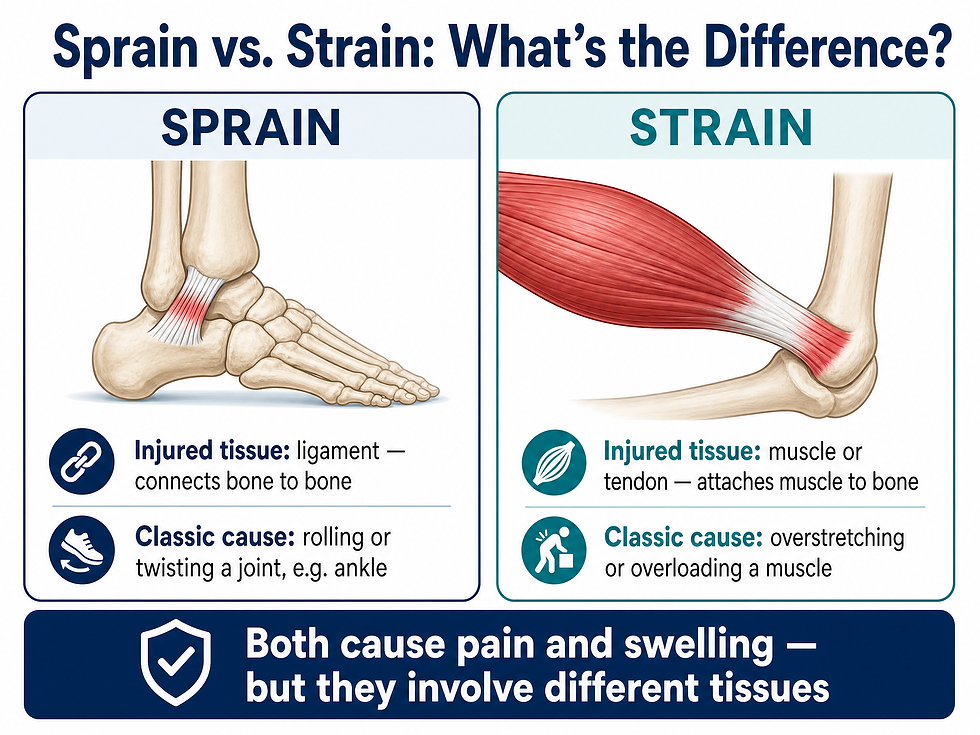
The ankle deserves special attention because it is where most sprains happen. Most ankle sprains involve injuries to the three ligaments on the outside of the ankle. Ligaments are tough bands of tissue that stabilize joints and help prevent excessive movement. An ankle sprain occurs when you roll, twist, or turn your ankle in an awkward way, which can stretch or tear the ligaments that hold the ankle bones together [1].
What does a sprain feel like? Signs and symptoms
Signs and symptoms of a sprain vary depending on the severity of the injury. The most common signs include [1]:
Symptom | What it looks like |
Pain | Aching in or around the injured joint |
Swelling | Puffiness that develops around the joint |
Bruising | Discoloration around the injured area |
Limited movement | Reduced ability to move the affected joint |
A "pop" | Hearing or feeling a pop in the joint at the time of injury |
Because these symptoms overlap with fractures, some injuries should never be managed at home. The same injuries that cause sprains can also cause serious injuries, such as fractures [1].
When should you see a doctor about a sprain?
Mild sprains can be treated at home. But the Mayo Clinic identifies three specific warning signs that mean it is time to see a doctor [1]:
Red flag | Why it matters |
Can't move or bear weight on the affected joint | May indicate a fracture or complete ligament tear |
Pain directly over the bones of an injured joint | Possible bone injury rather than (or in addition to) a sprain |
Numbness in any part of the injured area | Possible nerve involvement |
Children deserve an extra note of caution. Children have areas of softer tissue, called growth plates, near the ends of their bones. The ligaments around a joint are often stronger than these growth plates, so children are more likely to experience a fracture than a sprain [1]. When a child injures a joint and symptoms are significant, a medical evaluation is especially important.
How common are sprains?
Ankle sprains are among the most common injuries of all. Widely cited estimates from American orthopedic sources put the number at roughly 25,000 ankle sprains per day in the United States — more than 1 million emergency department visits per year [7] [8]. Some sources cite figures as high as 30,000 per day, so a reasonable reading is a daily range of 25,000–30,000 [8] [9].
The research literature adds useful detail about who sprains affect and where [10] [11] [12]:
Statistic | Finding | Source |
Daily U.S. ankle sprains | ~25,000–30,000 per day | Widely cited orthopedic estimates [8][9] |
Emergency visits | >1 million per year in the U.S. | Widely cited estimate [8] |
Athletic share | 33.2% of all ankle sprains tied to athletic activity; basketball alone 15.8% | PubMed 2025 national epidemiology study [10] |
Athletes | Ankle sprains are the most common lower-limb injury in athletes — 16–40% of injuries, ~14% of emergency visits | Open Access Journal of Sports Medicine review [11] |
High school sports | Ankle sprains ≈ 15–17% of all reported injuries | Journal of Athletic Training [12] |
What causes a sprain?
A sprain occurs when you overextend or tear a ligament while severely stressing a joint. The mechanism varies by joint, and each has a characteristic injury pattern [1]:
Joint | Typical mechanism |
Ankle | Walking or exercising on an uneven surface; landing awkwardly from a jump |
Knee | Pivoting during an athletic activity |
Wrist | Landing on an outstretched hand during a fall |
Thumb | Skiing injury; overextension when playing racquet sports such as tennis |

What increases your risk of spraining a joint?
Three categories of risk factors contribute to sprains, all fixable or manageable [1]:
Risk factor | How it raises risk |
Environmental conditions | Slippery or uneven surfaces make you more prone to injury |
Fatigue | Tired muscles provide less support for joints; fatigue also makes you more likely to succumb to forces that stress a joint |
Poor equipment | Ill-fitting or poorly maintained footwear or sporting equipment increases risk |
How are sprains diagnosed?
Diagnosis begins with a physical exam. The doctor checks for swelling and points of tenderness in the affected limb, and the location and intensity of pain help determine the extent and nature of the damage [2].
Because a sprain-producing injury can also produce a fracture, imaging is often part of the workup [2]:
Test | Purpose |
X-ray | Rules out a fracture or other bone injury as the source of the problem |
MRI | May be used to diagnose the extent of the soft-tissue injury |
How do you treat a sprain?
For immediate self-care of a sprain, the standard guidance is the R.I.C.E. approach — rest, ice, compression, elevation [2]:
Step | What to do | Key details |
R — Rest | Avoid activities that cause pain, swelling, or discomfort | Don't avoid all physical activity — total immobilization isn't the goal |
I — Ice | Ice the area immediately, even if seeking medical help | Use an ice pack or slush bath of ice and water for 15–20 minutes each time; repeat every 2–3 hours while awake during the first few days |
C — Compression | Compress with an elastic bandage until swelling stops | Don't wrap too tightly; begin wrapping at the end farthest from your heart; loosen if pain increases, numbness occurs, or swelling occurs below the wrap |
E — Elevation | Elevate the injured area above the level of your heart | Especially at night — gravity helps reduce swelling |

Over-the-counter pain medications such as ibuprofen and acetaminophen can also help [2].
One important detail that many people miss: after the first two days, gently begin to use the injured area. You should see a gradual, progressive improvement in the joint's ability to support your weight or your ability to move without pain [2].
How long does a sprain take to heal?
Recovery from sprains can take days to months, depending on severity and the joint involved [2]. This wide range reflects a basic truth about sprains: a mild stretch of an ankle ligament is a different injury than a complete tear requiring surgery.
For sprains that don't resolve with basic care, further support is available [2]:
Option | Purpose |
Physical therapy | Helps maximize stability and strength of the injured joint or limb |
Brace or splint | Immobilizes the area when the doctor suggests it |
Surgery | May be considered for injuries such as a torn ligament |
How can you prevent a sprain?
Prevention centers on conditioning the muscles that act as natural joint supports. The Mayo Clinic's guidance can be summarized as four habits [1]:
Regular stretching and strengthening exercises for your sport, fitness, or work activity, as part of an overall physical conditioning program. The memorable rule: be in shape to play your sport — don't play your sport to get in shape.
Condition previously injured joints. The best brace you can give yourself is your own "muscle brace." Ask your doctor about appropriate conditioning and stability exercises for joints you have injured before.
Wear supportive footwear that offers support and protection.
Match effort to fatigue. Tired muscles support joints poorly, so avoid pushing hard when fatigued, and keep playing surfaces and equipment in good condition.
Getting ready for a doctor's appointment
You may initially consult your family physician, who may refer you to a doctor who specializes in sports medicine or orthopedic surgery [2].
Before the visit, write a list that includes detailed descriptions of your symptoms, information about your own medical problems, the medical problems of your parents or siblings, all medications and dietary supplements you take, and the questions you want to ask [2].
During the exam, expect questions such as [2]:
Typical doctor's question | What it helps determine |
How exactly were you moving when the injury occurred? | Mechanism of injury |
Did you hear or feel a pop or snap? | Likelihood of ligament tear |
When did it happen? | Stage of injury and healing |
What types of home treatments have you tried? | What's already been attempted |
Have you ever injured this part of your body before? If so, how? | Recurrence and chronic instability |
Conclusion
A sprain is a stretched or torn ligament — most often in the ankle — and the vast majority of cases can be managed at home with the R.I.C.E. approach and over-the-counter pain relief. The three warning signs that change the game are inability to bear weight, bone pain, and numbness, because they point toward a fracture or more serious injury. Recovery takes days to months, and a previously sprained joint is your best project: the strongest protection against the next sprain is your own "muscle brace," built through conditioning and stability exercises.
What to do next: If your joint injury carries any of the three red flags — can't bear weight, pain over the bone, or numbness — see a doctor for an evaluation, and mention that children may need imaging even for modest injuries because their growth plates fracture more easily than their ligaments tear. For mild sprains, start R.I.C.E. now, and begin gentle use of the joint after about two days. Ask your doctor about a conditioning program for the muscles around the joint once you have recovered.
This article is for educational purposes only and is not a substitute for professional medical advice, diagnosis, or treatment.
FAQ
Is a sprain the same as a strain?
No. A sprain injures the ligaments — the bands of tissue connecting two bones together — while a strain injures a muscle or the tendon that attaches a muscle to a bone [1]. Both cause pain and swelling, but they involve different tissues and may require different care.
How long does it take for a sprained ankle to heal?
Recovery can take days to months depending on severity. Mild sprains improve within days to weeks with rest, ice, compression, and elevation, while severely torn ligaments can take months and sometimes need surgery [2].
Should I use ice or heat on a sprain?
Use ice for the first few days. Apply an ice pack or ice-and-water slush bath for 15–20 minutes at a time, every two to three hours while awake, immediately after the injury [2]. Heat is not part of the recommended early care described in Mayo Clinic's guidance.
What does it mean if I heard a "pop" when I was injured?
Hearing or feeling a pop in the joint at the time of injury is one of the classic signs of a sprain [1]. It suggests the ligament was significantly stressed, and combined with other red flags — inability to bear weight, bone pain, or numbness — it is a reason to see a doctor.
Can a sprain heal without a doctor?
Mild sprains can be successfully treated at home with the R.I.C.E. approach [1]. But because the same injuries that cause sprains can also cause fractures, any inability to bear weight, bone pain, or numbness warrants a medical evaluation [1].
Why do sprains keep happening to the same ankle?
A previously injured joint is more vulnerable, which is why the Mayo Clinic recommends strengthening and conditioning the muscles around an injured joint — its "muscle brace" — to protect it in the long term [1]. Recurrent sprains are common enough that chronic ankle instability is a recognized follow-on condition in the research literature [11].
When is surgery needed for a sprain?
Surgery may be considered for some injuries, such as a severely torn ligament [2]. Most sprains, however, heal without surgery.
What exercises prevent sprains?
Regular stretching and strengthening exercises for your sport, fitness, or work activity, as part of an overall physical conditioning program, help minimize sprain risk. Supportive footwear and avoiding high-intensity activity when fatigued also help [1].
Comments