The Ulna Bone: Anatomy, Function, and Common Conditions

Updated: 3 days ago
Medically reviewed by Dr. Baraa Alnahhal, MD | Last reviewed: October 31, 2026
Quick Answer: What is the ulna?
The ulna is the longer of the two forearm bones, running from the elbow to the wrist on the pinkie side. [1] It helps move the arm, wrist and hand and anchors more than a dozen muscles plus tendons and ligaments. [1] Its notched upper end forms the point of the elbow, and its narrow lower end forms part of the wrist. [1]
What the research says
A broken wrist can be a warning sign for bone weakness. A meta-analysis of 12 studies found that women who had a wrist fracture had a higher risk of a later hip fracture (RR 1.43, 95% CI 1.27–1.60), while the increase in men was not statistically significant (RR 2.11, 95% CI 0.93–4.85) (Johnson et al., Injury, 2017) [2].
Exercise can help build bone. A meta-analysis of 22 randomized trials (1,051 participants) found that exercise increased lumbar spine bone density (SMD 0.46, 95% CI 0.16–0.76) and femoral neck bone density (SMD 0.42, 95% CI 0.13–0.71) in women under 30, and that combined exercise programs improved femoral neck and whole-body bone density in adult women (Miao et al., Frontiers in Physiology, 2026) [3].
Calcium and vitamin D pills alone did little to prevent fractures in mostly lower-risk adults. A review of 69 randomized trials (153,902 participants) found little to no effect on any fracture for calcium (RR 0.91, 95% CI 0.81–1.01) or vitamin D (RR 1.00, 95% CI 0.95–1.06), and a small effect for the two combined (RR 0.91, 95% CI 0.84–0.99); most participants lived in the community and were not at high risk, and evidence for high-risk people was limited (Massé et al., BMJ, 2026) [4].
The Vital Role of the Ulna in Movement
The ulna is an indispensable part of the upper limb’s mechanical system. Its primary responsibility is to provide stability to the forearm while allowing a wide range of motion. Working together with the radius, it helps the forearm and wrist move, flex, and rotate smoothly, [1] which is what allows tasks like turning a doorknob or typing on a keyboard.
Beyond movement, the ulna serves as a structural anchor for the forearm. It holds more than a dozen muscles in place and supports tendons, ligaments and blood vessels. [1] Because it is connected to so many muscles and nerves, an injury to one structure can often affect the others. [1]
Function | Description | Impact on Daily Life |
Rotation | Helps the forearm and wrist turn | Enables tasks like using a screwdriver |
Stabilization | Provides a firm base for the arm, wrist and hand | Supports lifting and carrying objects |
Muscle Anchor | Holds more than a dozen muscles in place | Essential for grip strength and dexterity |
Elbow Movement | Meets the humerus to form the elbow joint | Allows bending and straightening of the arm |

Detailed Anatomy of the Ulna
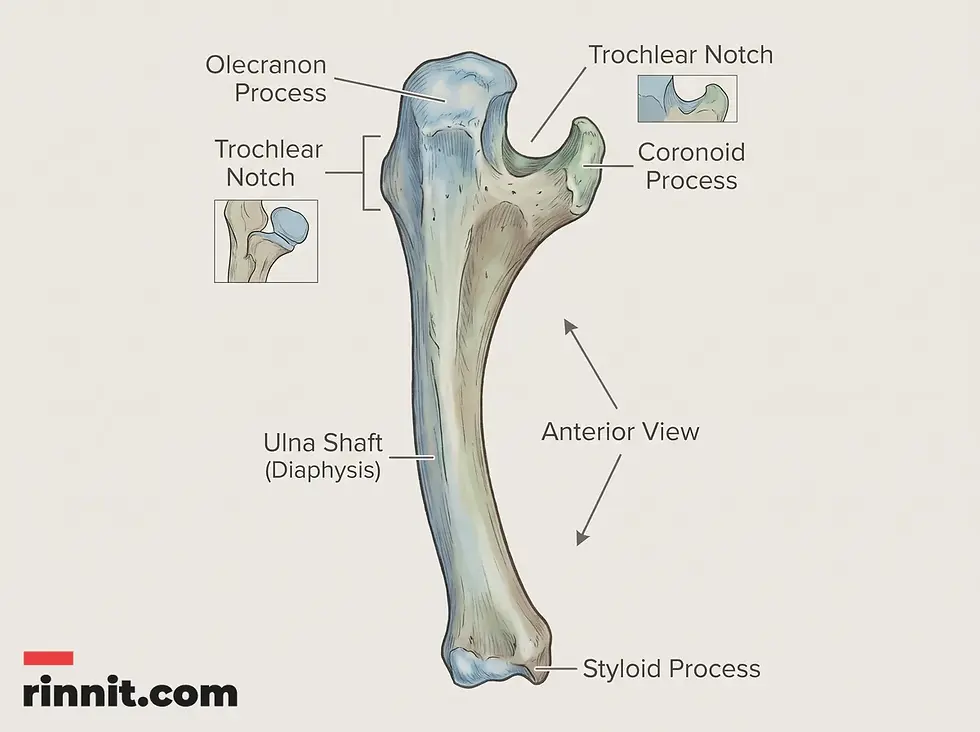
The ulna is made up of three main sections: the proximal (upper) end, the shaft, and the distal (lower) end. [1] The proximal end connects to the humerus, the upper arm bone, and forms the bony point of the elbow. [1] It includes the olecranon, the trochlear notch, the coronoid process, the radial notch and the ulnar tuberosity. [1]
The shaft is the long, slightly curved middle portion that supports the weight of the forearm and gives it its shape. [1] At the bottom, the distal end, sometimes called the head of the ulna, forms part of the wrist joint and ends in a rounded bump called the styloid process, which you can feel above the wrist on the pinkie side. [1] The ulna is the second longest bone in the arm and one of the longest bones in the body, and in most adults it is around 11 inches long. [1]
Anatomical Section | Key Components | Function |
Proximal (Upper) | Olecranon, trochlear notch, coronoid process, radial notch, ulnar tuberosity | Connects to the humerus and forms the point of the elbow |
Shaft (Middle) | Long, slightly curved bony body | Supports the weight of the forearm and gives it its shape |
Distal (Lower) | Head and styloid process | Forms part of the wrist joint |
Common Conditions and Diagnostic Tests
The most common problems that affect the ulna are fractures, osteoporosis, and damage to the ulnar nerve. [1] Other common conditions include osteoarthritis, ulnar wrist pain, and ulnar nerve entrapment. [1] Ulna fractures are most often caused by sports injuries, falls, and car accidents, and symptoms include pain, swelling, tenderness, bruising or discoloration, a bump or deformity that is not usually there, and being unable to move the arm as usual. [1] If you have had trauma or think you have a fracture, go to the emergency room right away. [1]
Osteoporosis weakens bones and makes them more susceptible to sudden and unexpected fractures. [1] It usually causes no noticeable symptoms, so many people do not know they have it until a bone breaks, and females and adults older than 65 have a higher risk. [1] The most common test used to check bone health is a bone density test, also called a DEXA or DXA scan, which uses low levels of X-rays to measure bone strength and track bone loss with age. [1] If an arm injury is suspected, providers may use X-rays, MRI, or CT scans to assess the damage. [1]
Condition | Common Causes | Typical Symptoms |
Fractures | Falls, sports injuries, car accidents | Pain, swelling, bruising, deformity, inability to move the arm as usual |
Osteoporosis | Weakened bone, more common in females and adults over 65 | Usually none until a fracture occurs |
Ulnar Nerve Entrapment | Compression of the ulnar nerve | Numbness or tingling in the ring and little fingers |
Osteoarthritis | Joint wear and tear | Pain and stiffness |

Treatment and Proactive Care
Usually the ulna needs treatment only after a fracture or other injury, or if osteoporosis is diagnosed. [1] A fracture needs some form of immobilization, such as a splint or cast, and some fractures need surgery to realign the bone so it can heal; physical therapy can then help you regain strength and movement. [1] Treatment for osteoporosis can include exercise, vitamin and mineral supplements, and medications, and your provider will build a plan around your own bone health. [1]
Keeping the ulna healthy involves both lifestyle choices and safety precautions. A good diet and exercise plan, along with regular checkups, helps maintain bone health. [1] Simple safety measures, such as wearing your seatbelt, using the right protective equipment for sports, keeping your home and workspace free of clutter, using proper tools instead of standing on chairs or countertops, and using a cane or walker if you are at risk of falls, reduce the risk of injury. [1]
Conclusion
The ulna is far more than just a bone; it is a central pillar of forearm function and stability. By understanding its anatomy and the conditions that can affect it, you can take better care of your arm health. Whether through good nutrition, regular medical checkups, or simple safety habits, protecting the ulna helps keep your arms strong and mobile throughout life.
Next Steps
If you are over the age of 50 or have a family history of osteoporosis, talk to your healthcare provider about a bone density test. Detecting osteoporosis early, before it causes a fracture, is one of the most effective ways to protect your bones and maintain your quality of life.
Frequently Asked Questions
What is the ulna?
The ulna is the longer of the two bones in the forearm, located on the pinkie side.
Where is the ulna located?
The ulna sits on the medial side of the forearm, the same side as your pinkie finger and opposite the thumb.
What is the difference between the ulna and the radius?
The ulna is slightly longer and on the pinkie side, while the radius is on the thumb side. They work together to support the forearm and wrist and let the hand rotate smoothly.
How long is the average adult ulna?
Most adults’ ulna bones are around 11 inches long.
What is the olecranon?
The olecranon is the bony part of the upper (proximal) ulna that forms the point of the elbow.
What does the ulna do for the wrist?
The ulna's lower end forms part of the wrist joint, and it helps the forearm and wrist move, flex, and rotate.
What is a DEXA scan?
A DEXA scan is a bone density test that uses low levels of X-rays to measure how strong your bones are, and it is used to track bone loss and check for osteoporosis.
What causes ulnar fractures?
The most common causes are sports injuries, falls, and car accidents.
What is ulnar nerve entrapment?
Ulnar nerve entrapment is a condition in which the ulnar nerve, which runs from the neck to the hand, becomes compressed, which can cause numbness or tingling in the ring and little fingers.
Can the ulna be repaired without surgery?
Some fractures heal with immobilization in a splint or cast, while others need surgery to realign the bone so it can heal. Your provider will recommend the right option for the type of fracture.
Why is the ulna shaft curved?
The shaft is the long middle part that supports the weight of the forearm and gives it its shape, and a slight curve is a normal feature of the bone.
What is the styloid process?
The styloid process is the rounded bump at the lower end of the ulna, which you can feel above the wrist on the pinkie side.
How does osteoporosis affect the ulna?
Like all bones, the ulna can be weakened by osteoporosis, which makes it more susceptible to sudden and unexpected fractures, sometimes before the person knows they have the condition.
What muscles attach to the ulna?
The ulna holds more than a dozen muscles in place, along with tendons, ligaments and blood vessels, which is why an injury to one structure can affect the others.
What should I do if I suspect an ulnar fracture?
Go to the emergency room right away if you have had trauma or think you have a fracture, so you can get imaging and have the arm stabilized.
Related Reading
Radius Bone: Anatomy, Location, Function and Common Problems describes the forearm bone that works alongside the ulna.
Broken Wrist: Symptoms, Causes, and Treatment explains wrist fractures, including breaks of the ulna end.
Understanding the Ulnar Nerve (Funny Bone) covers the nerve that runs along the ulna past the elbow.
What Is Ulnar Wrist Pain? Symptoms, Causes, and Treatment Explained (2026 Guide) explains pain on the pinky side of the wrist and its causes.
Sources
Cleveland Clinic. Ulna. Cleveland Clinic. Last updated December 9, 2022. https://my.clevelandclinic.org/health/body/24520-ulna
Johnson NA, Stirling ERB, Divall P, et al. Risk of hip fracture following a wrist fracture: a meta-analysis. Injury. 2017;48(2):399-405. PMID: 27839795. DOI: 10.1016/j.injury.2016.11.002
Miao T, Li X, Zhang W, et al. Effects of exercise on bone mineral density and bone turnover markers in adults: a systematic review and meta-analysis. Front Physiol. 2026;16:1672997. PMID: 41584801. DOI: 10.3389/fphys.2025.1672997
Massé O, Mercurio CM, Dupuis S, et al. Calcium, vitamin D, or combined supplementation to prevent fractures and falls: systematic review and meta-analysis. BMJ. 2026;393:e088050. PMID: 42161415. DOI: 10.1136/bmj-2025-088050
Medical disclaimer
This information is for educational purposes only and does not constitute medical advice. Always consult a healthcare professional for diagnosis and treatment.



Comments