What Is Ulnar Wrist Pain? Symptoms, Causes, and Treatment Explained (2026 Guide)

Updated: 2 days ago
Medically reviewed by Dr. Baraa Alnahhal, MD · Last reviewed: September 2026
Editorial note: This article is based exclusively on authoritative medical sources, including Mayo Clinic, the American Academy of Orthopaedic Surgeons, NIH/StatPearls, and CDC data. It is for general education only and is not medical advice. If you have persistent pain on the pinky side of your wrist — especially after a fall, or pain that weakens your grip — see a healthcare professional.
TL;DR
Ulnar wrist pain is pain on the side of the wrist opposite the thumb (the pinky side). It is most often caused by a fall onto an outstretched hand, repetitive wrist motion from work or sports, or arthritis. Key signs include pain when gripping or twisting, weak grip strength, and a popping or clicking sensation. Most cases are diagnosed with a physical exam and X-ray, and treated with rest, splinting, pain relievers, and physical therapy — surgery is reserved for cases that don't improve.
Quick Answer: What Is Ulnar Wrist Pain and How Is It Treated?
Ulnar wrist pain is pain on the pinky side of the wrist, caused by injuries to the bones, tendons, or ligaments — most often from a fall onto an outstretched hand, repetitive strain, or arthritis. Diagnosis usually involves a physical exam plus an X-ray, and most cases improve with over-the-counter pain relievers, splinting or bracing, and physical therapy, though some need minimally invasive surgery [1][2].
What Is Ulnar Wrist Pain?
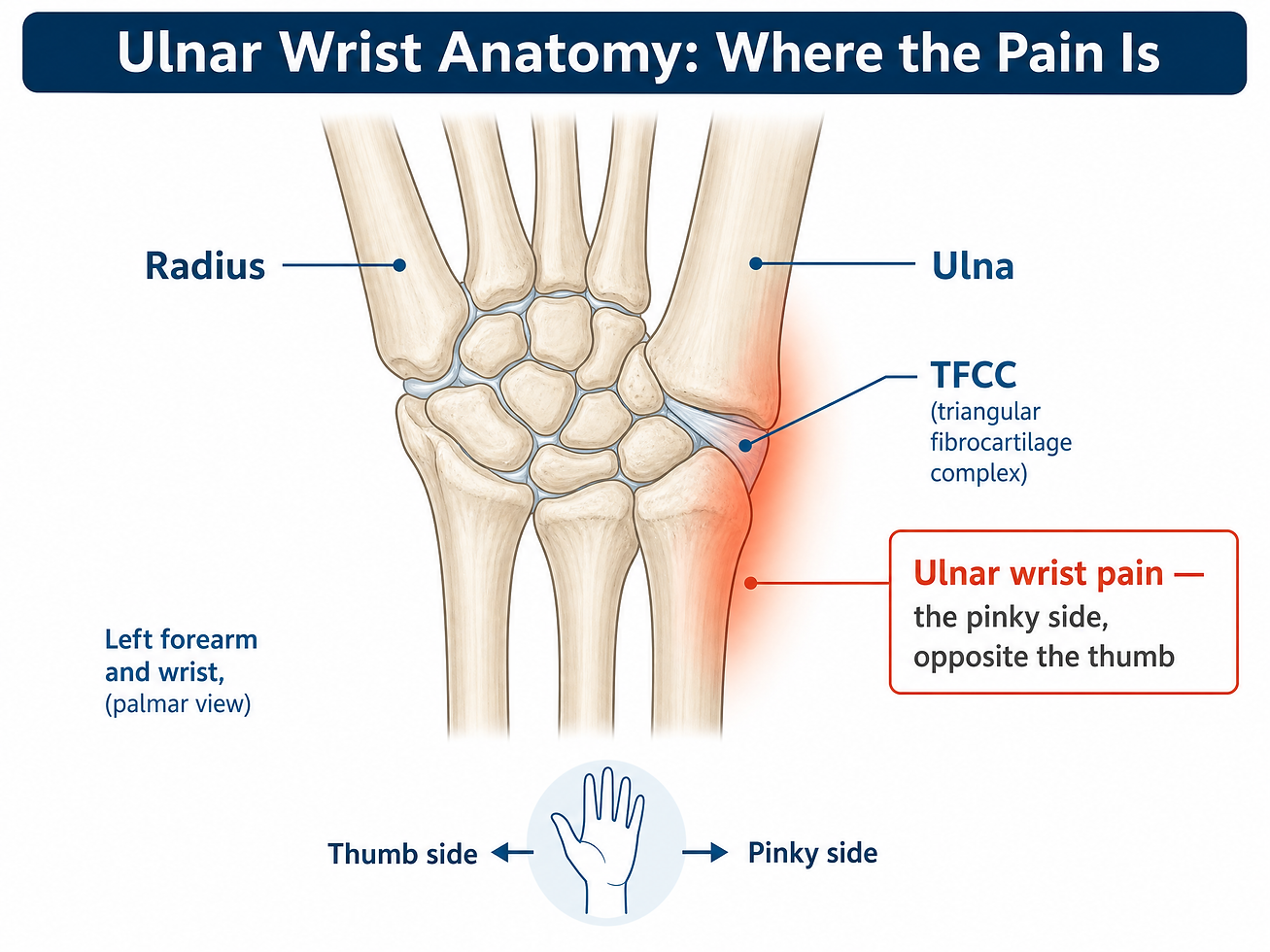
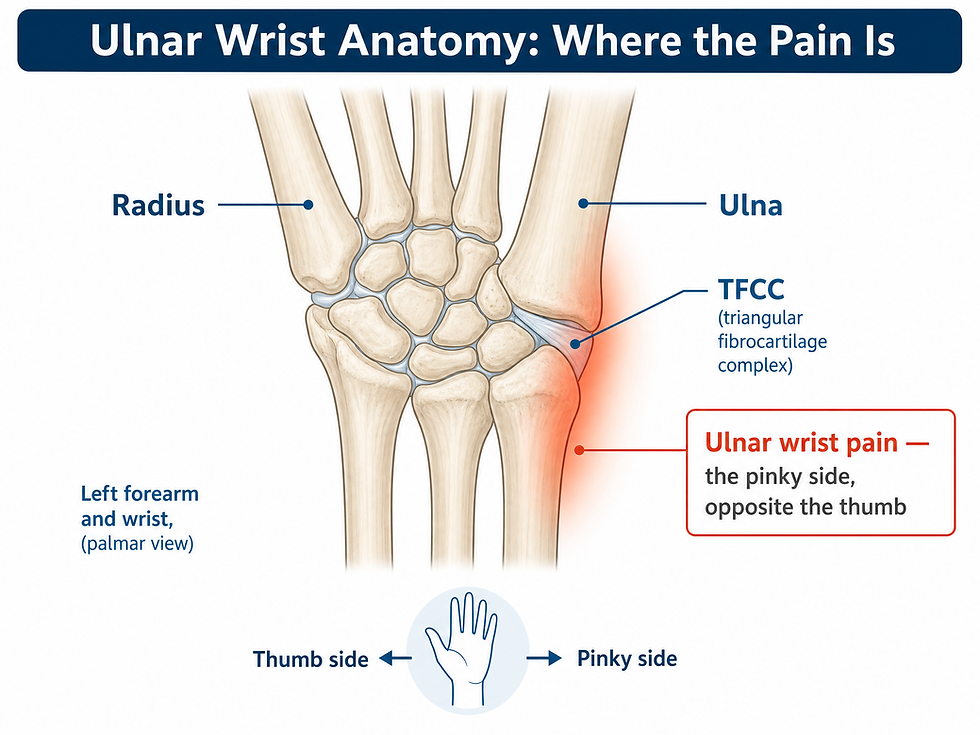
The forearm contains two bones: the radius on the thumb side and the ulna on the opposite side. Ulnar wrist pain is pain on the side of your wrist opposite the thumb — the pinky side [1].
Because so many structures crowd that small area, ulnar wrist pain can be linked to many different types of injuries, including problems with the bones, tendons, and ligaments. The pain can vary depending on the cause [1].
Wrist problems are extremely common. Among all broken bones treated in U.S. emergency rooms, about 1 in every 6 is a wrist fracture, and the single most frequent cause is falling on an outstretched hand [4][5].
What Does Ulnar Wrist Pain Feel Like?
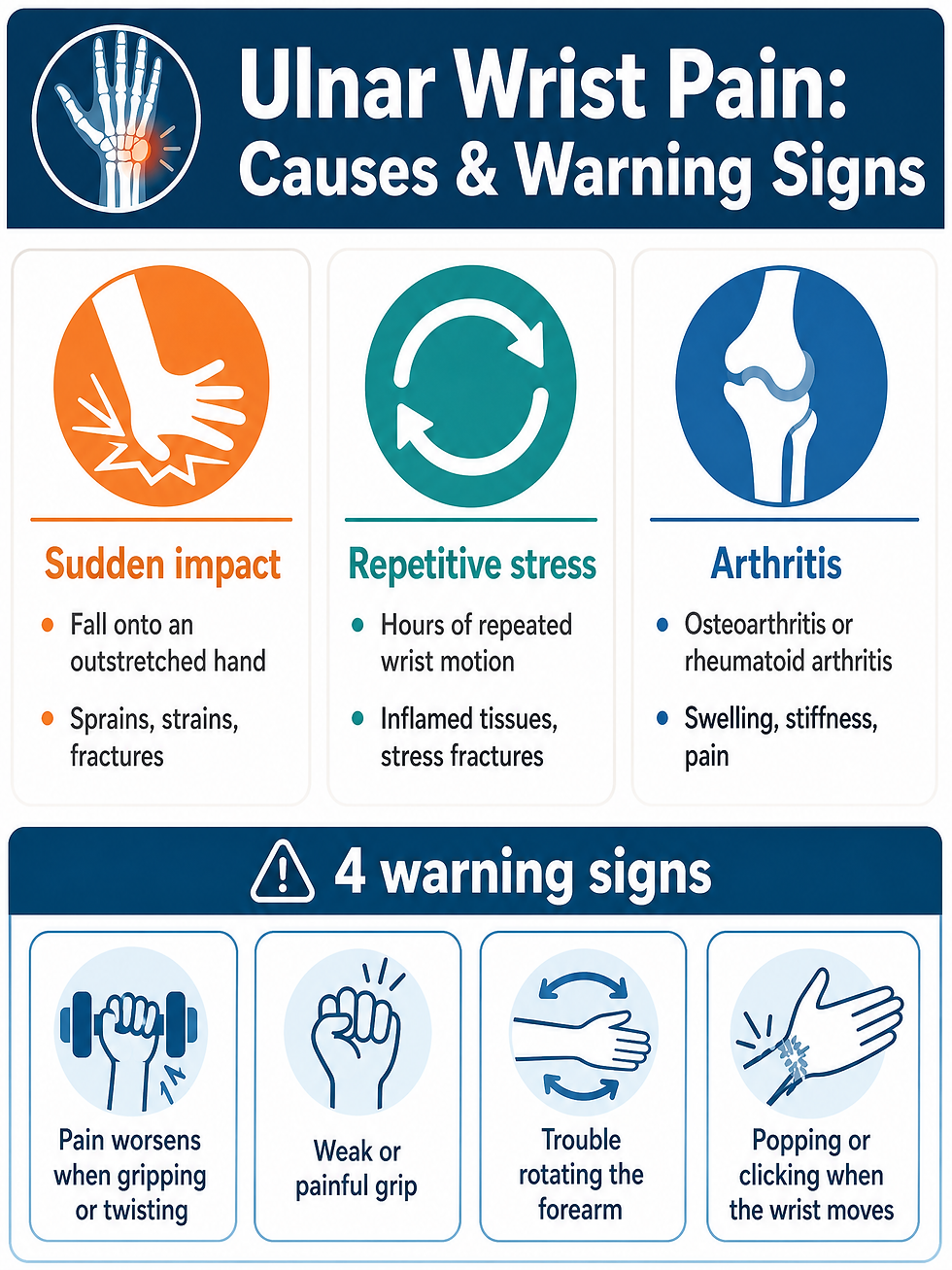
Four symptoms stand out as the hallmarks of ulnar wrist pain [1]:
Symptom | What it means |
|---|---|
Pain that worsens with gripping or twisting | The most characteristic sign — activities like opening jars, lifting, or turning doorknobs aggravate the pain |
Loss of grip strength | You cannot grip firmly, or your grip noticeably weakens |
Trouble moving the wrist or rotating the forearm | Rotating the forearm (like turning a palm up) becomes painful or difficult |
Popping or clicking sounds | A snapping or clicking noise or sensation when the wrist moves — often a sign of ligament or cartilage involvement |
What Causes Ulnar Wrist Pain?
Because so many factors can lead to wrist pain, it can be difficult to diagnose. Three causes account for most cases [1]:
Cause | How it happens | Typical injuries |
|---|---|---|
Sudden impacts | A fall onto an outstretched hand | Sprains, strains, and fractures — including the distal radius fracture, the most common broken wrist in the U.S. [4][5] |
Repetitive stress | Any activity that involves wrist motion done over and over | Inflamed tissues around the joint; stress fractures — risk rises when the movement is performed for hours without a break |
Arthritis | Joint inflammation | Both osteoarthritis and rheumatoid arthritis can cause swelling, stiffness, and pain in the wrist |
Beyond these, one structure deserves special mention: the triangular fibrocartilage complex (TFCC). This cartilage-and-ligament structure sits on the ulnar side of the wrist, acting as a cushion and stabilizer between the ulna and the small wrist bones. Tears in the TFCC are a leading cause of ulnar-sided wrist pain, especially in athletes and people over 50 — imaging studies find TFCC damage in roughly a quarter of symptom-free wrists in younger adults and nearly half in adults over 70, so finding a tear on a scan does not always explain the pain [6][7].
Who Is at Higher Risk?
Sports participation, repetitive work, and certain health conditions all raise the odds of ulnar wrist pain [1]:
Risk factor | Examples |
|---|---|
Sports participation | Football, golf, tennis, and pickleball — both impact sports and those with repetitive wrist stress |
Repetitive work | Regular computer mouse or keyboard use; carpenters and plumbers who use tools in small spaces, forcing the wrist into awkward positions |
Underlying diseases and conditions | Generally loose ligaments, osteoarthritis, rheumatoid arthritis, and gout |
Context matters here. Arthritis is widespread — diagnosed arthritis affected roughly 1 in 5 U.S. adults (18.9%) in 2022, with osteoarthritis being the most common form [8]. And in racquet-sport athletes specifically, studies found that 75% of TFCC injuries affect the dominant wrist, and about a third are ulnar-sided tears [9].
How Is Ulnar Wrist Pain Diagnosed?
Diagnosis starts with a physical exam. Your healthcare professional moves your wrist or hand into different positions to see what hurts, and checks your range of motion and grip strength [2].
Imaging tests then identify the specific problem:
Test | What it shows |
|---|---|
X-ray | The most commonly used test for wrist pain; reveals bone fractures or signs of osteoarthritis |
CT scan | More-detailed views of the wrist bones; may spot fractures that don't show up on X-rays |
MRI | Radio waves and a strong magnetic field produce detailed images of bones and soft tissues; a smaller device may be used for just the arm |
Ultrasound | A simple, noninvasive test that can examine tendons, ligaments, and cysts |
How Is Ulnar Wrist Pain Treated?
Treatment varies with the type of injury and how serious it is [2]:
Treatment | What it involves |
|---|---|
Pain relievers | Over-the-counter ibuprofen (Advil, Motrin IB) and acetaminophen (Tylenol) may reduce pain; stronger prescription options are available |
Physical therapy | Exercises to strengthen tendons and ligaments; a therapist teaches activity changes that relieve stress on the wrist |
Immobilization | A cast, brace, or splint holds the wrist still so the injury can heal |
Surgery | For some injury types; minimally invasive methods cause less damage to the body than open surgery, which can mean less pain, a shorter hospital stay, and fewer complications |
For most people, the path is simple: short-term pain relief, a period of rest or immobilization, and guided exercises to rebuild strength. Surgery is generally reserved for injuries that don't respond to conservative care.

Preparing for Your Appointment
You may start by seeing your primary healthcare professional, or you may be referred directly to an orthopedics or sports medicine specialist. Come prepared: bring a list of your symptoms (including any that seem unrelated), key personal information (major stresses, recent life changes, family medical history), all medications, vitamins, and supplements with doses, and your questions [2].
Take a family member or friend along if possible, to help you remember the information you're given [2].
Helpful questions to ask include what is likely causing your symptoms, what other possible causes exist, which tests you need, whether the condition is likely temporary or chronic, what the best course of action is, whether you need activity restrictions, and whether you should see a specialist [2].
Expect your healthcare professional to ask when your symptoms began, whether they are continuous or occasional, how serious they are, and what seems to improve or worsen them [2]. In the meantime, avoid anything that seems to worsen your signs and symptoms [2].
When to See a Doctor
See a healthcare professional for ulnar wrist pain if [1]:
Pain persists beyond a few days of rest, or keeps returning with activity
Pain followed a fall onto an outstretched hand (a fracture needs to be ruled out — and about 1 in 6 ER-treated broken bones is a wrist fracture [4])
You've lost grip strength or have trouble rotating your forearm
Your wrist pops, clicks, or feels unstable when it moves
Swelling, warmth, or visible deformity develops
Why Acting Early Matters
Wrist injuries that are rested and treated early usually heal well. Ignoring persistent ulnar-sided pain — especially a hidden fracture, ligament tear, or TFCC injury — can turn an easily treated problem into one that lingers for months, and repetitive-strain problems tend to worsen the longer the aggravating activity continues.
Conclusion and Next Steps
Ulnar wrist pain is one of the most common — and most treatable — wrist problems. It lives on the pinky side of the wrist and usually traces back to one of three causes: a fall onto an outstretched hand, hours of repetitive wrist motion, or arthritis. A physical exam plus an X-ray identifies the problem in most cases, and the combination of pain relievers, splinting, and physical therapy resolves the majority.
Your next steps: If you have pain on the pinky side of your wrist, start by resting the wrist, avoiding activities that make it worse, and using an over-the-counter pain reliever such as ibuprofen or acetaminophen as directed. Add a splint or brace for a few days. If the pain doesn't improve within a week or two — or immediately if it followed a fall, or comes with weakness, clicking, or swelling — see a healthcare professional. And if you work or play sports that strain your wrists, ask a physical therapist about form and activity modifications that take stress off the joint before the problem returns.
Frequently Asked Questions
Where exactly is ulnar wrist pain? It is pain on the side of the wrist opposite the thumb — the pinky side. The ulna is one of the two forearm bones, and it runs along that side of the forearm and wrist [1].
What is the most common cause of ulnar wrist pain? Sudden impact — especially a fall onto an outstretched hand, which can cause sprains, strains, and fractures — is a very common cause. Wrist fractures are among the most common fractures overall: about 1 in every 6 broken bones treated in U.S. emergency rooms is a wrist fracture [1][4].
Can repetitive work cause ulnar wrist pain? Yes. Any activity that involves repeated wrist motion can inflame the tissues around the joint or cause stress fractures, and the risk rises when the movement is performed for hours without a break. Regular computer mouse or keyboard use, and trades like carpentry and plumbing that use tools in small spaces, are classic examples [1].
What does a popping or clicking wrist mean? A popping or clicking sound when the wrist moves can point to a ligament tear or a problem with the triangular fibrocartilage complex (TFCC), the cushioning structure on the ulnar side of the wrist. It is one of the four hallmark signs of ulnar wrist pain and is a good reason to get the wrist examined [1][6].
How is ulnar wrist pain diagnosed? A healthcare professional performs a physical exam — moving the wrist and hand into different positions, checking range of motion and grip strength — and typically orders an X-ray, which is the most commonly used test and can reveal fractures or osteoarthritis. CT, MRI, and ultrasound are used for more detailed views [2].
How is it treated? Most cases are treated with over-the-counter pain relievers (ibuprofen or acetaminophen), a period of immobilization in a cast, brace, or splint, and physical therapy to strengthen tendons and ligaments and teach activity changes. Some cases need surgery, where minimally invasive methods can speed recovery [2].
Can arthritis cause pain on the pinky side of the wrist? Yes. Both osteoarthritis and rheumatoid arthritis can cause swelling, stiffness, and pain in the wrist. Arthritis is common — it affected about 18.9% of U.S. adults in 2022, with osteoarthritis as the most frequent form [8].
When should I worry about ulnar wrist pain? Get prompt evaluation if the pain followed a fall (a fracture needs ruling out), if your grip has weakened, if your wrist pops, clicks, or feels unstable, or if swelling, warmth, or deformity appears. Persistent pain that doesn't improve after a week or two of rest also warrants a visit [1][2].
References
1. Mayo Clinic — Ulnar wrist pain: Symptoms and causes (updated March 09, 2024)
2. Mayo Clinic — Ulnar wrist pain: Diagnosis and treatment (updated March 09, 2024)
Comments