Keratometry: Measuring Corneal Curve for Astigmatism and Cataract Surgery

Updated: 2 days ago
Written and medically reviewed by Dr. Baraa Alnahhal, MD · Last reviewed: November 2026 · How we review
Quick Answer
Keratometry is an eye test that measures the curve of the cornea, the clear front surface of the eye. Its main use is to diagnose astigmatism, and it's also used to fit contact lenses and choose the right lens implant for cataract surgery. A typical cornea measures about 43 diopters. The test is painless and has no risks.
What the research says
Corneal measurements matter for cataract surgery: in an analysis of 584 lens implant surgeries, errors in measuring corneal power accounted for about 8% of the error in predicting vision after surgery, with eye length and lens position contributing more (Olsen T, J Cataract Refract Surg, 1992) [2]
Different devices give similar but not identical results: a study comparing manual keratometry with four automated and imaging devices in normal eyes found most agreed well with manual readings, but one device's results differed enough that it shouldn't be used interchangeably (Mehravaran S et al., Int Ophthalmol, 2014) [3]
Key takeaways
Measures the curve of the cornea.
Main use is diagnosing astigmatism.
Also used for contact lens fitting and cataract surgery planning.
Results are K readings in diopters; about 43 D is typical.
Painless, quick and no risks.
Why is it done?
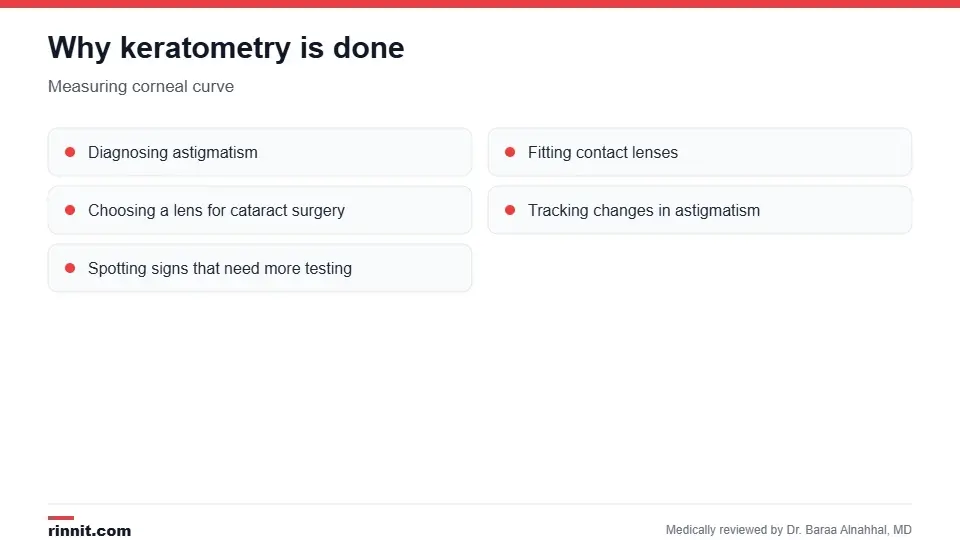
Keratometry measures how curved the cornea is.
To diagnose astigmatism, a refractive error in which the cornea is curved more in one direction.
To fit contact lenses.
To help choose the right intraocular lens for cataract surgery.
As part of a routine eye exam, or separately if astigmatism is suspected. Sources: [1]
Large or sudden changes in astigmatism can be a sign of keratoconus, which needs prompt attention. Sources: [1]
How do I prepare?
No special preparation is needed, and it can usually be done during a regular office visit. Sources: [1]
What happens during the test?
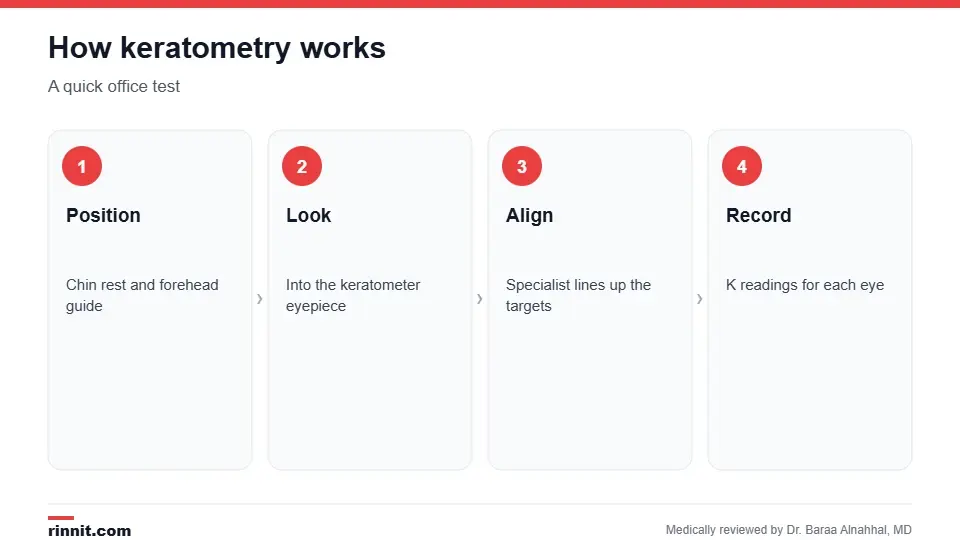
Keratometry takes just a few minutes.
You rest your chin on a support and your forehead against a guide.
The specialist lines up the keratometer with one eye; your other eye may be covered.
You look into the eyepiece and see three circles or targets with plus and minus signs.
The specialist adjusts the targets until the plus signs line up and touch, then records the readings.
The other eye is measured the same way. Sources: [1]
The light may be bright, but it doesn't harm your eyes. There are no risks. Sources: [1]
Understanding your results
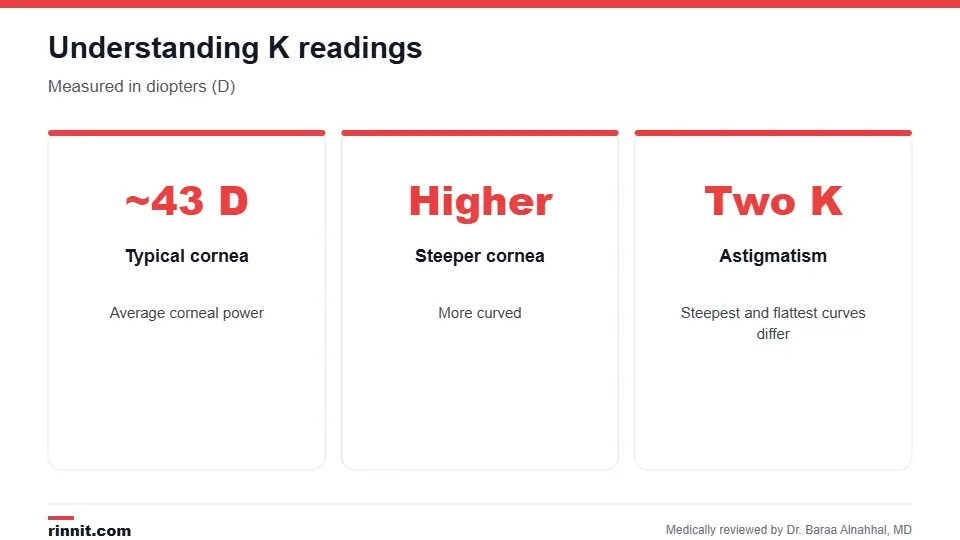
K readings are measured in diopters.
Finding | What it means |
About 43 diopters | Typical corneal curve |
Higher K value | Steeper cornea |
Lower K value | Flatter cornea |
Two different K values | Astigmatism; shows the steepest and flattest curves and where they are |
Sources: [1]
Keratometry is an estimate, because it treats the cornea as a perfect sphere. For more detail, your specialist may use corneal topography or tomography to double-check results. An optician or eye specialist can then help you choose eyeglasses, contacts or other correction. Sources: [1, 2, 3]
Conclusion
Keratometry is a simple, quick measurement of how your cornea curves. It's the classic way to find astigmatism and an important step before contact lens fitting and cataract surgery.
Keep learning: read about astigmatism and corneal topography.
Frequently asked questions
What is keratometry?
A test that measures the curve of the cornea.
What is it used for?
Diagnosing astigmatism, fitting contacts and planning cataract surgery.
What is a K reading?
The measurement of corneal curve, in diopters.
What is a normal K reading?
About 43 diopters.
What does astigmatism look like on keratometry?
Two different K values for the steepest and flattest curves.
Does it hurt?
No.
Do I need to prepare?
No.
Are there risks?
No.
How is it different from corneal topography?
Keratometry measures a few points; topography maps the whole surface.
Why is it done before cataract surgery?
To help choose the right lens implant.
Related Reading
Corneal Pachymetry: Measuring Corneal Thickness for Glaucoma and LASIK explains the test that measures corneal thickness.
Astigmatism: Symptoms, Causes & Treatment Options — Complete Guide the main condition keratometry finds.
Corneal Topography: Mapping the Cornea and Reading the Results a more detailed map of the cornea.
Cataracts: Symptoms, Causes, Diagnosis and Treatment — What You Need to Know surgery planned using K readings.
Refractive Errors: Symptoms, Causes, Types, and Treatment focusing problems of the eye.
Eye Exam: What Happens, Tests Included and How Often to Go where keratometry is often done.
References
Cleveland Clinic. Keratometry: What It Is, How It's Done & When It's Needed. Cleveland Clinic. Last updated November 14, 2024. https://my.clevelandclinic.org/health/diagnostics/keratometry
Olsen T. Sources of error in intraocular lens power calculation. J Cataract Refract Surg. 1992;18(2):125-129. PMID 1564648. https://doi.org/10.1016/s0886-3350(13)80917-0
Mehravaran S, Asgari S, Bigdeli S, et al. Keratometry with five different techniques: a study of device repeatability and inter-device agreement. Int Ophthalmol. 2014;34(4):869-875. PMID 24562593. https://doi.org/10.1007/s10792-013-9895-3
Medical disclaimer
This article is for general education only and does not replace advice from a qualified healthcare professional. Talk to your doctor about your own diagnosis and treatment, and seek emergency care right away for severe or sudden symptoms.



Comments