Kasabach-Merritt Syndrome: Understanding the Rare Vascular Complication

Updated: 2 days ago
Medically reviewed by Dr. Baraa Alnahhal, MD · Last reviewed: October 2026
Quick Answer: Key Facts About Kasabach-Merritt Syndrome
Kasabach-Merritt syndrome is a rare complication in infants with certain benign vascular tumors, causing low platelets, low clotting proteins and a risk of severe bleeding. Most children are diagnosed before age one, often with a large, growing reddish or purplish mass. Historically up to 30% of babies died; with modern treatment such as sirolimus, deaths are much less common.
Feature | Details |
Who it affects | Infants. Doctors diagnose most children before they are a year old. [1] |
Associated tumors | Kaposiform hemangioendothelioma (KHE) and tufted angioma (TA), both benign vascular tumors. [1] |
Core complication | Low platelets (thrombocytopenia), low clotting proteins and a risk of severe bleeding. [1] |
How often it develops | About 7 in 10 babies with KHE and 1 in 10 babies with TA. [1] |
Mortality | |
Common symptoms | A large, growing reddish or purplish mass, bruise-like patches, small red or purple spots, and pain or irritability. [1] |
Treatment | Medicines such as sirolimus (with or without a steroid) or vincristine, supportive blood product care, and in selected cases surgery, embolization or radiation. [1] |
What the research says
Adding a short course of prednisolone to sirolimus improved early platelet recovery. In a randomized trial of 73 participants with KHE and Kasabach-Merritt phenomenon, a durable platelet response (platelet count above 100 × 10⁹/L) at week 4 was reached by 35 of 37 given sirolimus plus prednisolone versus 24 of 36 given sirolimus alone (difference 27.9%; 95% CI 10.0 to 44.7). The combination group also had fewer blood transfusions, and rates of serious side effects were similar. (Ji et al., Blood, 2022) [3]
mTOR inhibitors such as sirolimus show high response rates in published reports. A systematic review of 327 patients with KHE treated with mTOR inhibitors found positive outcomes in 96.3%, complete remission in 12% and a mortality rate of 2% (7 patients). The authors suggest that mTOR inhibitors could be considered first-line therapy, noting that current consensus recommendations favor vincristine and/or systemic steroids. This was a review of published reports. (Maza-Morales et al., Pediatr Dermatol, 2023) [4]
Infections are the main safety issue to watch with sirolimus. A systematic review of 30 articles covering 1,182 patients with vascular anomalies treated with sirolimus or everolimus found 316 infections in 291 patients. Most were viral respiratory infections and were not severe, although almost one-third (32%) were graded 3 to 4. Six infection-related deaths occurred, all in children younger than 2 years, and two infants with KHE who were also taking steroids developed Pneumocystis jirovecii pneumonia without preventive treatment. (Kalbfell et al., Pediatr Blood Cancer, 2024) [5]
What Is Kasabach-Merritt Syndrome?
Kasabach-Merritt syndrome (KMS), also called Kasabach-Merritt phenomenon (KMP), is a rare complication of either of two benign (noncancerous) tumors that can affect infants: kaposiform hemangioendothelioma (KHE) and tufted angioma (TA). Both are vascular tumors, which means they are made of blood vessels. KMS is not a disease on its own. It develops when one of these tumors causes bleeding and clotting problems. [1]
About 7 out of 10 babies born with KHE and 1 out of 10 born with TA develop KMS. When it happens, the tumor leads to low platelets, low clotting proteins (including fibrinogen) and low red blood cells (anemia). Without treatment, KMS can cause severe bleeding that can be fatal, so healthcare providers start treatment as soon as possible. These tumors do not spread, but they can damage nearby tissue. [1]
How does platelet trapping happen in Kasabach-Merritt syndrome?
In KMS, the tumor traps platelets and, sometimes, red blood cells. The odd blood vessels inside the tumor can damage the red blood cells traveling through them, so they die too soon. Meanwhile, tiny clots form inside the vessels and use up clotting proteins such as fibrinogen. [1] StatPearls notes that the leading theory is that platelets become trapped in the tumor's convoluted blood vessels, which activates them and consumes fibrinogen. [2]
Platelets: trapped in the tumor, leaving too few to form clots, which raises the risk of bleeding. [1]
Fibrinogen and other clotting proteins: used up by tiny clots that form inside the tumor, so the body may be unable to stop bleeding elsewhere if the child is injured. [1]
Red blood cells: damaged or trapped in the tumor, which can lead to anemia and symptoms such as fatigue. [1]

What are the symptoms of Kasabach-Merritt syndrome in infants?
For most parents, the first sign is a tumor under the skin, most often on an arm, leg, the trunk, the neck or the face. Signs include: [1]
A large, growing reddish or purplish mass with poorly defined borders.
Darkened or reddened areas of skin that look like raised, scaly patches.
Lesions that look bruised or splotchy, with small red or purple spots (petechiae).
The tumors often hurt, so a baby may be fussy or irritable. KMS can also cause symptoms of anemia, such as fatigue, and bleeding that does not stop. In about 1 in 10 babies, the tumor forms inside a body cavity or organ, so it cannot be seen. The outlook tends to be worse for babies without visible tumors because they often are not diagnosed until their condition has become more serious. [1]

How is Kasabach-Merritt syndrome diagnosed?
Doctors diagnose most children before they are a year old. They assess any visible tumor, and imaging (for example, MRI) is often needed to see whether the tumor extends into tissues inside the body. [1] Blood tests check for abnormal blood counts and clotting problems and may include: [1]
A complete blood count (CBC).
Partial thromboplastin time (PTT).
Prothrombin time (PT).
A fibrinogen test.
A D-dimer test.
StatPearls notes that for a tumor on the skin, a physical exam may be enough to identify it, and that a biopsy is usually not possible once KMS is present because of the risk of bleeding. [2]
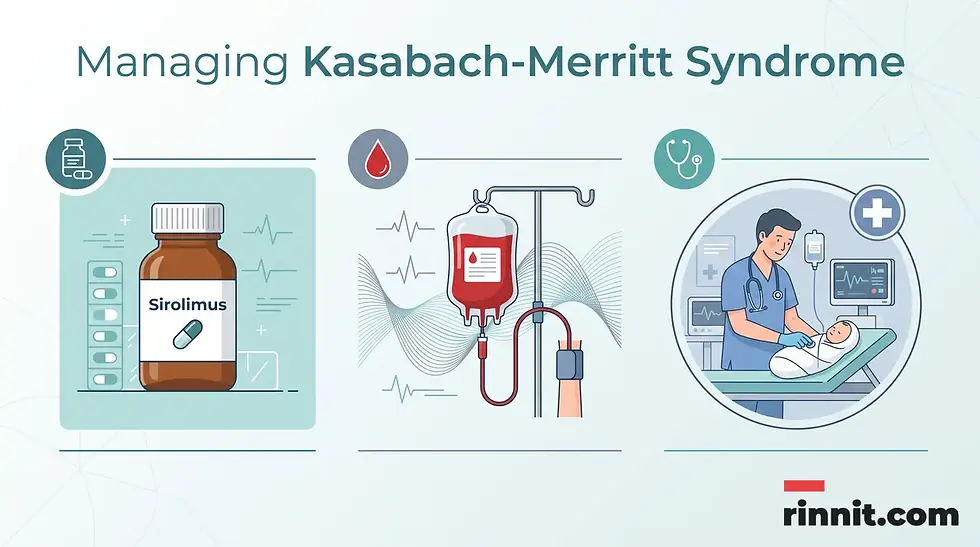
What are the treatment options for Kasabach-Merritt syndrome?
KMS is so rare that there is no single standard treatment that doctors agree on for everyone. Treatment focuses on preventing bleeding problems and getting rid of the tumor, and your child's healthcare provider will tailor it to your child's situation. [1]
Medications: Sirolimus starves the tumor of the nutrients it needs to survive and may be taken with or without a steroid. Vincristine, a chemotherapy drug, may be an option if sirolimus does not help enough, although it can cause side effects. [1]
Supportive care: A child may need blood components if they are at risk of major blood loss, if they are injured, or before surgeries or procedures that carry bleeding risks. These include red blood cell transfusions, platelet transfusions, cryoprecipitate and fresh frozen plasma. [1] Because transfused platelets can become trapped in the tumor and may worsen KMS, StatPearls advises reserving platelet transfusion for active bleeding. [2]
Procedures: Surgery to remove the tumor may be an option if the tumor is small, but because the tumors are made of blood vessels, it is not the best option in all cases. Embolization blocks the blood vessels that supply the tumor and may be a good option if only a few vessels feed it. [1]
Radiation therapy: Radiation can shrink tumors but can cause unpleasant side effects and increase a child's risk of cancer in adulthood. It may be the best option if other treatments are not helping enough. [1]
What is the outlook and recovery for Kasabach-Merritt syndrome?
Historically, KMS was fatal for up to about 3 in 10 babies; with modern treatment such as sirolimus, reported death rates are much lower (about 2% in one large review). [1] [2] New medicines such as sirolimus are helping more children survive. Platelets usually start to increase within a matter of days after treatment starts, and clotting proteins usually start to increase after a few weeks. Treatment usually continues until the tumor resolves or the child is no longer at risk of bleeding or clotting problems. [1]
Medical experts are still studying the best treatments for KMS, and there is still a lot to learn about the long-term effects of treatment. Working with healthcare providers who have experience treating these rare tumors offers the best outlook. [1]
Learn more. For more evidence-based health guides, visit Rinnit.com.
Frequently Asked Questions
Is Kasabach-Merritt syndrome a type of cancer?
No. The tumors that cause KMS, kaposiform hemangioendothelioma (KHE) and tufted angioma (TA), are benign (noncancerous) vascular tumors. They do not spread to other parts of the body, but they can damage nearby tissue. [1]
Can a child grow out of this condition?
KMS can be fatal without treatment, so it needs prompt medical care. Treatment usually continues until the tumor resolves or the child is no longer at risk of bleeding or clotting problems. [1]
Why is it called a syndrome if a tumor causes it?
Kasabach-Merritt syndrome is called a syndrome because it involves a specific group of problems, including low platelets, clotting problems and bleeding, that occur together as a result of the tumor. [1]
Are these tumors present at birth?
The tumors typically appear in early infancy. In one case series, the average age at diagnosis was 2 months. KMS can develop as the tumor grows. [2]
What are the signs of internal bleeding in an infant?
Signs include an irregular heartbeat, slow reflexes or movement, and trouble breathing. Seek emergency care right away if your child is bleeding. [1]
Can KMS be prevented?
There is no known way to prevent KMS. The most important steps are early diagnosis and treatment by healthcare providers who have experience with these rare tumors.
Is sirolimus safe for infants?
Sirolimus is one of the main medicines used to treat the underlying tumors, and published reviews describe high response rates. It can cause side effects, including infections, so children who take it need close monitoring by a specialist team. [5]
How common is Kasabach-Merritt syndrome?
Kasabach-Merritt syndrome is rare. KHE and TA are rare tumors, with one estimate based on cases at a large center of 0.07 per 100,000. KMS may affect up to 70% of patients with KHE and up to 10% of patients with TA. [2]
Can surgery cure the condition?
Removing the tumor may be an option if it is small. But because the tumors are made of blood vessels, which pose bleeding risks, surgery is not the best option in all cases, and once KMS has developed it is generally inadvisable because of the risks to the circulation. [2]
What is the difference between a hemangioma and a KHE?
Common infantile hemangiomas are a different kind of tumor that doctors consider when working out a diagnosis. KHE is a rarer, locally aggressive vascular tumor, and KMS is exclusively associated with KHE and TA. [2]
How long does treatment usually last?
Treatment usually continues until the tumor resolves or your child is no longer at risk of bleeding or clotting problems. [1]
What should I do if the tumor starts bleeding?
Seek emergency medical care immediately. Do not try to treat severe bleeding at home. [1]
Are there any long-term effects of having KMS?
Experts are still learning about the long-term effects of treatment. Radiation therapy, for example, can raise the risk of cancer in adulthood, so ask your child's care team how they will monitor your child over time. [1]
How quickly do blood counts improve once treatment starts?
Platelets usually start to increase within a matter of days after treatment starts, and clotting proteins usually start to increase after a few weeks. [1]
Where should my child be treated?
One of the best things you can do is work with healthcare providers who have experience treating these rare tumors. Experienced teams can tailor treatment to your child's situation. [1]
Conclusion
Kasabach-Merritt syndrome is a frightening diagnosis for any family, but understanding the link between vascular tumors and blood health is the first step toward effective management. Treatment is tailored to each child, newer medicines such as sirolimus are helping more children survive, and working with a team that has experience with these rare tumors gives your child the best outlook. [1] [2]
Related Reading
What Is a Hemangioma? Symptoms, Treatment & When to Worry explains common vascular birthmarks and when they need care.
Disseminated Intravascular Coagulation (DIC): A Rare Blood Clotting Disorder That Causes Organ Damage and Uncontrollable Bleeding — Symptoms, Causes, Diagnosis and Treatment — What You Need to Know explains the dangerous clotting disorder that can occur with this syndrome.
Platelet Count (PLT) Blood Test: Normal Range, Low and High Results Explained describes the blood test that tracks low platelets in this condition.
Fibrinogen Test: Normal Range and What High or Low Fibrinogen Means explains the clotting protein test used to monitor bleeding risk.
References
Cleveland Clinic. Kasabach-Merritt Syndrome. Cleveland Clinic. Last updated February 3, 2026. https://my.clevelandclinic.org/health/diseases/kasabach-merritt-syndrome
Lewis D, Vaidya R. Kasabach-Merritt syndrome. StatPearls. Treasure Island (FL): StatPearls Publishing; last update July 17, 2023. PMID 30085595. https://pubmed.ncbi.nlm.nih.gov/30085595/
Ji Y, Chen S, Zhou J, et al. Sirolimus plus prednisolone vs sirolimus monotherapy for kaposiform hemangioendothelioma: a randomized clinical trial. Blood. 2022;139(11):1619-1630. PMID 35030255. https://doi.org/10.1182/blood.2021014027
Maza-Morales M, Valdés-Loperena S, Durán-McKinster LC, et al. The use of mTOR inhibitors for the treatment of kaposiform hemangioendothelioma. A systematic review. Pediatr Dermatol. 2023;40(3):440-445. PMID 36716766. https://doi.org/10.1111/pde.15262
Kalbfell R, Cohen-Cutler S, Grisham E, et al. Infectious complications of vascular anomalies treated with sirolimus: A systematic review. Pediatr Blood Cancer. 2024;71(1):e30758. PMID 37933207. https://doi.org/10.1002/pbc.30758
Medical disclaimer
This article is for general educational purposes only and is not a substitute for professional medical advice. Always seek the advice of your physician or other qualified health provider with any questions you may have regarding a medical condition.



Comments