Implantable Collamer Lens (ICL) Surgery: Benefits, Procedure, and Recovery

Updated: 3 days ago
Medically reviewed by Dr. Baraa Alnahhal, MD · Last reviewed: October 2026
Implantable Collamer Lens (ICL) surgery places a flexible lens between your iris and your natural lens to correct nearsightedness and astigmatism without reshaping the cornea. It may be possible for people who don't meet the criteria for LASIK, and your eyesight may improve within 24 hours [1].
Quick Answer: What is ICL surgery?
ICL surgery is a refractive procedure in which a surgeon implants a Collamer lens behind the iris to treat nearsightedness and astigmatism. Unlike LASIK, it doesn't change the eye's structure, so the lens can be removed, and it treats higher degrees of nearsightedness. It typically takes under 30 minutes for both eyes, and nearly 95% of people are satisfied. [1]
What the research says
Newer central-port ICLs corrected moderate to high nearsightedness with few serious problems. A systematic review and meta-analysis of 27 prospective studies (2,204 myopic eyes, mean follow-up 13.84 months) of ICL models V4c and V5 found that 80.23% of eyes reached uncorrected 20/20 vision or better and 87.45% were within ±0.50 diopters of the intended refraction. Eye pressure stayed stable, endothelial cell density showed a statistically significant but clinically acceptable decrease, and no vision-threatening events were reported. The authors call for longer follow-up (Larivoir et al., Journal of Refractive Surgery, 2025 [2]).
ICL scored better than SMILE laser surgery on efficacy and safety in high nearsightedness, but halos were more common. A meta-analysis of five observational studies (555 eyes, nearsightedness of −6 to −12 diopters, mostly 6 to 12 months of follow-up) found a better efficacy index (mean difference 0.09) and safety index (0.08) with ICL, but a higher risk of halos (risk ratio 1.79, 95% CI 1.48 to 2.16) (Cao et al., BMC Ophthalmology, 2021 [3]).
Over 8 years, a central-port ICL stayed stable, with no significant endothelial cell loss. In a retrospective study of 177 eyes (106 patients), 83% of eyes were within ±0.5 diopters of the target at 8 years, and no significant eye-pressure rise or significant endothelial cell loss occurred. Three eyes (1.7%) developed cataracts, each with slight pre-existing peripheral cataract changes, and were managed with combined ICL removal and cataract surgery or a lens size change (Kamiya et al., Frontiers in Medicine, 2021 [4]).
What Is ICL Surgery?
ICL surgery treats poor eyesight from refractive errors by implanting a Collamer lens into your eye. Your surgeon places the lens behind your iris (the colored part of the eye) and in front of your natural lens. This surgery may be possible for people who don't meet the criteria for LASIK [1].

The Collamer Material
A Collamer lens combines plastic and collagen to create a more natural and flexible lens. These lenses are lighter than other types of lenses and hydrophilic, which means they mix with water and become wet. A Collamer lens is also better than some other types of lenses at letting gas and nutrients pass through [1].
Material: a blend of plastic and collagen.
Flexibility: flexible enough to be folded and inserted through a very small incision.
Hydration: hydrophilic, meaning it mixes with water.
Permeability: allows gas and nutrients to pass through.
The Modern EVO ICL
Earlier versions of the implantable lens called for a laser iridotomy before surgery. The surgeon made one or two tiny holes in the iris to help prevent pressure from building up and to allow proper drainage of aqueous fluid. The EVO Implantable Collamer Lens has a tiny hole in the middle of the lens, which makes laser iridotomy unnecessary because fluid can flow naturally through it [1].
What Does ICL Surgery Treat, and Who Is a Candidate?
ICL surgery treats two refractive errors: nearsightedness (myopia) and astigmatism. Your surgeon will need to examine you and measure your eyes to see if you're eligible. To be a candidate, you should [1]:
Have a stable prescription: the same for about a year.
Be between 21 and 45 years old.
Have eyes that meet certain criteria: in terms of shape, anterior chamber angle (the space between your cornea and iris, whose size influences how quickly fluid flows out of the eye), and thickness of cells on your cornea.
Before surgery, your eye care specialist will do an eye exam, take a medical history, and ask about any medicines you take. If your prescription is too high or your eyes don't suit LASIK, ICL may still be possible, because it can treat higher degrees of nearsightedness than LASIK can [1].
The ICL Procedure: Step by Step
Your provider will tell you how to prepare, such as whether you should stop eating, drinking, or taking certain medicines before the procedure. You'll need an adult friend or family member to drive you to and from surgery. Surgeons usually operate on both eyes at once, and the surgery typically takes less than 30 minutes for both eyes [1].
Preparation: your surgeon dilates and numbs your eyes with medicated drops. You may also be given a mild sedative to help you stay calm and relaxed.
Incision: the surgeon makes a very small incision at the base of your cornea.
Insertion: the lens is folded, inserted through the incision, and adjusted into place behind your iris and in front of your natural lens.
Closing: you probably won't need stitches because the incision is so small and heals on its own.

Recovery and Results
Your eyesight may improve within 24 hours, possibly even right away, and may continue to improve over the next two to three days. Within a few days you should recover completely and be able to return to most regular activities, although complete visual improvement may take a week to 10 days. Ask your provider specific questions about things like showering, driving, and going back to work or school [1].
Follow-up visits and eye drops
You'll have eye drops to keep your eyes clean and prevent infection, and you may need them for about two weeks to a few weeks, so ask your provider how long. Your provider will want you to return for appointments [1]:
The next day.
After one week.
After three months.
Then on a recommended schedule, which may vary among providers.
ICL Surgery vs. LASIK
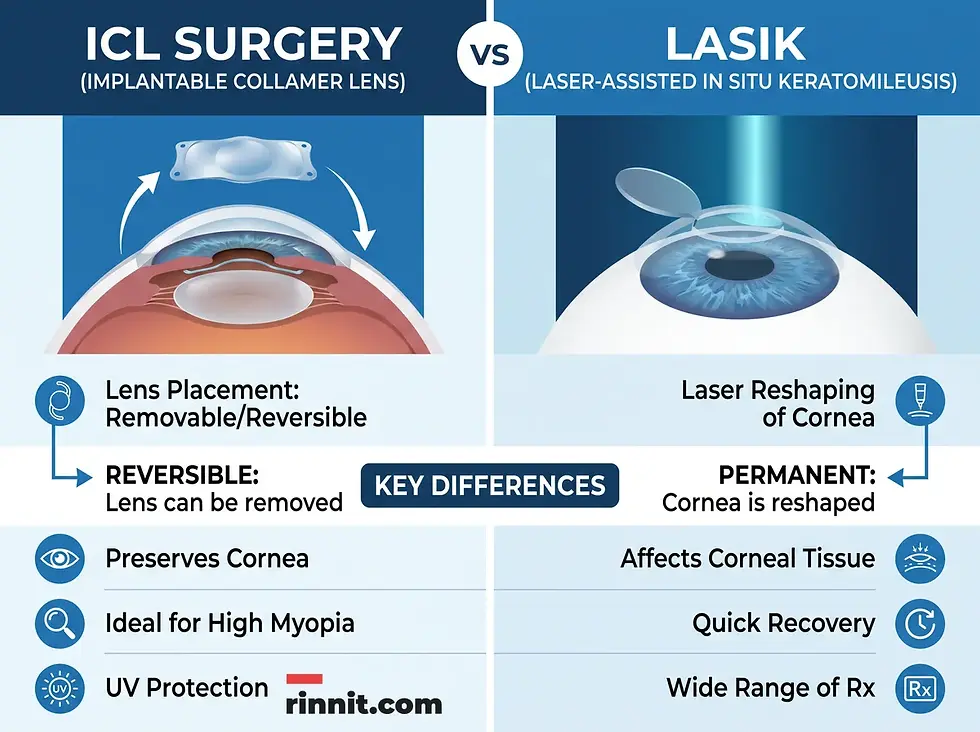
LASIK and ICL surgery try to achieve the same thing, decent vision without glasses or contact lenses, but they get there differently. LASIK uses lasers to reshape your cornea. ICL puts a new lens between your iris and your natural lens without changing the structure of your eye. Both are considered very safe and provide reliable results. LASIK has had U.S. government approval for longer, and it may cost less than ICL surgery [1].
Benefits
You may be able to have ICL surgery even if you can't have other types of eye surgery, like LASIK.
You may see very well right away, without glasses or contact lenses.
The effects should last a very long time, even for the rest of your life.
The surgery can be reversed if needed, because there's no structural damage to your eye.
You're at less risk for dry eye.
You may have very good night vision.
Some research indicates that nearly 95% of people who have this surgery are satisfied or very satisfied with the results [1].
Risks and Complications
Any type of surgery carries risks. Risks and complications of ICL surgery include [1]:
Bleeding.
Infection.
Inflammation inside the eye.
Seeing halos or glare.
Higher eye pressure, which usually gets better on its own.
Sensitivity to light, which also usually gets better on its own.
You might need to have the lens removed if your prescription changes or if you develop cataracts [1]. If cataracts develop, the lens can be taken out as part of cataract surgery, and an artificial intraocular lens (IOL) can then be implanted to restore vision.
When to Call Your Healthcare Provider
Your surgeon will probably send you home with a specific list of situations that call for a phone call or an emergency room visit. These may include [1]:
Excessive pain.
Excessive bleeding.
Signs of infection, like discharge from your eye or a fever.
Sudden loss of vision.
Cost and Insurance
Many insurance companies don't pay for elective surgery like ICL surgery, so contact your insurer before the procedure to find out what they will or won't cover. Some research indicates that ICL surgery costs about $4,000 per eye, but the cost varies with where you're located and which surgeon you use [1].
Bottom Line
ICL surgery is a flexible option for correcting nearsightedness and astigmatism, especially for people who can't have LASIK. It leaves the structure of the cornea unchanged, recovery is quick for most people, and the lens can be removed if needed. Whether it suits you depends on your prescription, your age, and your eye anatomy.
Your next step: if you'd like to stop wearing glasses or contact lenses, schedule a comprehensive eye exam with a qualified eye care provider. They can measure your eyes and tell you whether you're a good candidate for ICL surgery.
Frequently Asked Questions
What is the main difference between ICL and LASIK?
ICL surgery implants a lens in the eye without changing the structure of the cornea, whereas LASIK uses a laser to reshape the cornea. Because no corneal tissue is removed, ICL can be reversed.
Is ICL surgery painful?
ICL surgery isn't typically painful. Your eyes are numbed with medicated drops first, and your provider may give you a mild sedative to help you stay calm and relaxed.
How long do ICL lenses last?
The effects should last a very long time, even for the rest of your life. The lens can be removed if your prescription changes or if you develop cataracts.
How common is ICL surgery?
Surgeons have performed an estimated 500,000 ICL procedures worldwide, using about 1 million lenses, according to Cleveland Clinic.
What is the recovery time for ICL surgery?
Within a few days you should be able to return to most regular activities. Your vision often improves within 24 hours, and complete visual improvement may take a week to 10 days.
Who is a good candidate for ICL surgery?
Candidates are generally between 21 and 45 years old, have a prescription that has been stable for about a year, and have eyes that meet specific shape, anterior chamber angle, and corneal cell criteria. It may be an option if you can't have LASIK.
Are there any side effects?
Risks include bleeding, infection, inflammation inside the eye, halos or glare, higher eye pressure, and light sensitivity. Higher eye pressure and light sensitivity usually get better on their own.
What is a Collamer lens made of?
A Collamer lens combines plastic and collagen, which makes it flexible, lightweight, and hydrophilic, and lets gas and nutrients pass through.
Does insurance cover ICL surgery?
Many insurance companies don't pay for elective surgery like ICL surgery. Contact your insurer before the procedure to confirm what is covered.
What happens if I develop cataracts later?
You might need to have the ICL removed. This can be done as part of cataract surgery, and an artificial intraocular lens (IOL) can then be implanted to restore vision.
Related Reading
LASIK Eye Surgery: Procedure, Recovery and Results explains laser vision correction, candidacy and recovery.
Photorefractive Keratectomy (PRK) Eye Surgery describes a surface laser surgery option for thin corneas.
Refractive Lens Exchange: A Permanent Solution for Clearer Vision covers replacing the natural lens to correct vision.
Refractive Errors: Symptoms, Causes, Types, and Treatment explains nearsightedness, farsightedness, astigmatism and how they are corrected.
References
Cleveland Clinic. Implantable Collamer Lens (ICL) Surgery. Cleveland Clinic. June 5, 2023. https://my.clevelandclinic.org/health/treatments/25050-implantable-collamer-lens-icl-surgery
Larivoir NB, Ribeiro ACS, Morgado CR, et al. Efficacy, predictability, and safety of phakic implantable collamer lenses V4c and V5: a systematic review and meta-analysis. Journal of Refractive Surgery. 2025;41(12):e1349-e1359. PMID 41369665. https://doi.org/10.3928/1081597X-20251010-01
Cao K, Zhang J, Wang J, et al. Implantable collamer lens versus small incision lenticule extraction for high myopia correction: a systematic review and meta-analysis. BMC Ophthalmology. 2021;21(1):450. PMID 34961514. https://doi.org/10.1186/s12886-021-02206-9
Kamiya K, Shimizu K, Takahashi M, et al. Eight-year outcomes of implantation of posterior chamber phakic intraocular lens with a central port for moderate to high ametropia. Frontiers in Medicine. 2021;8:799078. PMID 34977099. https://doi.org/10.3389/fmed.2021.799078
Medical disclaimer
This article is for informational purposes only and is not a substitute for professional medical advice, diagnosis, or treatment. The clinical information in this guide reflects source material last reviewed in June 2023.



Comments