Hyperthermia Therapy for Cancer: Types and How It Works

Updated: 2 days ago
Written and medically reviewed by Dr. Baraa Alnahhal, MD · Last reviewed: November 2026 · How we review
Quick Answer
Hyperthermia therapy uses heat to damage and kill cancer cells and shrink tumors. It's mostly used to make chemotherapy and radiation work better and is often offered in clinical trials. Heat comes from radio waves, microwaves, ultrasound or lasers. Most people tolerate it well, though heat can cause burns, blisters and bruises.
What the research says
Adding heat to chemotherapy improved sarcoma survival: in a trial of 329 people with high-risk soft tissue sarcoma, adding regional hyperthermia to chemotherapy raised 5-year survival to 62.7% versus 51.3% and 10-year survival to 52.6% versus 42.7% (Issels RD et al., JAMA Oncology, 2018) [2]
Heated chemotherapy extended survival in ovarian cancer: in the OVHIPEC trial of 245 women with stage III ovarian cancer, adding HIPEC to surgery lengthened median survival to 45.7 months versus 33.9 months, with similar rates of serious side effects (van Driel WJ et al., New England Journal of Medicine, 2018) [3]
Key takeaways
Hyperthermia therapy uses heat to damage cancer cells.
It mostly boosts chemotherapy and radiation.
Types are local, regional and whole-body.
Tissue is heated to about 113°F (45°C) or higher.
Most people tolerate it well.
What is hyperthermia therapy?
Heat weakens cancer cells and makes them easier to kill. At higher temperatures, called thermal ablation, heat destroys tumor cells directly. Researchers are also studying nanoparticles activated by light and magnetic fields. Sources: [1]
Why it's used
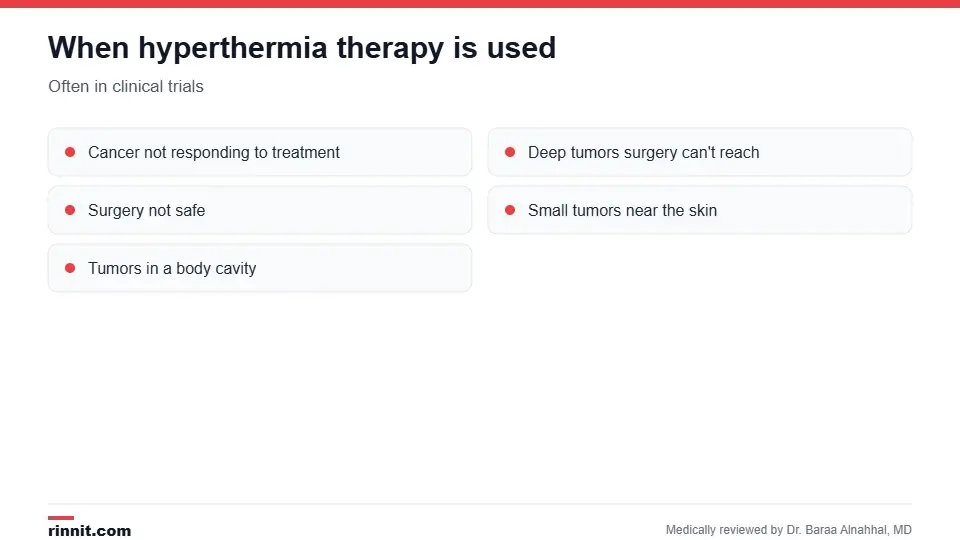
It can make chemotherapy and radiation work better.
Cancer that hasn't responded to other treatments.
Deep tumors that surgery can't reach.
Conditions that make surgery unsafe.
Small tumors near the skin's surface.
Tumors in a body cavity. Sources: [1]
Heat can activate the immune system, increase blood flow so chemotherapy reaches tumors, stop cancer cells from repairing radiation damage and raise oxygen in tumors. Sources: [1]
Types of hyperthermia therapy

Thermometers track the heat throughout treatment.
Type | Examples | Used for |
Local | Small tumors near the skin or in a body cavity | |
Regional | HIPEC, limb perfusion | Tumors in body cavities, organs or limbs |
Whole-body | Heated blanket, incubator or warm water bath | Cancer that has spread |
Sources: [1, 2, 3]
How it works

Anesthesia keeps you comfortable.
HIFU: focused sound waves heat the tumor with no incisions.
Radiofrequency ablation and LITT: a probe through the skin delivers heat into the tumor.
HIPEC: heated chemotherapy fills the belly after tumors are removed, usually during surgery.
Limb perfusion: heated chemotherapy flows to an isolated arm or leg, often for advanced melanoma.
Whole-body: body temperature is slowly raised to about 104°F (40°C) for a few hours. Sources: [1]
Higher temperatures usually mean shorter sessions. When combined with chemotherapy or radiation, it follows that treatment's schedule. Sources: [1]
Risks
Most people tolerate hyperthermia well. Heat can cause burns, blisters and bruises. Other risks depend on the type of treatment. Sources: [1, 3]
Outlook
Hyperthermia can shrink tumors, ease symptoms and improve tumor control, and in some cases it helps people live longer, as seen in trials for sarcoma and ovarian cancer. Sources: [1, 2, 3]
Questions to ask your provider
What benefits can I expect?
How will the heat be monitored?
Is this treatment part of a clinical trial? Sources: [1]
Conclusion
Hyperthermia therapy uses carefully controlled heat to weaken or destroy cancer cells and help other treatments work better. Ask your oncologist whether it, or a clinical trial, fits your cancer.
Keep learning: read about HIPEC and ablation therapy.
Frequently asked questions
What is hyperthermia therapy?
Using heat to damage and kill cancer cells.
What are other names for it?
Thermotherapy or, at higher heat, thermal ablation.
How hot does it get?
Up to about 113°F (45°C), or higher for ablation.
What are the types?
Local, regional and whole-body.
Is it used alone?
Usually with chemotherapy or radiation.
What is HIPEC?
Heated chemotherapy placed in the belly during surgery.
Does it hurt?
Anesthesia is used so you don't feel pain.
What are the side effects?
Burns, blisters and bruises, depending on the type.
Is it widely available?
It's mostly offered in clinical trials.
Does it help people live longer?
In some cancers, such as sarcoma and ovarian cancer, yes.
Related Reading
HIPEC (Hyperthermic Intraperitoneal Chemotherapy): How It Works, Recovery, and Risks heated chemotherapy in the belly.
Ablation Therapy: A Minimally Invasive Approach to Tissue Destruction destroying tumors with heat or cold.
HIFU (High-Intensity Focused Ultrasound): How It Works, What It Treats, and Recovery focused ultrasound heat.
Radiofrequency Ablation (RFA): A Guide to Long-Term Pain Management heat from radio waves.
Soft Tissue Sarcoma: Complete Guide to Symptoms, Types, Diagnosis, and Treatment a cancer hyperthermia can help treat.
References
Cleveland Clinic. Hyperthermia Therapy for Cancer. Cleveland Clinic. Last updated April 29, 2022. https://my.clevelandclinic.org/health/treatments/17114-hyperthermia-therapy
Issels RD, Lindner LH, Verweij J, et al. Effect of neoadjuvant chemotherapy plus regional hyperthermia on long-term outcomes among patients with localized high-risk soft tissue sarcoma: the EORTC 62961-ESHO 95 randomized clinical trial. JAMA Oncology. 2018;4(4):483-492. PMID 29450452. https://doi.org/10.1001/jamaoncol.2017.4996
van Driel WJ, Koole SN, Sikorska K, et al. Hyperthermic intraperitoneal chemotherapy in ovarian cancer. New England Journal of Medicine. 2018;378(3):230-240. PMID 29342393. https://doi.org/10.1056/NEJMoa1708618
Medical disclaimer
This article is for general education only and does not replace advice from a qualified healthcare professional. Talk to your doctor about your own diagnosis and treatment, and seek emergency care right away for severe or sudden symptoms.



Comments