Soft Tissue Sarcoma: Complete Guide to Symptoms, Types, Diagnosis, and Treatment

Updated: 2 days ago
Medically reviewed by Dr. Baraa Alnahhal, MD · Last reviewed: September 2026
TL;DR
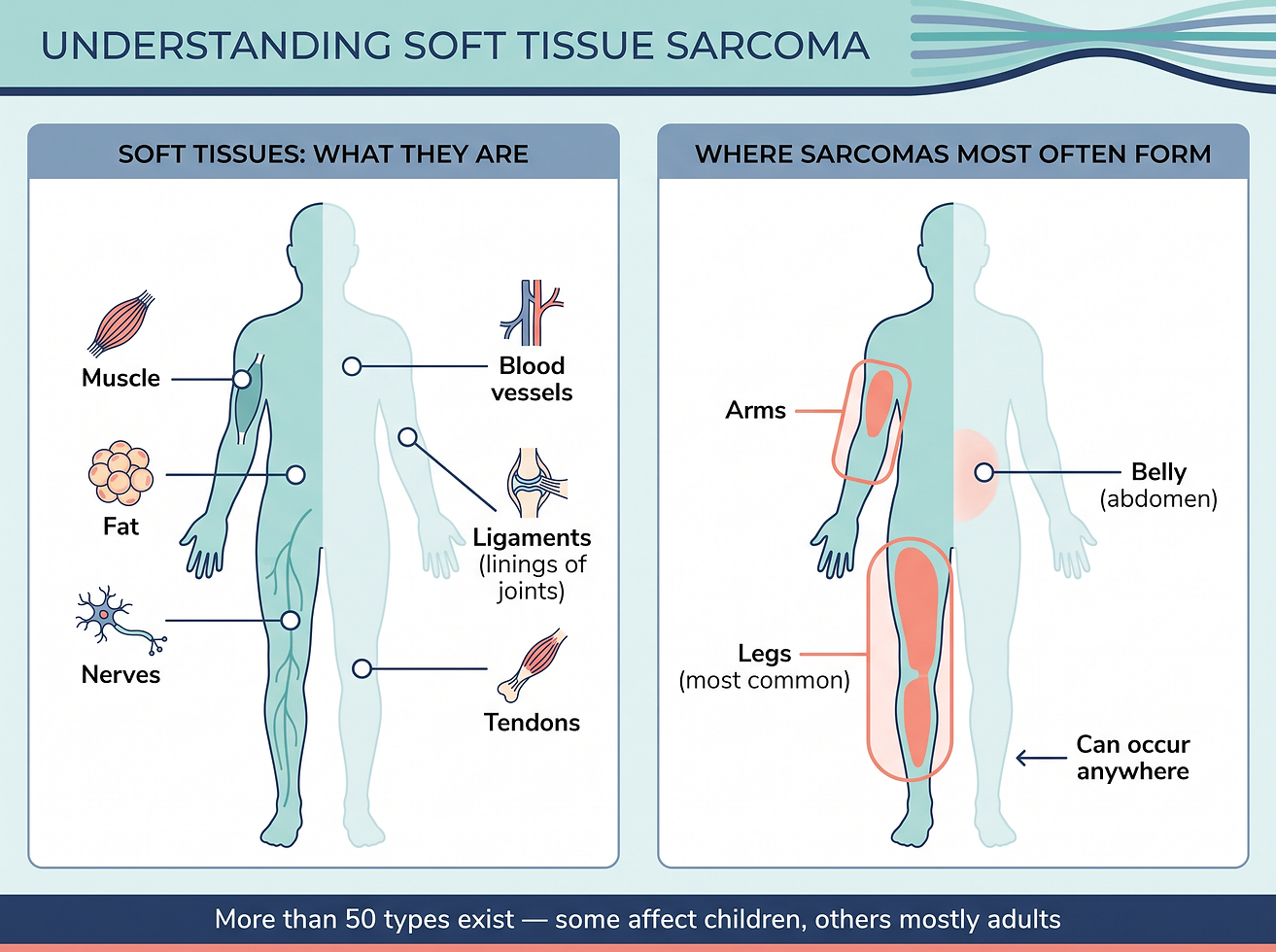
Soft tissue sarcoma is a rare cancer that begins as a growth of cells in the body's soft tissues — the muscle, fat, blood vessels, nerves, tendons, and joint linings that connect, support, and surround other body structures. More than 50 types exist, some more common in children, others mostly in adults. It most often appears in the arms, legs, or belly and may cause no symptoms at first. Treatment usually involves surgery, with radiation therapy, chemotherapy, and targeted therapy used depending on the cancer's size, type, and location. Because sarcomas are rare and can be mistaken for other growths, expert care at a center experienced with this cancer matters.
Quick Answer
What is soft tissue sarcoma? It is a rare type of cancer that starts when a connective tissue cell gets changes in its DNA and grows into a tumor. What are the main signs? A noticeable lump or swelling that may be painless at first, and pain if the growth presses on nerves or muscles. Where does it form? Anywhere in the body, but most often in the arms, legs, and belly. How is it treated? Surgery is the most common treatment, often combined with radiation therapy, chemotherapy, or targeted therapy depending on the tumor's size, type, and location.
What Is Soft Tissue Sarcoma?
Soft tissue sarcoma is a rare type of cancer that starts as a growth of cells in the body's soft tissues. Soft tissues are the tissues that connect, support, and surround other body structures. They include muscle, fat, blood vessels, nerves, tendons, and the linings of the joints.
Because these tissues run throughout the entire body, a soft tissue sarcoma can develop anywhere. In practice, most soft tissue sarcomas form in the arms, the legs, and the belly area.
More than 50 different types of soft tissue sarcoma exist. Some types are more likely to affect children, while others occur mostly in adults. The type of sarcoma a person has depends on which cell begins growing out of control.
Soft tissue sarcoma can be hard to diagnose. Early on it may cause no symptoms, and the lump or swelling it creates may be mistaken for many other, far more common types of growths.
How Does Soft Tissue Sarcoma Start?
The DNA Change That Turns a Cell Cancerous
What causes most soft tissue sarcomas is not clear. But the pattern of how they start is well understood.
A soft tissue sarcoma begins when a connective tissue cell gets changes in its DNA. DNA holds the instructions that tell a cell what to do. When the DNA changes, the instructions change. The cell loses the normal signals that make healthy cells die as part of their natural cycle. Instead, it keeps growing and making more of itself, forming a tumor.
In some types of sarcoma, the cancer cells stay in one location and the tumor simply gets bigger. In other types, the cancer cells might break away and spread to other parts of the body.
The Cell Type Determines the Sarcoma Type
The kind of cell with the DNA changes determines the name of the sarcoma. For example, angiosarcoma begins in the cells lining blood vessels, while liposarcoma starts in fat cells.
Symptoms: What Soft Tissue Sarcoma Feels Like
The Signs to Watch For
Soft tissue sarcoma may not cause any symptoms at first. As the cancer grows, it may cause a noticeable lump or swelling. It may also cause pain if the growth presses on nerves or muscles.
That is the core picture: a lump, often painless at first, that may later bring pain as it enlarges and presses on surrounding structures.
When to See a Doctor
The guidance is straightforward. Make an appointment with a doctor if you have any symptoms that worry you — including any new lump or swelling.
Because early sarcomas are often painless and easily mistaken for harmless growths, a lump that is growing, firm, or persistent deserves medical attention rather than watchful waiting.
Symptom | What It Feels Like | When It Typically Appears |
Noticeable lump or swelling | A firm mass under the skin or deeper in muscle | Often the first sign, as the cancer grows |
No symptoms at first | Nothing to feel or notice | Early stage — the cancer is silent |
Pain | Aching or pressure that will not go away | When the growth presses on nerves or muscles |
Types: More Than 50 Forms of Soft Tissue Sarcoma
Soft tissue sarcomas are named for the tissue or cell where they begin. Clinical sources name thirteen distinct types, and they illustrate an important pattern: some appear mostly in children, while others are found mostly in adults.
Sarcoma Type | Where It Begins |
Angiosarcoma | Cells lining blood vessels |
Dermatofibrosarcoma protuberans | Skin and tissue just under the skin |
Epithelioid sarcoma | Usually starts in the hands or arms |
Gastrointestinal stromal tumor (GIST) | The wall of the digestive tract |
Kaposi sarcoma | Cells lining blood or lymph vessels |
Leiomyosarcoma | Smooth muscle, such as in the uterus or stomach |
Liposarcoma | Fat cells |
Malignant peripheral nerve sheath tumors (MPNSTs) | Tissue around nerves |
Myxofibrosarcoma | Often in the arms and legs of older adults |
Rhabdomyosarcoma | Skeletal muscle — the most common type in children |
Solitary fibrous tumor | Tissue around organs |
Synovial sarcoma | Often near joints, despite the name |
Undifferentiated pleomorphic sarcoma | Previously called malignant fibrous histiocytoma |
Causes and Risk Factors
What Raises the Risk of Soft Tissue Sarcoma?
The exact cause of most soft tissue sarcomas is not clear. However, several risk factors are established.
Inherited syndromes. Certain inherited conditions raise the risk. These include hereditary retinoblastoma, Li-Fraumeni syndrome, familial adenomatous polyposis, neurofibromatosis, tuberous sclerosis, and Werner syndrome.
Chemical exposure. Exposure to certain chemicals — herbicides, arsenic, and dioxin — is linked to a higher risk.
Radiation exposure. Radiation therapy used to treat other cancers can increase the risk of developing a soft tissue sarcoma later.
Risk Factor | Detail |
Hereditary retinoblastoma | Inherited syndrome that raises sarcoma risk |
Li-Fraumeni syndrome | Inherited syndrome that raises sarcoma risk |
Familial adenomatous polyposis | Inherited syndrome that raises sarcoma risk |
Neurofibromatosis | Inherited syndrome that raises sarcoma risk |
Tuberous sclerosis | Inherited syndrome that raises sarcoma risk |
Werner syndrome | Inherited syndrome that raises sarcoma risk |
Chemical exposure | Herbicides, arsenic, dioxin |
Prior radiation therapy | Treatment for other cancers raises later risk |
How Is Soft Tissue Sarcoma Diagnosed?
Imaging Tests
Doctors begin with imaging tests that create pictures of the inside of the body. These pictures help show the size and location of the sarcoma. The tests used include X-rays, CT scans, MRI scans, and PET scans.
Biopsy: The Definitive Step
A biopsy is a procedure that removes cells for testing. It is the only way to confirm whether a lump is a soft tissue sarcoma and what type it is.
A biopsy must be done in a way that will not cause problems with future surgery. Because of this, it is best to seek care at a medical center that sees many people with this type of cancer. Experienced teams know how to select and perform the right type of biopsy.
Two main approaches exist. In a core needle biopsy, a needle removes tissue samples from the cancer, and doctors usually try to take samples from several parts of it. In a surgical biopsy, surgery is used in some cases to obtain a larger tissue sample.
The biopsy sample goes to a laboratory. Pathologists — specialists in analyzing blood and body tissue — test the cells to see whether they are cancerous. Other lab tests reveal more details, such as what type of cells they are.
Diagnostic Step | What It Shows |
X-ray | Basic picture of the affected area |
CT scan | Detailed cross-sectional view showing size and location |
MRI scan | Detailed images of soft tissue, helpful for planning surgery |
PET scan | Shows how active cells in the area are |
Core needle biopsy | Tissue samples taken from several parts of the tumor |
Surgical biopsy | A larger tissue sample obtained through surgery |
Pathology lab analysis | Confirms cancer and identifies the sarcoma type |
Treatment: Four Main Approaches
Treatment for soft tissue sarcoma depends on three things: the size of the cancer, the type of the cancer, and the location of the cancer — and how quickly it grows.
Surgery
Surgery is a common treatment for soft tissue sarcoma. The surgeon usually removes the cancer and some of the healthy tissue around it.
Soft tissue sarcoma often affects the arms and legs. In the past, removing an arm or leg was a common approach. Today, other approaches are used whenever possible. Radiation therapy and chemotherapy might be used to shrink the cancer so it can be removed without removing the entire limb.
Radiation Therapy
Radiation therapy uses powerful energy beams — such as X-rays or protons — to kill cancer cells. A machine moves around the person, directing radiation to specific points.
Intraoperative radiation therapy (IORT) delivers radiation during surgery, aimed exactly where it is needed. Because it targets the tumor bed directly, the dose can be much higher than standard radiation while sparing healthy tissues.
Radiation can be timed three ways: before surgery, to shrink a tumor and make it easier to remove; during surgery, to deliver a higher dose directly to the target area while sparing healthy tissue; or after surgery, to kill any cancer cells that remain.
Chemotherapy
Chemotherapy uses strong medicines to kill cancer cells. It is often given through a vein, though some chemotherapy comes in pill form.
Some sarcoma types respond better to chemotherapy than others. Chemotherapy is often used to treat rhabdomyosarcoma — the type most common in children.
Targeted Therapy
Targeted therapy uses medicines that attack specific chemicals in cancer cells. Blocking these chemicals causes the cancer cells to die.
Cancer cells might be tested to see whether targeted therapy might help. It works well for some sarcoma types, such as gastrointestinal stromal tumors (GISTs).
Treatment | How It Works | When It Is Used |
Surgery | Removes the cancer plus surrounding healthy tissue | The most common treatment |
Radiation before surgery | Energy beams shrink the tumor | Makes removal easier, spares the limb |
Intraoperative radiation (IORT) | High-dose radiation during surgery | Targets the tumor bed, spares healthy tissue |
Radiation after surgery | Energy beams kill remaining cells | After the tumor is removed |
Chemotherapy | Strong medicines kill cancer cells | Often through a vein; key for rhabdomyosarcoma |
Targeted therapy | Attacks specific chemicals in cancer cells | For types such as GISTs; cells may be tested first |
Self-Care and Coping With a Diagnosis
A cancer diagnosis can feel overwhelming. Learning enough about soft tissue sarcoma to make decisions about your care is one of the most useful steps you can take. Ask your doctors about the sarcoma itself, the treatment options available, and the prognosis.
Keep friends and family close. Support does not have to come from medical professionals alone — a friend, a family member, a counselor, a medical social worker, clergy, or a cancer support group can all help you carry the weight of treatment.
Coping Step | Why It Helps |
Learn about your sarcoma type | Better information leads to better decisions |
Ask about treatment options and prognosis | Reduces uncertainty and fear of the unknown |
Keep friends and family close | Emotional support eases the burden |
Find someone to talk with | Counselors, social workers, and support groups help |
Preparing for Your Appointment
If a soft tissue sarcoma is suspected, you will likely be referred to a cancer doctor — an oncologist. Soft tissue sarcoma is rare, and it is best treated by someone experienced with it. Doctors with this experience are often found within an academic or specialized cancer center.
Before the appointment, write down your symptoms and a list of all medicines, vitamins, and supplements you take. Ask a family member or friend to come along. Write down your questions, listing the most important ones first.
Good questions to bring include: Do I have cancer? What other causes are possible? What tests do I need? What type of sarcoma do I have, and what stage? What treatments are available or recommended? Can the cancer be removed? What side effects should I expect? Are clinical trials available? What is the prognosis? What other specialists should I see?
Your doctor will likely ask when your symptoms first appeared, whether there is pain, what makes symptoms better or worse, and whether anyone in your family has had cancer — and what type.
Conclusion
Soft tissue sarcoma is a rare but serious cancer of the tissues that connect, support, and surround the body's structures. Its early signs are quiet — a painless lump or swelling that is easy to dismiss — and it can form in more than 50 different cell types across the arms, legs, belly, and beyond. The encouraging facts are just as real: surgery commonly removes the cancer, radiation and chemotherapy can shrink tumors to make limb-sparing surgery possible, and targeted therapy offers real options for specific types such as GISTs.
Your next step: if you have a new lump or swelling that will not go away, grows, or becomes painful, make an appointment with a doctor. If sarcoma is suspected, seek care at a center experienced in treating rare cancers, and bring the questions above to your first visit. Early, expert evaluation gives treatment the best chance of success.
Frequently Asked Questions
What is soft tissue sarcoma?
Soft tissue sarcoma is a rare cancer that begins as a growth of cells in the body's soft tissues — the muscle, fat, blood vessels, nerves, tendons, and joint linings that connect, support, and surround other body structures. It can form anywhere in the body but most often appears in the arms, legs, and belly.
Is a lump always a sign of soft tissue sarcoma?
No. Most lumps are harmless. But because soft tissue sarcoma may cause no symptoms at first and can be mistaken for many other types of growths, any new lump or swelling — especially one that is growing, firm, or painful — should be checked by a doctor.
What causes soft tissue sarcoma?
What causes most soft tissue sarcomas is not clear. They start when a connective tissue cell gets changes in its DNA that make it grow without stopping and form a tumor. Established risk factors include certain inherited syndromes, exposure to chemicals such as herbicides, arsenic, and dioxin, and radiation therapy used for other cancers.
What are the most common types of soft tissue sarcoma?
More than 50 types exist. Named types include liposarcoma (fat cells), leiomyosarcoma (smooth muscle), rhabdomyosarcoma (skeletal muscle — the type most common in children), GIST (digestive tract wall), angiosarcoma (blood vessel linings), and Kaposi sarcoma, among others. The type depends on which cell begins growing out of control.
How is soft tissue sarcoma diagnosed?
Imaging tests — X-rays, CT scans, MRI scans, and PET scans — show the size and location of the tumor. A biopsy then removes cells for testing and confirms the diagnosis and the type. Because the biopsy must not interfere with future surgery, it is best performed at a medical center experienced with this rare cancer.
What is the most common treatment for soft tissue sarcoma?
Surgery is the most common treatment. The surgeon usually removes the cancer along with some healthy tissue around it. In the past, removing an entire limb was common for arm and leg sarcomas. Today, radiation and chemotherapy can shrink the tumor first, making limb-saving surgery possible.
Can soft tissue sarcoma spread to other parts of the body?
Yes. In some types of soft tissue sarcoma, the cancer cells stay in one location and the tumor grows larger. In other types, the cancer cells can break away and spread to other parts of the body. This is why prompt evaluation and expert treatment planning matter.
What is targeted therapy for soft tissue sarcoma?
Targeted therapy uses medicines that attack specific chemicals in cancer cells. Blocking those chemicals causes the cancer cells to die. Cancer cells may be tested to see whether targeted therapy will help. It works well for some sarcoma types, such as gastrointestinal stromal tumors (GISTs).
External Links
This article is for general informational purposes only and is not a substitute for professional medical advice, diagnosis, or treatment. Always seek the advice of a qualified healthcare provider with any questions you may have regarding a medical condition. Never disregard professional medical advice or delay in seeking it because of something you have read here. If you suspect a medical emergency, contact emergency services immediately.
Comments