Hair Transplant: How It Works, Types, Recovery, Risks and Results

Updated: 6 days ago
Written and medically reviewed by Dr. Baraa Alnahhal, MD · Last reviewed: October 2026 · How we review
Quick Answer: What is a hair transplant?
A hair transplant is a surgery that moves skin containing healthy hair, usually from the back of the scalp, to bald or thinning areas. It treats permanent hair loss, most often pattern baldness and hair loss from injuries or burns. Grafting, the most common method, uses numbing medicine, and full results can take up to a year. [1]
What the research says
Serious problems are uncommon; pain is the usual complaint. A 2025 systematic review and meta-analysis of 45 studies found that 442 of 2,353 patients in observational studies reported a complication. Pain and discomfort were the most common, and scarring was the most reported problem at the recipient site. The authors concluded the surgery is generally safe. (Khatib et al., Aesthetic Plastic Surgery, 2025) [2]
Self-esteem rises after surgery. In 875 men with pattern baldness who completed a 9-month follow-up, self-esteem scores rose by 1.56 points and satisfaction-with-appearance scores rose by 30.25 points compared with before surgery. Men with low self-esteem before surgery tended to be less satisfied afterwards. (Liu et al., Journal of Cosmetic Dermatology, 2019) [3]
Quality of life improves. A two-center study of 48 people with pattern baldness who had grafting found significant gains in physical and mental quality-of-life scores, higher life satisfaction, and lower stress and anxiety scores after the procedure. Depression scores did not change significantly. (Maletic et al., Aesthetic Plastic Surgery, 2024) [4]
Key takeaways
A hair transplant moves healthy, hair-bearing skin from a thick area (the donor site) to bald or thinning areas. [1]
It is usually for people who have already tried other hair loss treatments. [1]
There are four main types: grafting, scalp reduction, flap surgery, and tissue expansion. Grafting is the most common. [1]
Most hair transplants are outpatient surgeries, so you go home the same day. [1]
New hair can fall out while the graft heals. This is normal, and full results can take up to a year. [1]
How does a hair transplant work?
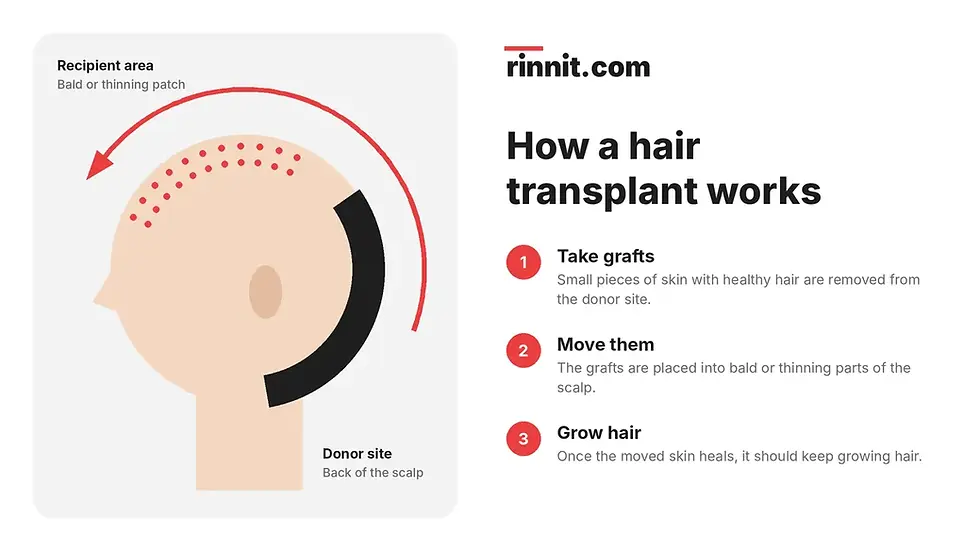
A hair transplant works by taking small pieces of skin with healthy hair from one part of the scalp and moving them to areas where hair has stopped growing. [1]
The area the hair comes from is called the donor site. It is usually at the back of the scalp, where hair tends to be thickest. [1]
The surgeon places these pieces, called grafts, into hairless parts of the scalp. Once the moved skin heals, it should keep growing hair. [1]
Hair transplants are performed by dermatologists, who specialize in skin, or by plastic surgeons, who specialize in reconstructive procedures. [1] The surgery is also called hair restoration or hair replacement.
What types of hair loss can a hair transplant treat?
A hair transplant can help with permanent hair loss. Some hair loss is temporary and grows back on its own, so the cause matters before surgery is considered. [1]
Cause of permanent hair loss | What it is |
Androgenic alopecia | Pattern baldness — see our guides to male pattern baldness and female pattern baldness |
Alopecia areata | An autoimmune disease that attacks hair follicles |
Thyroid disease or hormonal imbalance | Hormone problems that can lead to lasting hair loss |
Traumatic injury or burns | Damage to the scalp that leaves bald areas |
Source: [1]
If you are not sure why your hair is thinning, our guide to hair loss in women and our explainer on the hair growth cycle are good places to start.
Who is a good candidate for a hair transplant?
A good candidate for a hair transplant is someone in good health who still has areas of thick hair on the scalp and has realistic expectations about the results. [1]
You may be a good fit if you… | Why it matters |
Are in good health | Like any surgery, a transplant carries risks such as infection and bleeding |
Still have areas of thick hair growth | These areas supply the healthy hair that gets moved |
Have realistic expectations | Results take time, and touch-up procedures may be needed |
Have already tried other hair loss treatments | Surgery is usually considered after other options |
Source: [1]
What are the different types of hair transplant surgery?
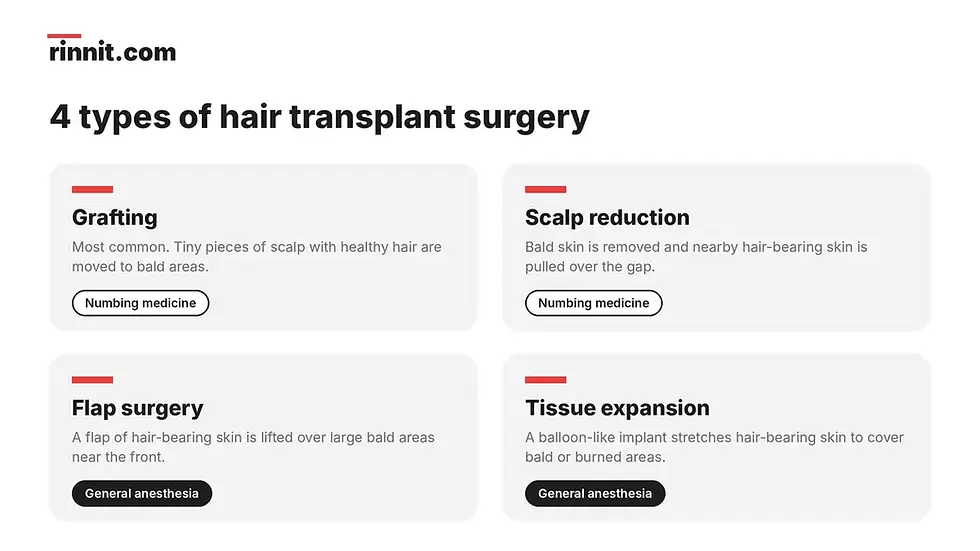
The four types of hair transplant surgery are grafting, scalp reduction, flap surgery, and tissue expansion. Grafting is the most common. [1]
Type | What happens | Best for | Anesthesia |
Grafting | Tiny pieces of scalp with healthy hair are moved to bald areas | Most people having a transplant | Numbing medicine on the scalp |
Scalp reduction | Bald skin is removed and nearby hair-bearing skin is pulled over it and stitched | Bald areas on the top and back of the head | Numbing medicine on the scalp |
Flap surgery | A flap of hair-bearing skin is cut on three sides and lifted over the bald area | Large bald areas near the front of the scalp | General anesthesia |
Tissue expansion | A balloon-like implant stretches hair-bearing skin, which then covers the bald area | Baldness or scalp disfigurement from burns | General anesthesia |
Source: [1]
What is scalp reduction?
Scalp reduction, also called alopecia reduction, is a procedure that removes a small area of bald skin and closes the gap with nearby hair-bearing skin. [1] The surgeon loosens the surrounding skin, pulls it over the bald area, and stitches it in place. Surgeons sometimes combine scalp reduction with grafting to get full coverage. [1]
What is flap surgery?
Flap surgery is a staged procedure that moves a section of hair-bearing scalp over a large bald area while keeping its blood supply. [1] The surgeon makes shallow cuts on three sides of the donor site and leaves the fourth side attached. This keeps the flap alive while it is lifted into place. The process takes place in several phases over a few weeks. [1]
What is tissue expansion?
Tissue expansion is a reconstructive procedure that stretches hair-bearing skin so it can cover a bald or scarred area. [1] It happens in steps:
A surgeon places a balloon-shaped implant, called a tissue expander, under the scalp where hair still grows.
Over several weeks, the expander is slowly inflated to stretch the skin.
In a second procedure, the surgeon uses the stretched skin to cover the bald area. [1]
What happens during hair grafting?
During hair grafting, a surgeon cuts tiny pieces of scalp that contain healthy hair and moves them to bald areas while you stay awake with a numbed scalp. [1]
Graft size: A small, round punch can remove skin containing about 10 to 15 hairs. These used to be called "hair plugs." Micro-grafts contain one to two hairs. [1]
Time: The procedure can take several hours. [1]
Comfort: Most people stay awake and receive medicine to numb the scalp. [1]
Number of sessions: You may need several procedures, depending on how much hair needs to be moved. The scalp needs a few months to heal between sessions. [1]
What are the risks and side effects of a hair transplant?
The main risks of a hair transplant are those of any surgery, including infection, bleeding, scarring, and grafts that fail to take. Most side effects, such as swelling and itching, are temporary. [1]
Risks (less common, more serious) | Side effects (common, usually temporary) |
Allergic reaction to anesthesia | Crusts or scabs |
Excessive blood loss | Itching |
Failed grafts or flaps | Loss of feeling |
Infection | Pain or throbbing |
Loss of feeling on the scalp | Swelling |
Scarring | Tightness |
Source: [1]
Side effects can show up on the scalp, at the donor site, or where the new hair is placed. [1] In research, pain and swelling at the donor site were the most often reported problems, and scarring was the most reported problem where hair was placed. [2]
What are the benefits of a hair transplant?
The main benefits of a hair transplant are a fuller head of hair, fewer bald areas, and a lasting solution to permanent hair loss. [1] Many people also report better self-esteem. [1] Studies back this up: self-esteem and satisfaction with appearance rose after surgery in a large group of men with pattern baldness, [3] and quality-of-life scores improved in a smaller follow-up study. [4]
What is hair transplant recovery like?
Hair transplant recovery is usually short, and many people can return to work within 3 to 5 days, although the exact plan depends on the type of transplant. [1] Most hair transplants are outpatient surgeries, so you can go home the same day. [1]

When | What you may be able to do |
Day 1 | Remove bandages |
Day 2 | Wash your hair |
Days 3 to 5 | Return to work and start light activities |
After 10 days | Have stitches removed by your healthcare provider |
After 3 weeks | Return to exercise or sports |
Source: [1]
You will likely have several follow-up visits so your provider can check that your scalp is healing well. [1]
How long does it take to see hair transplant results?
It can take up to a year to see the full results of a hair transplant. [1]
The transplanted hair may fall out as the graft or flap heals. This is normal, and the hair should grow back. [1] Some people need several "touch-up" procedures to get a natural-looking result. [1]
When should you call a doctor after a hair transplant?
Call your healthcare provider right away after a hair transplant if you have a fever that doesn't go away, heavy bleeding, severe redness or pain, or signs of infection. [1]
Warning signs to act on:
A fever that doesn't go away
Excessive bleeding from the scalp
Severe redness or pain on the scalp
Green or yellow pus oozing from the cuts in the scalp [1]
How do you choose a hair transplant provider?
The right hair transplant provider is a skilled professional with experience in hair loss and hair restoration. [1] Work with them to choose the technique that best fits your goals, since there are several different methods. [1]
Before you book, also think about the practical side: the total cost and the healing time needed between treatments. [1] For more background, you can read the hair transplant overviews from the American Academy of Dermatology and the American Society of Plastic Surgeons.
Conclusion
A hair transplant moves healthy hair from a thick donor area to bald or thinning parts of the scalp, and it can offer a lasting answer to permanent hair loss. Grafting is the most common method, recovery is usually short, and many people are back at work within days. The real wait is for results: transplanted hair often sheds first, and the final look can take up to a year.
The best outcomes start with the right reason for surgery and the right surgeon. If other treatments haven't worked for you, book a visit with a dermatologist or plastic surgeon who specializes in hair restoration and ask which technique suits your hair loss.
Want to understand your hair loss before you decide? Explore our guides to male pattern baldness, female pattern baldness, and scarring hair loss conditions such as lichen planopilaris and frontal fibrosing alopecia.
FAQ
Is a hair transplant permanent?
A hair transplant is considered a permanent solution for permanent hair loss, because the moved skin should keep growing hair once it heals. [1] Some people need touch-up procedures to get a natural-looking result. [1]
Does a hair transplant hurt?
Most people stay awake during grafting and receive medicine to numb the scalp. [1] Pain, throbbing, and tightness afterwards are common but usually temporary. [1] In research, pain and discomfort were the most reported complications. [2]
Why is my transplanted hair falling out?
Transplanted hair often falls out as the graft or flap heals. This is normal, and the hair should grow back. [1] Full results can take up to a year. [1]
How many hair transplant sessions will I need?
The number of sessions depends on how much hair needs to be moved. [1] Some people need several procedures, with a few months of healing between them. [1]
When can I go back to work after a hair transplant?
Many people can return to work and light activities 3 to 5 days after a hair transplant. [1] Your provider may adjust this based on the type of transplant you had. [1]
When can I exercise after a hair transplant?
You can usually return to exercise or sports about 3 weeks after a hair transplant. [1] Ask your provider before restarting heavy activity.
Who performs hair transplants?
Hair transplants are performed by dermatologists, who specialize in skin, or plastic surgeons, who specialize in reconstructive procedures. [1] Choose someone with experience in hair loss and hair restoration. [1]
Can a hair transplant help with alopecia areata?
Alopecia areata, an autoimmune disease that attacks hair follicles, is usually treated with medicine rather than a hair transplant, because hair often regrows and transplanted hair can be attacked too. [1] Your provider will check whether your hair loss is permanent before recommending surgery.
What is the difference between FUT and FUE hair transplants?
In follicular unit transplantation (FUT), the surgeon removes a thin strip of scalp and divides it into grafts, leaving a thin line scar. In follicular unit extraction (FUE), single follicles are removed one by one, leaving tiny dot scars.
How long does a hair transplant procedure take?
A hair transplant can take several hours, and most people go home the same day. Larger sessions take longer.
Related Reading
Hair Loss Treatments: Medications, Procedures, and What to Expect compares medicines and procedures for treating hair loss.
Understanding Male Pattern Baldness: Stages, Causes, and Management explains male pattern baldness stages, causes and treatment.
Female Pattern Baldness: Symptoms, Causes, Stages, Diagnosis, Treatment and Prevention — What You Need to Know covers female pattern hair loss signs, causes and treatment.
Eyebrow Transplant: Procedure, Recovery, Results and Risks explains how scalp hair is moved to fill thin eyebrows.
References
Cleveland Clinic. Hair Transplant: How Does It Work, Success Rates. Cleveland Clinic. Last updated April 30, 2021. https://my.clevelandclinic.org/health/treatments/21519-hair-transplant
Khatib M, Skorochod R, Wolf Y. Complications Following Hair Transplantation: A Systematic Literature Review and Meta-Analysis. Aesthetic Plast Surg. 2025;49(23):6393-6405. PMID 40913181. https://doi.org/10.1007/s00266-025-05125-y
Liu F, Miao Y, Li X, et al. The relationship between self-esteem and hair transplantation satisfaction in male androgenetic alopecia patients. J Cosmet Dermatol. 2019;18(5):1441-1447. PMID 30582267. https://doi.org/10.1111/jocd.12839
Maletic A, Dumic-Cule I, Zic R, et al. Impact of Hair Transplantation on Quality of Life. Aesthetic Plast Surg. 2024;48(9):1825-1830. PMID 38123846. https://doi.org/10.1007/s00266-023-03781-6
Medical disclaimer
This article is for general educational purposes only and is not a substitute for professional medical advice, diagnosis, or treatment. Always talk to a qualified healthcare provider about your own health and before making decisions about any procedure.



Comments