Understanding Male Pattern Baldness: Stages, Causes, and Management

Updated: 2 days ago
Medically reviewed by Dr. Baraa Alnahhal, MD · Last reviewed: October 2026
Male pattern baldness, or androgenic alopecia, is a common and permanent form of hair loss that affects two-thirds of men. It follows a predictable pattern across seven stages, often starting at the temples or crown. It is driven mainly by genetics and hormones such as DHT, and treatments such as minoxidil, finasteride, and hair transplants can slow the process or restore hair. Early treatment helps, both for the physical progression and for the emotional impact of the condition [1].
Quick Answer: What is male pattern baldness?
Male pattern baldness, or androgenic alopecia, is a permanent form of hair loss that affects two-thirds of men. It follows a predictable seven-stage progression driven by genetics and hormones such as DHT. It does not harm physical health but can cause psychological distress. Treatments include minoxidil, finasteride, hair transplants and PRP therapy, and starting early helps slow loss. [1]
What the research says
Finasteride increases hair count in men, with a small increase in erectile dysfunction. A systematic review of 12 randomized trials (3,927 men) found that more men reported improved scalp hair with finasteride than with placebo, both in the short term (relative risk 1.81, 95% CI 1.42 to 2.32) and the long term at 24 months or more (relative risk 1.71, 95% CI 1.15 to 2.53). Hair count rose by 9.42% in the short term and 24.3% in the long term compared with placebo, while erectile dysfunction was more common (relative risk 2.22, 95% CI 1.03 to 4.78; number needed to harm 82), and stopping treatment because of sexual side effects was no more common than with placebo (Mella et al., Arch Dermatol, 2010 [2]).
Finasteride outperformed topical minoxidil on terminal hair count at 48 weeks. In a network meta-analysis of 23 studies in men, finasteride 1 mg a day increased terminal hair count more than 2% topical minoxidil (mean difference 32.1 hairs/cm², 95% CI 23.9 to 40.3) and 5% topical minoxidil (26.2 hairs/cm², 95% CI 16.2 to 36.2). The authors note that more head-to-head trials are needed to compare doses (Gupta et al., JAMA Dermatol, 2022 [3]).
PRP injections may increase hair number, but the evidence comes from small studies. A meta-analysis of 6 studies (177 patients) found a significantly higher hair number per cm² after PRP injections than with control (mean difference 17.90, 95% CI 5.84 to 29.95) and greater hair thickness, but the pooled percentage increases in hair number and thickness were not statistically significant. The authors advise caution because the studies were small (Giordano et al., J Cosmet Dermatol, 2017 [4]).
What is androgenic alopecia (male pattern baldness)?
Male pattern baldness, clinically known as androgenic alopecia, is a very common type of hair loss in men, marked by a permanent reduction in hair growth on the scalp. It typically involves thinning hair and a hairline that gradually moves farther back on the head. For many men it is a natural part of aging, but it can begin as early as the late teens or early 20s, and most men notice significant changes by their 30s [1].
Its progression is usually described with the Hamilton-Norwood scale, which identifies seven stages of hair loss, from minimal recession at the temples to complete hair loss on top of the head, leaving only a thin band of hair around the sides [1].
What are the seven stages of male pattern baldness?
The Hamilton-Norwood scale gives a structured way to understand how male pattern baldness evolves over time. Recognizing the stages early can help you seek appropriate management [1].
Stage | Description of hair loss pattern |
Stage 1 | Little or no visible hair loss or hairline recession. |
Stage 2 | Slight hair loss near the temples, between the ears and forehead. |
Stage 3 | Deep recession at the temples, often forming an "M" or "U" shape. |
Stage 4 | Very deep temple recession and noticeable thinning or loss at the crown. |
Stage 5 | The receding hairline begins to connect with the bald spot on the crown. |
Stage 6 | The hair between the temples and crown is thinning or gone. |
Stage 7 | No hair on top of the head, with only a thin band of hair on the sides. |

The Hamilton-Norwood scale shows how male pattern baldness progresses from a full hairline to hair loss on top of the head.
What causes male pattern baldness, and who is at risk?
Male pattern baldness is driven mainly by a combination of age, hormones, and genetics [1].
Age: the chances increase with age. About 25% of men see the first signs of hair loss before age 21, half experience hair loss by age 50, and about 70% will lose hair as they get older.
Hormones: dihydrotestosterone (DHT) is an androgen, and experts think there may be a link between DHT and hair follicles shrinking. As follicles shrink, individual hairs get shorter and thinner until they eventually stop growing.
Genetics: the AR gene on the X chromosome, which tells the body how to make androgen receptors (the proteins that respond to hormones like DHT), helps determine male pattern baldness.
A common myth says hair loss only comes from the mother's side. If your maternal grandfather has male pattern baldness there is a good chance you will too, but having a father who is bald makes you twice as likely to have it. Your odds are also higher if your grandfather or brothers have it [1].
How is male pattern baldness diagnosed?
Male pattern baldness is easy to recognize and can be confirmed with a physical examination of the scalp. Your healthcare provider will review your medical history, including when you noticed hair loss and your family history, and note the shape of your hairline. A densitometer may be used to measure the thickness of hair follicles. If the hair loss looks atypical, your provider may examine your scalp for infection, send a hair sample to a lab, take a scalp biopsy to check for skin disease, or order blood tests [1].
How is male pattern baldness managed and treated?
Male pattern baldness is permanent without treatment, but several medical and surgical options can slow it or restore hair. How well they work often depends on how early they are started [1].
Medical Treatments
Over-the-counter minoxidil applied to the scalp is usually the first course of treatment. It may take two to four months of daily use before you notice any improvement, and side effects can include headache, scalp irritation, and unusual hair growth. Prescription oral finasteride may take at least three months of daily use, and side effects can include allergic reactions, testicular pain, and erectile dysfunction. It can also cause depression and, rarely, suicidal thoughts, and people who are or may become pregnant should not handle crushed or broken tablets. If you stop either medication, your regrown hair will fall out [1][2].
Advanced Procedures
In a hair transplant, a healthcare provider takes skin grafts from areas with healthy hair and moves them to bald or thinning areas of the scalp. Recovery usually takes at least three weeks, full results can take up to a year, and you may need several "touch-up" surgeries. With platelet-rich plasma (PRP), a provider removes blood, processes it, and injects it into your scalp to stimulate hair growth. Recovery usually takes at least three weeks, and you may need more injections to maintain results. Possible side effects of both include scalp pain and irritation, dizziness, nausea, and vomiting [1][4].
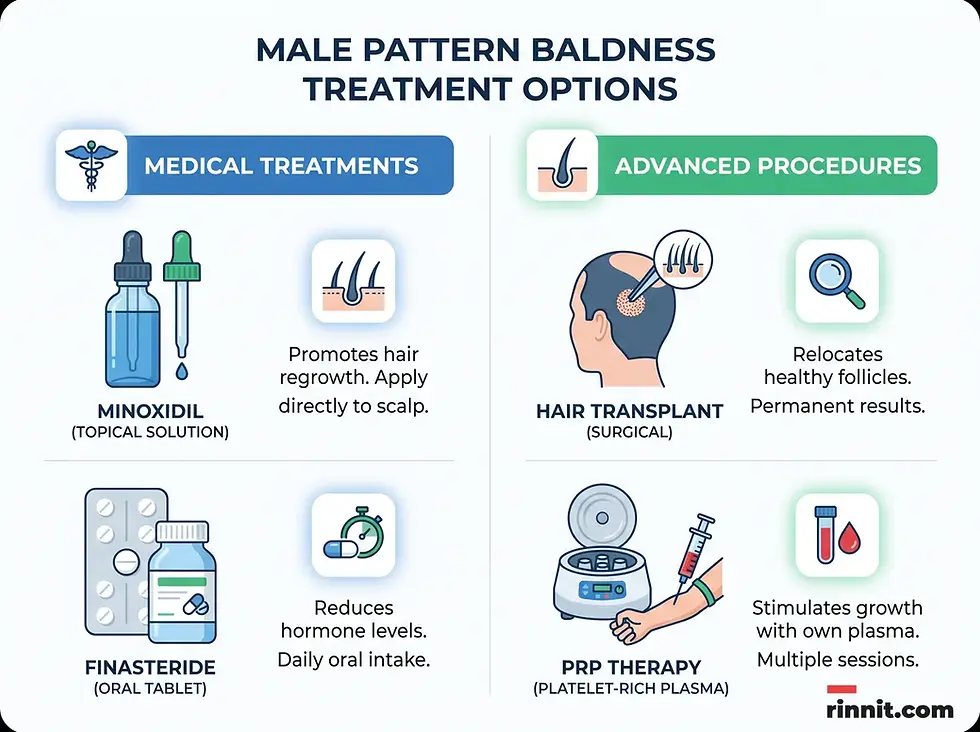
Medical treatments and advanced procedures for male pattern baldness work in different ways.
How does male pattern baldness affect well-being, and what habits help?
Beyond the physical changes, male pattern baldness can have a significant psychological impact, including emotional stress, anxiety, or depression. If it is affecting your mental health, reach out to your healthcare provider [1]. Researchers do not know of any way to prevent male pattern baldness, but healthy habits can help keep the hair you have healthy [1].

Nutrition, stress management, and consistent habits support overall hair health.
Nutritional support: get enough protein (about 40 to 60 grams a day, especially if you are vegetarian or vegan) from sources such as fish, eggs, and beans, along with vitamins A, B, C, D, E, zinc, and iron, which help maintain healthy hair. A Mediterranean-style diet includes fruits, vegetables, and protein that may help minimize hair loss [1].
Stress management: stress may contribute to male pattern baldness by increasing androgen activity, so finding ways to cope with stress may help [1].
Gentle scalp care: gentle scalp massage and avoiding harsh chemical treatments and tight hairstyles are commonly recommended habits, although they do not prevent male pattern baldness.
What is the bottom line on male pattern baldness?
Male pattern baldness is a common experience for most men, shaped by an interplay of genetics and hormones. It does not threaten physical health, but the emotional toll can be significant. By understanding the stages of hair loss and exploring treatment options early, you can make informed decisions about managing your appearance and well-being.
If you are noticing early signs of thinning or a receding hairline, talk with a healthcare provider about a personalized management plan that fits your needs.
Frequently Asked Questions
Does male pattern baldness only come from my mother's side?
No. If your maternal grandfather has male pattern baldness there is a good chance you will too, but having a father with male pattern baldness also doubles your risk of developing the condition.
At what age does male pattern baldness typically start?
Signs can appear as early as the late teens or early 20s, though many men begin to notice significant thinning or recession by their 30s.
Is male pattern baldness a sign of a serious health problem?
No. It does not affect your physical health, although it can lead to psychological challenges such as emotional stress, anxiety, or depression.
How long does it take for minoxidil to show results?
Minoxidil may take two to four months of daily use before you notice any improvement in hair loss. Finasteride may take at least three months of daily use.
Can I stop using hair loss medication once my hair grows back?
No. If you stop using minoxidil or finasteride, your regrown hair will fall out.
What is the Hamilton-Norwood scale?
The Hamilton-Norwood scale is a clinical scale used to categorize the seven stages of male pattern baldness, ranging from little or no hair loss to complete hair loss on top of the head with only a thin band of hair around the sides.
Are hair transplants permanent?
A hair transplant moves healthy hair from other areas of your scalp to thinning areas, but you may need several "touch-up" surgeries to achieve a natural-looking result, and it can take up to a year to see the full results.
Does wearing hats cause male pattern baldness?
No. Male pattern baldness is primarily caused by genetics, hormones (DHT), and aging, not by wearing hats or specific styling habits.
Can diet help prevent male pattern baldness?
No known method prevents male pattern baldness, and diet cannot prevent genetic hair loss. Getting enough protein and key vitamins and minerals, such as iron and zinc, may help keep your hair healthy.
What is PRP treatment for hair loss?
Platelet-rich plasma (PRP) involves removing a sample of your own blood, processing it, and injecting it into your scalp to stimulate hair growth. You may need more injections to maintain your results.
Related Reading
Hair Loss Treatments: Medications, Procedures, and What to Expect compares medicines and procedures used to slow or reverse hair loss.
Hair Transplant: How It Works, Types, Recovery, Risks and Results explains how hair transplant surgery works and what results to expect.
Telogen Effluvium: Symptoms, Causes, Treatment and Regrowth explains sudden temporary shedding that can be confused with balding.
Female Pattern Baldness: Symptoms, Causes, Stages, Diagnosis, Treatment and Prevention — What You Need to Know explains how pattern hair loss looks and is treated in women.
References
Cleveland Clinic. Male Pattern Baldness (Androgenic Alopecia). Cleveland Clinic. December 9, 2022. https://my.clevelandclinic.org/health/diseases/24515-male-pattern-baldness-androgenic-alopecia
Mella JM, Perret MC, Manzotti M, et al. Efficacy and safety of finasteride therapy for androgenetic alopecia: a systematic review. Arch Dermatol. 2010;146(10):1141-1150. PMID 20956649. https://doi.org/10.1001/archdermatol.2010.256
Gupta AK, Venkataraman M, Talukder M, et al. Relative efficacy of minoxidil and the 5-α reductase inhibitors in androgenetic alopecia treatment of male patients: a network meta-analysis. JAMA Dermatol. 2022;158(3):266-274. PMID 35107565. https://doi.org/10.1001/jamadermatol.2021.5743
Giordano S, Romeo M, Lankinen P. Platelet-rich plasma for androgenetic alopecia: does it work? Evidence from meta analysis. J Cosmet Dermatol. 2017;16(3):374-381. PMID 28296142. https://doi.org/10.1111/jocd.12331
Medical disclaimer
This article is for informational purposes only and is not a substitute for professional medical advice, diagnosis, or treatment. The clinical information in this guide reflects source material last reviewed in December 2022.



Comments