Hair Loss in Women: What It Is, Why It Happens, and How It's Treated

Updated: 2 days ago
Medically reviewed by Dr. Baraa Alnahhal, MD · Last reviewed: October 2026
Quick Answer
Hair loss in women occurs when the natural balance of growth and shedding is interrupted, resulting in more than 125 hairs lost daily [3]. Causes include female pattern hair loss, hormonal changes, stress and chemotherapy [3]. Signs include a widening part and visible scalp [3]. Treatments include topical minoxidil, laser therapy and PRP injections [2] [3]; stress-related shedding often resolves on its own [3].
What the research says
Topical minoxidil helps more women regrow hair than placebo. According to PubMed, a Cochrane review of 47 trials (5,290 participants) found that 157 of 593 women using minoxidil reported moderate to marked regrowth versus 77 of 555 on placebo (risk ratio 1.93). Seventeen of the trials tested minoxidil, and 2% and 5% strengths showed no clear difference in side effects (van Zuuren et al., Cochrane Database of Systematic Reviews, 2016) [1].
Many treatment types promote hair growth, and combining them works best. A systematic review of 141 studies in people with androgenic alopecia found that over-the-counter options (such as topical minoxidil and low-level light), prescription drugs (such as oral minoxidil and finasteride), and procedures (such as platelet-rich plasma and hair transplantation) all promoted hair growth, with a multifaceted, individualized approach working best (Rosenthal et al., Journal of Cosmetic and Laser Therapy, 2024) [2].
Laser combs raised hair counts, but women did not always rate them better than a sham device. In two trials of 141 participants, hair count rose more with a low-level laser comb than with a sham device (mean difference about 17), yet participants did not rate the comb as more effective (van Zuuren et al., Cochrane Database of Systematic Reviews, 2016) [1].
Study details are from PubMed abstracts.

What Is Hair Loss in Women?
Hair loss in women is a condition where females experience an unexpected and heavy loss of hair that disrupts the natural growth cycle [3]. Under normal circumstances, humans shed between 50 and 100 single hairs every day [3] as part of a healthy balance where old hairs fall out and new ones grow in. When this balance is broken, meaning hair falls out but less hair grows back, it is medically diagnosed as alopecia [3].
Hair on the human body is categorized into two main types: vellus hair, which is fine, light, and short (often called "peach fuzz"), and terminal hair, which is thicker, darker, and longer [1] [3]. The hair on your scalp typically follows a specific lifecycle consisting of three distinct phases.
Growth Phase | Name | Duration | Function |
Phase 1 | Anagen | 2 to 8 years | The active growing phase; accounts for 85-90% of scalp hair. |
Phase 2 | Catagen | 2 to 3 weeks | The transition phase where hair follicles begin to shrink. |
Phase 3 | Telogen | 2 to 4 months | The resting phase, at the end of which the hair falls out. |
What Are the Different Types of Female Hair Loss?
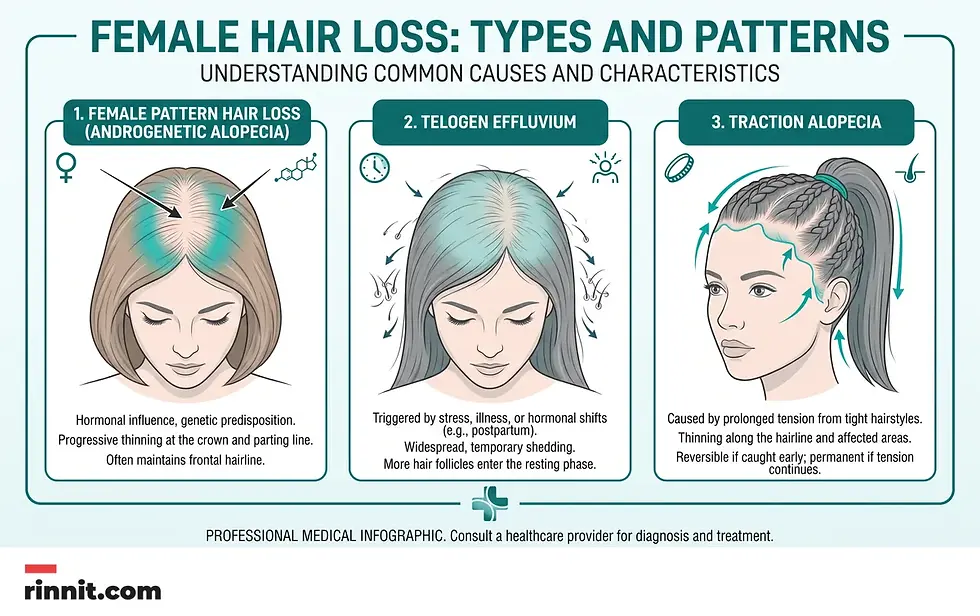
Not all hair loss is the same. In women, the condition is generally categorized into three primary types based on the underlying mechanism of the loss.
Androgenetic Alopecia: Also known as female pattern hair loss (FPHL), this is the most common form [1] [3]. It typically involves thinning over the top and sides of the head and affects approximately 30 million women in the United States alone [3].
Anagen Effluvium: This type occurs when medications, such as chemotherapy, compromise a hair follicle during its active growing phase [3].
Telogen Effluvium: This happens when an abnormally high number of hair follicles enter the resting (telogen) phase simultaneously, leading to widespread shedding [3].
What Causes Hair Loss in Women?
Hair loss is rarely caused by a single factor. Instead, it is often the result of complex interactions between genetics, health, and environment. Hormonal changes are a significant contributor, particularly during pregnancy or menopause, when fluctuating hormone levels cause hair follicles to shrink and produce finer, thinner strands [3].
Category | Potential Triggers |
Medical & Health | Thyroid abnormalities, anemia, iron or vitamin deficiencies, and autoimmune conditions. |
Physical Stress | Rapid weight loss, high fever, or recovery from surgery. |
External Factors | Chemical hair treatments, radiation therapy, and tight hairstyles that damage follicles. |
Medications | Blood pressure drugs, gout medications, and high doses of Vitamin A. |
Genetics | A biological family history of thinning or baldness. |
What Are the Visible Signs and Symptoms?
Unlike male hair loss, which often begins with a receding hairline, female hair loss usually presents as general thinning. Women may notice that their part is becoming wider or that their scalp is increasingly visible through their hair [3]. Other signs include seeing significantly more hair in the drain or hairbrush, feeling hair break off more easily, or noticing that ponytails feel much smaller than they used to [3].
How Is Hair Loss in Women Diagnosed?
Diagnosing the cause of hair loss requires a thorough evaluation by a healthcare provider, usually a dermatologist [3]. The process begins with a physical examination and a detailed history of your hair habits, diet, and stress levels. Providers may perform a "pull test," where they gently tug on a small section of hair to see how many strands come out [3].
Advanced diagnostic tools include:
Blood tests: To check for underlying issues like thyroid dysfunction or deficiencies in iron, zinc, and vitamins D and B [3].
Microscopic exam: Using a specialized tool to examine the scalp and hair follicles closely [3].
Scalp biopsy: Removing a tiny piece of scalp skin to examine it for signs of follicle damage or disease [3].
What Treatment Options Are Available?
The most effective treatment for hair loss depends entirely on the underlying cause [3]. For temporary hair loss caused by stress or pregnancy, no treatment may be necessary, as the hair often regrows naturally once the trigger is removed [3]. For more persistent types, several medical and procedural options exist.

Topical medications: Minoxidil (Rogaine®) is FDA-approved for female pattern hair loss. It is available over the counter in 2% or 5% solutions and must be used indefinitely to maintain results [3].
Light therapy: Low-light laser devices, such as specialized combs or helmets, are approved to stimulate hair follicles [3].
Procedural treatments: Microneedling, Platelet-Rich Plasma (PRP) injections, and hair transplant surgery are options for more advanced cases [2] [3].
Hormonal therapy: Medications like spironolactone or estrogens may be prescribed if the loss is linked to hormonal imbalances [3] [4].
Conclusion
While hair loss is not physically dangerous, it can be a deeply emotional experience that impacts self-esteem and social confidence [3]. Early intervention is the most effective way to manage thinning and promote regrowth [4]. If you notice unexpected shedding or thinning, consulting a dermatologist can help you identify the cause and start a tailored treatment plan.
"Unwanted changes to your appearance can influence your self-esteem and social life. Some people find comfort in talking with a mental health professional if their hair loss causes discomfort." (Cleveland Clinic)
For more expert guides on maintaining your health and wellness, visit Rinnit.com.
Frequently Asked Questions
Is it normal to lose hair every day?
Yes, shedding 50 to 100 hairs daily is part of the natural growth cycle.
Can stress cause my hair to fall out?
Yes, significant physical or emotional stress can push more hair follicles into the resting phase, leading to telogen effluvium.
Will my hair grow back after chemotherapy?
In most cases, hair lost due to anagen effluvium (like chemo) will begin to grow back after treatment ends.
Is female pattern baldness hereditary?
Yes, genetics play a major role in the most common type of hair loss in women.
Does menopause cause hair loss?
Hormonal shifts during menopause can cause hair follicles to shrink, resulting in finer, thinner hair.
Can a poor diet lead to hair thinning?
Yes, deficiencies in iron, protein, and vitamins (like B and D) can negatively impact hair growth.
What is the "pull test"?
The "pull test" is a diagnostic method where a doctor gently pulls on a section of hair to determine the severity of active shedding.
How does minoxidil work?
Minoxidil is a topical treatment that helps stimulate hair follicles and prolong the growth phase.
Is hair loss in women permanent?
It depends on the cause; damage to the hair follicles can cause permanent loss, while other types are temporary.
Can tight hairstyles cause hair loss?
Yes, hairstyles that pull constantly on the hair can damage follicles over time.
Are there shampoos that help with hair loss?
Volumizing, sulfate-free shampoos can help hair appear fuller and prevent further damage.
Can hair dye make hair loss worse?
While chemical treatments can damage hair, some dyes can actually make hair appear thicker by increasing strand volume.
Does scalp massage help?
Massaging the scalp can stimulate blood flow to the follicles, which may support healthy growth.
When should I see a doctor about hair loss?
You should see a dermatologist as soon as you notice unexpected thinning or patches of missing hair.
Are laser helmets effective?
Several low-light laser devices are FDA-approved and have shown effectiveness in treating female pattern hair loss.
References
van Zuuren EJ, et al. Interventions for female pattern hair loss. Cochrane Database Syst Rev. 2016;2016(5):CD007628. PMID 27225981. https://doi.org/10.1002/14651858.CD007628.pub4
Rosenthal A, et al. Management of androgenic alopecia: a systematic review of the literature. J Cosmet Laser Ther. 2024;26(1-4):1-16. PMID 38852607. https://doi.org/10.1080/14764172.2024.2362126
Cleveland Clinic. Hair Loss in Women. Cleveland Clinic. Last updated February 9, 2024. https://my.clevelandclinic.org/health/diseases/16921-hair-loss-in-women
Herskovitz I, et al. Female pattern hair loss. Int J Endocrinol Metab. 2013;11(4):e9860. PMID 24719635. https://doi.org/10.5812/ijem.9860
Rebora A. Telogen effluvium: a comprehensive review. Clin Cosmet Investig Dermatol. 2019;12:583-590. PMID 31686886. https://doi.org/10.2147/CCID.S200471
Medical Disclaimer
This article is for general educational purposes only and is not a substitute for professional medical advice, diagnosis, or treatment. Always seek the advice of your physician or other qualified healthcare provider with any questions you may have about a medical condition. Never disregard professional medical advice or delay seeking care because of something you have read here. If you think you may have a medical emergency, call your doctor or emergency services immediately.



Comments