Glucose Test in Pregnancy: One-Hour Screening, Three-Hour Test and Results

Written and medically reviewed by Dr. Baraa Alnahhal, MD · Last reviewed: November 2026 · How we review
Quick Answer: What is the glucose test in pregnancy?
The glucose test in pregnancy checks for gestational diabetes, a condition where blood sugar is too high during pregnancy. It usually happens between weeks 24 and 28. You drink a sugary liquid, then have blood drawn from a vein in your arm. [1]
There are two versions. The one-hour glucose challenge test is a screening. If it is abnormal, a three-hour glucose tolerance test, done after fasting, confirms or rules out gestational diabetes. [1]
What the research says
Higher glucose means higher risk, with no clear cutoff. In 23,316 pregnant women with blinded results from a 75-g glucose tolerance test, each rise in fasting, 1-hour or 2-hour glucose raised the odds of birth weight above the 90th percentile (odds ratios 1.38 to 1.46), with no obvious threshold where risk jumped. (HAPO Study Cooperative Research Group, The New England Journal of Medicine, 2008) [2]
Treating mild gestational diabetes helps. In a trial of 958 women, treatment cut large-for-gestational-age babies from 14.5% to 7.1%, shoulder dystocia from 4.0% to 1.5% and cesarean delivery from 33.8% to 26.9% compared with usual care. (Landon et al., The New England Journal of Medicine, 2009) [3]
Key takeaways
The glucose test screens for gestational diabetes, which affects up to 10% of pregnant women. [1]
Most people are tested between weeks 24 and 28; some are tested earlier. [1]
The one-hour test is a screening; the three-hour test makes the diagnosis. [1]
A one-hour result under 140 mg/dL is normal; 140 mg/dL or higher leads to the three-hour test. [1]
Two or more high values on the three-hour test usually mean gestational diabetes. [1]
What is a glucose test in pregnancy?
Gestational diabetes means your blood glucose (sugar) is too high during pregnancy. It affects up to 10% of pregnant women and, if untreated, can harm both you and the fetus. A glucose test is how providers screen for and diagnose it. [1]
Both versions of the test involve drinking a sweet liquid called glucola and having blood drawn from a vein in your arm. The drink tastes like an extra-sweet sports drink or flat soda. [1]
Glucose challenge test vs. glucose tolerance test
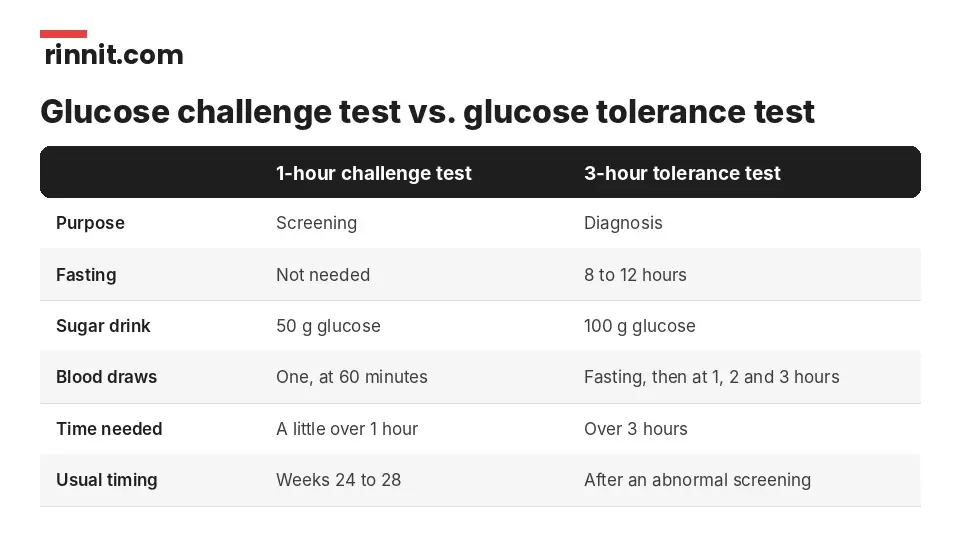
Screening first, diagnosis second.
Glucose challenge test | Glucose tolerance test | |
Other names | Glucose screening, gestational diabetes screening, one-hour test | Three-hour glucose test |
Purpose | Screening: shows a higher chance of gestational diabetes | Diagnosis of gestational diabetes |
Fasting | Not needed | At least 8 to 12 hours |
Glucose drink | 50 grams | 100 grams |
Blood draws | One, 60 minutes after the drink | Fasting, then at 1, 2 and 3 hours |
Time needed | A little over one hour | More than three hours |
Sources: [1]
A normal screening result means you need no further testing. An abnormal one leads to the three-hour test. It is possible to fail the screening and pass the three-hour test. [1]
When is the glucose test done?
Most people have the test between weeks 24 and 28 of pregnancy. Your provider may test you earlier if you: [1]
Had diabetes in a previous pregnancy
Have sugar in your urine at a prenatal visit
Have a family history of diabetes
Have obesity
Have high blood pressure
Are older than 35
Have polyendocrine metabolic ovarian syndrome (PMOS) or another condition linked to a higher diabetes risk
How do you prepare?
For the one-hour screening
No special preparation is needed, and you can eat normally. Most providers suggest skipping high-sugar breakfast foods such as pancakes, donuts and juice. If your test is later in the day, a lot of sugar at lunch may affect the result. [1]
For the three-hour test
Providers typically ask you to: [1]
Eat at least 150 grams of carbohydrates a day for three days before the test
Fast for at least 8 to 12 hours beforehand (a few sips of water in the morning are usually fine)
Schedule the test first thing in the morning
What happens during the test?

The three-hour test step by step.
One-hour glucose challenge test
You drink glucola containing 50 grams of glucose within five minutes.
You do not eat or drink (except a few sips of water) while you wait.
Blood is drawn from your arm 60 minutes later.
The screening takes a little over an hour. [1]
Three-hour glucose tolerance test
Your fasting blood glucose is measured first.
You drink glucola containing 100 grams of glucose within five minutes.
Blood is drawn one, two and three hours after you finish the drink.
You stay at the testing site between draws. Sips of water are usually allowed, but no food until after the last draw. The test takes more than three hours. [1]
Are there side effects?
Most people have none. Some feel nauseated or dizzy, but serious side effects are rare. [1]
What are normal glucose test results?
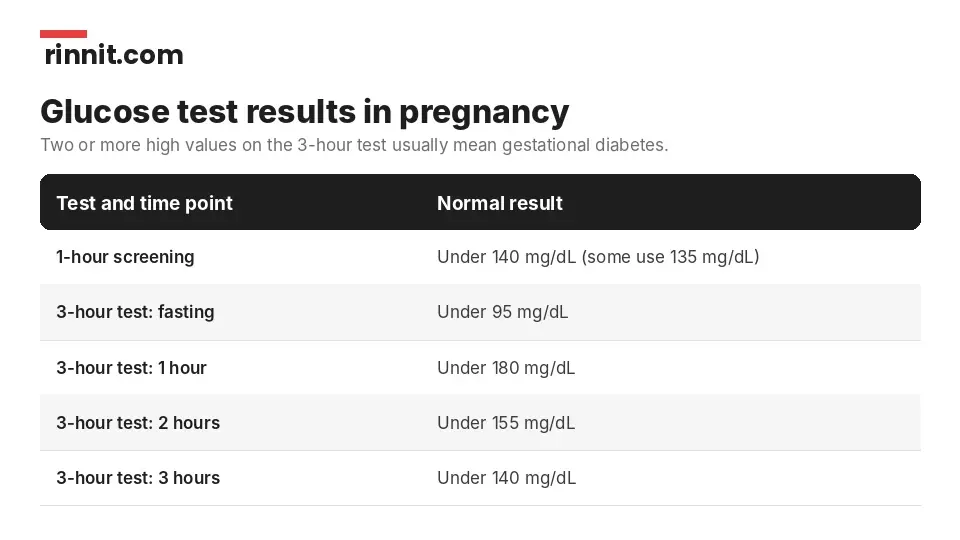
Normal cutoffs for each glucose reading.
Screening results usually come back within one or two days. [1]
Test | Normal result |
One-hour screening | Under 140 mg/dL (some providers use 135 mg/dL) |
Three-hour test: fasting | Under 95 mg/dL |
Three-hour test: 1 hour | Under 180 mg/dL |
Three-hour test: 2 hours | Under 155 mg/dL |
Three-hour test: 3 hours | Under 140 mg/dL |
Sources: [1]
Ranges vary by provider. Generally, two or more high values on the three-hour test lead to a gestational diabetes diagnosis. One high value may mean you are retested in a few weeks. [1]
What happens if you have gestational diabetes?
Treatment usually starts with changes to what you eat and checking your blood sugar with a home glucose meter at set times. If diet changes are not enough, you may need insulin. A provider or dietitian helps you manage your blood sugar for the rest of your pregnancy. [1]
Untreated gestational diabetes raises the risk of: [1]
Preeclampsia, a pregnancy-related form of high blood pressure
A large baby, which raises the risk of birth injury or cesarean delivery
Low blood sugar (hypoglycemia) in the newborn
Type 2 diabetes in the child later in life
You can decline screening, but major medical associations recommend it, and it is the only way to help diagnose gestational diabetes. [1]
Conclusion
The pregnancy glucose test is a simple, relatively painless way to catch gestational diabetes early. Most people only need the one-hour screening, and a high screening result is not a diagnosis on its own. [1]
If you do need the three-hour test, follow the carbohydrate and fasting instructions closely, and ask your provider what your numbers mean for you and your baby. [1]
Keep learning: Read our gestational diabetes guide, see how an A1C test measures average blood sugar, or use our due date calculator. For more background, see MedlinePlus on gestational diabetes.
FAQ
What is the glucose test in pregnancy?
A blood test after a sugary drink that screens for or diagnoses gestational diabetes. [1]
When is the glucose test done in pregnancy?
Usually between weeks 24 and 28, or earlier if you have risk factors. [1]
Do I need to fast for the one-hour glucose test?
No. You can eat normally, but avoid high-sugar foods beforehand. [1]
How do I prepare for the three-hour glucose test?
Eat at least 150 grams of carbohydrates a day for three days, then fast 8 to 12 hours. [1]
How much glucose is in the drink?
50 grams for the one-hour screening and 100 grams for the three-hour test. [1]
What is a normal one-hour glucose test result?
Under 140 mg/dL; some providers use 135 mg/dL as the cutoff. [1]
What are normal three-hour glucose test values?
Under 95 fasting, 180 at 1 hour, 155 at 2 hours and 140 mg/dL at 3 hours. [1]
What if I fail the one-hour glucose test?
You will usually have the three-hour test, and it is possible to pass it. [1]
Does the glucose test have side effects?
Most people have none; some feel nauseated or dizzy. [1]
How is gestational diabetes treated?
With diet changes and home blood sugar checks, plus insulin if needed. [1]
Related Reading
Gestational Diabetes: Symptoms, Causes, Risks & Treatment — Complete Guide explains the condition this test is used to find.
Preeclampsia: Symptoms, Causes & What Helps — A Complete Guide covers a pregnancy blood pressure problem that untreated gestational diabetes can raise the risk of.
Glucose Tolerance Test: Types, How to Prepare, What Happens and What Results Mean explains the 2-hour sugar-load test used to diagnose prediabetes, diabetes and gestational diabetes.
References
Cleveland Clinic. Oral Glucose Tolerance Test In Pregnancy: What To Expect. Cleveland Clinic. Last updated November 11, 2022. https://my.clevelandclinic.org/health/diagnostics/9696-glucose-test-pregnancy
HAPO Study Cooperative Research Group; Metzger BE, Lowe LP, Dyer AR, et al. Hyperglycemia and adverse pregnancy outcomes. N Engl J Med. 2008;358(19):1991-2002. PMID 18463375. https://doi.org/10.1056/NEJMoa0707943
Landon MB, Spong CY, Thom E, et al. A multicenter, randomized trial of treatment for mild gestational diabetes. N Engl J Med. 2009;361(14):1339-1348. PMID 19797280. https://doi.org/10.1056/NEJMoa0902430
Medical disclaimer
This article is for general education only and does not replace advice from a qualified healthcare professional. Talk to your doctor about your own diagnosis and treatment, and seek emergency care right away for severe or sudden symptoms.



Comments