Fetal Fibronectin (fFN) Test: Purpose, Preparation, Accuracy and Results

Updated: 2 days ago
Written and medically reviewed by Dr. Baraa Alnahhal, MD · Last reviewed: November 2026 · How we review
Quick Answer: What is a fetal fibronectin test?
A fetal fibronectin (fFN) test checks a swab of vaginal fluid for fetal fibronectin, a protein that helps hold the amniotic sac to the uterus. It's done between 22 and 34 weeks of pregnancy when there are signs of preterm labor. A negative result means you're very unlikely to deliver in the next one to two weeks.
What the research says
Measuring the amount of fFN sharpens the prediction. In a meta-analysis of 15 studies, the sensitivity of quantitative fFN for birth before 34 weeks fell from 78% at a 10 ng/mL cutoff to 11% at 500 ng/mL, while specificity rose from 63% to 99%, so higher levels mean higher risk. (Chen et al., International Journal of Gynecology & Obstetrics, 2021) [2]
Higher levels carry much higher odds of preterm birth, even without symptoms. In a pooled analysis of two studies of asymptomatic pregnancies, the odds of spontaneous birth before 28 weeks were 9 times higher with fFN of 50 ng/mL or more and 25 times higher above 200 ng/mL, compared with levels under 50 ng/mL. (Ruma et al., Journal of Maternal-Fetal & Neonatal Medicine, 2023) [3]
Key takeaways
Fetal fibronectin is a protein that should not be found in vaginal fluid before 35 weeks; its presence suggests the amniotic sac is loosening from the uterus. [1]
The test is a painless vaginal swab done between 22 and 34 weeks, usually for people with signs of preterm labor or high risk factors. [1]
A negative result is very reliable: labor is unlikely within 14 days. A positive result raises the risk but many people still carry to term. [1]
Avoid sex, lubricants, douches, pelvic exams and transvaginal ultrasound for 24 hours before the test to prevent false positives. [1]
Results take 24 to 48 hours and guide decisions about steroids, tocolytics and monitoring. [1]
What is fetal fibronectin?
Fetal fibronectin is a protein made during pregnancy that helps keep the amniotic sac attached to the lining of the uterus. If that connection starts to break down, fFN can leak into the vagina. Normally there should be none in vaginal fluid before 35 weeks, so a positive test suggests the sac is not holding as it should. [1]
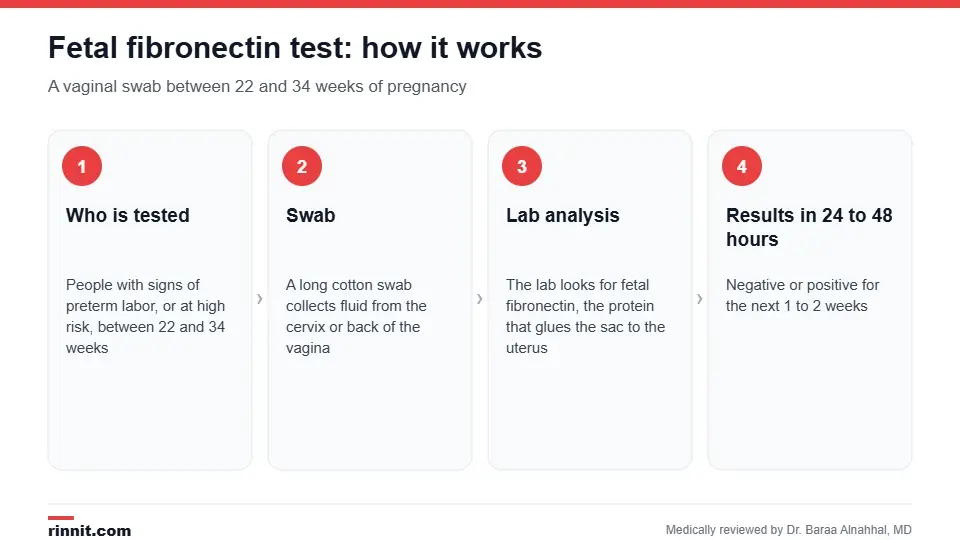
How the fetal fibronectin test works.
Who needs a fetal fibronectin test?
Providers usually test people who show signs of preterm labor, such as: [1]
Uterine contractions [1]
Abdominal pain, cramping or a dull lower backache [1]
Bloody show or loss of the mucus plug [1]
Pelvic pressure or pain, or signs of cervical dilation [1]
People without symptoms but with high risk factors may also be tested, including a history of preterm delivery, certain cervical or uterine surgeries, a short cervix, smoking during pregnancy, low pre-pregnancy weight or a short gap between pregnancies. The test is not recommended for low-risk pregnancies without symptoms. [1]
When is the test done?
The test is performed between 22 and 34 weeks. It is usually not done after 35 weeks, because babies born after that point are less likely to have severe complications of prematurity. [1]
How do you prepare for a fetal fibronectin test?
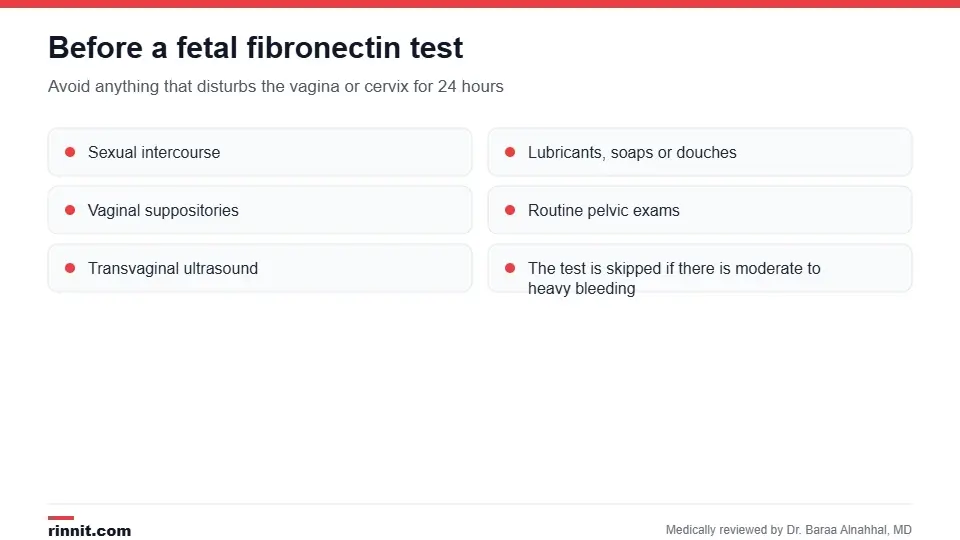
What to avoid before the test.
Anything that disturbs the vagina or cervix can cause a false-positive result, so for 24 hours before the test avoid: [1]
Sexual intercourse [1]
Lubricants, soaps, suppositories or douches in the vagina [1]
Routine pelvic exams or transvaginal ultrasounds [1]
The test is not done if you have moderate to heavy vaginal bleeding. [1]
What happens during a fetal fibronectin test?
Your provider inserts a long, thin cotton swab into the vagina to collect fluid from the cervix or the back of the vagina. The swab goes to a laboratory for analysis. The test is painless and safe. [1]
Fetal fibronectin test at a glance
Item | Typical detail |
Timing | 22 to 34 weeks of pregnancy |
Sample | Vaginal fluid collected with a cotton swab |
Pain | None |
Results | 24 to 48 hours |
Risk window | The next one to two weeks |
Sources: [1]
What do fetal fibronectin results mean?
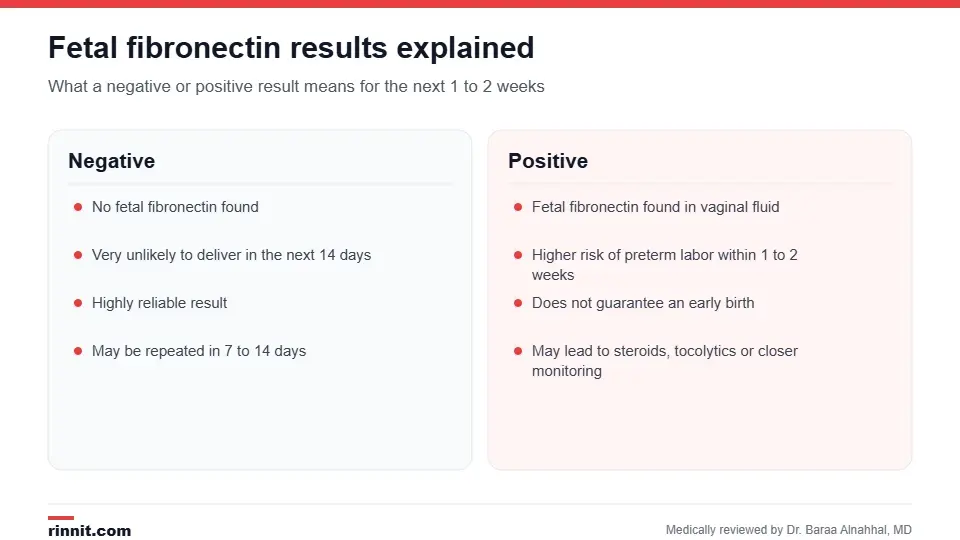
What negative and positive results mean.
Result | What it means | What happens next |
Negative | No fFN detected; preterm birth in the next one to two weeks is very unlikely | Your provider may retest in 7 to 14 days or order an ultrasound, depending on symptoms |
Positive | fFN detected; higher risk of labor or delivery within one to two weeks | Closer monitoring and possible treatment |
Sources: [1]
A negative result is very accurate for predicting that labor will not start within 14 days. A positive result is less certain, and many people with a positive test carry to full term. [1] Studies that measure the exact fFN level show that risk rises with the concentration: low levels carry little risk, while levels above 200 ng/mL carry much higher odds of early birth. [2] [3]
What happens after a positive result?
There is no set timeline for delivery after a positive test; it only signals higher risk. Your provider may recommend corticosteroids to help the fetus's lungs mature, tocolytic medicines to slow or stop contractions, and antibiotics if you have tested positive for group B strep or your water has broken. [1]
When should you call a doctor?
Call your provider or go to the hospital right away if you have regular contractions before 37 weeks, fluid leaking from the vagina, vaginal bleeding, or pelvic pressure or cramping that does not ease. [1]
Conclusion
The fetal fibronectin test is a quick, painless swab that helps your provider judge how likely preterm birth is in the next one to two weeks. Its real strength is a negative result, which can reassure you and avoid unnecessary treatment. [1]
A positive result means closer watching and sometimes medicines to protect the baby, not a certain early delivery. Preparing properly, by avoiding sex, exams and vaginal products for 24 hours, keeps the result reliable. [1]
Keep learning: Read our preterm labor guide to recognize the warning signs that lead to this test.
Frequently asked questions
What is fetal fibronectin?
A protein that helps hold the amniotic sac to the uterine lining. Its presence in vaginal fluid before 35 weeks suggests the sac is loosening.
When is the fetal fibronectin test done?
Between 22 and 34 weeks of pregnancy, usually when there are signs of preterm labor.
How is the fetal fibronectin test done?
A provider collects vaginal fluid with a long cotton swab, and a lab tests it for the protein.
Does the fetal fibronectin test hurt?
No. It is painless and safe.
How should I prepare for the test?
Avoid sex, lubricants, douches, suppositories, pelvic exams and transvaginal ultrasound for 24 hours beforehand.
What does a negative fetal fibronectin test mean?
You are very unlikely to go into labor within the next 14 days.
What does a positive fetal fibronectin test mean?
Your risk of preterm labor in the next one to two weeks is higher, but many people with a positive result still deliver at term.
How long do results take?
Usually 24 to 48 hours, because the sample goes to a lab.
Can the test give a false positive?
Yes, especially if anything was placed in the vagina in the 24 hours before testing.
What happens if the test is positive?
Your provider may order closer monitoring, corticosteroids for the baby's lungs, tocolytics or antibiotics.
Related Reading
Preterm Labor Guide: Symptoms, Causes, Diagnosis, and Treatment explains the symptoms, causes and treatment of labor that starts before 37 weeks.
Preterm Labor: Recognizing Early Signs and Seeking Care helps you recognize early warning signs of preterm labor.
Premature Rupture of Membranes (PROM): Symptoms, Risks, and Management covers water breaking early, one reason the test is ordered.
Incompetent Cervix: Symptoms, Causes & Treatment Guide describes a short or weak cervix, a risk factor for preterm birth.
References
Cleveland Clinic. Fetal Fibronectin (fFN): Testing, Purpose & Accuracy. Cleveland Clinic. Last updated December 16, 2022. https://my.clevelandclinic.org/health/diagnostics/21068-fetal-fibronectin-ffn
Chen J, Gong G, Zheng W, et al. Diagnostic accuracy of quantitative fetal fibronectin to predict spontaneous preterm birth: A meta-analysis. Int J Gynaecol Obstet. 2021;153(2):220-227. PMID 33336362. https://doi.org/10.1002/ijgo.13550
Ruma MS, Betts M, Dodman S, et al. Predictive value of quantitative fetal fibronectin for spontaneous preterm birth in asymptomatic pregnancies: a systematic literature review and meta-analysis. J Matern Fetal Neonatal Med. 2023;36(2):2279923. PMID 37953268. https://doi.org/10.1080/14767058.2023.2279923
Medical disclaimer
This article is for general education only and does not replace advice from a qualified healthcare professional. Talk to your doctor about your own diagnosis and treatment, and seek emergency care right away for severe or sudden symptoms.



Comments