Incompetent Cervix: Symptoms, Causes & Treatment Guide

Updated: 2 days ago
Medically reviewed by Dr. Baraa Alnahhal, MD · Last reviewed: September 2026
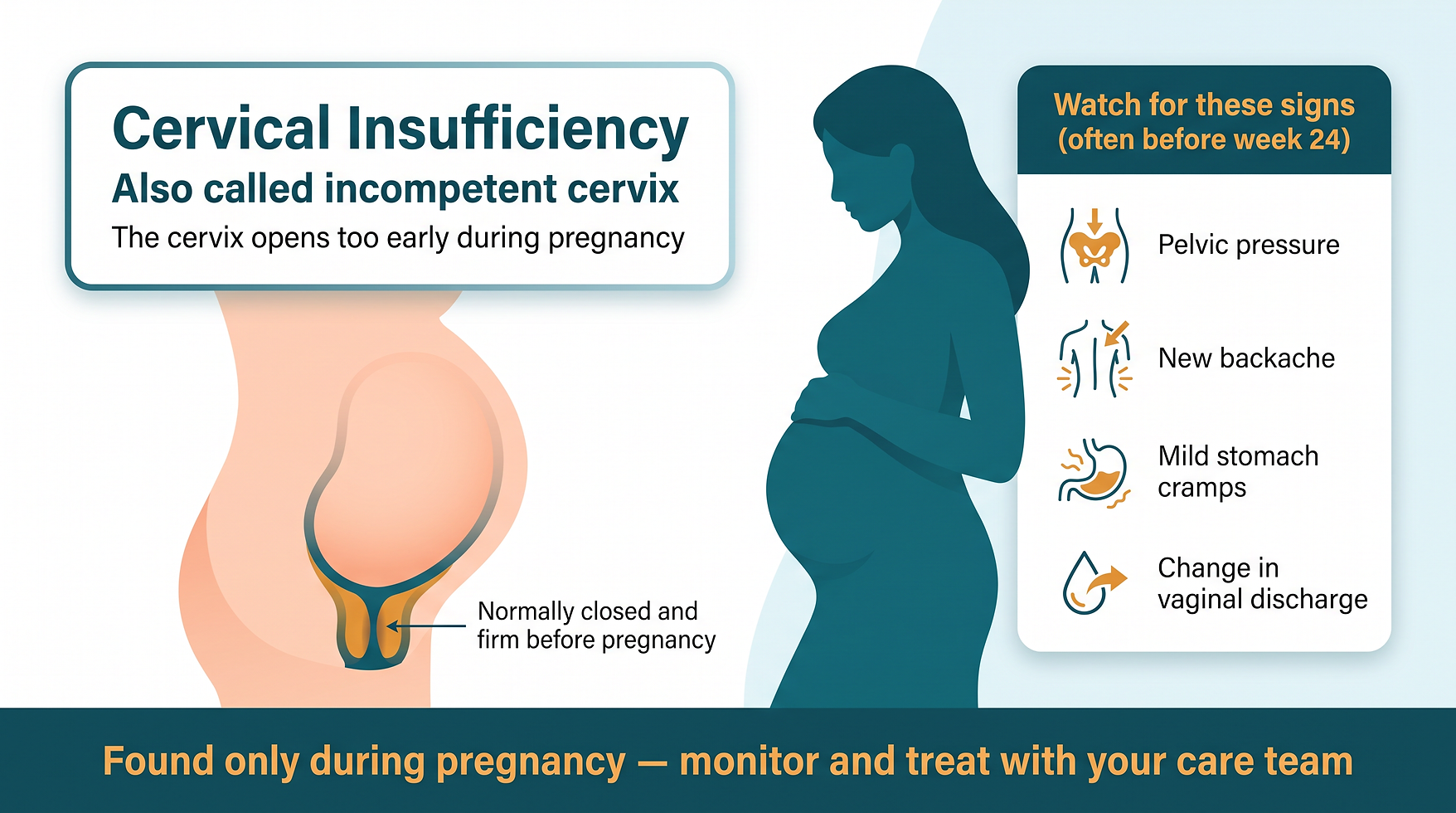
An incompetent cervix — also called cervical insufficiency — happens when weak cervical tissue causes or plays a part in a premature birth or the loss of a healthy pregnancy. The cervix, the lower part of the uterus that opens to the vagina, is normally closed and firm before pregnancy, and softens, shortens, and opens as birth approaches. With cervical insufficiency, it can begin to open too soon. The condition often shows no signs in early pregnancy, though some women notice pelvic pressure, a new backache, mild cramps, or changes in discharge, typically before 24 weeks. It is diagnosed only during pregnancy — usually with a transvaginal ultrasound, a pelvic exam, and sometimes lab tests. Treatment may include a cervical cerclage (stitches that close the cervix), vaginal progesterone, repeated ultrasounds, or a pessary. You cannot prevent the condition itself, but regular prenatal care and a healthy pregnancy plan give you the best chance of carrying to term.
Quick Answer
What is an incompetent cervix? A condition in which weak cervical tissue causes or contributes to a premature birth or pregnancy loss. It is also called cervical insufficiency.
What are the main symptoms? Often none in early pregnancy. Warning signs include pelvic pressure, a new backache, mild stomach cramps, a change in vaginal discharge, and light bleeding — usually before 24 weeks.
How is it diagnosed? Only during pregnancy, through your history, a transvaginal ultrasound to measure the cervix, a pelvic exam, and sometimes lab tests to rule out infection.
What causes it? Often the cause is unknown. Known risk factors include prior cervical surgery or procedures (such as a D&C) and certain conditions present at birth that affect the uterus or collagen.
How is it treated? Options include a cervical cerclage (strong stitches that hold the cervix closed), daily vaginal progesterone, close monitoring with ultrasounds every two weeks from weeks 16–24, and in some cases a pessary device.
Can it be prevented? You cannot prevent the condition itself, but regular prenatal care, a prenatal vitamin, a healthy diet, and avoiding smoking, alcohol, and drugs support a healthier, full-term pregnancy.
Will it happen again? Having an incompetent cervix in one pregnancy raises the risk of premature birth or pregnancy loss in later pregnancies — so planning your next pregnancy with your doctor is important.
What Is an Incompetent Cervix?
An incompetent cervix happens when weak cervical tissue causes or plays a part in a premature birth or the loss of a healthy pregnancy. This condition also is called cervical insufficiency.
The cervix is the lower part of the uterus that opens to the vagina. Before pregnancy, it is usually closed and firm.
As pregnancy progresses and the body prepares for birth, the cervix slowly changes. It softens, gets shorter, and opens. If you have an incompetent cervix, this opening may begin too soon, causing you to give birth too early.
The encouraging news: if your cervix begins to open early, or if you have had cervical insufficiency in the past, treatment is often available. This may include a procedure to close the cervix with strong sutures called a cervical cerclage, medicine to help, and ultrasound exams to check how things are going.
It is worth saying clearly: an incompetent cervix is a recognized medical condition — not something you did wrong. Cervical tissue can be weak for reasons you have no control over.
What Are the Symptoms of an Incompetent Cervix?
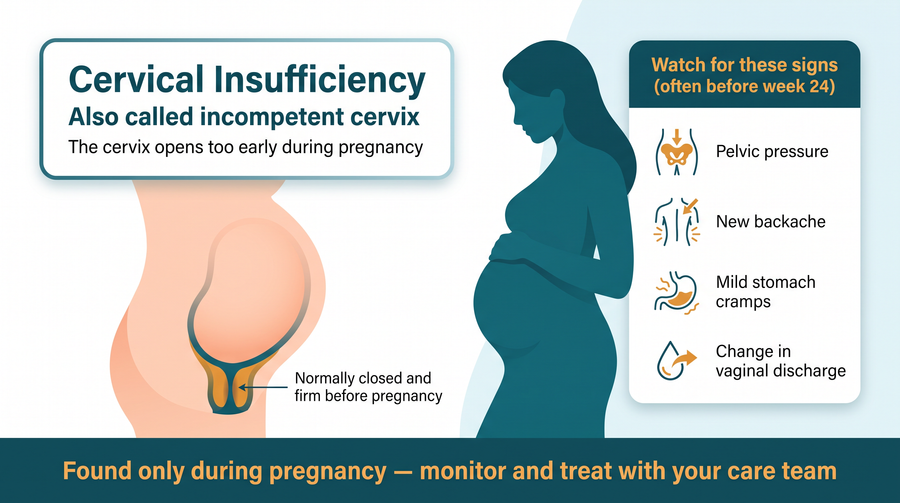
With an incompetent cervix, there may be no signs or symptoms at all during early pregnancy. Some women experience mild discomfort or spotting before the diagnosis.
These signs often appear before 24 weeks of pregnancy.
Pelvic pressure: a feeling of pressure low in the pelvis.
New backache: a backache you have not had before in this pregnancy.
Mild stomach cramps: gentle, cramp-like abdominal discomfort.
Change in vaginal discharge: any unusual change in the amount, color, or consistency of discharge.
Light vaginal bleeding: spotting or light bleeding.
Because symptoms can be subtle — or absent entirely — this is one reason the condition is difficult to catch early. That is why any unusual pelvic pressure or cramping in the second trimester deserves a conversation with your care team, even if it seems minor.
What Causes an Incompetent Cervix?
Many women who develop cervical insufficiency have no known risk factor at all. When causes can be identified, they generally fall into two categories.

Cervical trauma (most common known factor): A previous procedure or surgery on the cervix could lead to an incompetent cervix. This includes surgery to treat a cervical problem found during a Pap test, and a procedure called dilation and curettage (D&C). Rarely, a cervical tear during a previous labor and delivery can also be a risk factor.
A condition you're born with (congenital): Certain uterine conditions might cause an incompetent cervix. Genetic problems affecting collagen — a protein that makes up your body's connective tissues — might also cause it.
What Are the Complications?
An incompetent cervix may be risky for your pregnancy. The two possible complications are:
Premature birth: delivery before 37 weeks of pregnancy.
Pregnancy loss: loss of the pregnancy.
These possibilities are understandably frightening. But diagnosis and monitoring give your care team the chance to intervene — and treatment exists precisely to lower these risks.
Can an Incompetent Cervix Be Prevented?
You cannot prevent an incompetent cervix itself. However, there is a great deal you can do to support a healthy, full-term pregnancy.
Seek regular prenatal care: Regular checkups let your care team monitor your health and your baby's health. Tell your doctor about any signs or problems that worry you — even if they seem silly or unimportant.
Eat a healthy diet: Pregnancy requires more folic acid, calcium, iron, and other essential nutrients. A daily prenatal vitamin can help if you are not eating enough healthy foods, starting a few months before conception and continuing through pregnancy.
Gain weight wisely: A gain of 25 to 35 pounds (about 11 to 16 kilograms) is often the target if you are at a healthy weight before pregnancy.
Avoid risky substances: Quit smoking; alcohol and illegal drugs are off-limits; get your doctor's OK before taking any medicines or supplements — even those available without a prescription.
Planning another pregnancy? If you have had an incompetent cervix during one pregnancy, you are at risk of premature birth or pregnancy loss in later pregnancies. If you are considering getting pregnant again, talk with your doctor to understand the risks and what you can do to promote a healthy pregnancy.
How Is an Incompetent Cervix Diagnosed?
An incompetent cervix can be found only during pregnancy. It can be a difficult diagnosis to make — especially during a first pregnancy.
Your care team will start by asking about your symptoms and medical history. Be sure to tell them if you have had a pregnancy loss in the second trimester of a past pregnancy, a history of preterm delivery, or any procedures you have had on your cervix. Your history matters enormously here.
A doctor might diagnose an incompetent cervix if you have:
History-based: A past pregnancy with painless widening of the cervix (called dilation) and second-trimester delivery.
Physical finding: Advanced cervical dilation and effacement before week 24 of pregnancy. Effacement means the cervix gets thinner and softer. Dilation and effacement can happen without painful contractions — they may also occur with vaginal bleeding, infection, or ruptured membranes (when your water breaks).
Diagnosis during the second trimester may also include the following exams and tests:
Transvaginal ultrasound: A thin, wandlike device called a transducer is placed inside the vagina; it emits sound waves converted into pictures on a screen. This checks the length of your cervix, and whether any tissues are sticking out of the cervix.
Pelvic exam: The doctor checks the cervix to see if the amniotic sac (where the baby is growing) can be felt through the opening. If the wall of the sac is in the cervical canal or vagina, it is called prolapsed fetal membranes — meaning the cervix has started to open. The doctor may also check for contractions and track them.
Lab tests: If you have prolapsed fetal membranes, you may need other tests to rule out an infection — in some cases an amniocentesis, which takes a sample of amniotic fluid to check the amniotic sac and fluid for infection.
Before pregnancy: There are no reliable tests that can predict an incompetent cervix before you conceive. But certain tests done before pregnancy, such as an ultrasound or MRI, could help find congenital problems with the uterus that might cause it.
How Is an Incompetent Cervix Treated?
Treatment options for managing an incompetent cervix range from monitoring to a surgical stitch, and the right approach depends on your history, how far along you are, and how the cervix is behaving.
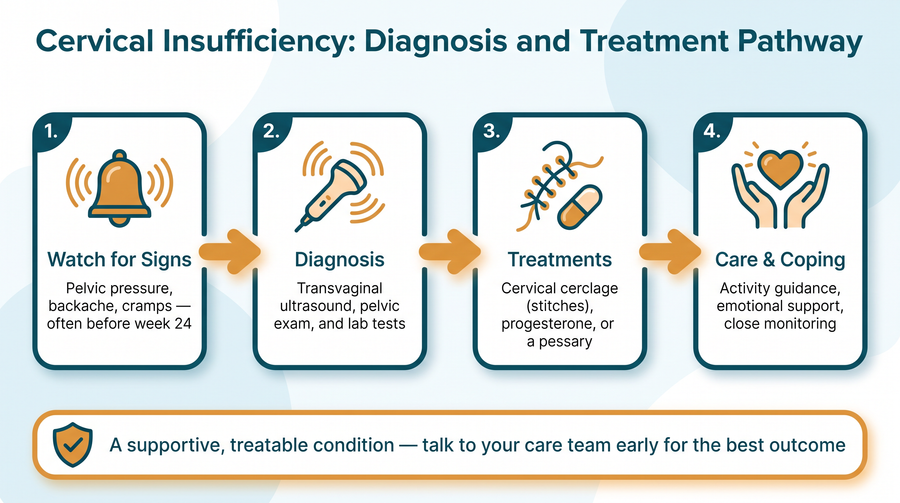
Progesterone supplementation: A daily vaginal progesterone gel or suppository may lower the risk of having your baby too early. Used if you have a short cervix with no history of a preterm birth.
Repeated ultrasounds: Ultrasounds every two weeks from week 16 through week 24 of pregnancy to monitor cervix length. If the cervix begins to open or shortens past a certain point, a cervical cerclage may be needed. Used if you have a history of early premature birth or other factors that raise your risk.
Cervical cerclage: The cervix is stitched tightly closed to help prevent premature birth. The stitches are removed during the last month of pregnancy or just before delivery. Used if you are less than 24 weeks pregnant, have a history of early births, and ultrasound shows the cervix starting to open.
Prophylactic cervical cerclage: A preventive cerclage done before the cervix starts to open, often before 14 weeks of pregnancy — used if you have had an incompetent cervix with past pregnancies.
Pessary: A device that fits inside the vagina and holds the uterus in place, which may lessen pressure on the cervix. Considered in some cases — but more research is needed to confirm it works well for treating an incompetent cervix.
Important caveat on cerclage: A cervical cerclage is not the right choice for everyone at risk of premature birth. For example, the procedure is not recommended if you are pregnant with twins or more. Be sure to talk to your doctor about the risks and benefits of a cerclage for your situation.
What Lifestyle Changes Help?
If you have an incompetent cervix, your doctor might suggest limiting sexual activity or avoiding certain other physical activities. This advice depends entirely on your individual situation — there is no one-size-fits-all rule, so follow your own care team's guidance.
How Can You Cope and Find Support?
It may be difficult to learn that you have an incompetent cervix. It can make you feel anxious about your pregnancy and afraid to think about the future. Ask your care team for suggestions on safe ways to relax.
Having a premature birth might make you feel that you did something to cause it — or that you could have done more to stop it. If you are struggling with these feelings, talk to your partner and loved ones, as well as your doctor. Try to focus your energy on caring for and getting to know your baby.
Grief and anxiety after a pregnancy loss are normal responses. Reaching out — to your care team, to loved ones, and to support communities — is part of healing and of preparing for the future.
How Should You Prepare for Your Appointment?
Tell your doctor about any risk factors you may have for an incompetent cervix. Also report any second-trimester symptoms that might point to one. Depending on the situation, you might need immediate medical care.
Before your appointment:
Bring a loved one or friend. Worry and anxiety can make it hard to absorb what your doctor says. A companion can help you remember what was discussed.
Write down your questions. This helps you make the most of your time with the doctor.
Questions worth asking your care team:
Has my cervix begun to open? If so, how much?
Is there anything I can do to help continue my pregnancy?
Are there treatments that can make my pregnancy last longer or help the baby?
Do I need to be on bed rest? How long? What can I do? Will I need to be in the hospital?
What warning signs should make me call you?
What warning signs should make me go to the hospital?
If my baby is born now, what can I expect?
What your doctor will likely ask you:
When did your symptoms start?
Have you had any contractions?
Have you noticed changes in vaginal discharge?
Have you had any earlier pregnancies, miscarriages, or cervical surgeries you have not mentioned?
How long would it take you to get to the hospital in an emergency, including time to arrange child care or a ride?
Do you have friends or family nearby who could care for you if you need bed rest?
Conclusion
An incompetent cervix is a quiet condition — it often gives no early warning, and for many women there is no known risk factor. But it is also a condition with real, proven ways to monitor and treat it. From repeated ultrasounds and vaginal progesterone to a cervical cerclage, your care team has tools to help your pregnancy continue as safely and as long as possible. The single most important step you can take is staying close to your prenatal care and speaking up about any unusual pressure, cramping, or changes in discharge.
Ready to talk it through? If you are pregnant and concerned about your cervix, or planning a pregnancy after a loss, book an appointment with your care team — and bring this guide's question list with you.
Frequently Asked Questions
What is an incompetent cervix?
An incompetent cervix — also called cervical insufficiency — is a condition in which weak cervical tissue causes or contributes to a premature birth or the loss of a healthy pregnancy.
What are the warning signs of cervical insufficiency?
Warning signs include a feeling of pelvic pressure, a new backache, mild stomach cramps, a change in vaginal discharge, and light vaginal bleeding. They often appear before 24 weeks of pregnancy — but some women have no symptoms at all.
What causes an incompetent cervix?
Many women have no known risk factor. Known causes include cervical trauma from previous surgery or procedures (such as a D&C or surgery after an abnormal Pap test, or rarely a cervical tear in a past delivery) and congenital factors such as certain uterine conditions or collagen (connective tissue) problems.
Can an incompetent cervix be detected before pregnancy?
There are no reliable tests that can predict it before pregnancy. Before conception, tests such as an ultrasound or MRI may help find congenital uterine problems that could contribute, but the condition itself is diagnosed only during pregnancy.
How is cervical insufficiency treated?
Treatment may include vaginal progesterone, repeated ultrasounds every two weeks from weeks 16–24, a cervical cerclage (stitches that close the cervix), or a pessary device. A preventive cerclage may be placed before 14 weeks for women with a history of the condition.
Who should not get a cervical cerclage?
A cerclage is not recommended for everyone — for example, it is not advised if you are pregnant with twins or more. Your doctor will weigh the risks and benefits for your individual situation.
Can you get pregnant again after an incompetent cervix?
Yes — but having an incompetent cervix in one pregnancy raises your risk of premature birth or pregnancy loss in later pregnancies. Planning your next pregnancy with your doctor helps you understand the risks and put monitoring and treatment in place early.
Is it my fault if my cervix opened early?
No. Cervical insufficiency is a medical condition related to tissue weakness — it is not caused by anything you did. Talking through these feelings with your doctor, partner, and loved ones is an important part of coping.
References
Incompetent cervix — Symptoms and causes (Last reviewed May 15, 2026)
Incompetent cervix — Diagnosis and treatment (Last reviewed May 15, 2026)
Rinnit.com provides general health information for educational purposes. This content does not replace professional medical advice — always consult a qualified healthcare provider for diagnosis and treatment.
Health information, not medical advice. This article is for general education and is not a substitute for professional diagnosis or treatment. Always consult a qualified healthcare provider about your own health, and seek emergency care for urgent symptoms.
Comments