Eye Surgery: Types, Recovery Time, Risks and What to Expect

Updated: 6 days ago
Written and medically reviewed by Dr. Baraa Alnahhal, MD · Last reviewed: October 2026 · How we review
Quick Answer: What is eye surgery?
Eye surgery is an operation that removes, repairs or reshapes the eye or its surrounding muscles and nerves, performed by an ophthalmologist. It treats cataracts, refractive errors, glaucoma, retinal detachment, drooping eyelids and eye cancer. Most common procedures are very safe and many are same-day, but infection, bleeding, dry eyes or vision loss can occur. [1]
What the research says
Most people are satisfied with LASIK results. A review of 19 high-quality studies covering 2,198 patients found an overall satisfaction rate of 95.4% after LASIK, with individual studies ranging from 87.2% to 100%. (Solomon et al., Ophthalmology, 2009)
An antibiotic given during cataract surgery sharply lowers serious infection risk. A review of 5 trials including 101,005 adults found that an antibiotic injected into the eye plus antibiotic drops cut the risk of endophthalmitis, a severe infection inside the eye, to about one-seventh of the risk with placebo (risk ratio 0.14; 8,106 participants). (Gower et al., Cochrane Database of Systematic Reviews, 2017)
Some health and surgical factors raise infection risk after cataract surgery. A meta-analysis of 57 studies linked higher odds of endophthalmitis to high blood pressure (odds ratio 2.88) and to a tear in the lens capsule during surgery (odds ratio 9.18), while modern phacoemulsification carried lower odds than older extracapsular extraction (odds ratio 0.62). (Zhang and Xu, Ophthalmic Research, 2025)
Key takeaways
Eye surgery covers many different operations, from LASIK and cataract removal to glaucoma surgery and corneal transplants. [1]
The right procedure is the one that treats your specific eye problem. [1]
Many routine eye operations are outpatient, so you go home the same day but need an adult to drive you. [1]
Recovery ranges from a few weeks (LASIK, cataract surgery) to a year or more (corneal transplant). [1]
More pain than expected, heavy bleeding, signs of infection or loss of vision after surgery need urgent medical attention. [1]
Eye surgery at a glance
Feature | Details |
Also called | Ocular surgery, ophthalmic surgery |
Performed by | Ophthalmologists (eye surgeons) |
Main goals | Treat eye disease and/or improve vision |
Usual anesthesia | Local or topical (numbing drops or gel); general for some cases |
Setting | Many routine procedures are same-day outpatient surgery |
Common risks | Dry eyes, glare or halos, infection, bleeding, blurred or decreased vision |
Source: [1]
What is eye surgery?
Eye surgery is the physical removal, repair or manipulation of the eye and the tissues around it, including its muscles and nerves, to treat disease or improve sight. [1] Other names for it are ocular surgery and ophthalmic surgery. [1]
The eyes are fragile organs, so these operations are done by ophthalmologists, the doctors trained as eye surgeons. [1] Surgeons perform many different types, from procedures that sharpen vision to those that remove disease. [1]
What conditions does eye surgery treat?
Eye surgery treats a range of eye conditions, most often cataracts, refractive errors, glaucoma, retinal detachment, a drooping eyelid (ptosis) and eye cancer. [1]
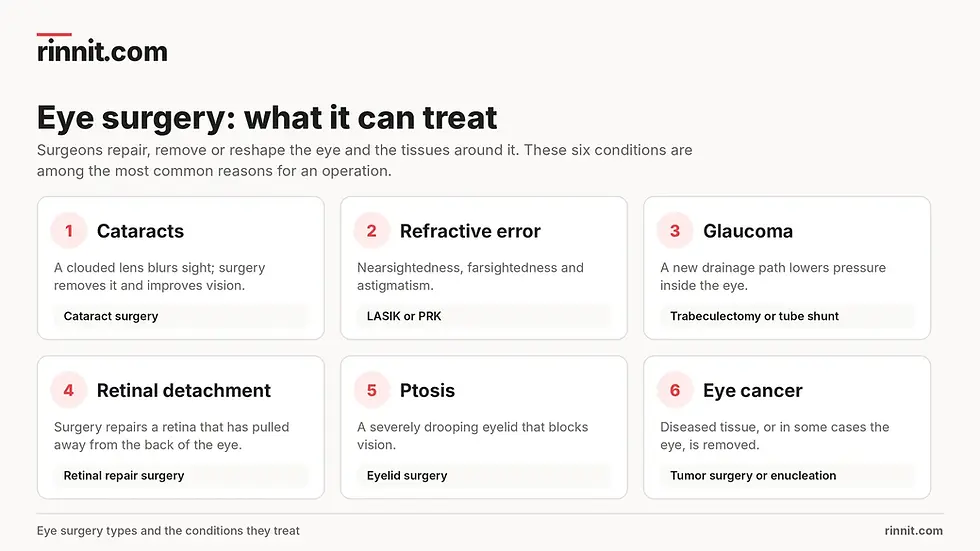
Condition | What it is | Learn more |
Cataracts | Clouding of the eye's lens that blurs vision | |
Refractive error | Nearsightedness, farsightedness and astigmatism | |
Glaucoma | Raised pressure that damages the optic nerve | |
Retinal detachment | The retina pulls away from the back of the eye | |
Ptosis | A drooping upper eyelid | |
Eye cancer | Cancer that starts in or around the eye |
[1]
Can eye surgery improve vision?
Eye surgery can improve vision in many cases, especially when it corrects refractive error, removes cataracts or lifts a severely drooping eyelid that blocks sight. [1] Other operations, such as glaucoma surgery, aim mainly to protect the vision you still have: surgery can't cure glaucoma or reverse vision loss, but it can help stop it from getting worse. [6]
What are the main types of eye surgery?
The main types of eye surgery are vision correction surgery, cataract surgery, corneal transplant, vitrectomy, strabismus surgery, glaucoma surgery, eye injury repair, eye removal and eyelid surgery. [1]
Type of eye surgery | What it does |
Vision correction (LASIK, PRK) | Reshapes the eye's focus to correct refractive error; often called "laser surgery" |
Cataract surgery | Removes a clouded lens to restore clearer vision |
Corneal transplant (keratoplasty, corneal grafting) | Replaces damaged corneal tissue with donor tissue |
Vitrectomy | Surgery inside the eye; recovery includes head-positioning instructions |
Strabismus surgery | Treats misaligned eyes |
Glaucoma surgery (trabeculectomy, tube shunt) | Creates a new drainage path so fluid leaves the eye and pressure drops |
Open globe injury repair | Repairs a serious injury to the eyeball |
Enucleation | Removes an eye |
Eyelid surgery (blepharoplasty) | Operates on the structures around the eye, as part of some facial plastic surgery |
[1]
Surgeons use lasers for more than vision correction, so "laser surgery" can describe several of these operations. [1] For a closer look at glaucoma options, see our glaucoma surgery guide or the federal eye institute's overview of glaucoma surgery.
Which type of eye surgery is best?
The best type of eye surgery is the one that treats your specific medical problem. [1] In recent years, lasers and robots have improved some procedures, making them the preferred choice in those cases. [1]
How common is eye surgery?
Eye surgery is very common: cataract surgery alone accounts for about 20 million operations worldwide each year. [1] How often each type is done depends on insurance coverage, access to healthcare and, for transplants, the number of tissue donors. [1]
Procedure | Estimated yearly number |
Cataract surgery (worldwide) | About 20 million |
Cataract surgery (United States) | About 3.7 million |
Laser refractive surgery (United States, 2020) | About 800,000 |
Corneal transplants (United States) | About 47,000 |
Sources: [1], [5]
How do you prepare for eye surgery?
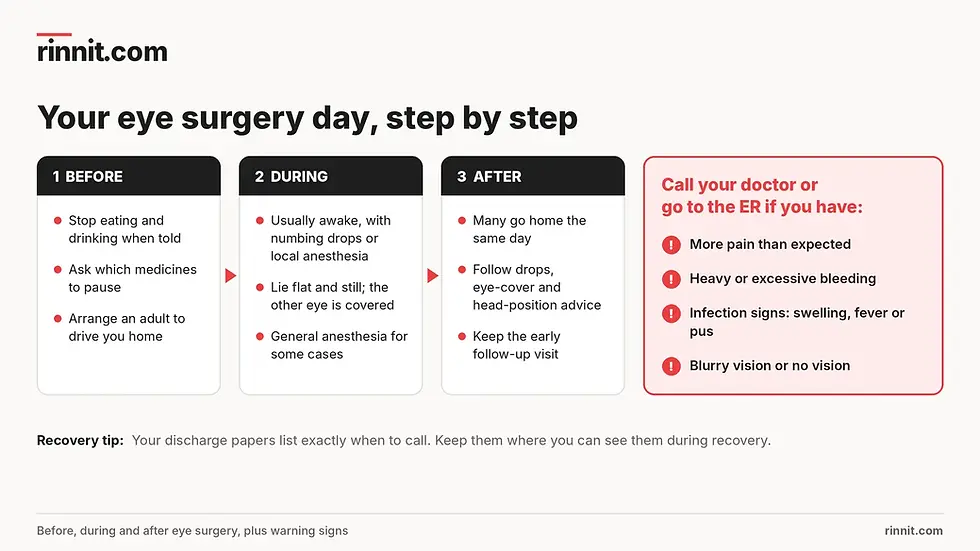
You prepare for eye surgery by following your surgeon's instructions on fasting, medicines and transport home. [1]
Fasting: You will usually stop eating and drinking for a set time beforehand, often from midnight. Confirm the exact cut-off with your care team. [1]
Medicines: You may need to pause some regular medicines. Ask which ones and when to stop. [1]
Transport: Arrange for an adult to drive you home, and possibly to stay with you for a while. [1]
If you are having LASIK, extra steps apply, such as stopping contact lenses weeks before your evaluation. The federal LASIK patient guide explains them in detail. [7]
What happens during eye surgery?
During most eye surgery you stay awake while anesthesia keeps you from feeling pain, and you lie flat and still while the eye that is not being treated is covered. [1] The type of surgery decides the preparation, equipment (such as lasers) and any implants used. [1]
Anesthesia type | How it works | Typical use |
Topical | Drops or gel numb the eye | Cataract removal, vision correction surgery |
Local | You are awake but feel no pain | Many eye surgeries |
General | You are fully asleep | Eye injury repair, children, or very anxious patients |
[1]
What happens after eye surgery?
After eye surgery you go home with instructions on pain, medicines, covering your eye, head position and how your vision should improve. [1] You will need an adult driver after an outpatient procedure and a follow-up appointment fairly soon. [1] After LASIK, for example, the first check is usually within 24 to 48 hours. [7]
How long is recovery after eye surgery?
Recovery after eye surgery ranges from a few weeks to more than a year, depending on the procedure. [1] Cataract surgery and vision correction surgery heal faster than most other types. [1]

Procedure | Typical recovery | Notes |
LASIK and similar | Up to 4 weeks for all activities | Many return to work the next day |
Vitrectomy | About 2–4 weeks off work or school | Follow head-positioning instructions |
Glaucoma surgery | About 2–6 weeks | — |
Cataract surgery | 4–8 weeks for full recovery | Daily routine usually resumes earlier |
Corneal transplant | Full vision after about 3 months | Can take 12 months or more |
[1]
What are the benefits and risks of eye surgery?
The main benefit of eye surgery is treating an eye condition and, often, improving vision, while the main risks are dry eyes, glare or halos, infection, bleeding, and blurred or decreased vision. [1] Most common eye surgeries are very safe, but risks differ by procedure and are higher for some people than others. [1]
Possible risk | What you might notice |
Dry eyes | Gritty, burning or irritated eyes (dry eyes guide) |
Glare or halos | Rings or starbursts around lights |
Infection | Swelling, fever or pus (eye infection guide) |
Bleeding | Bleeding from or into the eye |
Blurred or decreased vision | Vision that gets worse instead of better |
Source: [1]
Research shows that steps taken during surgery can lower these risks. An antibiotic injected into the eye during cataract surgery, combined with antibiotic drops, cut serious eye infection risk to about one-seventh of placebo. [3] Health factors such as high blood pressure raise that risk. [4] Review the benefits and risks of your specific operation with your ophthalmologist before the procedure. [1]
When should you call a doctor after eye surgery?
Call your doctor or go to an emergency room after eye surgery if you have more pain than expected, excessive bleeding, signs of infection, or you cannot see clearly or at all. [1]
More pain than you were told to expect [1]
Excessive bleeding [1]
Signs of infection: swollen skin, fever or pus in the wound [1]
Being unable to see clearly or at all [1]
Your discharge paperwork lists exactly when to call or go to the emergency room, so keep it close during recovery. [1]
Conclusion
Eye surgery is a broad group of operations that treat eye disease and, in many cases, restore clearer sight. [1] The right procedure depends on your diagnosis, and most common eye surgeries are very safe and done as day cases. [1] Recovery can take a few weeks or more than a year, so knowing what to expect and which warning signs need urgent care helps you heal with confidence. [1]
Preparing for an eye operation? Bring this guide to your next appointment and use it to ask your ophthalmologist which procedure fits your condition, what your recovery will look like and which symptoms should prompt a call. For more on the conditions behind eye surgery, explore our complete guide to eye diseases.
FAQ
Is eye surgery painful?
Most eye surgery is not painful during the procedure, because numbing drops, gel or local anesthesia block feeling while you stay awake. Children and people who are very anxious may receive general anesthesia instead. Afterward, your surgeon will explain what level of discomfort to expect.
Are you awake during eye surgery?
Yes, you are usually awake during eye surgery, because many procedures use local or topical anesthesia and you need to keep your head and eye flat and still. Repairs of serious eye injuries are done under general anesthesia.
How long does it take to recover from eye surgery?
Recovery from eye surgery ranges from a few weeks to a year or more, depending on the procedure. LASIK takes up to 4 weeks, cataract surgery 4 to 8 weeks, glaucoma surgery 2 to 6 weeks and a corneal transplant 3 to 12 months or longer.
Can you drive yourself home after eye surgery?
No, you should not drive yourself home after eye surgery. You need an adult to drive you home after an outpatient procedure, and you may need someone to stay with you for a while.
What are the most common risks of eye surgery?
The most common risks of eye surgery are dry eyes, glare or halos, infection, bleeding, blurred vision and decreased vision. Most common eye surgeries are very safe, and risks vary by procedure and by person.
Can eye surgery improve your vision?
Yes, eye surgery often improves vision, especially when it corrects refractive error, removes cataracts or lifts a severely drooping eyelid. Surgery for glaucoma mainly protects the vision you still have rather than restoring lost sight.
When should you call a doctor after eye surgery?
Call your doctor or go to an emergency room after eye surgery if you have more pain than expected, excessive bleeding, signs of infection such as swelling, fever or pus, or you cannot see clearly or at all. Your discharge papers list the exact warning signs for your procedure.
How common is cataract surgery?
Cataract surgery is very common, with about 20 million procedures performed worldwide each year. About 3.7 million of these take place in the United States.
How should I prepare for eye surgery?
Follow your surgeon's instructions about contact lenses, makeup and eating before surgery. Arrange for someone to drive you home, and bring a list of your medicines.
Will I need eye drops after eye surgery?
Many people use antibiotic or anti-inflammatory eye drops after eye surgery to prevent infection and ease swelling. Use them exactly as prescribed.
Related Reading
Cataract Surgery: What to Expect, Recovery and Results explains how cataract surgery replaces a cloudy lens.
LASIK Eye Surgery: Procedure, Recovery and Results explains how LASIK reshapes the cornea to correct vision.
Glaucoma Surgery: Modern Approaches to Protecting Your Vision compares laser, MIGS and trabeculectomy surgery for glaucoma.
Vitrectomy: Restoring Vision Through Specialized Eye Surgery describes vitrectomy surgery for retinal and vitreous problems.
References
Cleveland Clinic. Eye Surgery: Types, Details & Risks. Cleveland Clinic. Last updated December 16, 2022. https://my.clevelandclinic.org/health/treatments/24546-eye-surgery
Solomon KD, Fernández de Castro LE, Sandoval HP, et al. LASIK world literature review: quality of life and patient satisfaction. Ophthalmology. 2009;116(4):691-701. PMID 19344821. https://doi.org/10.1016/j.ophtha.2008.12.037
Gower EW, Lindsley K, Tulenko SE, et al. Perioperative antibiotics for prevention of acute endophthalmitis after cataract surgery. Cochrane Database Syst Rev. 2017;2(2):CD006364. PMID 28192644. https://doi.org/10.1002/14651858.CD006364.pub3
Zhang S, Xu J. Impact of patient characteristics and surgery-related risk factors on endophthalmitis after cataract surgery: a meta-analysis. Ophthalmic Res. 2025;68(1):117-136. PMID 39773547. https://doi.org/10.1159/000543353
Joffe SN. The 25th anniversary of laser vision correction in the United States. Clin Ophthalmol. 2021;15:1163-1172. PMID 33762815. https://doi.org/10.2147/OPTH.S299752
National Eye Institute. Glaucoma Surgery. National Eye Institute. Last updated August 20, 2026. https://www.nei.nih.gov/eye-health-information/eye-conditions-and-diseases/glaucoma/glaucoma-surgery
U.S. Food and Drug Administration. What should I expect before, during, and after surgery? FDA.gov. Content current as of July 11, 2018. https://www.fda.gov/medical-devices/lasik/what-should-i-expect-during-and-after-surgery
Medical disclaimer
This article is for general education and does not replace advice from your ophthalmologist or another qualified healthcare professional. Decisions about eye surgery should be made with a doctor who knows your medical history. If you have sudden vision loss, severe eye pain or signs of infection after surgery, seek emergency care right away.



Comments