Esophagectomy: A Guide to Esophageal Removal Surgery

Updated: 3 days ago
Medically reviewed by Dr. Baraa Alnahhal, MD · Last reviewed: October 2026
Source currency note: This guide reflects medical information reviewed in October 2023. Always confirm current guidance with your surgical team.
Quick Answer: What is an esophagectomy?
An esophagectomy is a major operation that removes all or part of the esophagus and rebuilds the digestive path so you can eat. It is most often used to treat esophageal cancer. The operation usually takes three to six hours, and recovery includes intensive care, up to two weeks in hospital and gradual progression from tube feeding to small meals. [3]
What the research says
Minimally invasive surgery lowered early lung infections. In a randomized trial of 115 patients with resectable esophageal cancer, pulmonary infection within the first two weeks occurred in 29% of patients after open surgery and 9% after minimally invasive surgery (relative risk 0.30), and in-hospital rates were 34% versus 12% (Biere et al., The Lancet, 2012 [1]).
Robot-assisted surgery shortened hospital stays. A meta-analysis of ten mostly observational studies found that robot-assisted minimally invasive esophagectomy was associated with lower odds of pneumonia (odds ratio 0.39) and hospital stays about 9 days shorter than open surgery, although operations took about 69 minutes longer (Esagian et al., Cancers, 2022 [2]).
Common surgical techniques
Surgeons choose a specific esophagectomy technique based on the location of the tumor or damage and the patient’s overall health. All esophagectomies remove the esophagus, and your surgeon may use traditional open surgery or a minimally invasive approach that works through a few small incisions of about 1 inch [3].
Technique | Incision locations | Access method |
Transhiatal | Neck and abdomen | Reaches the esophagus through the diaphragm |
Ivor Lewis | Right chest and abdomen | Common for lower esophageal tumors |
McKeown | Neck, chest, and abdomen | Provides full access to the entire esophagus |
Thoracoabdominal | Left chest to abdomen, plus the neck | Used for complex reconstructions |
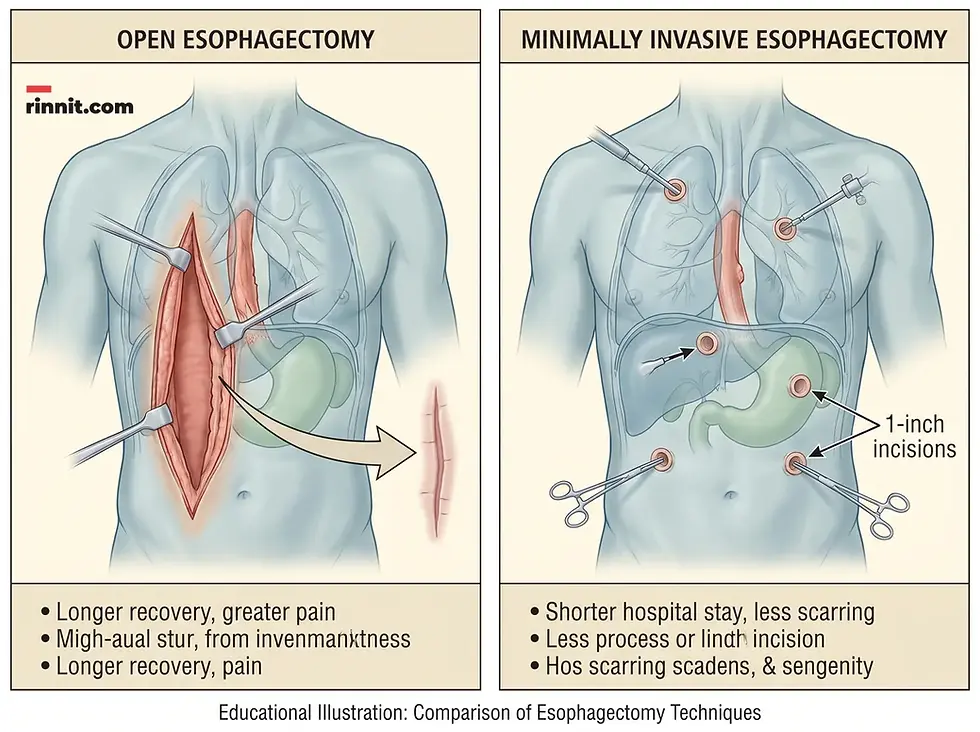
The procedure in detail
An esophagectomy is a complex operation that usually lasts between three and six hours and is performed under general anesthesia [3].
Preparing for surgery
Before surgery, you will have extensive testing, including CT, PET, and endoscopic ultrasound (EUS) scans, to map the diseased tissue. Your overall health matters too: managing conditions like high blood pressure and diabetes and quitting tobacco all improve healing, because smoking slows the healing process. You may work with a dietitian to prepare for changes in how you eat and drink, and with a speech-language pathologist to learn breathing exercises that help prevent lung complications. If you have esophageal cancer, you may also receive chemotherapy or radiation therapy before surgery, which leads to better long-term results for some people [3].
What happens during surgery
Your surgeon removes the damaged part of your esophagus and often a small section of your stomach. If cancer is present, nearby lymph nodes are removed and sent to a laboratory to see whether the disease has spread. The surgeon then reconstructs the digestive tract by pulling the stomach (or a section of small intestine) up into the chest or neck and reconnecting it to the remaining healthy esophagus. A feeding tube is placed in your stomach or small intestine to provide nutrition while you recover your ability to swallow [3].

Recovery after surgery
Recovery moves in phases, from intensive care to the hospital ward to home. Most people spend one to two days in the intensive care unit (ICU) and then up to two weeks in a regular hospital room. During this time you receive nutrition through the feeding tube and your pain is managed with an epidural or medication. Early walking while wearing compression stockings helps prevent blood clots, and breathing exercises help clear your lungs. Before you go home, you and your caregivers learn how to care for your wounds and your feeding tube [3].
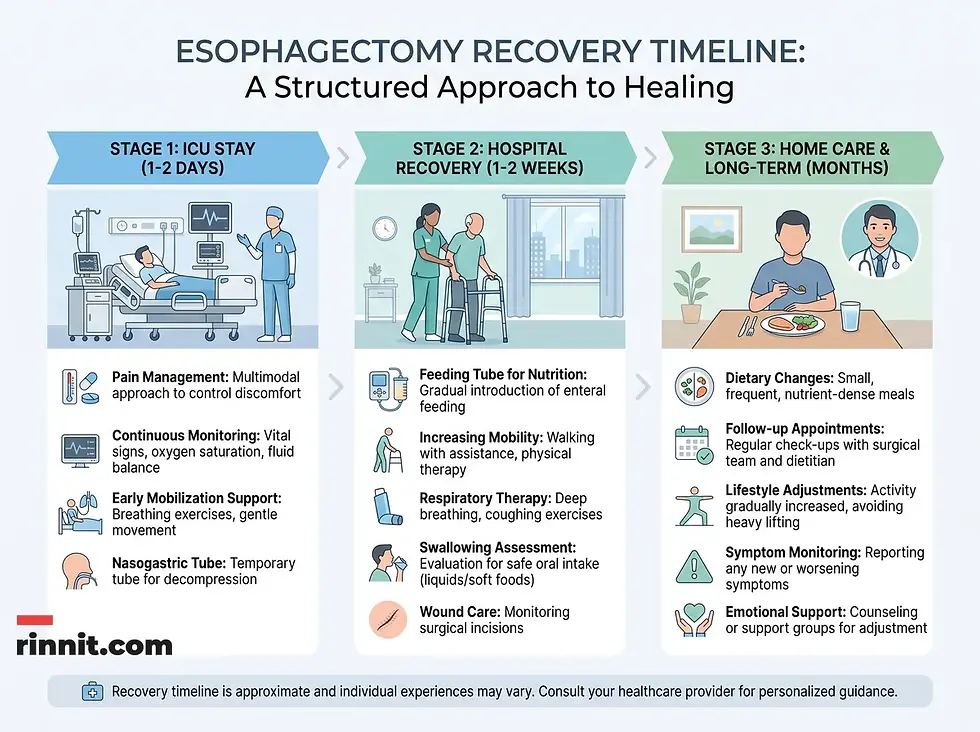
Long-term management
Life after an esophagectomy involves lasting changes to how you eat and drink. Because the stomach is repositioned and the digestive path is shorter, you move from liquids to soft foods and eventually to small, frequent meals. The feeding tube stays in place until you can take in enough calories by mouth to maintain your weight. Regular follow-up visits with your surgical team, dietitian, and oncologist help monitor healing and check for any return of the underlying condition [3].
Recovery alert: Contact your surgical team immediately if you have a high fever, severe chest or abdominal pain, persistent nausea, or signs of infection at your incision sites, such as redness, warmth, bleeding, or drainage [3].
Conclusion
Esophagectomy is a major but often life-saving operation that asks a lot of both the patient and the medical team. By removing diseased tissue and rebuilding the swallowing path, it gives people with esophageal cancer and other serious esophageal conditions a way forward. The recovery journey is long and involves permanent changes to eating, but esophagectomy is the most common surgery used to treat esophageal cancer, and your surgeon can explain how the plan fits your diagnosis and your recovery milestones [3].
Frequently Asked Questions
What is the primary reason for an esophagectomy?
The most common reason is to treat esophageal cancer, but it is also used for severe Barrett’s esophagus or benign conditions that prevent normal swallowing.
How long does the surgery take?
A typical esophagectomy takes between three and six hours, depending on the complexity and technique used.
Will I be able to eat normally after surgery?
You will eventually be able to eat, but you will start with liquids and soft foods and move to small, frequent meals because of the changes in your digestive anatomy.
How long is the hospital stay?
Most patients stay in the hospital for one to two weeks, including an initial day or two in the intensive care unit (ICU).
What is the purpose of the feeding tube?
The feeding tube provides essential nutrition and hydration while your new esophageal connection heals and before you can swallow enough food by mouth.
Is esophagectomy performed laparoscopically?
Yes. Many surgeons use minimally invasive laparoscopic or thoracoscopic techniques, which involve smaller incisions and a potentially faster recovery.
What are the main risks of the procedure?
Major risks include lung complications such as pneumonia, blood clots, and a leak at the site where the esophagus and stomach are reconnected.
Why do I need to quit smoking before surgery?
Smoking slows healing and increases the risk of respiratory complications during and after the operation.
What happens to the lymph nodes removed during surgery?
The lymph nodes removed during surgery are sent to a laboratory and checked for cancer cells, which helps doctors determine the stage of the cancer and plan further treatment.
Can I live without my entire esophagus?
Yes. Surgeons can reconstruct your digestive tract using your stomach or small intestine as a new pathway for food.
How do I prepare for an esophagectomy?
Before surgery you'll have imaging such as a CT scan, endoscopic ultrasound or PET scan so your team can locate the tissue to remove. [3] If you have esophageal cancer, you may receive chemotherapy and radiation first. [3] Keeping diabetes and high blood pressure under control lowers your risk of complications, and stopping tobacco and nicotine helps healing. [3] A dietitian can prepare you for eating changes, and a speech-language pathologist can teach breathing exercises. [3] Follow your provider's instructions on which medicines to pause, including blood thinners such as aspirin, and when to stop eating and drinking. [3] Plan for a one- to two-week hospital stay, a ride home and help at home. [3]
Does an esophagectomy hurt, and what anesthesia is used?
You'll have general anesthesia, so you won't feel pain during the operation. [3] Your team may place an epidural catheter in your back to control pain afterward. [3] While you recover in the hospital, your pain medication is adjusted, and it's eventually given as liquid through your feeding tube. [3] Pain when swallowing is a common side effect after surgery, along with fatigue, loss of appetite, indigestion and nausea. [3]
When should I call my doctor after an esophagectomy?
Contact your care team if your pain gets worse or you develop a fever, redness or warmth around an incision, weakness, shortness of breath or a racing heartbeat. [3] Also call about diarrhea or black stools, a burning feeling in your throat, a cough that won't go away, yellowing skin or eyes, trouble swallowing or ongoing weight loss. [3] Go to the emergency room or call 911 right away if you can't swallow or breathe, you vomit blood, or you have severe pain, including chest pain. [3]
Related Reading
Understanding the Esophagus: Anatomy, Function, and Health explains how the esophagus moves food and what can go wrong.
J-tube Placement: What to Expect from Your Jejunostomy Procedure describes the feeding tube often placed to support nutrition after surgery.
Esophageal Strictures: Symptoms, Causes, Diagnosis, Treatment and When to Seek Emergency Care — What You Need to Know explains narrowing of the esophagus, a possible problem after surgery.
Esophageal Dilation: Uses, Procedure, Risks and Recovery describes how a narrowed esophagus is gently stretched to ease swallowing.
References
Biere SSAY, van Berge Henegouwen MI, Maas KW, et al. Minimally invasive versus open oesophagectomy for patients with oesophageal cancer: a multicentre, open-label, randomised controlled trial. The Lancet. 2012;379(9829):1887-1892. PMID 22552194. https://doi.org/10.1016/S0140-6736(12)60516-9
Esagian SM, Ziogas IA, Skarentzos K, et al. Robot-assisted minimally invasive esophagectomy versus open esophagectomy for esophageal cancer: a systematic review and meta-analysis. Cancers. 2022;14(13):3177. PMID 35804949. https://doi.org/10.3390/cancers14133177
Cleveland Clinic. Esophagectomy. Cleveland Clinic. October 26, 2023. https://my.clevelandclinic.org/health/procedures/21054-esophagectomy
Medical disclaimer
This article was prepared for general information only and is not a substitute for professional medical advice.



Comments