Dysgeusia (Distorted Taste): Why Everything Suddenly Tastes Metallic or Bitter — the 15 Causes, 4 Symptoms, Diagnosis, 7 Self-Care Fixes and Outlook — What You Need to Know

Updated: 3 days ago
Medically reviewed by Dr. Baraa Alnahhal, MD · Last reviewed: October 2026
Quick Answer
Dysgeusia is a taste disorder that often makes food seem metallic, rancid or bitter. [1] It is not serious by itself but can reduce appetite and quality of life. [1] Causes include smoking, medications, poor oral hygiene, infections and pregnancy, and it usually resolves once the cause is addressed. [1] Up to 17% of people in the U.S. experience it at some point. [1]
What the research says
Taste distortion is very common in head and neck cancer. Across 23 studies of 4,805 patients, the pooled prevalence of dysgeusia was 42.7% (95% CI 29.7–56.9%), and it was higher with older age, male sex and advanced stage (III–IV). (Afiyanti et al., J Oral Rehabil, 2026) [2]
Taste changes are also frequent in children having stem cell transplants. In 1,403 pediatric patients, the pooled event rate of taste alterations was 0.457 (95% CI 0.330–0.590), most evident in the early post-transplant phases and including dysgeusia and reduced sensitivity to sweet and salty tastes. (Savaş et al., Semin Oncol Nurs, 2025) [3]
Smell loss after viral infection is common, and olfactory training is a mainstay. A clinical review reports that meta-analysis estimates put olfactory loss after SARS-CoV-2 infection at around 50%, with more than one in three later reporting parosmia (distorted smell), and with few effective treatments, support and olfactory training are essential. (Liu et al., BMJ Med, 2023) [4]
Food tastes metallic, bitter, rotten or "off" even when you have not eaten anything: that is dysgeusia, also called altered taste or parageusia. It is an altered sense of taste, not a loss of taste. Losing your sense of taste entirely is a separate condition called ageusia. [1] Causes range from everyday factors (smoking, aging, some medications, poor oral hygiene) to medical conditions (dry mouth, GERD, infections, metabolic disorders, nerve damage, neurologic disorders, head and neck cancer treatments, pregnancy, traumatic brain injury and vitamin deficiencies). [1]
What Exactly Is Dysgeusia?
Dysgeusia is a disorder that distorts your sense of taste. People with the condition often say that anything they eat tastes like metal, rancid or bitter. [1] The condition is not a serious medical problem on its own, but it can affect your appetite and quality of life. [1] When everything tastes wrong, eating stops being enjoyable, and some people end up eating less than they should, which can lead to weight loss. Healthcare providers may use the terms "altered taste" or "parageusia" to describe the same problem. [1]
What is the difference between dysgeusia and ageusia?
They are different disorders. Dysgeusia means your sense of taste is distorted: food tastes wrong, usually metallic, bitter or rotten. Ageusia means you have lost your sense of taste entirely. [1] The two can sound similar, but they involve opposite problems.
How common is dysgeusia?
Research suggests up to 17% of people in the U.S. experience this taste disorder at some point in their lives. [1]

Term | Meaning |
|---|---|
Dysgeusia | A taste disorder that distorts how food tastes (metallic, rancid, bitter). |
Altered taste | Alternative term providers may use for this condition. |
Parageusia | Another alternative term providers may use for this condition. |
Ageusia | The complete loss of the sense of taste, a different condition. |
Anosmia | Loss of the sense of smell, sometimes ruled out during diagnosis. |
What Does Dysgeusia Feel Like? The 4 Key Symptoms
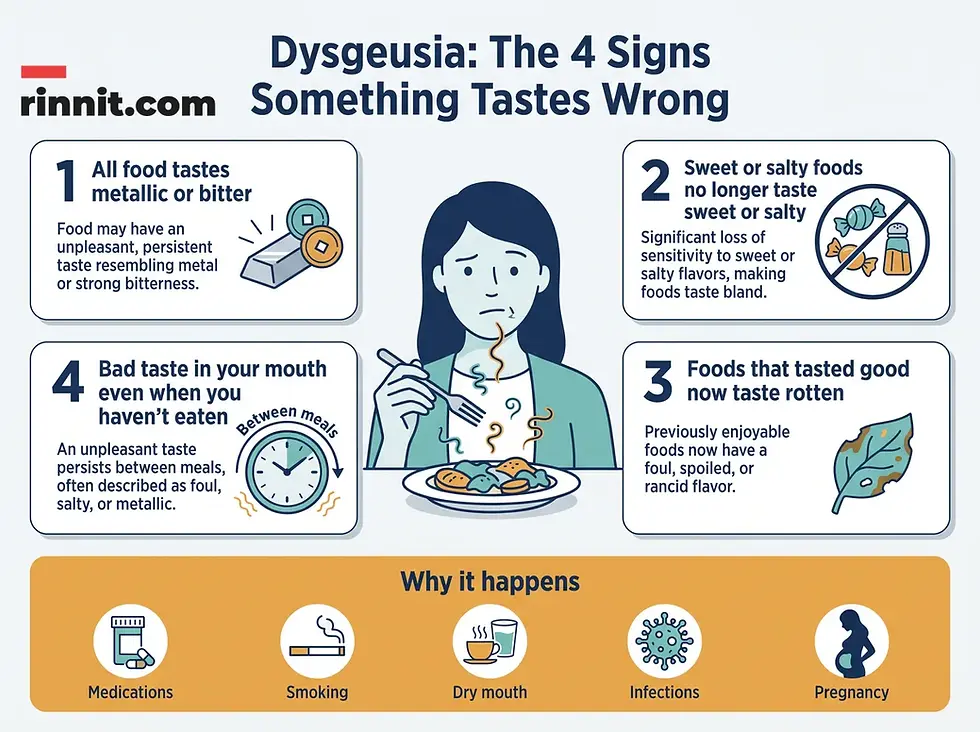
Distorted taste affects people in different ways. In general, food simply does not taste the same as you remember. Four common symptoms of dysgeusia stand out, from metallic sensations to foods that taste rotten.
All foods taste metallic or bitter. [1] This is the classic complaint: even neutral foods take on a metal or bitterness overlay.
Sweet or salty foods no longer taste sweet or salty. [1] Your memory of the flavor does not match what you experience.
Foods that used to taste good now taste bad, sometimes rotten. [1] Something once pleasant reads as spoiled.
A nasty taste in your mouth even though you haven't eaten anything. [1] The distortion is present between meals, not only during them.
What Causes Dysgeusia?
Many things can distort your sense of taste. The everyday factors are things most people can act on directly. Aging changes your sense of taste naturally over time. [1] Many medications affect taste, including over-the-counter allergy medications and prescription antibiotics, antidepressants and chemotherapy drugs. [1] Dental prostheses that cover your soft palate can affect your taste buds, so food tastes different. [1] Poor oral hygiene and tobacco use also play a role. [1] Beyond these, a number of medical conditions are associated with distorted taste, and dysgeusia treatment depends entirely on which one applies to you.
Cause | How it distorts taste |
|---|---|
Aging | Sense of taste changes as you age. |
Medications | Allergy medications, antibiotics, antidepressants and chemotherapy drugs can affect taste. |
Dental prostheses | Devices covering the soft palate affect taste receptors. |
Poor oral hygiene | Mouth health directly shapes taste perception. |
Tobacco use | Using tobacco degrades the sense of taste. |
Dry mouth (xerostomia) | Salivary glands produce less saliva, often from not drinking enough fluid. |
GERD (acid reflux) | Stomach acid enters the mouth and affects taste function. |
Head and neck cancers | The cancer itself, plus chemotherapy and radiation therapy, may affect taste. |
Viral infections | Colds, flu and COVID-19 affect your sense of taste. |
Tongue inflammation | Any condition inflaming the tongue affects taste receptors. |
Metabolic disorders | Diabetes, hypothyroidism, kidney disease, liver disease and others. |
Nerve damage | Damage to taste nerves, for example from ear or neck surgery, breaks taste signaling. |
Neurologic disorders | Alzheimer's disease, Parkinson's disease and multiple sclerosis (MS) are associated with distorted taste. |
Pregnancy | A hormone surge causes common, usually temporary taste distortion. |
Traumatic brain injury | Damage to the lining of the nose, the olfactory nerve or the brain's taste-processing area. |
Vitamin and mineral deficiencies | Zinc and vitamin B deficiencies are especially linked to taste changes. |
Two of these deserve extra attention. Pregnancy-related taste distortion is common and usually stems from a surge of hormones; symptoms typically go away on their own after the first trimester. [1] And head and neck cancers carry a double risk: the disease itself and its treatments (chemotherapy or radiation therapy) may both lead to dysgeusia. [1]
How Is Dysgeusia Diagnosed?
Your healthcare provider will do a physical examination and ask about your symptoms. [1] From there, several tests may follow.
Test | What it checks |
|---|---|
Physical examination | General assessment plus symptom history. |
Smell identification test | Rules out anosmia, since taste and smell are closely linked. |
Taste threshold tests | Measures when you detect changes in how food tastes. |
Blood tests | Complete blood count (CBC); potassium, calcium, iron and vitamin B12 levels. |
Imaging (X-ray, CT, MRI) | Abnormal growths or physical changes that could affect taste. |
How Is Dysgeusia Treated?
Treatment depends on what is causing your distorted taste. The guiding principle is to address the underlying cause rather than the taste symptom itself. If medication is the cause, changing medications may help. [1] If smoking is the cause, quitting smoking makes the bad taste go away. If poor oral hygiene is involved, improving oral hygiene is the path back. [1]
When a viral infection like COVID-19 is affecting your sense of smell and taste, your provider may recommend olfactory training therapy. [1] [4] This works because studies show your sense of smell is responsible for about 80% of what you taste. [1] Your nose and throat share the same airway, so chewing some foods allows food aroma to reach your nose through the back of your mouth. Olfactory training therapy involves daily exposure to different odors for several weeks. [1] Over time, what you smell stimulates the olfactory system in your brain and re-establishes your memories of that smell.
Scenario | Treatment direction |
|---|---|
Medication-caused | Changing medications may help. |
Smoking-caused | Quitting smoking makes the bad taste go away. |
Viral infection (e.g., COVID-19) | Olfactory training therapy: daily odor exposure for several weeks. |
Oral hygiene-related | Improved brushing, flossing and mouth care. |
What Can I Do at Home? Seven Self-Care Steps
Often, the distorted taste goes away after your provider diagnoses the underlying cause. But there are many things you can do to ease symptoms in the meantime.
Self-care step | How it helps |
|---|---|
Eat citrus, pickles and vinegar-based foods | Masks the taste of metal. |
Avoid spicy, preservative-heavy and very sweet food | Reduces triggering flavors. |
Drink water or noncaffeinated drinks | Prevents dry mouth, which can distort taste. |
Swap metal cutlery and bottles for glass, plastic or ceramic | Removes a direct metallic taste source. |
Brush and floss regularly | Keeps the mouth healthy. |
Rinse with baking soda and water before meals | Neutralizes acid in your mouth so food tastes like it should. |
Suck on ice cubes, chips or sugar-free ice pops | Helps prevent dry mouth. |
Quitting tobacco use will also improve your sense of taste. [1]

Can I prevent dysgeusia?
You can reduce your risk by not smoking, drinking lots of water or beverages without sugar or caffeine, and protecting yourself from traumatic brain injury and viral infections. [1] Track your sense of taste, too: if food tastes different, look for anything new in your daily life, such as new medications or new foods. [1]
What Is the Outlook for People With Dysgeusia?
The outlook depends on the cause. In most cases, distorted taste goes away on its own once your provider finds the underlying cause. [1] If smoking is the cause, quitting will make it go away. If medication is the culprit, changing medication may help. But in some cases, the underlying cause is a chronic condition or there is no substitute for medication. In these scenarios, the distorted taste does not go away, but there are ways to mask the nasty taste it causes. [1] The seven self-care steps above are exactly those tools.
When should I see my provider?
Distorted taste is not a medical emergency. See your provider if food does not taste the same as you remember, especially if the change is sudden, persistent, or paired with a new medication, a viral illness, pregnancy or a chronic condition like diabetes, kidney disease or a neurologic disorder. Because a taste change can reflect a medication effect, infection, deficiency or neurologic problem, an early evaluation helps catch the cause while it is still easy to address.
Conclusion: Your Taste Can (Usually) Come Back
Dysgeusia is the taste disorder that makes everything seem metallic, bitter or rotten. It is not serious in itself, but it can quietly erode your appetite and enjoyment of food. Up to 17% of people in the U.S. experience it at some point [1], and its causes are numerous, from smoking, aging, medications and oral hygiene to infections, pregnancy, deficiencies and chronic conditions. The good news: in most cases it resolves once the underlying cause is identified and managed, and practical self-care steps can restore some pleasure to meals in the meantime.
Next Steps for Health
If food has started tasting wrong, do not simply write it off. Check whether a new medication, a recent illness or a mouth-care gap explains the change, and talk to your healthcare provider about an evaluation if it does not. The cause may be as simple as a medication you can swap.
Frequently Asked Questions
1. What is dysgeusia?
Dysgeusia is a disorder that distorts your sense of taste. People with the condition often say that anything they eat tastes like metal, rancid or bitter.
2. How do you pronounce dysgeusia?
Dysgeusia is pronounced "dis-gyoo-zee-uh."
3. Is dysgeusia a serious condition?
No. It is not a serious medical condition on its own, but it can affect your appetite and quality of life.
4. What is another name for dysgeusia?
Healthcare providers may use the terms "altered taste" or "parageusia."
5. What is the difference between dysgeusia and ageusia?
Dysgeusia distorts taste, so food tastes metallic, bitter or rotten. Ageusia is the complete loss of the sense of taste.
6. How common is dysgeusia?
Research suggests up to 17% of people in the U.S. experience this taste disorder at some point in their lives.
7. Why does everything taste metallic to me?
A metallic taste across all foods is a classic sign of distorted taste. Possible causes include medications, smoking, dry mouth, dental prostheses, poor oral hygiene, infections, deficiencies, pregnancy and metabolic or neurologic conditions.
8. Why does food suddenly taste rotten or bad?
Foods that used to taste good can start tasting bad or rotten with distorted taste. It is a taste-signaling problem, not actual spoilage.
9. Why do I have a bad taste in my mouth when I haven't eaten anything?
A persistent nasty taste between meals is a hallmark symptom of distorted taste; it exists independently of what you are eating.
10. Why do sweet foods no longer taste sweet?
Distorted taste can make foods that are characteristically sweet or salty stop tasting sweet or salty.
11. Does aging cause distorted taste?
Yes. Your sense of taste changes as you age, and aging is listed as a cause of distorted taste.
12. Can medications cause dysgeusia?
Yes. Many medications affect taste, including over-the-counter allergy medications and prescription antibiotics, antidepressants and chemotherapy drugs.
13. Can dental prostheses change how food tastes?
Yes. Prostheses that cover your soft palate can affect your taste receptors, making food taste different.
14. Does smoking affect taste?
Yes. Using tobacco is a listed cause of distorted taste, and quitting smoking makes smoking-related taste changes go away.
15. Can dry mouth cause dysgeusia?
Yes. Dry mouth (xerostomia) happens when salivary glands produce less saliva, often because you are not drinking enough fluid, and it can distort taste.
16. Can acid reflux cause a metallic taste?
Yes. With GERD, stomach acid enters your mouth and can affect your taste function.
17. Can COVID-19 cause dysgeusia?
Yes. Viral infections like colds, flu or COVID-19 affect your sense of taste, and olfactory training therapy may be recommended.
18. Can pregnancy cause a metallic taste?
Yes. Taste distortion during pregnancy is common, usually due to a surge of hormones, and symptoms typically go away on their own after the first trimester.
19. Can zinc deficiency cause dysgeusia?
Yes. People with zinc or vitamin B deficiencies are especially prone to taste distortion.
20. Can diabetes, kidney or liver disease cause dysgeusia?
Yes. These metabolic disorders are listed among the conditions that can distort taste, along with hypothyroidism.
21. Can a traumatic brain injury cause distorted taste?
Yes. A TBI that damages the lining of your nose, your olfactory nerve or the brain area that processes taste can distort your sense of taste.
22. Can nerve damage from surgery affect taste?
Yes. When something damages the nerves that manage taste sensation, such as ear or neck surgery, they do not work as they should, causing distorted taste.
23. Can head and neck cancer treatment affect taste?
Yes. The cancer itself and treatments like chemotherapy or radiation therapy may affect your sense of taste.
24. How is dysgeusia diagnosed?
Your provider performs a physical examination and asks about symptoms, then may order a smell identification test, taste threshold tests, blood tests and imaging.
25. What is olfactory training therapy?
Olfactory training therapy involves daily exposure to different odors for several weeks. Because smell drives about 80% of what you taste, it helps re-establish the brain's smell memories.
26. Will dysgeusia go away?
In most cases, yes. Once the underlying cause is found and addressed, it goes away on its own. When the cause is chronic or a medication cannot be substituted, it may persist, but there are ways to mask the bad taste.
27. Can you prevent dysgeusia?
You can lower your risk by not smoking, drinking plenty of water or sugar-free and caffeine-free beverages, protecting yourself from head injury and viral infections, and tracking your sense of taste for changes.
28. What can I do at home for a metallic taste?
Eat citrus, pickles or vinegar-based foods, drink plenty of water, swap metal cutlery for glass, plastic or ceramic, brush and floss, rinse with baking soda and water before meals, and suck on ice.
29. Should I see a doctor about a metallic taste?
Yes. If food no longer tastes the same as you remember, talk to a healthcare provider. The cause may be a medication, infection, deficiency or condition that deserves attention.
Related Reading
Ageusia (Loss of Taste): What It Is, What Causes It, and How You Get Your Taste Back covers complete loss of taste and how it can recover.
Zinc Deficiency: A Comprehensive Guide to Symptoms, Causes, and Treatment explains how low zinc can affect taste and overall health.
Burning Mouth Syndrome: Symptoms, Causes, and Treatment covers a burning mouth feeling that often comes with taste changes.
Dry Mouth: Symptoms, Causes, Diagnosis and Treatment — What You Need to Know explains why dry mouth happens and how it affects taste.
References
Cleveland Clinic. Dysgeusia. Cleveland Clinic. Last updated April 19, 2024. https://my.clevelandclinic.org/health/diseases/22047-dysgeusia
Afiyanti Y, et al. Prevalence of Dysgeusia in Head and Neck Cancer Patients: A Meta-Analysis and Moderator Analysis. Journal of Oral Rehabilitation. 2026;53(4):900-915. PMID 41532612. https://doi.org/10.1111/joor.70147
Savaş EH, et al. Taste Alterations in Pediatric Oncology Patients Undergoing Hematopoietic Stem Cell Transplantation: A Systematic Review and Meta-Analysis. Seminars in Oncology Nursing. 2025;41(4):151909. PMID 40425372. https://doi.org/10.1016/j.soncn.2025.151909
Liu ZY, et al. Post-viral olfactory loss and parosmia. BMJ Medicine. 2023;2(1):e000382. PMID 37841969. https://doi.org/10.1136/bmjmed-2022-000382
Medical disclaimer
This article is for informational purposes only and does not constitute medical advice. Consult a healthcare professional for diagnosis and treatment.



Comments