Relapsing-Remitting Multiple Sclerosis (RRMS): Symptoms, Causes, and Management

Updated: 2 days ago
Medically reviewed by Dr. Baraa Alnahhal, MD · Last reviewed: September 2026
Last updated: September 2026 | Source content date: May 23, 2023
TL;DR
Relapsing-Remitting Multiple Sclerosis (RRMS) is the most common form of multiple sclerosis, affecting 80% to 85% of people diagnosed with MS. It is characterized by clearly defined attacks (relapses) followed by periods of partial or complete recovery (remissions). While the exact cause is unknown, it involves the immune system attacking the protective myelin sheath around nerves. Symptoms range from vision changes and fatigue to mobility issues. Management focuses on disease-modifying therapies (DMTs) to reduce relapses and slow disease progression, alongside lifestyle adjustments to avoid triggers like stress and heat.
Quick Answer
What is Relapsing-Remitting Multiple Sclerosis (RRMS)? RRMS is a type of multiple sclerosis where symptoms flare up (relapse) and then disappear or improve (remit). It is an autoimmune condition where the immune system mistakenly attacks the myelin sheath, the protective layer around nerves in the brain and spinal cord.
Key facts about RRMS include:
Most Common Type: It accounts for approximately 80% to 85% of all MS diagnoses.
Relapses vs. Remissions: Relapses are episodes of new or worsening symptoms lasting days to weeks. Remissions are periods of recovery where symptoms may be absent or stable.
Common Symptoms: Vision changes, numbness, fatigue, bladder and bowel problems, and cognitive difficulties (brain fog).
Triggers: Flare-ups can be triggered by stress, heat, infections, smoking, and vitamin D deficiency.
Management: While there is no cure, FDA-approved disease-modifying therapies (DMTs) help reduce the frequency of relapses and prevent further nervous system damage.
The Cycle of RRMS: Relapse and Remission
The defining characteristic of RRMS is the cyclical nature of symptom onset and recovery.
Relapse vs. Remission Comparison
Phase | Characteristics | Duration |
|---|---|---|
Relapse (Attack) | New symptoms appear or old ones worsen; involves active inflammation. | Days to several weeks. |
Remission | Symptoms stabilize, improve, or disappear completely; no disease progression. | Months to years. |
Incomplete Recovery | Some symptoms persist even during remission due to previous nerve damage. | Permanent or long-term. |
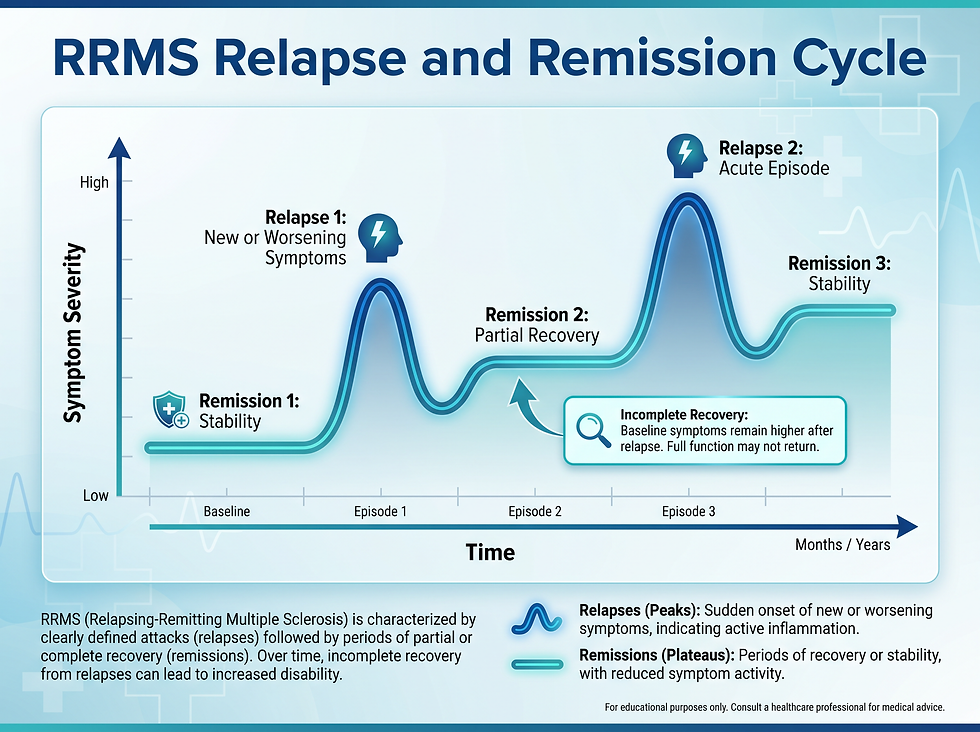
A visual representation of the RRMS disease course, showing the peaks of relapses and the plateaus of remission.
Symptoms and Complications
Symptoms vary significantly between individuals and even between different relapses for the same person.
Common RRMS Symptoms
Vision Changes: Blurry vision, double vision, or painful eye movement.
Sensory Issues: Numbness, tingling, or the "MS Hug" (a squeezing sensation around the chest).
Motor Difficulties: Muscle weakness, stiffness (spasticity), and difficulty walking.
Systemic Symptoms: Severe fatigue and cognitive "brain fog" affecting memory and focus.
Autonomic Issues: Bladder and bowel urgency or hesitation.
Lhermitte's Sign: An electrical shock sensation down the back when bending the neck forward.
Potential Complications
Permanent vision loss or difficulty focusing.
Chronic spasticity and muscle tightness.
Long-term bladder, bowel, or sexual dysfunction.
Mood changes, including clinical anxiety and depression.
Progression to Secondary Progressive MS (SPMS).
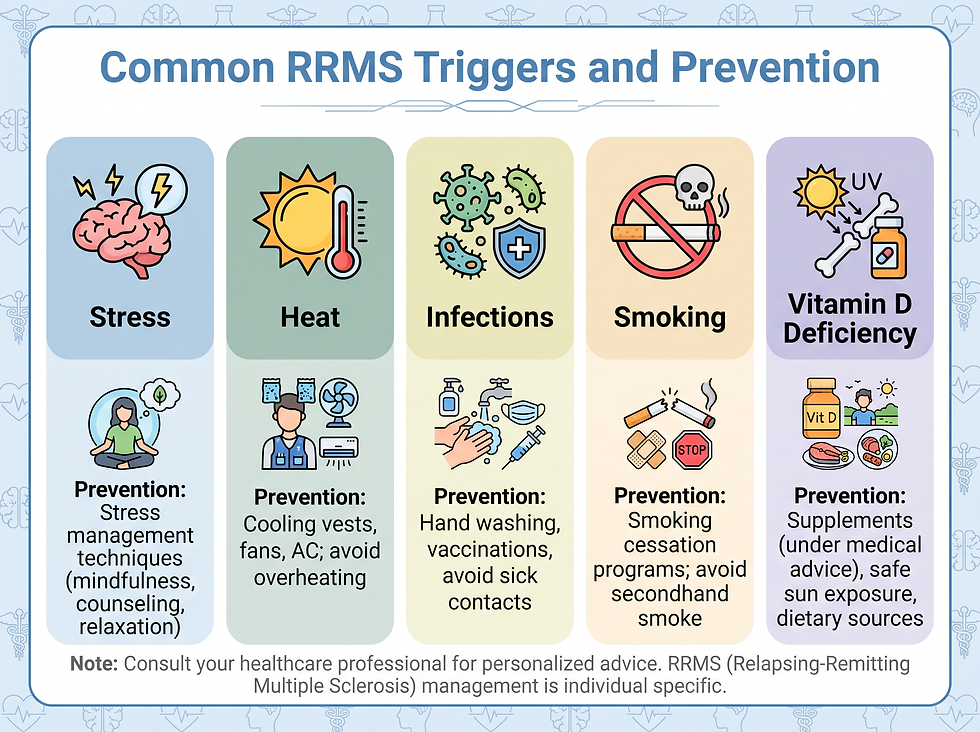
Environmental triggers that can worsen RRMS symptoms and strategies for prevention.
Causes and Diagnosis
RRMS is believed to be caused by a combination of genetic predisposition and environmental factors.
The Autoimmune Response
In RRMS, the immune system attacks myelin, the fatty substance that insulates nerve fibers. This damage disrupts the electrical signals traveling between the brain and the rest of the body, leading to the symptoms experienced during a flare-up.
Diagnostic Tools
Test | Purpose |
|---|---|
MRI Scan | Detects areas of damage (lesions) in the brain and spinal cord. |
Lumbar Puncture | Checks spinal fluid for oligoclonal bands (signs of inflammation). |
OCT Scan | Scans the retina to detect nerve damage in the eye. |
Blood Tests | Used to rule out other conditions with similar symptoms. |
Management and Treatment
Treatment for RRMS is proactive, focusing on preventing future damage rather than just treating current symptoms.
Disease-Modifying Therapies (DMTs)
DMTs are the cornerstone of RRMS management. They are available in three main forms:
Injectables: Self-administered shots under the skin.
Oral Medications: Daily pills taken by mouth.
Infusions: Administered by a healthcare provider into a vein.
Integrated Care
Symptom Management: Using physical therapy, stretching programs, and medications (like Botox) for spasticity.
Lifestyle Adjustments: Managing stress, staying cool, and ensuring adequate vitamin D levels.
Regular Monitoring: Ongoing MRIs and neurological exams to track disease activity.

A patient's guide to managing RRMS, highlighting the importance of early treatment and integrated care.
Frequently Asked Questions
Is RRMS the same as Multiple Sclerosis?
RRMS is the most common type of Multiple Sclerosis. It describes a specific disease course of relapses and remissions.
Can RRMS be cured?
Currently, there is no known cure for RRMS, but modern treatments are highly effective at managing the condition and slowing its progress.
What is a "flare-up" or "relapse"?
A relapse is an episode where new symptoms appear or existing symptoms get significantly worse for at least 24 to 48 hours.
How long do RRMS relapses last?
Relapses can last anywhere from a few days to several weeks.
Does heat make RRMS worse?
Yes, many people with RRMS experience a temporary worsening of symptoms when they get overheated (known as Uhthoff's phenomenon).
Is RRMS hereditary?
There is a genetic predisposition, but the risk of passing it directly to children is relatively low. It is not considered a purely hereditary disease.
Can I still work with RRMS?
Yes, many people with RRMS lead long, fulfilling professional lives. Early treatment and workplace accommodations can help.
What is "brain fog"?
Brain fog refers to cognitive difficulties such as trouble with memory, concentration, and processing information quickly.
Why is vitamin D important for RRMS?
Research suggests that vitamin D deficiency may be a risk factor for developing MS and can trigger flare-ups in those already diagnosed.
What is the "MS Hug"?
It is a sensory symptom that feels like a tight band or squeezing sensation around the chest or abdomen.
Will I need a wheelchair?
Not necessarily. While some people experience mobility issues, many others remain mobile for decades, especially with early and aggressive DMT treatment.
What is Secondary Progressive MS (SPMS)?
SPMS is a stage that some people with RRMS transition into later in life, where symptoms gradually worsen without clear relapses.
Can stress trigger a relapse?
Yes, high levels of stress are a known trigger for MS flare-ups.
How often should I get an MRI?
Your neurologist will determine the frequency, but it is common to have an annual MRI to monitor for new lesions even if you feel well.
Are there natural treatments for RRMS?
While lifestyle factors like diet and exercise are important, they should be used alongside medical treatments (DMTs), not as a replacement.
Related Reading
Further Reading
National Multiple Sclerosis Society: support, research, and advocacy.
Multiple Sclerosis Association of America (MSAA): patient resources and tools.
Medical Disclaimer: The information provided in this article is for educational purposes only and is not intended as medical advice. Always seek the advice of your physician or other qualified health provider with any questions you may have regarding a medical condition. Never disregard professional medical advice or delay in seeking it because of something you have read here. If you think you may have a medical emergency, call your doctor or 911 immediately.
Comments