
Ageusia (Loss of Taste): What It Is, What Causes It, and How You Get Your Taste Back

Updated: 2 days ago
Medically reviewed by Dr. Baraa Alnahhal, MD · Last reviewed: September 2026
This article is for general education only. It is not medical advice and does not replace evaluation by a licensed healthcare professional. If you cannot taste food or drinks — especially with a poor appetite — see a healthcare provider.
TL;DR
Ageusia is the complete loss of taste. It affects only 1–2 out of 1,000 people, while reduced taste (hypogeusia) and distorted taste (dysgeusia) are far more common. Most causes — infections, medications, and vitamin deficiencies — are reversible, and COVID-19-related taste loss usually resolves in one to three weeks. An ENT (ear, nose, and throat specialist) can run taste tests, imaging, and blood work to find the cause and restore your taste.
Quick Answer: What Is Ageusia?
Ageusia is the complete loss of your sense of taste — the inability to detect sweet, sour, salty, bitter, or umami flavors. True ageusia is rare, affecting only about 1–2 out of 1,000 people, and reduced or distorted taste is much more common. Most cases are temporary and resolve once the underlying cause — such as an infection, medication, dry mouth, or a vitamin B12 or zinc deficiency — is treated. If you cannot taste food, especially with a reduced appetite, see an ENT specialist for testing.
What Is Ageusia?
Ageusia (pronounced "uh-GYOU-zee-uh") is the complete loss of your sense of taste. That means you cannot detect flavors like sweet, sour, salty, bitter, or umami (the savory taste of meats and broths).
True ageusia — a total, complete loss of taste — is rare. It affects only 1 or 2 out of 1,000 people.
It is far less common than two related taste disorders:
Ageusia: complete loss of taste, no flavors detected — rare, affects 1–2 per 1,000 people.
Hypogeusia: reduced (weakened) sense of taste — much more common.
Dysgeusia: distorted or unpleasant perception of taste — very common, about 5% of Americans report it.
This condition takes the joy out of eating. More than that, it can have a significant impact on health and well-being.
Ageusia happens when something interferes with the process that turns the food you eat into chemical signals your brain recognizes as specific flavors. It can affect anyone, but it is most common in people over 50.
A note on the numbers: about 5% of Americans report distorted taste (dysgeusia), more than 200,000 people visit a doctor each year for problems with taste or smell, and up to 15% of adults may have some form of taste disorder. Taste problems also rise sharply with age — about 1 in 4 adults 80 and older report having had a problem with their sense of taste.
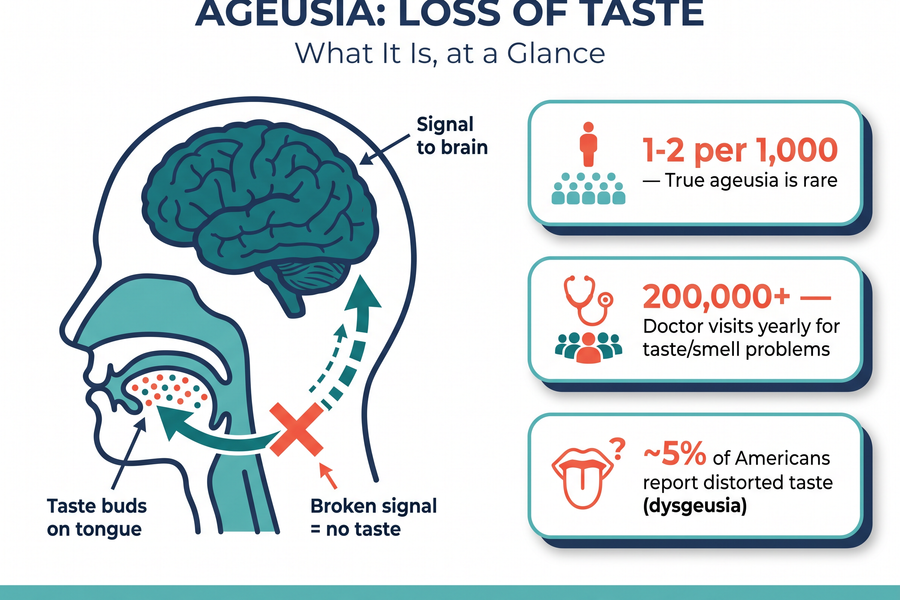
Overview of ageusia: complete taste loss vs. related disorders, the interrupted tongue-to-brain signal pathway, and key statistics.
What Does Ageusia Feel Like?
With ageusia, you cannot distinguish any taste in foods or drinks. Without flavor, you focus on the texture of what you eat and drink.
For example, eating salty chips may feel like you are eating something bland and crunchy. The familiar flavor is simply gone.
Because taste and smell work together, most "loss of taste" complaints are actually driven by a reduced sense of smell. Your senses of taste and smell cooperate constantly — that is why your mouth waters and your stomach growls when you catch a whiff of something tasty.
What Causes Ageusia?
Your sense of taste relies on healthy taste buds and continuous communication between the nerves that carry taste signals to your brain. Many things can affect your taste buds or disrupt communication between your nerves and brain.
Smoking, for example, can damage your taste buds and affect your sense of taste. Other causes include infections, issues with your mouth and teeth, medications, and nerve damage.
Infections: COVID-19 (the most common cause of sudden taste loss), sinus infection, common cold, influenza, and strep throat can all disrupt taste through congestion, inflammation, or direct viral effects.
Issues with your mouth or teeth: gum (periodontal) disease, glossitis (tongue inflammation), xerostomia (dry mouth), Sjögren's syndrome, and burning mouth syndrome can all interfere with taste.
Nerve damage: three cranial nerves support your sense of taste. Diabetes, Bell's palsy, Alzheimer's disease, multiple sclerosis, Parkinson's disease, and stroke can all affect them. Radiation therapy may also damage these nerves.
Medications: hundreds of medications list taste loss as a side effect, including antibiotics (amoxicillin, clarithromycin, tetracyclines), antivirals, antifungals, antihistamines, antiseizure medications, tricyclic antidepressants, bronchodilators, and chemotherapy drugs.
Issues like vitamin B12 deficiency and zinc deficiency can also cause this condition.
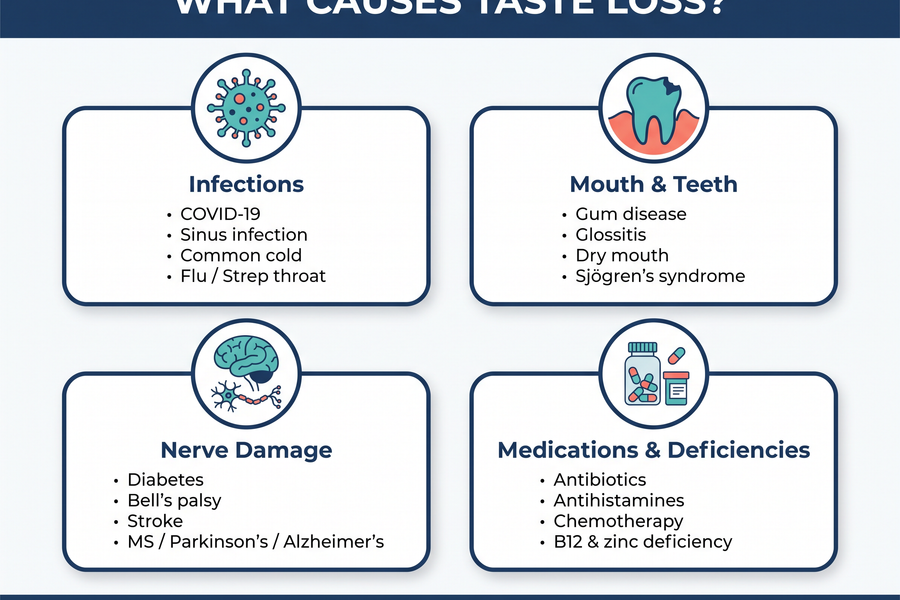
Four cause categories for ageusia: infections, mouth/teeth conditions, nerve damage, and medications/deficiencies, with common examples.
Prevalence Statistics
True ageusia prevalence: 1–2 per 1,000 people.
Americans reporting distorted taste (dysgeusia): ~5% (1 in 20).
Adults who may have some taste disorder: up to 15%.
Annual doctor visits for taste or smell problems: 200,000+.
Adults 80+ who report a taste problem: ~27%.
U.S. population experiencing taste disorders (NHANES-based): >5%.
Is Ageusia Dangerous?
Losing your taste is rarely dangerous by itself, but it can cause real health problems. Without flavor, you may eat less or fail to detect when something is "off" in the food or drink you consume.
Unintentional weight loss: food loses its appeal, so you eat less.
Inadequate nutrition: reduced intake leads to nutrient shortfalls.
Food poisoning: you cannot taste spoiled food or drink.
Mood changes and depression: loss of a basic pleasure affects well-being.
These complications matter most for older adults, who are already at higher risk of malnutrition and weight loss.
How Is Ageusia Diagnosed?
Otolaryngologists (ENTs — ear, nose, and throat specialists) diagnose taste disorders like ageusia. During a physical exam, they review your medical history to see if any conditions, recent procedures, or medications may be the cause.
Taste tests: you taste solutions ranging from sweet and salty to sour and bitter, at different strengths, delivered via dropper, spray, tablet, taste strip, or wafer.
Imaging tests: CT or MRI scans to check for neurological issues affecting taste.
Blood test: a small blood sample to check for vitamin deficiencies such as B12 or zinc.
How Is Ageusia Treated?
There are several steps you and your healthcare provider may take to restore your sense of taste.
Treat the underlying condition: your healthcare provider can treat the root cause — for example, antihistamines or decongestants for cold and flu symptoms, or antibiotics for a sinus infection.
Smell retraining therapy (SRT): because taste and smell work together, smelling strong scents several times a day for several months can help your brain relearn how to smell.
Supplements: some healthcare providers believe alpha-lipoic acid and CoQ10 supplements can help restore taste. Talk to your provider before taking these if you're on prescription medication.
When nerve damage is the cause: ageusia from nerve damage may be an ongoing issue, so treatment focuses on making sure you get enough nutrition.
Things you can do to trigger your appetite:
Eat crunchy foods: a crisp apple or chewy grains stimulate cranial nerves.
Engage your sense of smell: savory scents boost appetite; add fresh herbs like rosemary, basil, or sage.
Stay hydrated: saliva is an important part of taste; hydration helps your mouth produce it.
Support oral health: daily brushing and flossing can reverse gum disease and restore taste.
Get enough vitamin B12 and zinc: milk, fortified cereals, and eggs supply B12; cheddar, pumpkin seeds, and turkey breast supply zinc.
Switch medications: your provider may recommend alternatives that do not affect taste.

Treatment pathway for ageusia — treating the underlying cause, smell retraining therapy, supplements, and daily appetite triggers — with the COVID-19 recovery curve.
What Is the Outlook?
This condition is rarely permanent. Most things that cause it — like an infection — are temporary.
For example, people who have ageusia as a symptom of COVID-19 usually recover in one to three weeks.
Larger studies support this: an analysis published in The BMJ found that 79% of patients who lost taste during COVID-19 recovered by day 30, 88% by day 60, 90% by day 90, and 98% by day 180.
If you have been diagnosed with ageusia, your healthcare provider can help you find ways to manage until you regain your sense of taste.
When Should You See a Healthcare Provider?
Talk to a healthcare provider if you notice you cannot taste what you eat and drink. That is especially important if you do not have much appetite. See a provider promptly if you experience any of the following alongside taste loss:
Unintentional weight loss: may indicate malnutrition.
Inability to detect spoiled food: raises food poisoning risk.
New neurological symptoms: weakness, facial droop, confusion — could signal stroke or nerve damage.
Taste loss after starting a new medication: your provider may switch medications.
Conclusion
Ageusia — the complete loss of taste — is rare, affecting only 1–2 out of 1,000 people, while reduced or distorted taste is far more common. Most causes are temporary and treatable: infections, medications, dry mouth, and vitamin deficiencies. With proper diagnosis by an ENT specialist, your taste can often be restored.
If you cannot taste your food — especially with a poor appetite — do not wait. See a healthcare provider to identify and treat the cause.
Frequently Asked Questions
What is the difference between ageusia, hypogeusia, and dysgeusia?
Ageusia is the complete loss of taste — you cannot detect sweet, sour, salty, bitter, or umami at all. Hypogeusia is a reduced or weakened sense of taste. Dysgeusia is a distorted or unpleasant perception of taste, often described as metallic or bitter. True ageusia is rare (1–2 per 1,000 people), while dysgeusia affects about 5% of Americans.
Why did I suddenly lose my sense of taste?
Sudden taste loss is most often caused by an infection (such as COVID-19, a cold, or a sinus infection), a new medication, or dry mouth. COVID-19 is a leading cause of sudden taste loss — about 40–46% of patients report it. In most cases, taste returns within a few weeks once the underlying cause resolves.
Is ageusia the same as losing your sense of smell?
No, but they are closely related. Most people who think they have lost their sense of taste have actually lost their sense of smell, since smell contributes heavily to flavor perception. An ENT can run tests to determine which sense is impaired.
Can COVID-19 permanently damage your sense of taste?
Usually no. Most people with COVID-19-related taste loss recover in one to three weeks, and large studies show 90% recovery by day 90 and 98% by day 180. A small number of people experience lingering taste changes for months, but permanent loss is rare.
Which medications cause loss of taste?
Hundreds of medications list taste loss as a side effect, including antibiotics, antivirals, antifungals, antihistamines, antiseizure drugs, tricyclic antidepressants, bronchodilators, and chemotherapy. If taste changes start after a new medication, ask your provider about alternatives.
Can vitamin deficiencies cause ageusia?
Yes. Both vitamin B12 deficiency and zinc deficiency can cause loss of taste. A simple blood test can check for these deficiencies, and supplementation often restores taste once levels are corrected.
Is ageusia more common in older adults?
Yes. Taste problems rise sharply with age. About 27% of adults 80 and older report having had a problem with their sense of taste, compared to less than 1% of young adults. Some loss is natural with aging, but other factors — medications, dry mouth, gum disease, and neurological conditions — also contribute.
What can I do to get my appetite back when I can't taste food?
Eat crunchy foods (crisp apples, chewy grains) to stimulate cranial nerves, add fresh herbs like rosemary or basil to engage your sense of smell, stay hydrated (saliva carries flavors), brush and floss daily to reverse gum disease, and make sure you get enough vitamin B12 and zinc. Your provider may also recommend smell retraining therapy.
Related Reading
References
Cleveland Clinic. "Ageusia (Loss of Taste)." Medically reviewed; last updated Apr. 14, 2026. https://my.clevelandclinic.org/health/diseases/21850-ageusia-loss-of-sense-of-taste
NIDCD. "Quick Statistics About Taste and Smell." Updated Sept. 20, 2024. https://www.nidcd.nih.gov/health/statistics/quick-statistics-taste-smell
NIDCD. "Problems with ability to smell or taste common in middle-aged and older adults." Published Mar. 3, 2016. https://www.nidcd.nih.gov/news/2015/problems-ability-smell-taste-middle-aged-older-adults
Vennemann et al. "The Impact of Aging and Medical Status on Dysgeusia." Am J Med, 2016. https://www.amjmed.com/article/S0002-9343(16)30358-2/fulltext
Chen et al. "Meta-analysis with parametric cure modelling of recovery curves." BMJ, 2022. https://www.bmj.com/content/378/bmj-2021-069503
Comments