Dwarfism: Symptoms, Causes, Diagnosis & Treatment

Updated: 1 day ago
Medically reviewed by Dr. Baraa Alnahhal, MD · Last reviewed: October 2026
Dwarfism is short stature caused by a genetic or medical condition, generally defined as an adult height of 4 feet 10 inches (147 cm) or less [1]. It falls into two categories: disproportionate dwarfism, where some body parts are small while others are average-sized (most commonly from achondroplasia) [1], and proportionate dwarfism, where all parts of the body are small to the same degree [1] (often from growth hormone deficiency). Most cases result from gene changes, which are random in many children and can be inherited in others [1]. Most dwarfism treatments do not increase stature but instead manage complications [2] through medicines such as growth hormone or vosoritide, surgery when needed, and a coordinated specialist team.
Quick Answer: What is dwarfism, and what are the two types?
Dwarfism is short stature caused by a genetic or medical condition, generally an adult height of 4 feet 10 inches (147 cm) or less. It is disproportionate, most often from achondroplasia, or proportionate, often from growth hormone deficiency. Diagnosis uses growth measurements, imaging and genetic and hormone tests, and most treatments manage complications rather than increase height. [1] [2] [4]
What the research says
Achondroplasia is rare. A meta-analysis of 52 studies estimated its worldwide birth prevalence at about 4.6 per 100,000 births, with higher rates reported in North Africa and the Middle East (Foreman et al., American Journal of Medical Genetics Part A, 2020 [3]).
A daily injection speeds growth in children with achondroplasia. In a phase 3 trial of 121 children aged 5 to 17, daily vosoritide injections increased growth by 1.57 cm per year more than placebo over 52 weeks. Whether it increases final adult height is not yet known (Savarirayan et al., The Lancet, 2020 [4]).
What Is Dwarfism?
Dwarfism is short stature that results from a genetic or medical condition [1]. Stature is simply the height of a person in a standing position.
Dwarfism is generally defined as an adult height of 4 feet 10 inches (147 cm) or less [1]. Among people with dwarfism, the average adult height is about 4 feet 1 inch (125 cm) for women and 4 feet 4 inches (132 cm) for men [1].
Disproportionate dwarfism happens when some parts of the body are small while others are average or above-average size, because the underlying condition gets in the way of bone development [1]. Proportionate dwarfism happens when all parts of the body are small to the same degree and look like a body of average stature, because a condition present at birth or in early childhood limits overall growth and development [1].

Note: Some people prefer the term “short stature” or “little people” rather than “dwarf” or “dwarfism,” and it is important to respect each person's preference. Short stature conditions do not include familial short stature [1], which is a typical variation with typical bone development.
Dwarfism is not a disease on its own; hundreds of medical conditions can cause it, and healthcare providers usually diagnose it in childhood [5]. It is offensive to call someone who has dwarfism a "dwarf" or a "midget"; the preferred terms are little person or little people, and medical experts also use the terms short stature and restricted growth [5].
Dwarfism Symptoms
Symptoms other than short stature vary greatly across the range of dwarfism conditions [1], and they differ by type.
Disproportionate Dwarfism
Most people with dwarfism have conditions that cause short stature with body parts that are not the same size as one another. Usually this means an average-sized trunk with very short limbs [1], though some people may have a very short trunk with short limbs [1], in which case the limbs appear larger than the rest of the body and the head is large in comparison.
Achondroplasia is the most common cause of dwarfism [1]. It typically produces an average-sized trunk, short arms and legs (especially the upper arms and upper legs), short fingers with a wide separation between the middle and ring fingers, limited elbow mobility, a large head with a prominent forehead and flattened nose bridge, and bowed legs and a swayed lower back that tend to worsen over time [1].
Achondroplasia accounts for about 4 out of 5 cases of dwarfism [5].

Important: almost all people with disproportionate dwarfism have average intelligence [1]. Rare exceptions are usually due to a secondary factor, such as hydrocephalus, excess fluid around the brain [1].
A rare second cause is spondyloepiphyseal dysplasia congenita (SEDC), which produces a very short trunk, short neck, shortened arms and legs with average-sized hands and feet, a broad rounded chest, slightly flattened cheekbones, a cleft palate, inward-turning thighbones, a twisted foot, unstable neck bones, worsening curves of the upper and lower spine, vision and hearing problems, arthritis, and an adult height ranging from about 3 feet (91 cm) to just over 4 feet (122 cm) [1].
Proportionate Dwarfism
Proportionate dwarfism results from conditions present at birth or occurring in early childhood that limit overall growth, so the head, trunk, and limbs are all small to the same degree [1]. A fairly common cause is growth hormone deficiency [1], which occurs when the pituitary gland does not make enough of the hormone needed for typical childhood growth.
The key signs are a height below the third percentile on standard pediatric growth charts, a growth rate slower than expected for the child's age, and delayed or absent sexual development during the teen years [1].
What Causes Dwarfism?
Most often, dwarfism is caused by gene changes, also called genetic variants [1]. In many children, the gene change happens at random. But dwarfism can also be inherited from a genetic variant in one or both parents [1]. Other causes include low levels of hormones and poor nutrition, and sometimes the cause is never identified [1].
Achondroplasia: About 80% of people with achondroplasia are born to parents of average height; the child inherits one changed gene and one regular gene and can pass either on to their own children [1]
Turner syndrome: Affects only female children, when the X chromosome is missing or partially missing [1]
Low growth hormone levels: Sometimes traceable to a genetic change or injury; for most people, no cause is found [1]
Other causes: Other genetic conditions, low levels of other hormones, or poor nutrition; sometimes the cause is not known
Other causes include genetic conditions such as hypochondroplasia and Down syndrome; bone diseases called skeletal dysplasias; systemic diseases that slow growth, such as juvenile idiopathic arthritis, chronic kidney disease and cancers; and nutrition-related problems such as malnutrition, inflammatory bowel disease or celiac disease [5].
Risk Factors
Risk factors depend on the type of dwarfism. In many cases, the gene change happens at random and is not passed from parent to child [1]. If one or both parents have dwarfism, however, the risk of having a child with dwarfism rises [1].
If you are planning a pregnancy and want to understand the chances of your child having dwarfism, talk with your healthcare professional about genetic testing and other risk factors.
Possible Complications
Disproportionate dwarfism: Delays in motor skills such as sitting, crawling, and walking; frequent ear infections with risk of hearing loss; bowed legs; sleep apnea; pressure on the spinal cord at the base of the skull; hydrocephalus [1]; dental work needs; serious spinal curves with back pain or breathing problems; spinal stenosis causing leg pain or numbness; arthritis; weight gain worsening joint, spine, and nerve problems [1]
Proportionate dwarfism: Underdeveloped organs, such as heart conditions that often accompany Turner syndrome; absence of sexual maturation affecting physical development and social functioning [1]
Pregnancy: Women with disproportionate dwarfism may have respiratory problems during pregnancy [1], and a cesarean delivery is almost always needed because the pelvis typically does not allow vaginal delivery [1]
Some conditions that cause dwarfism can also cause developmental delays or intellectual disabilities [5].
Public Perceptions and Emotional Health
Most people with dwarfism prefer not to be labeled by a condition [1], though some refer to themselves as “dwarfs,” “little people,” or “people of short stature.”
People of average height sometimes hold misconceptions, and portrayals in movies often rely on stereotypes [1]. These misconceptions can affect self-esteem and limit how well someone does at school or work [1]. Children with dwarfism are often teased or mocked by classmates and, because the condition is relatively uncommon, may feel like they are on their own [1]. Mental health support and peer connection play an important role in the best possible quality of life.
When to See a Doctor
Symptoms of disproportionate dwarfism are often present at birth or in early infancy, while proportionate dwarfism may not be noticed at first [1]. See your child's healthcare professional if you are worried about your child's growth or overall development.
How Dwarfism Is Diagnosed
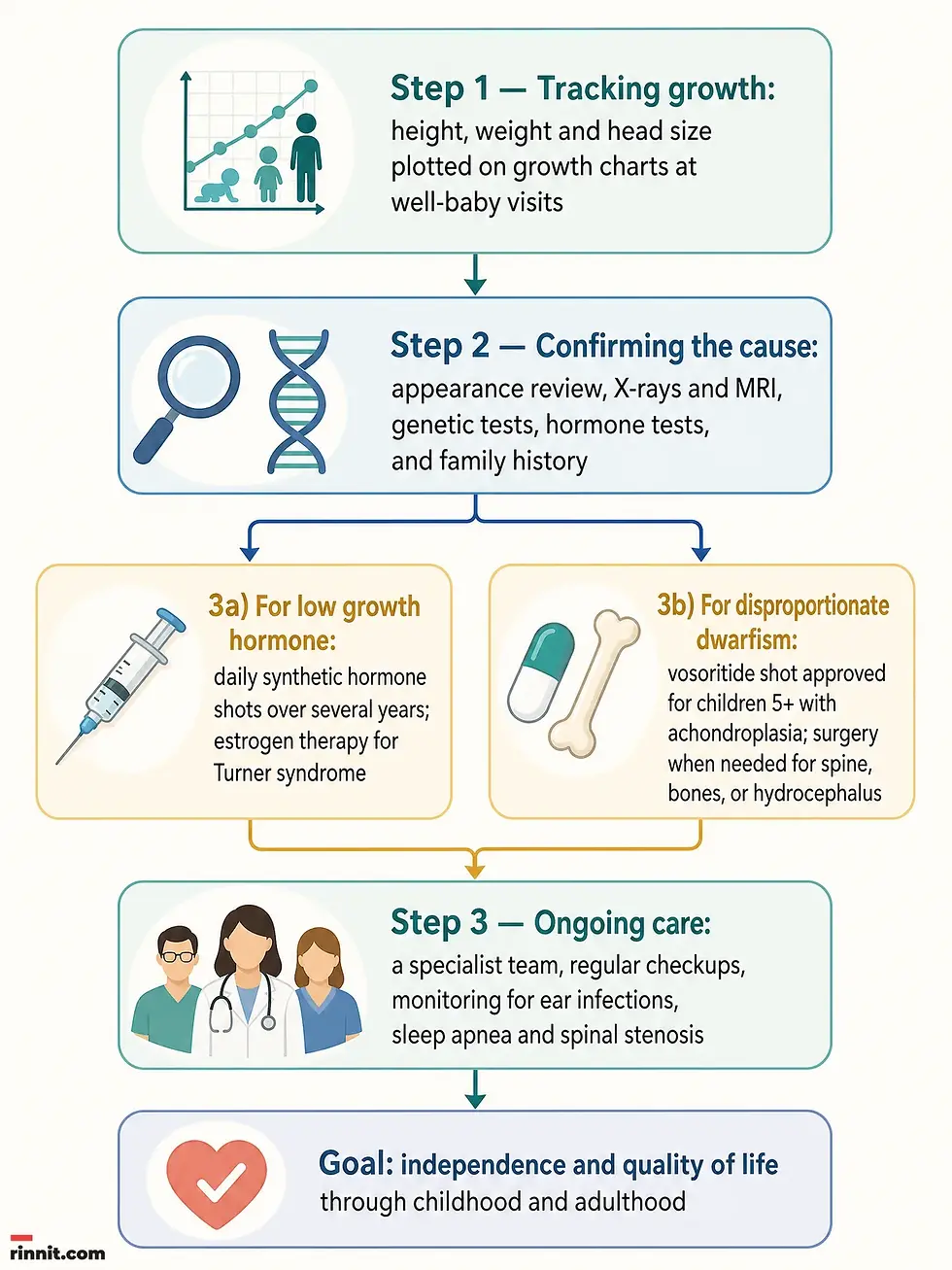
A pediatrician will look at several factors to understand your child's growth and find out whether a dwarfism-related condition is present, referring you to specialists in endocrinology and genetics when needed [2]. In some cases, disproportionate dwarfism is suspected during a prenatal ultrasound when very short limbs are noted in relation to the trunk [2].
Measurements: Height, weight, and head size plotted on charts at every well-baby exam to spot atypical growth patterns, such as delayed growth or a disproportionately large head [2]
Appearance: Distinct facial and skeletal features help the pediatrician and a geneticist identify the specific condition [2]
Imaging: X-rays reveal differences in the skull and skeleton or delayed bone maturation; an MRI can show whether the pituitary gland or hypothalamus is typical [2]
Genetic tests: Available for many genetic causes; they confirm the diagnosis, help manage the condition, and aid family planning, such as checking the X chromosomes for Turner syndrome [2]
Family history: Heights of parents, siblings, and grandparents to see whether short stature falls within the family's typical range [2]
Hormone tests: Measure growth hormone and other hormones critical for childhood growth and development [2]
The Care Team
Because some dwarfism conditions can affect development, growth, and overall health, care is usually coordinated by your child's pediatrician with help from several specialists. The team may change as your child's needs change and may include a hormone specialist (endocrinologist), an ear, nose, and throat specialist (otolaryngologist), a skeletal specialist (orthopedist), a geneticist, a heart specialist (cardiologist), an eye specialist (ophthalmologist), a mental health professional, a nervous system specialist (neurologist), an orthodontist, a developmental therapist, and an occupational therapist.
Treatment Options
The goal of treatment is to help you do what you want to do independently [2]. Most dwarfism treatments do not increase stature; instead, they correct or ease problems caused by complications [2].
Medications
In 2021, the U.S. Food and Drug Administration approved vosoritide to improve growth in children with the most common type of dwarfism [2]. Given as a shot, it is now approved for children of any age who have achondroplasia and still have open growth plates (the FDA widened the age range in 2023) [2]. In studies, children who took it grew an average of 0.6 inches (1.6 cm) more per year than children given a placebo [2]. Discuss the potential risks and benefits with your doctor and geneticist, and note that additional medicines are still being studied.
Hormone Therapy
For dwarfism caused by low growth hormone levels, daily shots of a synthetic version of the hormone may increase final height [2]. Children usually receive daily shots for several years until they reach a maximum adult height, often within the average adult range for their families [2]. Treatment may continue through the teen years and early adulthood, some people need lifelong therapy, and other related hormones may be added if their levels are also low [2].
For girls with Turner syndrome, treatment also requires estrogen and related hormone therapy to start puberty and support adult development, usually continuing until the average age of menopause [2].
Important limitation: giving growth hormone to children with achondroplasia does not increase final adult height [2].
Surgery
Surgical procedures that may help people with disproportionate dwarfism include correcting the direction in which bones grow, stabilizing and correcting the shape of the spine, enlarging the openings in the vertebrae to ease pressure on the spinal cord, and placing a shunt to drain excess fluid around the brain (hydrocephalus) [2].
Some people choose extended limb lengthening surgery, but this procedure is controversial because of its risks and the emotional and physical stress of multiple operations [2]. Families are urged to wait until the child is old enough to take part in the decision.
Orthotic devices, such as back braces for scoliosis or special shoes that help with posture and gait, can support the body [5]. Many people with dwarfism do not need treatment because it is not causing them harm, and some may not want treatment because they do not feel the benefits outweigh the possible drawbacks [5].
Ongoing Health Care
Regular checkups with a healthcare professional familiar with dwarfism can improve quality of life [2]. Because symptoms and complications span a wide range, conditions are managed as they occur, with testing and treatment for ear infections, spinal stenosis, or sleep apnea as needed [2]. Adults with dwarfism should continue to be monitored and treated for conditions that arise throughout life [2].
Many people with dwarfism live just as long as people without it and have little or no negative health effects, although some causes affect other body systems and could affect life expectancy [5]. Many countries consider dwarfism a disability, which gives people who have it certain legal protections and may qualify them for support services and care [5].
At-Home Care for Children
For children with disproportionate dwarfism, several everyday practices make a meaningful difference. Use an infant car seat with firm back and neck supports, and keep the seat rear-facing to the highest weight and height possible, beyond the recommended age limit [2]. Avoid infant devices such as swings, umbrella strollers, slings, jumper seats, and backpack carriers that do not support the neck or curve the back into a C shape, and support the head, neck, and upper back whenever your child is seated [2].
Promote good posture with a pillow for the lower back and a footstool, begin healthy eating habits early to prevent weight gain, and encourage activities recommended by the healthcare team, such as swimming or bicycling [2]. Avoid sports involving collision or impact, such as football, wrestling, diving, or gymnastics [2]. Keep an eye out for complication signs such as ear infections or sleep apnea [2].
Coping and Support
Several practical steps help children with dwarfism cope with daily challenges and build independence.
Little People of America, a nonprofit organization, provides social support, condition information, advocacy, and resources, and many people with dwarfism stay involved throughout their lives [2]. Their website links to companies selling adaptive products, from size-appropriate furniture to everyday household tools [2].
At home, consider modifications such as light switch extensions, lower handrails on stairways, and lever doorknobs [2]. An occupational therapist can recommend personal adaptive tools for activities of daily living, especially where limited arm reach or hand use makes self-care difficult.
At school, talk with teachers about what dwarfism is, how it affects your child, and what classroom needs exist [2]. Encourage your child to share feelings about teasing, and practice how to respond to insensitive questions [2]. If bullying occurs, reach out to the teacher, principal, or school counselor, and ask for a copy of the school's bullying policy [2].
Preparing for Your Appointment
Disproportionate dwarfism is usually seen at birth or early in infancy, while proportionate dwarfism may not be diagnosed until later childhood or the teenage years if a child is not growing at an expected rate [2]. Attending all well-baby visits and annual checkups gives the healthcare team a chance to track growth, note delays, and catch other developmental or health issues.
Expect your doctor to ask about your growth concerns, how well your child eats, whether your child is reaching milestones such as rolling over, sitting up, crawling, walking, or speaking, and whether relatives are very short or experienced growth delays. Bring a measuring chart marking your child's height over time, along with photographs from various ages.
Useful questions to ask include which diagnostic tests are needed and when results will come back, which specialists you should see, how common complications will be screened for, how your child's health and development will be monitored, and whether educational materials and local support services are available.
Bottom Line
Dwarfism is a broad term covering many different conditions, and the differences between them matter. Disproportionate dwarfism, led by achondroplasia, is a story about how bones develop, while proportionate dwarfism is a story about how overall growth is fueled by hormones. Knowing which type a child has shapes everything that follows: the tests, the specialists, the treatments, and the daily care.
The encouraging news is that almost all children with disproportionate dwarfism have average intelligence, that growth hormone therapy can help children with hormone-related short stature reach family-typical adult heights, and that a coordinated care team can manage complications from infancy into adulthood.
Your next step: if you are concerned about your child's growth, do not wait it out. Keep every well-baby visit and annual checkup, bring a height log and old photos to the appointment, and ask directly whether genetic testing, hormone testing, or a specialist referral makes sense. If dwarfism has been diagnosed, ask about a referral to Little People of America for peer support, adaptive equipment, and school advocacy.
Frequently Asked Questions
How do you know if a child has dwarfism?
The key indicators are an adult height of 4 feet 10 inches (147 cm) or less for dwarfism generally, and for proportionate dwarfism specifically, a height below the third percentile on pediatric growth charts, a slower-than-expected growth rate, and delayed sexual development in the teen years. For disproportionate dwarfism, physical signs such as an average-sized trunk with short limbs often appear at birth or in early infancy. A pediatrician confirms the diagnosis with growth measurements, imaging, genetic tests, and hormone tests.
What is the most common cause of dwarfism?
Achondroplasia is the most common cause of dwarfism and the most common form of disproportionate dwarfism. About 80% of people with achondroplasia are born to parents of average height, because the gene change often happens at random rather than being inherited.
Does growth hormone treatment work for all types of dwarfism?
No. Growth hormone therapy can increase final height in children whose dwarfism is caused by low growth hormone levels, often bringing them into the average adult range for their families. However, giving growth hormone to children with achondroplasia does not increase final adult height. For children of any age with achondroplasia and open growth plates, the medicine vosoritide is approved and showed an average additional growth of about 0.6 inches per year in studies.
Is dwarfism always genetic?
Most often it is caused by gene changes, which may be random or inherited from a parent. Other causes include low levels of growth hormone or other hormones and poor nutrition, and sometimes the cause is never found. Turner syndrome, which affects only girls, results from a missing or partially missing X chromosome.
What is the average height of an adult with dwarfism?
The average adult height is about 4 feet 1 inch (125 cm) for women and 4 feet 4 inches (132 cm) for men, against the general definition of dwarfism as an adult height of 4 feet 10 inches (147 cm) or less.
What are the two main types of dwarfism?
Disproportionate dwarfism means some body parts, such as the arms and legs, are short compared with the trunk, and it is most often caused by achondroplasia. Proportionate dwarfism means the whole body is small in proportion, often because of a hormone problem such as growth hormone deficiency.
Can dwarfism be found before birth?
Some types, such as achondroplasia, may be suspected on an ultrasound later in pregnancy when the limbs measure short. Genetic testing can help confirm the diagnosis.
Can parents of average height have a child with dwarfism?
Yes. Most children with achondroplasia are born to parents of average height because the gene change happens for the first time in that child. A genetic counselor can explain the chances for future pregnancies.
What health problems can come with dwarfism?
Depending on the type, problems can include ear infections, sleep apnea, bowed legs, back and joint pain and narrowing of the spinal canal. Regular checkups help find these early, and new weakness, numbness or breathing pauses during sleep should be checked promptly.
Is there a medicine for achondroplasia?
Yes. Vosoritide is a daily injection approved for children with achondroplasia whose growth plates are still open, and it can speed up growth. Whether it increases final adult height is not yet known.
Related Reading
Achondroplasia: What It Is, How It Affects Growth, and How It Is Managed explains achondroplasia, the most common cause of dwarfism.
Growth Hormone Deficiency (GHD): What It Is, Why It Happens, and How It's Treated explains growth hormone deficiency, a common cause of proportionate dwarfism.
Hypochondroplasia: A Comprehensive Guide to Skeletal Dysplasia and Growth Management explains a milder skeletal condition related to achondroplasia.
Turner Syndrome: A Comprehensive Guide to Symptoms and Care explains the chromosome condition that causes short stature in girls.
References
Mayo Clinic Staff. Dwarfism - Symptoms and causes. Mayo Clinic. November 7, 2024. https://www.mayoclinic.org/diseases-conditions/dwarfism/symptoms-causes/syc-20371969
Mayo Clinic Staff. Dwarfism - Diagnosis and treatment. Mayo Clinic. November 7, 2024. https://www.mayoclinic.org/diseases-conditions/dwarfism/diagnosis-treatment/drc-20371975
Foreman PK, et al. Birth prevalence of achondroplasia: a systematic literature review and meta-analysis. American Journal of Medical Genetics Part A. 2020;182(10):2297-2316. PMID 32803853. https://doi.org/10.1002/ajmg.a.61787
Savarirayan R, et al. Once-daily, subcutaneous vosoritide therapy in children with achondroplasia: a randomised, double-blind, phase 3, placebo-controlled, multicentre trial. The Lancet. 2020;396(10252):684-692. PMID 32891212. https://doi.org/10.1016/S0140-6736(20)31541-5
Cleveland Clinic. Dwarfism, Short Stature, Growth Disorder Types & Causes. Cleveland Clinic. Last updated January 15, 2026. https://my.clevelandclinic.org/health/diseases/dwarfism-short-stature
Medical disclaimer
This article is based on clinical reference sources current as of November 7, 2024. Medical information changes over time — this content is for general education and is not a substitute for professional medical advice. Always consult a licensed clinician for diagnosis and treatment.



Comments