Hypochondroplasia: A Comprehensive Guide to Skeletal Dysplasia and Growth Management

Updated: 2 days ago
Medically reviewed by Dr. Baraa Alnahhal, MD · Last reviewed: October 2026
Quick Answer
Hypochondroplasia is a genetic skeletal dysplasia that causes short-limbed dwarfism, caused in almost all cases by a change in the FGFR3 gene. Signs include short stature, a larger head, short arms and legs, broad hands and feet and bowed legs. It is autosomal dominant, though most cases occur at random. It is lifelong, with a normal life expectancy. [1]
What the research says
Short stature can affect quality of life in children with hypochondroplasia and similar conditions. Parents of children in a phase II vosoritide trial (children with hypochondroplasia and other genetic causes of short stature: ACAN, NPR2 and RASopathy) completed the QoLISSY quality-of-life survey. The group's mean total score was 54.0 compared with 70.0 in a reference group with idiopathic short stature or growth hormone deficiency (p < 0.001), with lower physical (44.8 vs 71.8) and social (54.0 vs 69.4) scores. Older age, male sex and shorter height were linked to lower scores. This was a parent-reported survey, so it shows an association and does not measure the effect of any treatment. (Galetaki et al., Horm Res Paediatr, 2026)
What is hypochondroplasia?
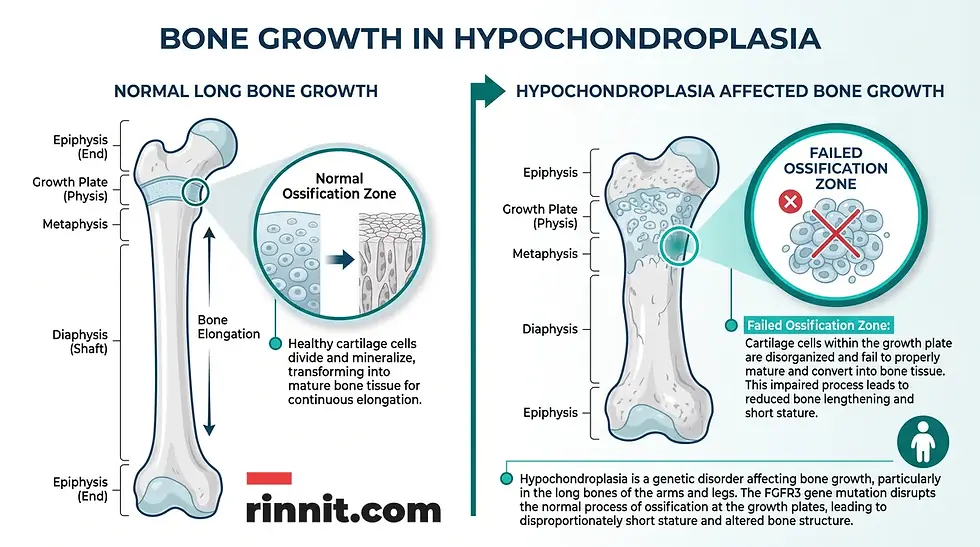
Hypochondroplasia is a genetic condition that affects the development of cartilage and bone. A genetic change stops cartilage from turning into bone (a process called ossification) in the long bones of the arms and legs, which leads to short arms and legs and short stature. [1]
It is considered a milder form of achondroplasia and there is no cure. [1] Treatment focuses on managing symptoms and preventing complications.
Symptoms and physical features
Symptoms vary from person to person. Common features include: [1]
Short stature
A larger-than-typical head
Short arms and legs
Broad hands and feet
Limited range of motion in the elbows
Bowed legs
An inward curve of the lower spine (lordosis)
Joint pain in the arms and legs, especially after exercise
Growth slows from toddlerhood through early school age. [1] Fewer than 10% of people with hypochondroplasia have mild intellectual disability or learning difficulties, and intelligence is usually not affected. [1]
Adult height
Hypochondroplasia vs. achondroplasia

Both conditions involve the FGFR3 gene, but hypochondroplasia is milder. Features such as head size and facial characteristics are less pronounced, and it is often diagnosed later in childhood than achondroplasia. [1]
Causes and inheritance
Almost all cases of hypochondroplasia result from a change in the FGFR3 gene. This gene makes a protein that guides bone growth, especially the conversion of cartilage into bone. When the gene is altered, the protein becomes overactive and cannot regulate bone development properly. A small minority of cases involve a different gene that has not been identified. [1]
Diagnosis
Hypochondroplasia is usually diagnosed after birth, because it is often not visible on a prenatal ultrasound. Diagnosis involves a physical exam and genetic testing. [1]
Physical exam: Looks at growth patterns and physical features.
Genetic testing: Looks for the FGFR3 change.
Imaging: X-rays assess bone growth, and MRI or CT scans can check for spinal curvature or nerve compression.
Prenatal testing: If the genetic cause in the family is known, chorionic villus sampling (CVS) or amniocentesis is an option.
Treatment and management

Treatment is aimed at symptoms and varies from person to person. Options include: [1]
Spinal surgery: Laminectomy or spinal decompression for nerve compression in the lower back (spinal stenosis).
Physical therapy: To improve mobility and range of motion.
Growth hormone therapy: An option for some children.
Pain medicines: For joint pain.
Support groups: For families and individuals.
A pediatrician, geneticist and orthopedic specialist can work together on a care plan. Growth is monitored during routine checkups.
Outlook
Hypochondroplasia is a lifelong condition with a normal life expectancy. Children usually take part in everyday activities, although they may face a higher risk of bullying at school. Mild aches in the knees, elbows or ankles after exercise are common, and long-term joint pain can continue into adulthood. [1]
When to see a provider: See a healthcare provider if your child's symptoms interfere with daily tasks, if they have severe pain (especially in the arms or legs), or if they miss developmental milestones such as an expected growth spurt.
Prevention and family planning
Because the gene change usually happens at random, hypochondroplasia generally cannot be prevented. The exception is preimplantation genetic testing. People who are thinking about having children can talk to a healthcare provider about genetic risk and testing. [1]
Conclusion
Hypochondroplasia is a milder skeletal dysplasia caused by a change in the FGFR3 gene. There is no cure, but with monitoring, physical therapy, pain management and, when needed, growth hormone therapy or surgery, most people lead full, active lives. [1] If you are concerned about your child's growth, a healthcare provider can arrange an evaluation.
Frequently Asked Questions
When will I notice if my child has hypochondroplasia?
Growth slows from toddlerhood through early school age, and symptoms may not be noticeable until early adolescence, when a child may not have a growth spurt. [1]
Does hypochondroplasia affect intelligence?
Usually not. Fewer than 10% of people have mild intellectual disability or learning difficulties. [1]
How is it different from achondroplasia?
Hypochondroplasia is milder. Features such as head size and facial characteristics are less pronounced, and it is often diagnosed later in childhood. [1]
Can hypochondroplasia be prevented?
Usually not, because the gene change generally happens at random. The exception is preimplantation genetic testing. [1]
Is joint pain common?
Yes. Joint pain in the arms and legs is common, especially after exercise, and can continue into adulthood. [1]
Is surgery always required?
No. Surgery such as spinal decompression is used for complications such as spinal stenosis.
What gene is responsible for the condition?
FGFR3 in almost all cases. A small minority involve a different, unidentified gene. [1]
What is the inheritance risk if one parent has it?
Hypochondroplasia is autosomal dominant, so there is a 50% chance of passing it to each child. [1]
Can it be diagnosed during pregnancy?
Usually not on ultrasound. If the genetic cause in the family is known, CVS or amniocentesis can be used. [1]
What kind of doctor treats hypochondroplasia?
Pediatricians, geneticists and orthopedic specialists commonly work together on a care plan.
Are there medicines for growth?
Growth hormone therapy is an option for some children. [1]
Does it affect life expectancy?
No. People with hypochondroplasia have a normal life expectancy. [1]
What is lordosis?
An inward curve of the lower spine. It is one of the features of hypochondroplasia. [1]
What is ossification?
The process in which cartilage turns into bone. It is impaired in hypochondroplasia. [1]
What is the typical adult height?
About 138 to 165 cm (54 to 65 inches) for males and 128 to 151 cm (50 to 59 inches) for females. [1]
References
Cleveland Clinic. Hypochondroplasia Dwarfism: Symptoms, Causes & Outlook. Cleveland Clinic. Last updated January 3, 2024. https://my.clevelandclinic.org/health/diseases/hypochondroplasia
Galetaki D, Zhang A, Rangos N, et al. Parental Perception of Quality of Life and Impact of Short Stature in Children with Hypochondroplasia and Other Genetic Causes of Short Stature. Horm Res Paediatr. 2026;99(6):841-849. PMID 40096834. https://doi.org/10.1159/000545318
Medical disclaimer
This article is for general educational purposes only and is not a substitute for professional medical advice, diagnosis, or treatment. Always seek the advice of your physician or other qualified healthcare provider with any questions you may have about a medical condition. Never disregard professional medical advice or delay seeking care because of something you have read here. If you think you may have a medical emergency, call your doctor or emergency services immediately.



Comments