Achondroplasia: What It Is, How It Affects Growth, and How It Is Managed

Updated: 2 days ago
Medically reviewed by Dr. Baraa Alnahhal, MD · Last reviewed: September 2026
Editorial note: This article is for general educational purposes only and does not constitute medical advice. Always consult a qualified healthcare professional for diagnosis and treatment decisions.
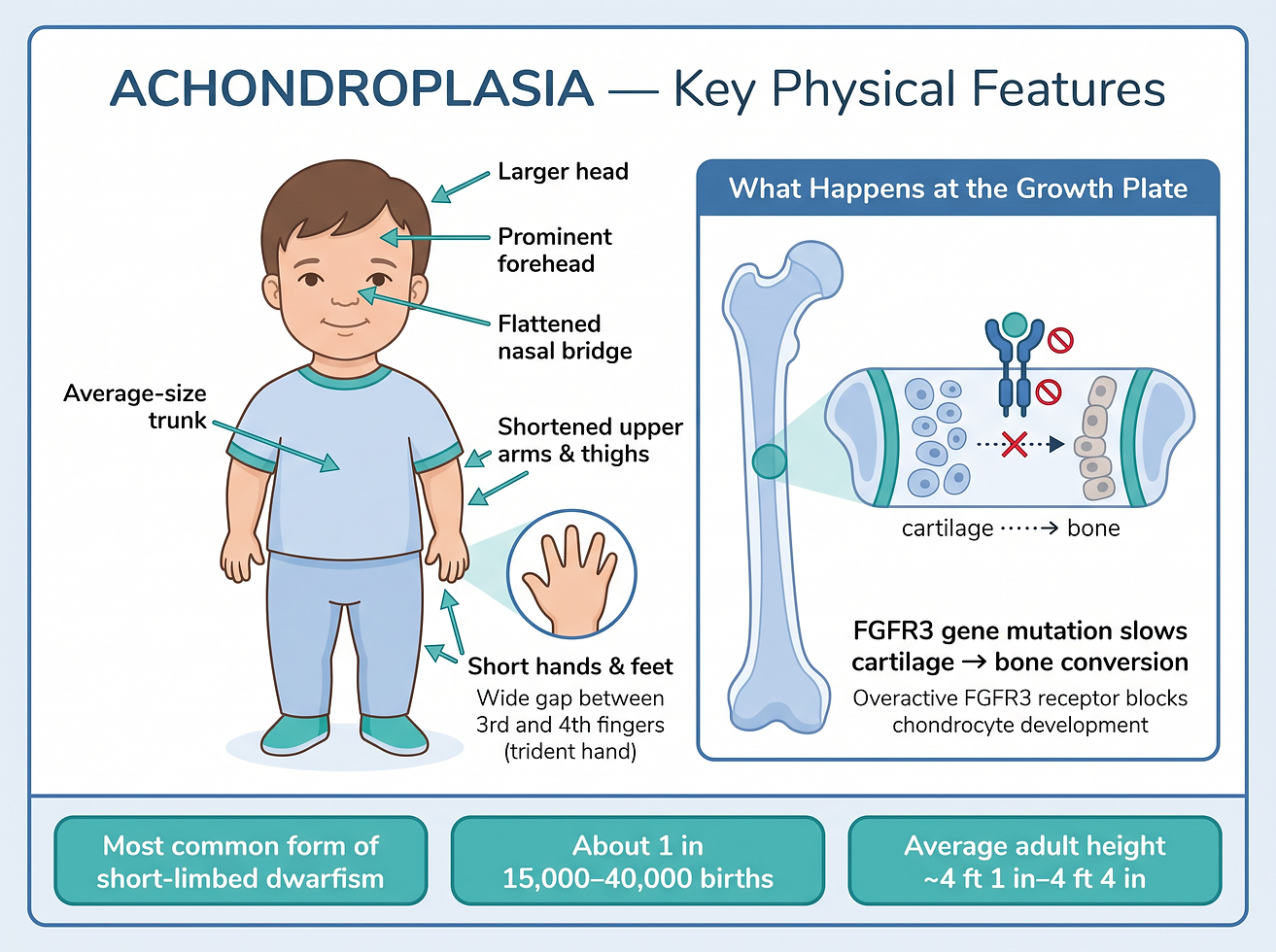
TL;DR — Achondroplasia is the most common form of short-limbed dwarfism, caused by a mutation in the FGFR3 gene that stops cartilage from converting into bone in the arms and legs. It affects about 1 in 15,000 to 1 in 40,000 babies, and about 80% of cases arise from a new mutation in children of average-height parents. There is no cure, but most people with achondroplasia have normal intelligence, live long lives, and lead full, healthy lives with regular medical monitoring and symptom management.
Quick Answer
Achondroplasia is a genetic bone growth disorder in which cartilage fails to convert into bone during development, producing disproportionately short arms and legs, a larger head with a prominent forehead, and an average adult height of about 4 feet 4 inches in men and 4 feet 1 inch in women. Around 80% of cases are not inherited and occur through a random new mutation. Although there is no cure, most people with achondroplasia have normal intelligence and a life span close to average, especially with regular checkups that catch complications such as spinal cord compression, ear infections, and sleep apnea early.
What Is Achondroplasia?
In early fetal development, much of the skeleton is made of cartilage that later converts into bone. Achondroplasia occurs when that conversion is disrupted in the bones of the arms and legs. The result is short-limb dwarfism with rhizomelic shortening — the upper portions of the arms and legs (thighs and upper arms) are shorter than the lower portions [1].
Achondroplasia is the most common form of skeletal dysplasia, the umbrella term for hundreds of conditions that affect bone and cartilage growth. What distinguishes it is that it specifically targets bone growth in the limbs [1].
| Term | Meaning | |---|---| | Achondroplasia | The most common form of short-limbed dwarfism; "without cartilage formation" describes the disrupted conversion of cartilage to bone | | Skeletal dysplasia | The umbrella category covering hundreds of bone and cartilage growth disorders | | Rhizomelic shortening | Upper limbs and thighs proportionally shorter than the lower limbs | | Short stature | Adult height below 4 feet 10 inches | | Hypotonia | Weak muscle tone common in infants with the condition | | Macrocephaly | A head that is larger than typical for age |
How Common Is Achondroplasia?
About 1 in 15,000 to 1 in 40,000 babies are born with achondroplasia [1]. Worldwide estimates cluster around 1 in 25,000 live births, and a recent national analysis found a birth prevalence of about 3.72 per 100,000 — consistent with roughly 1 in 27,000 [2] [3]. That makes it the most common genetic form of short stature, yet still a rare condition.
| Statistic | Figure | |---|---| | Incidence at birth | About 1 in 15,000 to 1 in 40,000 live births | | Worldwide estimate | Roughly 1 in 25,000 live births | | Cases arising from a new (de novo) mutation | About 80% | | Chance of passing it on to a child (one affected parent) | 50% | | Chance of homozygous achondroplasia (both parents affected) | 25%, usually fatal before or shortly after birth | | Average adult height, untreated (men) | About 131 cm (4 ft 4 in) | | Average adult height, untreated (women) | About 124 cm (4 ft 1 in) |
Is Achondroplasia Hereditary?
Most cases — around 80% — are not inherited at all. The majority of affected children have parents of average height and are born with a new (de novo) gene mutation, and it is rare for those parents to have another child with the condition [1].
When the condition runs in a family, it follows an autosomal dominant pattern: only one parent needs to carry the mutation for a child to be affected.
| Parent situation | Risk to each child | |---|---| | One parent has achondroplasia, other parent does not | 50% chance the child has achondroplasia | | Neither parent is affected (most common scenario) | Very low — a new mutation can still occur randomly | | Both parents have achondroplasia | 50% affected; 25% unaffected; 25% homozygous (typically stillbirth or death shortly after birth) |
What Causes Achondroplasia?
The condition is caused by a mutation in the FGFR3 gene, which encodes a receptor that regulates how cartilage converts to bone during fetal development [4]. In achondroplasia, the mutated receptor becomes overactive and excessively blocks the signals that stimulate cartilage cells to multiply and build bone matrix. The long bones of the arms and legs grow less than they should, while the trunk develops close to average size [5].
What Are the Signs and Symptoms?
The physical features of achondroplasia are usually recognizable at birth and remain consistent throughout life.
| Feature | Description | |---|---| | Shortened limbs | Thighs and upper arms are disproportionately short (rhizomelia) | | Short hands and feet | With a wide separation between the third and fourth fingers, sometimes called a "trident" hand | | Head size | Larger than typical for age (macrocephaly) | | Forehead | Prominent or protruding | | Face | Flattened bridge of the nose | | Height | Maximum adult height around 4 feet | | Infant development | Delayed sitting, crawling, and walking, often related to weak muscle tone |
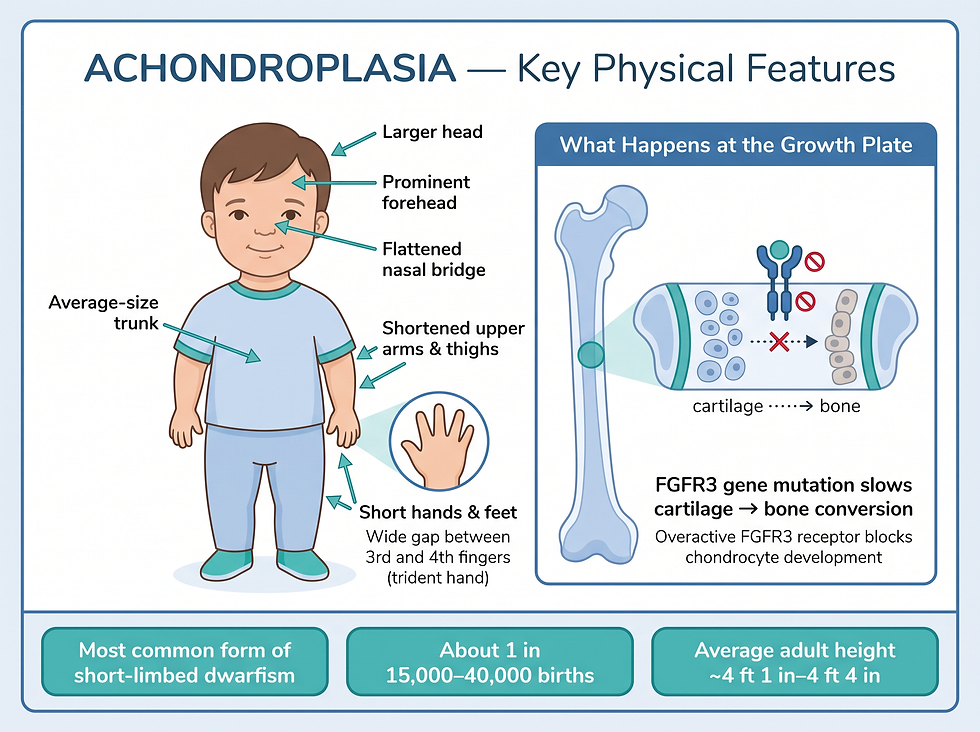
Because the trunk is near average size while the limbs are short, the body proportions themselves are the most visible clue that a provider will look for.
What Health Complications Can Occur?
Most people with achondroplasia are healthy, but the skeletal differences raise the risk of several complications that merit regular monitoring.
| Complication | What happens | |---|---| | Spinal cord compression | Narrowing at the base of the skull (foramen magnum) or in the spinal canal can compress the spinal cord — a serious risk in infants | | Obstructive sleep apnea | Repeated breathing pauses during sleep caused by narrowed airways | | Recurrent ear infections | Frequent middle ear infections (otitis media) | | Hydrocephalus | Excess fluid buildup in the brain | | Curved spine | Permanent lower-back sway (lordosis) in childhood; some develop front-to-back curvature (kyphosis) and back pain | | Bowed legs | Characteristic outward bowing of the lower legs | | Obesity | Higher tendency toward weight gain, which worsens joint and spine strain | | Spinal stenosis | Narrowing of the spinal canal with age, causing leg pain, tingling, and walking difficulty | | Back and leg pain | Common in adulthood |
Research highlights why early monitoring matters: children under five with achondroplasia face a nearly 50-fold higher risk of sudden death than the general population, mainly from compression at the base of the skull, and a 42-year follow-up study found average life expectancy reduced by about 10 years — a difference driven largely by preventable respiratory and neurological complications [6] [7].
How Is Achondroplasia Diagnosed?
Providers can sometimes spot achondroplasia before birth. If an ultrasound shows arms and legs shorter than average combined with a large head, a prenatal suspicion is raised — especially when one or both parents are affected. Most cases, however, are confirmed after birth [1].
| Diagnostic step | What it establishes | |---|---| | Physical examination | Body proportions, head size, facial features, limb length | | X-ray | Characteristic bone patterns (pelvis shape, skull base narrowing, limb proportions) | | Genetic testing | Confirms the FGFR3 mutation | | MRI or CT scan | Checks for muscle weakness, spinal cord compression, or fluid buildup | | Prenatal examination | Offered when a parent carries the mutation | | Growth monitoring | Regular tracking of height, weight, and head circumference in infancy |
How Is Achondroplasia Treated and Managed?
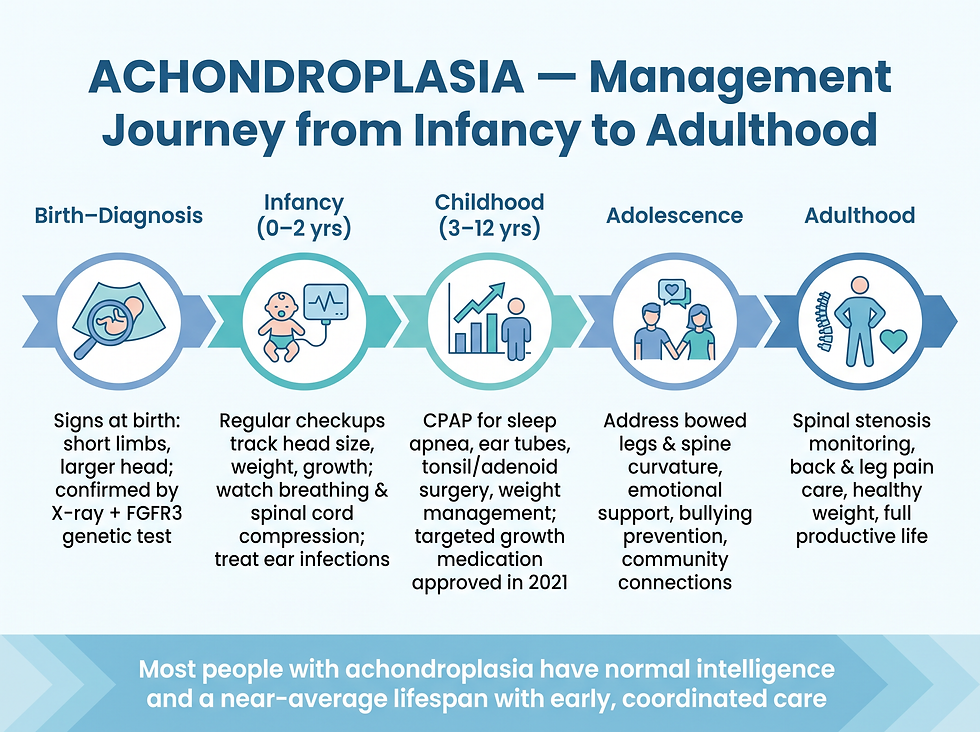
There is no cure for achondroplasia, but the outlook is strongly positive: almost everyone diagnosed is able to live a full and healthy life [1]. Care focuses on preventing and managing complications.
| Management approach | Purpose | |---|---| | Growth monitoring | Tracking height, weight, and head circumference during infancy to catch problems early | | Weight management | Healthy eating habits prevent obesity and reduce strain on the spine and joints | | CPAP therapy | Nasal mask support for obstructive sleep apnea | | Ear tubes or antibiotics | Prevents damage from recurrent ear infections | | Ventriculoperitoneal shunt | Surgery that relieves fluid pressure on the brain (hydrocephalus) | | Decompression surgery | Corrects life-threatening compression at the skull base (craniocervical junction) | | Tonsil and adenoid removal | Opens the airway in children with sleep apnea | | Growth hormone therapy | Used in some countries to modestly improve early growth, though its benefit remains debated | | Targeted medication (vosoritide) | First drug aimed at the underlying mechanism; approved in 2021 for children with achondroplasia | | Social and emotional support | School accommodations, bullying prevention, and connection with the dwarfism community |
What Has Changed With Targeted Medication?
In November 2021, regulators approved the first therapy designed to address achondroplasia's root mechanism rather than just its symptoms: an injected C-type natriuretic peptide analog that counteracts the overactive FGFR3 signal [5]. Phase II and III trials found it increased annual growth velocity by roughly 1.5 to 2.0 cm per year compared with placebo, with growth gains sustained over seven years of continued treatment [5]. Studies also report improvements in body proportions, reductions in lower-back sway and leg bowing, and better walking capacity [5]. Common side effects are mild injection-site reactions and temporary drops in blood pressure in infants [5].
Longer-term real-world data continue to emerge: children who started treatment after age five gained an average of about 10.6 cm in standing height over six years compared with expected growth [8]. Researchers caution that the effect on final adult height and quality of life is still being studied.
What Is the Life Expectancy and Long-Term Outlook?
The majority of people living with achondroplasia have a normal life span and normal intelligence, despite delayed motor milestones in infancy [1]. The historical reduction in average lifespan of about a decade reflects complications — especially breathing problems and compression at the base of the skull — that modern monitoring and early intervention are increasingly able to prevent [6] [7]. Caring for complications as they arise is the single most important factor in a healthy, long life.
How Can Parents Support a Child With Achondroplasia?
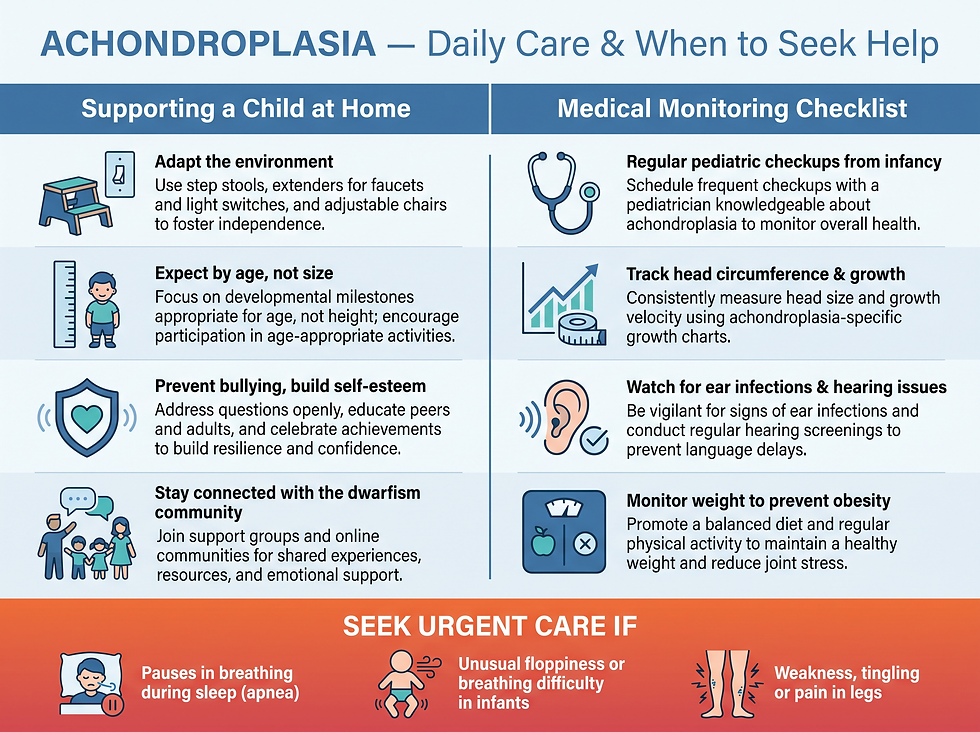
Beyond medical care, practical home and social adjustments make a substantial difference [1].
| Support strategy | Why it matters | |---|---| | Adapt the physical environment | Step stools and lowered light switches promote independence | | Provide emotional and educational support | Prevents bullying and supports healthy self-esteem at school | | Engage with community organizations | Connection with the dwarfism community provides role models and resources | | Parent by age, not size | Age-appropriate expectations build confidence and self-worth | | Keep regular checkups | Catching spinal, respiratory, and ear problems early prevents serious complications |
When Should You Contact a Healthcare Provider?
Contact a provider during early infancy if a child is not meeting height benchmarks for their age or shows developmental delays in sitting, crawling, or walking [1]. Also seek evaluation for breathing problems, frequent ear infections, back and leg pain, or weight gain that raises obesity risk [1]. In infants, unusual pauses in breathing during sleep or extreme floppiness deserve urgent attention because of the risk of spinal cord compression.
Conclusion
Achondroplasia is a genetic condition that shortens the arms and legs but does not define a person's life. Regular monitoring, complication prevention, and — more recently — targeted growth medication have transformed the outlook, and the overwhelming majority of people with achondroplasia live full, healthy lives with normal intelligence and near-average lifespans. For parents, the most important steps are early diagnosis, consistent checkups, and nurturing a child's independence and self-esteem at home and school.
If your child's growth, development, or breathing ever concerns you, schedule an evaluation with a pediatric specialist. Early, coordinated care is the key to a healthy future with achondroplasia.
Frequently Asked Questions
What is the difference between achondroplasia and other forms of dwarfism? Achondroplasia is the most common specific type of skeletal dysplasia. Other forms may affect the trunk rather than the limbs, have different facial features, or vary in severity — hypochondroplasia, for example, has similar but milder features.
Is achondroplasia always inherited? No. Around 80% of cases result from a new (de novo) mutation in children born to average-height parents. When a parent is affected, the chance of passing it to each child is 50%.
Can achondroplasia be detected before birth? Yes. Prenatal ultrasound can raise suspicion when a baby's limbs are shorter than average and the head is large, especially if a parent has the condition, though most cases are confirmed after birth through exam, X-ray, and FGFR3 genetic testing.
How tall do adults with achondroplasia get? Average adult height is about 4 feet 4 inches (131 cm) for men and 4 feet 1 inch (124 cm) for women without treatment, with a maximum around 4 feet in many cases.
Is there a cure for achondroplasia? No cure exists yet, but it can be managed very effectively. A targeted medication approved in 2021 improves childhood growth rates, and comprehensive monitoring prevents most serious complications.
Do people with achondroplasia have normal intelligence? Yes. Intelligence is typically normal, and most people with achondroplasia have a life span close to the general population when complications are monitored and treated early.
What are the most serious risks for infants? Compression of the spinal cord at the base of the skull and upper airway blockage are the most dangerous infant complications, which is why regular checkups and monitoring for breathing pauses are essential.
Does growth hormone therapy work for achondroplasia? Growth hormone can modestly improve growth in the first year of use in some countries, but its overall benefit is debated. The newer targeted therapy (vosoritide) addresses the underlying mechanism and shows larger, sustained growth gains in trials.
References
Cleveland Clinic. Achondroplasia. Medically reviewed; last updated Dec. 10, 2021.
Genetic and Rare Diseases Information Center (NIH). Achondroplasia. Accessed Aug. 2026.
Orphanet. Achondroplasia — disease information. Accessed Aug. 2026.
National Human Genome Research Institute. About Achondroplasia. Accessed Aug. 2026.
Jones HL, et al. Vosoritide (Voxzogo) for Achondroplasia: A Review of Clinical and Real-World Evidence. Cureus. 2025;17(7):e87983.
Hoover-Fong J, et al. Lifetime impact of achondroplasia: Current evidence and perspectives. Bone. 2021;147:115872.
Hecht JT, et al. Mortality in achondroplasia study: a 42-year follow-up. Am J Med Genet A. 2007;143A(21):2502-2511.
BioMarin Pharmaceutical. Long-term data on vosoritide in children with achondroplasia. May 2026.
Orphanet Journal of Rare Diseases. A nationwide epidemiological analysis of achondroplasia. 2025.
Pediatric Orthopaedic Society of North America. Achondroplasia. Accessed Aug. 2026.
Comments