Growth Hormone Deficiency (GHD): What It Is, Why It Happens, and How It's Treated

Updated: 3 days ago
Medically reviewed by Dr. Baraa Alnahhal, MD · Last reviewed: October 2026
Quick Answer
Growth hormone deficiency (GHD) is a condition in which the pituitary gland does not make enough growth hormone. Children may grow less than about 1.4 inches a year after age 3 and have delayed puberty, while adults may have more belly fat and low energy. It is treated with synthetic growth hormone injections monitored by a specialist. [1]
What the research says
GH therapy improves body composition and cholesterol in adults with GHD. A meta-analysis of 22 placebo-controlled trials (591 treated adults, 562 on placebo) found lean body mass rose by 2.61 kg with GH versus 0.04 kg with placebo, fat mass fell by 2.19 kg versus a 0.31 kg gain, and LDL cholesterol dropped by 0.42 mmol/L versus 0.1 mmol/L (all differences statistically significant). Higher doses worked better on body composition, not on lipids. (Newman et al., Pituitary, 2015)
GHD from childhood carries health risks, and GH replacement did not raise mortality. In a Danish nationwide registry of 494 people with childhood-onset GHD matched with 100 controls each, mortality was higher than in the general population (HR 7.51, 95% CI 6.06–9.31). GH-replaced patients had lower mortality than non-replaced patients (adjusted HR 0.56, 95% CI 0.32–0.96), although this was an observational comparison. (Berglund et al., Clin Endocrinol (Oxf), 2015)
New diagnoses are uncommon. In Denmark from 1980 to 1999, 1,823 people were newly diagnosed. Average yearly incidence per 100,000 was 2.58 for boys and 1.70 for girls with childhood-onset GHD, and 1.90 for men and 1.42 for women with adult-onset GHD. (Stochholm et al., Eur J Endocrinol, 2006)
What Is Growth Hormone Deficiency?
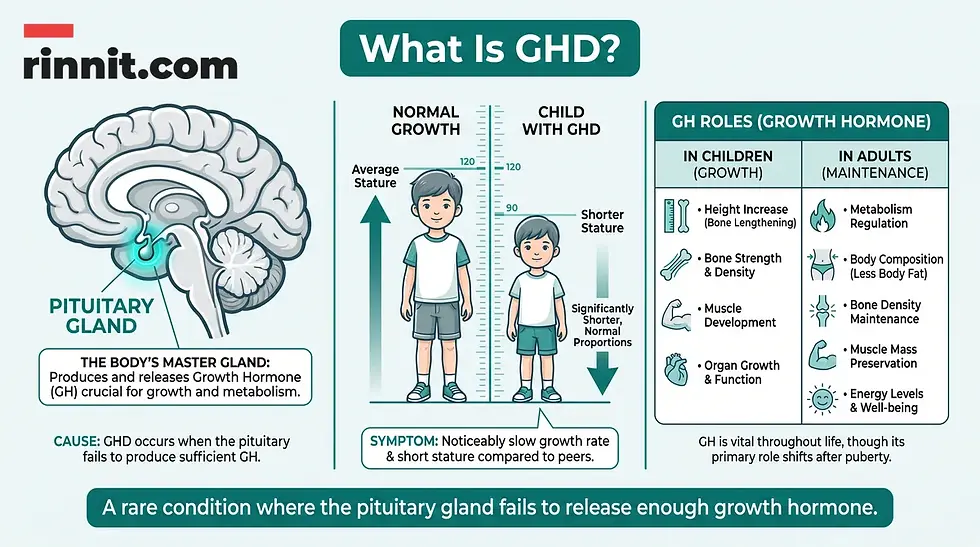
Growth hormone deficiency (GHD) occurs when the anterior lobe of the pituitary gland, a pea-sized organ at the base of the brain, does not release enough somatotropin, commonly called growth hormone (GH). GH is a chemical messenger that travels through the blood and signals muscles, bones and other tissues to grow and maintain their structure.
Cleveland Clinic reports that GHD affects about 1 in 4,000 to 10,000 children and about 1 in 10,000 people have adult-onset GHD. [1] It is often linked with short stature in children, but the hormone remains important in adulthood for metabolism and body composition.
Feature | Role of Growth Hormone | Impact of Deficiency |
In children | Promotes height, bone strength and muscle development. | Slow growth (sometimes called pituitary dwarfism) and delayed physical milestones. |
In adults | Maintains body structure, metabolism and blood sugar levels. | More body fat, bone loss and higher cholesterol and triglycerides. |
The Three Types of GHD
Doctors classify GHD by when it begins and what caused it. The type shapes the long-term treatment plan and the chance of other health problems.
Congenital GHD: Present from birth, usually from a genetic change or a structural brain difference during fetal development.
Acquired GHD: Occurs when the pituitary gland is damaged later. It can affect children and adults, often after injury or disease.
Idiopathic GHD: The cause cannot be found with medical testing.
Causes and Risk Factors
Congenital cases are mostly linked to specific genetic changes, some of which also affect facial structure (such as a cleft palate) or the immune system. [1]
Acquired Pituitary Damage
Later in life, GHD usually results from damage to the pituitary gland or to the hypothalamus, which controls it. Common causes include:
Brain injuries: Severe head trauma or traumatic brain injury.
Tumors: Benign growths such as pituitary adenomas or hypothalamic tumors that press on the gland.
Medical treatments: Radiation therapy near the brain or complications of brain surgery.
Infections and diseases: Central nervous system infections and infiltrative diseases such as sarcoidosis and tuberculosis.
Blood flow problems: Too little blood supply to the pituitary gland.
Recognizing the Symptoms

Symptoms depend on the age at which hormone levels fall. In children the signs are mostly physical and developmental, while in adults they are mostly metabolic and emotional.
Symptoms in Infants and Children
The most reliable sign is growing less than about 1.4 inches a year after the third birthday. [1] Other signs include:
A face that looks younger than the child's age.
Delayed tooth development and slow hair or nail growth.
Delayed puberty.
In infants: Low blood sugar (hypoglycemia) and, in newborn boys, a very small penis (micropenis). [1]
Symptoms in Adults
Adult GHD can be hard to diagnose because the symptoms are subtle and mimic other conditions. Key signs include:
Physical changes: More body fat (especially around the abdomen), reduced muscle tone and lower bone density.
Metabolic risks: Insulin resistance, high cholesterol and high triglycerides, which raise heart disease risk.
Mental health: Anxiety, depression, low energy and a reduced sense of well-being.
Associated Hormone Deficiencies (Hypopituitarism)
People with GHD may also have hypopituitarism, in which the pituitary gland does not make other essential hormones. These can include thyroid-stimulating hormone (TSH), adrenocorticotropic hormone (ACTH), antidiuretic hormone (ADH) and the reproductive hormones FSH and LH.
Diagnosis and Treatment
In children, diagnosis often happens at two points: around age 5, when school starts and height differences become obvious, and in the early teens, when delayed puberty is noticed. Doctors track growth over 6 to 12 months as a main diagnostic tool, and hormone tests confirm the diagnosis. In adults, the Endocrine Society guideline notes that confirmation with a stimulation test is usually required unless a genetic or structural cause has been proven since childhood. (Molitch et al., J Clin Endocrinol Metab, 2011)
Treatment Options
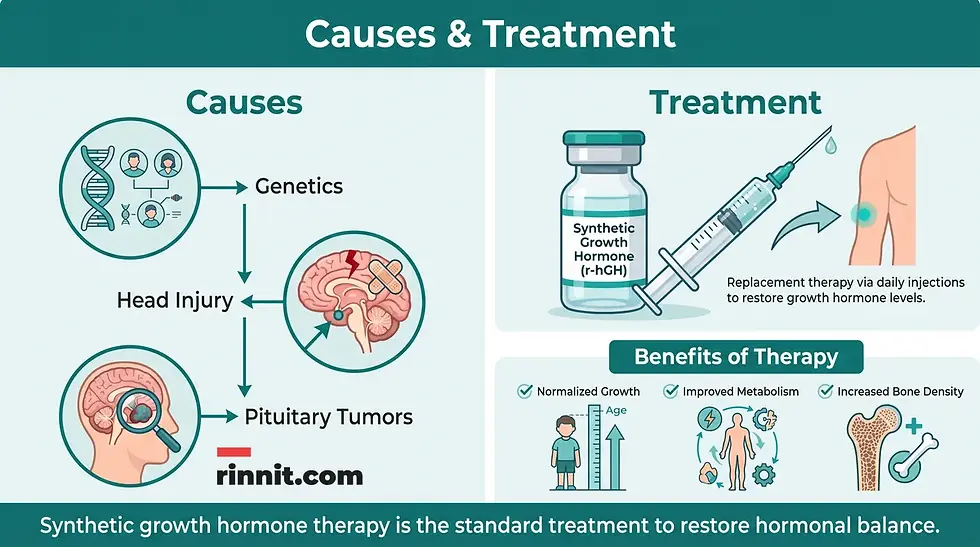
The standard treatment is synthetic growth hormone given by injection. In children, the goal is to restore growth. (Grimberg et al., Horm Res Paediatr, 2016) In adults, GH therapy can improve body composition, exercise capacity, bone health and quality of life, and it is most likely to help people with more severe GHD. The decision to treat adults should weigh the benefits and risks for each person. (Molitch et al., 2011)
Treatment Goal | Benefit for Children | Benefit for Adults |
Growth restoration | Increases height and supports bone strength. | Not applicable (growth plates are already fused). |
Metabolic balance | Improves the muscle-to-fat ratio. | Reduces fat mass and lowers cholesterol. |
Overall health | Supports normal physical development. | Can improve energy, bone health and well-being. |
Looking for clear answers on tough health questions? Browse plain-language health guides at Rinnit.com.
Frequently Asked Questions
What is growth hormone deficiency (GHD)?
Growth hormone deficiency (GHD) is a rare condition in which the pituitary gland does not make enough growth hormone, leading to slow growth in children and metabolic changes in adults.
Is GHD the same as dwarfism?
GHD is sometimes called "pituitary dwarfism," an older term. It is a hormonal cause of short stature and is different from skeletal conditions such as achondroplasia, where body proportions differ. In GHD, body proportions are usually normal.
What causes GHD in children?
GHD in children can be congenital (present from birth because of a genetic change or a structural brain difference) or acquired (for example after a brain injury, tumor or radiation). In many children no cause is found, which is called idiopathic GHD.
How do I know if my child has GHD?
A key sign is growing less than about 1.4 inches (3.5 cm) a year after age 3. Other signs include a younger-looking face, delayed tooth development and delayed puberty. Only a doctor can diagnose GHD, usually after tracking growth and running hormone tests.
Can adults develop GHD?
Yes. Adult-onset GHD usually follows damage to the pituitary gland from a tumor, surgery, radiation or a head injury.
What are the symptoms of GHD in adults?
Common symptoms include more belly fat, low energy, anxiety, depression, reduced muscle mass and lower bone density. They are subtle and overlap with many other conditions.
How is GHD diagnosed?
Doctors review growth or symptoms and blood tests. The Endocrine Society guideline notes that confirmation with a growth hormone stimulation test is usually required, except when a genetic or structural cause has been proven since childhood.
Is GHD treatable?
Yes. Treatment is injections of synthetic growth hormone, prescribed and monitored by an endocrinologist.
Does growth hormone therapy make you taller?
In children whose growth plates have not yet fused, treatment can increase height. In adults, growth plates are already fused, so treatment does not add height; it is used to improve body composition, bone health and well-being.
How common is GHD?
Cleveland Clinic reports about 1 in 4,000 to 10,000 children and about 1 in 10,000 people with adult-onset GHD. A Danish nationwide study estimated new diagnoses at roughly 1.4 to 2.6 per 100,000 people per year, depending on age group and sex.
What is the pituitary gland?
The pituitary gland is a pea-sized gland at the base of the brain that makes several essential hormones, including growth hormone.
Can GHD cause low blood sugar?
Yes. Infants and toddlers with GHD can have low blood sugar (hypoglycemia).
Can a head injury cause GHD?
Yes. A severe traumatic brain injury can damage the pituitary gland or hypothalamus and reduce hormone production.
Does GHD affect puberty?
Often, yes. Children with GHD commonly have delayed puberty, and some also lack other pituitary hormones that drive puberty.
Is growth hormone therapy safe?
When prescribed and monitored by a specialist, risks are considered low. The Endocrine Society guideline states that the risks of GH treatment in adults are low, and the decision to treat should weigh benefits and risks for each person.
Related Reading
Pituitary Gland: Anatomy, Hormones, Function and Related Conditions explains the pituitary gland, which makes growth hormone.
Panhypopituitarism: Understanding the Total Lack of Pituitary Hormones covers a broader shortage of several pituitary hormones.
Pituitary Tumors and Adenomas: Types, Symptoms, and Treatment Guide explains pituitary tumors, one possible cause of hormone deficiency.
Dwarfism (Short Stature): Definition, Causes, Diagnosis and Treatment explains the many causes of short stature and their care.
References
Cleveland Clinic. Growth Hormone Deficiency (GHD). Cleveland Clinic. June 21, 2022. https://my.clevelandclinic.org/health/diseases/23343-growth-hormone-deficiency-ghd
Molitch ME, et al. Evaluation and treatment of adult growth hormone deficiency: an Endocrine Society clinical practice guideline. J Clin Endocrinol Metab. 2011;96(6):1587-609. PMID 21602453. https://doi.org/10.1210/jc.2011-0179
Grimberg A, et al. Guidelines for Growth Hormone and Insulin-Like Growth Factor-I Treatment in Children and Adolescents: Growth Hormone Deficiency, Idiopathic Short Stature, and Primary Insulin-Like Growth Factor-I Deficiency. Horm Res Paediatr. 2016;86(6):361-397. PMID 27884013. https://doi.org/10.1159/000452150
Newman CB, et al. Effects of low dose versus high dose human growth hormone on body composition and lipids in adults with GH deficiency: a meta-analysis of placebo-controlled randomized trials. Pituitary. 2015;18(3):297-305. PMID 24810900. https://doi.org/10.1007/s11102-014-0571-z
Berglund A, et al. Growth hormone replacement does not increase mortality in patients with childhood-onset growth hormone deficiency. Clin Endocrinol (Oxf). 2015;83(5):677-83. PMID 26147754. https://doi.org/10.1111/cen.12848
Stochholm K, et al. Incidence of GH deficiency - a nationwide study. Eur J Endocrinol. 2006;155(1):61-71. PMID 16793951. https://doi.org/10.1530/eje.1.02191
Medical disclaimer
This article is for general educational purposes only and is not a substitute for professional medical advice, diagnosis, or treatment. Always seek the advice of your physician or other qualified healthcare provider with any questions you may have about a medical condition. Never disregard professional medical advice or delay seeking care because of something you have read here. If you think you may have a medical emergency, call your doctor or emergency services immediately.



Comments