Distended Bladder: When Your Bladder Stretches Because You Can’t Pee — What It Is, The 4 Causes, Symptoms, Diagnosis, Treatment and When It Becomes an Emergency — What You Need to Know

Updated: 3 days ago
Medically reviewed by Dr. Baraa Alnahhal, MD | Last reviewed: October 7, 2026
Know the emergency line: A distended bladder on its own is not an emergency, but acute urinary retention is. If you are barely peeing or cannot pee at all, especially if you are in pain, go to the nearest emergency room or seek medical attention right away.
Quick Answer
A distended bladder is an enlarged bladder that stretches to hold more urine because a person is not peeing enough, or at all, a problem called urinary retention. [1] Causes include blockages, infections, neurological conditions and surgery. [1] The usual treatment is draining the bladder with a catheter. [1] [5] Being unable to pee at all, especially with pain, is an emergency. [1]
What the research says
After surgery, a full bladder is common and the risk factors are identifiable. Using ultrasound in 177 adults at discharge from the recovery room after thoracic, vascular, abdominal, orthopedic or ENT surgery, 44% had a bladder volume above 500 mL. Risk factors for urinary retention were age over 60 (odds ratio 2.11, 95% CI 1.01–4.38), spinal anesthesia (OR 3.97, 95% CI 1.32–11.89) and surgery lasting more than 120 minutes (OR 3.03, 95% CI 1.39–6.61) (Lamonerie et al., British Journal of Anaesthesia, 2004) [2].
After spine surgery, an enlarged prostate and diabetes raise the risk of urinary retention, while walking on the day of surgery is linked to lower risk. A meta-analysis of 11 studies covering 31,251 patients (2,858 with postoperative urinary retention) found higher risk with benign prostatic hyperplasia (OR 3.79, 95% CI 1.89–7.62), diabetes (OR 1.50, 95% CI 1.17–1.93), a previous urinary tract infection (OR 1.70, 95% CI 1.28–2.24) and male sex (OR 1.31, 95% CI 1.04–1.64), and lower risk with ambulation on the same day as surgery (OR 0.65, 95% CI 0.52–0.81) (Chang et al., The Spine Journal, 2021) [3].
Many fetuses with an enlarged bladder (megacystis) do well, but outcomes vary. A systematic review of 13 studies with 1,675 fetuses found spontaneous resolution of megacystis in 32% and survival to follow-up in 44%; chromosomal abnormalities were present in 10% and associated structural anomalies in 24%. Oligohydramnios was linked to worse survival (OR 0.14), and intrauterine intervention did not significantly improve prognosis (Chen et al., European Journal of Obstetrics & Gynecology and Reproductive Biology, 2019) [4].
What is a distended bladder?
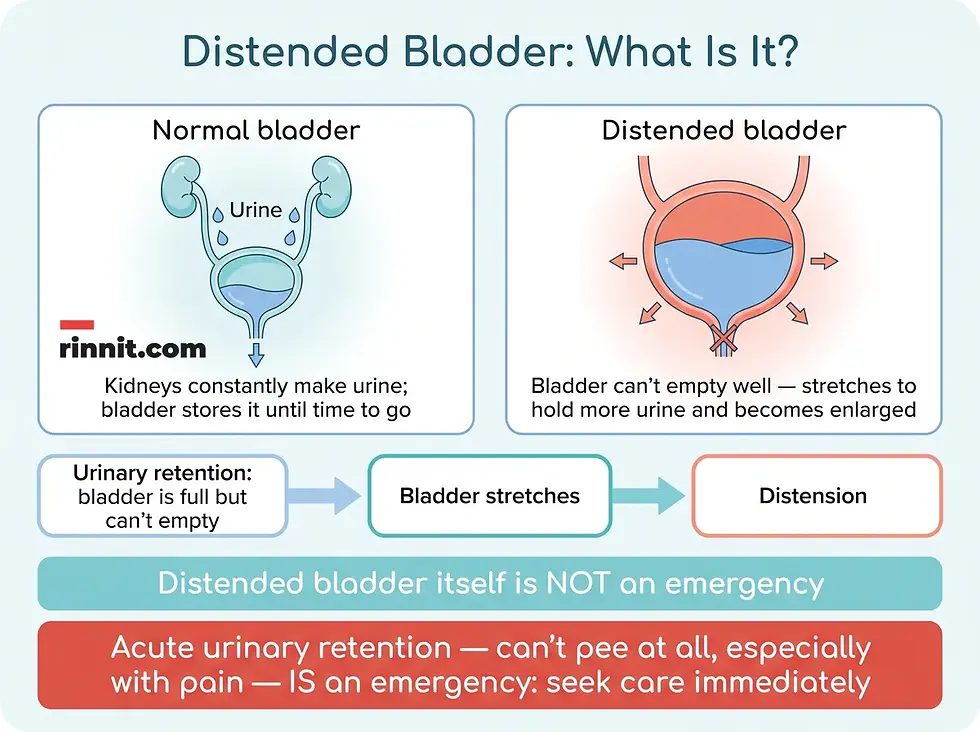
A distended bladder is when the pouch that holds your pee (urine) is enlarged. This happens when it stretches to hold more fluid because you are not peeing enough (urinary retention). Not everyone with urinary retention has bladder distention. [1]
Your kidneys remove excess fluids and substances that your body does not need and turn them into pee. Your kidneys are constantly making pee, so your bladder stores it until it is time to go. When your bladder is full, it tells you that it is time to empty it. Urinary retention is when your bladder is full and you cannot empty it. [1]
Is a distended bladder a medical emergency?
A distended bladder is not an emergency on its own. But acute urinary retention, when you are barely peeing or not peeing at all, is. If you cannot pee and you are in pain, seek medical attention immediately. [1]
What are the symptoms of a distended bladder?
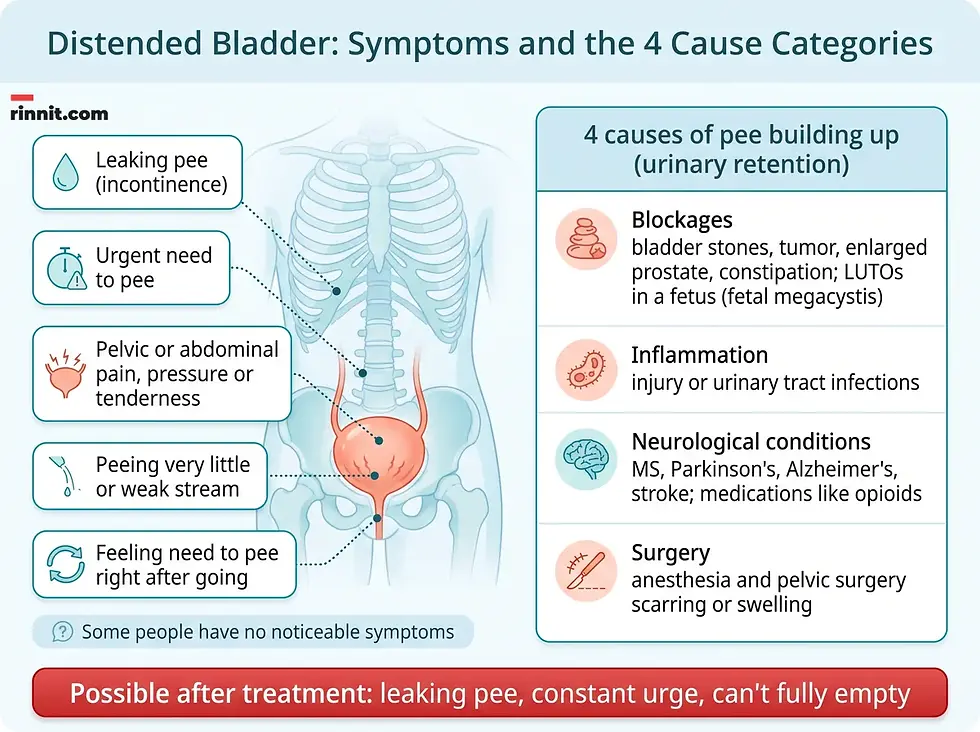
Symptoms of a distended bladder include leaking pee (urinary incontinence), an urgent need to pee, and pain, pressure or tenderness in your pelvis or abdomen. You may also have other symptoms of urinary retention, like peeing very little or with a weak stream, or feeling the need to pee right after you have gone. [1] Some people do not have noticeable symptoms. [1]
Symptom | What you will notice |
Leaking pee | Urinary incontinence: pee leaks out without warning |
Urgency | A sudden, urgent need to pee |
Pelvic or abdominal pain | Pain, pressure or tenderness in your pelvis or abdomen |
Poor emptying | Peeing very little or with a weak stream |
Incomplete emptying feeling | Feeling the need to pee right after you have gone |
No symptoms at all | Some people do not have noticeable symptoms |
What causes a distended bladder?
Pee building up in your bladder, or urinary retention, causes distention. Pee can build up for many reasons, which fall into four categories.
Blockages
Bladder stones, a tumor, an enlarged prostate or constipation can block pee from getting out of your bladder. [1] Lower urinary tract obstructions (LUTOs) are the most common cause of distended bladder in a fetus (fetal megacystis). [1]
Inflammation
Swelling in your bladder or urethra (the tube that your pee goes through to get from your bladder to the outside of your body) can prevent you from being able to empty your bladder. Injury or urinary tract infections can cause inflammation. [1]
Neurological conditions
Medical conditions and medications (like opioids) can affect the nerves that tell your brain that your bladder is full, which means you might not empty it when you need to. Conditions that could cause this include multiple sclerosis (MS), Parkinson’s disease, Alzheimer’s disease and stroke. [1]
Surgery
Anesthesia (medication that keeps you from feeling pain during surgery) can interfere with your ability to empty your bladder. Pelvic surgery can also cause scarring or swelling that blocks your bladder or urethra. [1]
Cause category | Specific causes |
Blockages | Bladder stones, a tumor, an enlarged prostate, constipation; lower urinary tract obstructions (LUTOs) in a fetus (fetal megacystis) |
Inflammation | Swelling in the bladder or urethra from injury or urinary tract infections |
Neurological conditions | Multiple sclerosis (MS), Parkinson’s disease, Alzheimer’s disease, stroke; medications like opioids that affect the bladder nerves |
Surgery | Anesthesia interfering with emptying; pelvic surgery causing scarring or swelling |
What are the complications of a distended bladder?
A distended bladder can sometimes cause problems going to the bathroom (bladder dysfunction), even after treatment. You might leak pee, have the urge to go to the bathroom when you do not need to, or not be able to fully empty your bladder. [1]
How is a distended bladder diagnosed?
A provider will listen to your symptoms and examine you. They might feel your abdomen and ask if it hurts to press on it. If they think your bladder is distended, they might order imaging, like an ultrasound. [1] A pregnancy care provider may diagnose a distended bladder in a fetus during a prenatal ultrasound. [1]
Test | What it does |
Abdominal exam | The provider feels your abdomen and checks whether pressing on it hurts |
Ultrasound | Looks at your bladder to confirm distension |
Post-void residual urine test | An ultrasound performed after you have emptied your bladder (peed out as much as you can) to see how well you are emptying |
Additional tests | May be ordered or performed to find out what is causing the urinary retention |
How is a distended bladder treated?
Providers can treat a distended bladder by draining the excess pee from it. If you cannot pee at all, your provider will do this before looking for the cause or making any other diagnoses. [1] Then they will diagnose and treat the underlying cause (usually whatever is causing urinary retention), with medications, surgery or other procedures. [1] [5]
Treatment | Detail |
Drain the bladder first | If you cannot pee at all, drainage comes before any other diagnosis |
Transurethral bladder catheterization | The most common treatment: a thin tube is inserted into the urethral opening, moved through the urethra to the bladder and drains the pee; it may empty the bladder once or stay in place for days or weeks |
Treat the underlying cause | Medications, surgery or other procedures, depending on what caused the retention |
Fetal megacystis observation | Can sometimes go away on its own as the fetus continues to grow |
Vesicocentesis | A needle removes fluid from a fetus’s bladder |
Vesicoamniotic shunt | A tube inserted into a fetus’s bladder drains fluid from it |
Fetal megacystis may or may not be treated. A pregnancy care provider is the right person to talk to about what to expect.
What are the side effects of treatment?
After a catheter is removed, you might experience blood in your pee (hematuria), an increased need to pee, or low blood pressure (hypotension). Most of the time these side effects are temporary. [1]
How soon after treatment will I feel better?
You should feel some relief right away when a provider drains your bladder. [1] How long additional treatments take depends on what is causing the urinary retention.

Can a distended bladder be prevented?
Managing any chronic illnesses that can lead to urinary retention can help prevent a distended bladder. In some cases, like a distended bladder after surgery or fetal megacystis, it cannot be prevented. [1]
When should I go to the ER?
If you are unable to pee and are in pain, go to the nearest emergency room or seek medical attention right away. Acute urinary retention is a medical emergency. [1] A distended bladder on its own is not an emergency, but not being able to empty your bladder at all is.
What questions should I ask my doctor?
What caused this?
How can I prevent it from happening again?
What are my treatment options?
Do I need ongoing treatment?
A note from the experts: A provider can usually treat a distended bladder by draining it, and it is important to treat any underlying cause of urinary retention. Let your provider know if you are having trouble peeing or have abdominal or pelvic pain, especially if you have recently had surgery. A distended bladder is not an emergency, but not being able to empty your bladder at all can be.
The Bottom Line: What You Need to Know About a Distended Bladder
A distended bladder is simply an enlarged bladder: the pouch that holds your urine stretches to hold more fluid because you are not peeing enough or at all. The driving force behind it is urinary retention, where your bladder is full and you cannot empty it. Your kidneys never stop making urine, so when it cannot get out, the bladder takes the strain and swells.
The reasons urine cannot get out fall into four groups. Blockages (bladder stones, a tumor, an enlarged prostate or even constipation) physically stop the flow. Inflammation from injury or urinary tract infections swells the bladder or urethra shut. Neurological conditions such as multiple sclerosis, Parkinson’s disease, Alzheimer’s disease or stroke, and medications like opioids, disrupt the nerve signals that tell your brain the bladder is full. And surgery, both the anesthesia and the scarring or swelling from pelvic procedures, can interrupt emptying. In a fetus, lower urinary tract obstructions (LUTOs) are the most common cause (fetal megacystis). [1]
Symptoms include leaking pee, urgency, and pelvic or abdominal pain, pressure or tenderness, but some people notice nothing at all. Diagnosis is straightforward: a physical exam and an ultrasound, usually with a post-void residual urine test to see how well you empty. [1] Treatment starts with draining the bladder, most commonly through a thin catheter passed through the urethra and sometimes left in place for days or weeks [1], followed by treating the underlying cause. You should feel relief right away after draining, and possible after-effects like temporary blood in the urine, an increased need to pee or low blood pressure are usually short-lived. [1]
Keep the emergency rule clear in your mind: the distended bladder itself is not an emergency, but if you cannot pee, especially with pain, that is acute urinary retention, and it is. Go to the ER right away. Prevention comes down to managing chronic conditions that can cause retention, though post-surgical cases and fetal megacystis often cannot be prevented. [1]
Take the first step. If you are having trouble peeing, leaking urine, or feeling pain, pressure or tenderness in your pelvis or abdomen, especially after surgery, let your provider know. If you cannot pee at all, seek emergency care immediately.
Frequently Asked Questions
What is a distended bladder?
A distended bladder is when the pouch that holds your urine is enlarged. It stretches to hold more fluid because you are not peeing enough (urinary retention).
Is a distended bladder the same as urinary retention?
Not exactly. Urinary retention is when your bladder is full and you cannot empty it. Distention is what happens when the bladder cannot empty well and stretches to hold more urine. Not everyone with urinary retention has bladder distention.
How does the bladder normally work?
Your kidneys are constantly making pee from excess fluids, and your bladder stores it until it is time to go. When your bladder is full, it tells you it is time to empty it.
Is a distended bladder an emergency?
A distended bladder is not an emergency on its own. But acute urinary retention, barely peeing or not peeing at all, is a medical emergency. If you cannot pee and you are in pain, seek medical attention immediately.
What are the symptoms of a distended bladder?
Leaking pee (urinary incontinence), an urgent need to pee, and pain, pressure or tenderness in your pelvis or abdomen. You may also pee very little or with a weak stream, or feel the need to pee right after you have gone.
Can a distended bladder have no symptoms?
Yes. Some people do not have noticeable symptoms.
What causes a distended bladder?
Pee building up in the bladder (urinary retention), which can result from blockages, inflammation, neurological conditions, or surgery and anesthesia.
Can bladder stones cause a distended bladder?
Yes. Bladder stones, a tumor, an enlarged prostate or constipation can block pee from getting out of your bladder.
Can constipation cause a distended bladder?
Yes. Constipation is one of the blockages that can prevent pee from getting out of the bladder.
Can a UTI cause a distended bladder?
Yes. Urinary tract infections and injury can cause inflammation in the bladder or urethra that prevents you from emptying your bladder.
Which neurological conditions cause a distended bladder?
Multiple sclerosis (MS), Parkinson’s disease, Alzheimer’s disease and stroke can affect the nerves that tell your brain the bladder is full, so you might not empty it when you need to.
Can medications cause a distended bladder?
Yes. Medications like opioids can affect the nerves that signal your brain that your bladder is full.
Can surgery cause a distended bladder?
Yes. Anesthesia can interfere with your ability to empty your bladder, and pelvic surgery can cause scarring or swelling that blocks the bladder or urethra.
What is fetal megacystis?
A distended bladder in a fetus, most commonly caused by lower urinary tract obstructions (LUTOs). It can sometimes go away on its own as the fetus continues to grow.
What are LUTOs?
Lower urinary tract obstructions, the most common cause of distended bladder in a fetus (fetal megacystis).
How is a distended bladder diagnosed?
With a symptom review and physical exam (the provider may feel your abdomen and check for pain when pressing), plus imaging such as an ultrasound and a post-void residual urine test.
What is a post-void residual urine test?
An ultrasound done after you have emptied your bladder (peed out as much as you can) to see how well you are emptying it.
Can a distended bladder be seen in a pregnancy?
Yes. A pregnancy care provider may diagnose a distended bladder in a fetus during a prenatal ultrasound.
How is a distended bladder treated?
By draining the excess urine from the bladder, then diagnosing and treating the underlying cause (usually whatever is causing the urinary retention) with medications, surgery or other procedures.
What is transurethral bladder catheterization?
The most common way to treat a distended bladder: a provider inserts a thin tube into the urethral opening, moves it through the urethra to the bladder and drains the pee. The tube may empty the bladder once or stay in place for days or weeks.
How are fetal distended bladders treated?
They may or may not be treated. Options include vesicocentesis (a needle removes fluid from the fetus’s bladder) or a vesicoamniotic shunt (a tube drains fluid from the fetus’s bladder).
What are the side effects of catheter treatment?
After a catheter is removed you might have blood in your pee (hematuria), an increased need to pee, or low blood pressure (hypotension). Most of the time these side effects are temporary.
How soon will I feel better after treatment?
You should feel some relief right away when a provider drains your bladder. How long additional treatments take depends on the cause of the urinary retention.
What complications can a distended bladder cause?
Even after treatment, it can sometimes cause bladder dysfunction: leaking pee, feeling the urge to go when you do not need to, or not being able to fully empty your bladder.
Can a distended bladder be prevented?
Managing chronic illnesses that can lead to urinary retention can help. In some cases, like a distended bladder after surgery or fetal megacystis, it cannot be prevented.
When should I go to the ER for a distended bladder?
If you are unable to pee and are in pain, go to the nearest ER or seek medical attention right away. Acute urinary retention is a medical emergency.
What questions should I ask my doctor?
What caused this? How can I prevent it from happening again? What are my treatment options? Do I need ongoing treatment?
Related reading on Rinnit
Learn more in our guide to Credé Maneuver: How to Do It, Who Should Avoid It and Safer Alternatives.
Sources
Cleveland Clinic. Distended Bladder. Cleveland Clinic. Last updated November 23, 2023. https://my.clevelandclinic.org/health/diseases/distended-bladder
Lamonerie L, Marret E, Deleuze A, et al. Prevalence of postoperative bladder distension and urinary retention detected by ultrasound measurement. Br J Anaesth. 2004;92(4):544-546. PMID 14977795. https://doi.org/10.1093/bja/aeh099
Chang Y, Chi KY, Tai TW, et al. Risk factors for postoperative urinary retention following elective spine surgery: a meta-analysis. Spine J. 2021;21(11):1802-1811. PMID 34015508. https://doi.org/10.1016/j.spinee.2021.05.009
Chen L, Guan J, Gu H, et al. Outcomes in fetuses diagnosed with megacystis: Systematic review and meta-analysis. Eur J Obstet Gynecol Reprod Biol. 2019;233:120-126. PMID 30594021. https://doi.org/10.1016/j.ejogrb.2018.12.007
Selius BA, Subedi R. Urinary retention in adults: diagnosis and initial management. Am Fam Physician. 2008;77(5):643-650. PMID 18350762. https://pubmed.ncbi.nlm.nih.gov/18350762/
Medical disclaimer
This article is provided for general educational purposes only and is not a substitute for professional medical advice, diagnosis or treatment. If you cannot pee and are in pain, treat it as a medical emergency and seek immediate care. Only a qualified healthcare provider can diagnose a distended bladder, identify its underlying cause and manage catheterization and any related treatment safely.



Comments