Direct Thrombin Inhibitors: Types, Uses and Side Effects

Updated: 2 days ago
Written and medically reviewed by Dr. Baraa Alnahhal, MD · Last reviewed: November 2026 · How we review
Quick Answer
Direct thrombin inhibitors (DTIs) are anticoagulants (blood thinners) that prevent blood clots by attaching directly to thrombin, an enzyme central to clotting, and blocking it. The main ones are argatroban and bivalirudin, given by IV, and dabigatran, a pill. They treat or prevent DVT, pulmonary embolism and stroke in atrial fibrillation. The main risk is bleeding.
What the research says
Dabigatran prevented more strokes than warfarin: in the RE-LY trial of 18,113 people with atrial fibrillation, stroke or systemic clots occurred at 1.11% per year with dabigatran 150 mg versus 1.69% with warfarin, and bleeding strokes were much less common (0.10% vs. 0.38% per year) (Connolly SJ et al., New England Journal of Medicine, 2009) [2]
Dabigatran matched warfarin for treating clots: in the RE-COVER trial of 2,539 people with acute venous thromboembolism, repeat clots occurred in 2.4% on dabigatran versus 2.1% on warfarin, with less bleeding overall (16.1% vs. 21.9%) (Schulman S et al., New England Journal of Medicine, 2009) [3]
Key takeaways
DTIs block thrombin directly to prevent clots.
Types are argatroban, bivalirudin (IV) and dabigatran (pill).
They treat DVT, pulmonary embolism, Afib-related clots and HIT.
Bleeding is the main risk.
Dabigatran's effects can be reversed.
What are direct thrombin inhibitors?
They're a type of anticoagulant. Heparin also affects thrombin, but indirectly. DTIs give more predictable results than heparin and don't cause heparin's low-platelet reaction. Dabigatran doesn't need routine clotting checks, but IV forms are adjusted with blood tests. Sources: [1]
What they treat

They're not for people with mechanical heart valves.
Clots or stroke in atrial fibrillation without valve problems.
Clots after hip replacement.
Acute coronary syndrome and clots in the heart.
During angioplasty. Sources: [1]
Types of DTIs
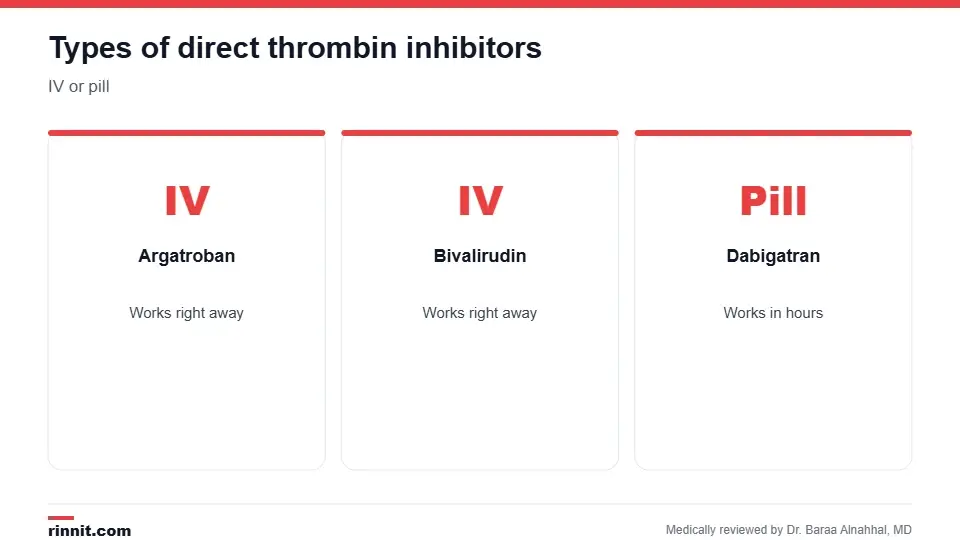
Your provider picks the right one for your situation.
Medicine | How it's given | Starts working |
Argatroban | IV injection | Right away |
Bivalirudin | IV injection | Right away |
Dabigatran | Pill, once or twice a day | In a few hours |
Sources: [1]
DTIs vs. warfarin and heparin
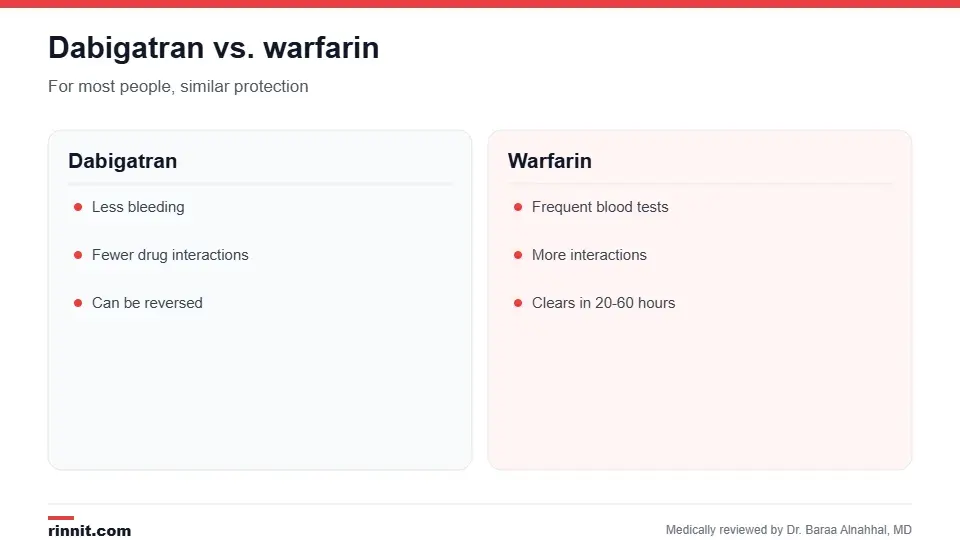
DTIs are as safe and effective as warfarin or heparin for most people.
Dabigatran causes fewer bleeding strokes and has fewer drug interactions than warfarin, though major bleeding was similar at the higher dose.
Half a dabigatran dose leaves the body in 12 to 14 hours, versus 20 to 60 hours for warfarin.
DTIs are an option for people who can't take heparin.
Studies show they're as safe and effective as warfarin or heparin, except with certain valve conditions such as mechanical valves. Sources: [1, 2, 3]
Reversing DTIs
Idarucizumab, given by IV, reverses dabigatran. IV DTIs have no antidote, but their effects fade fairly quickly once the infusion stops. Sources: [1]
Side effects
Bleeding.
Indigestion or belly pain.
Brown or pink urine.
Headache or dizziness.
Low blood pressure.
Chest pain or shortness of breath.
Rarely, fever, sepsis or cardiac arrest. Sources: [1]
How long you'll take them
Some people take DTIs short term, such as about a month after hip replacement. Others with a high clot risk take them long term or indefinitely. Missing a pill dose or stopping early can raise your clot and stroke risk, so don't stop without talking to your provider. Tell your care team you take it before any epidural or spinal procedure, because of a rare risk of bleeding around the spine. Sources: [1]
When to call your provider
Contact your provider about side effects. Get emergency care for heavy bleeding or other serious problems. Sources: [1]
Conclusion
Direct thrombin inhibitors offer predictable, effective clot prevention with fewer blood tests than older blood thinners. Taking every dose on time keeps you protected.
Keep learning: read about anticoagulants and factor Xa inhibitors.
Frequently asked questions
What are direct thrombin inhibitors?
Blood thinners that block thrombin directly.
What are some examples?
Argatroban, bivalirudin and dabigatran.
What do they treat?
DVT, pulmonary embolism, Afib-related clots and HIT.
How are they given?
Argatroban and bivalirudin by IV; dabigatran as a pill.
How fast do they work?
IV forms right away; the pill in a few hours.
What's the main risk?
Bleeding.
Can dabigatran be reversed?
Yes, with idarucizumab.
Are they better than warfarin?
Dabigatran causes fewer bleeding strokes and has fewer interactions.
Can I take them with a mechanical valve?
No. They're not recommended.
Do I need regular blood tests?
Usually not as often as with warfarin.
Related Reading
Anticoagulants (Blood Thinners): Types, Uses and Side Effects an overview of blood thinners.
Understanding Warfarin: A Guide to Anticoagulant Therapy an older blood thinner.
Understanding Factor Xa Inhibitors: Modern Blood Thinner Solutions another newer blood thinner.
Deep Vein Thrombosis (DVT): Symptoms, Causes, Diagnosis & Treatment — Complete Guide a clot DTIs treat.
Heparin-Induced Thrombocytopenia (HIT): Risks and Management a condition DTIs treat.
References
Cleveland Clinic. Direct Thrombin Inhibitors. Cleveland Clinic. Last updated May 30, 2023. https://my.clevelandclinic.org/health/treatments/25036-direct-thrombin-inhibitors
Connolly SJ, Ezekowitz MD, Yusuf S, et al. Dabigatran versus warfarin in patients with atrial fibrillation. New England Journal of Medicine. 2009;361(12):1139-1151. PMID 19717844. https://doi.org/10.1056/NEJMoa0905561
Schulman S, Kearon C, Kakkar AK, et al. Dabigatran versus warfarin in the treatment of acute venous thromboembolism. New England Journal of Medicine. 2009;361(24):2342-2352. PMID 19966341. https://doi.org/10.1056/NEJMoa0906598
Medical disclaimer
This article is for general education only and does not replace advice from a qualified healthcare professional. Talk to your doctor about your own diagnosis and treatment, and seek emergency care right away for severe or sudden symptoms.



Comments