Anticoagulants (Blood Thinners): Types, Uses and Side Effects

Updated: 2 days ago
Written and medically reviewed by Dr. Baraa Alnahhal, MD · Last reviewed: November 2026 · How we review
Quick Answer
Anticoagulants, often called blood thinners, are medicines that make the blood less likely to clot. They help prevent new clots and keep existing ones from growing, lowering the risk of stroke, heart attack and pulmonary embolism. Examples include heparin, warfarin and direct oral anticoagulants like apixaban. The most common risk for all of them is bleeding.
What the research says
Newer blood thinners beat warfarin on key outcomes: pooling 4 trials with 71,683 people with atrial fibrillation, direct oral anticoagulants lowered stroke or clots elsewhere by 19%, brain bleeding by 52% and death by 10% compared with warfarin, but raised stomach and bowel bleeding by 25% (Ruff CT et al., Lancet, 2014) [2]
Apixaban lowered stroke and bleeding: in the ARISTOTLE trial of 18,201 people with atrial fibrillation, apixaban lowered stroke or clots (1.27% vs. 1.60% per year), major bleeding (2.13% vs. 3.09% per year) and death compared with warfarin (Granger CB et al., New England Journal of Medicine, 2011) [3]
Key takeaways
Anticoagulants make blood less likely to clot.
They help prevent stroke, heart attack and pulmonary embolism.
They come as IV, injection or pill forms.
Warfarin needs regular blood tests; DOACs usually don't.
Bleeding is the most common risk.
What are anticoagulants?
Anticoagulants are a family of medicines that slow your blood's ability to clot. More than 5 million people with Medicare Part D received an anticoagulant prescription in 2019. Learn more about blood clots. Sources: [1]
Why they're used
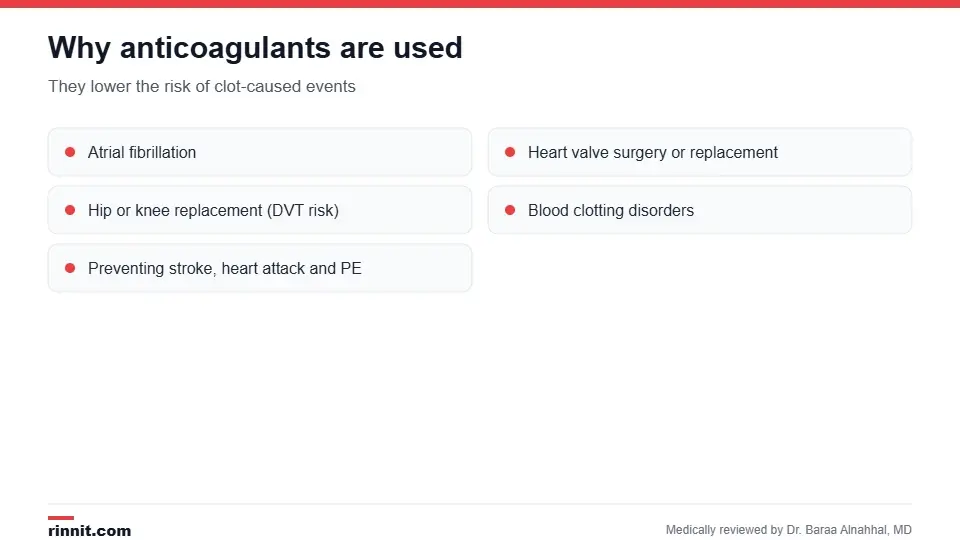
They lower the risk of clot-caused events.
Heart valve surgery or replacement.
Hip or knee replacement, to lower DVT risk.
Blood clotting disorders, some of them genetic.
Preventing stroke, heart attack and pulmonary embolism. Sources: [1]
Types of anticoagulants

DOACs don't need regular lab testing.
Type | Examples | Notes |
UFH | Strong and fast; needs constant lab monitoring | |
Low-molecular-weight heparin | LMWH | Longer-lasting; less monitoring |
Fondaparinux | Synthetic injection | Mostly for prevention |
Direct thrombin inhibitors (IV) | Argatroban, bivalirudin, desirudin | Given by IV or injection |
Vitamin K antagonist pill | Needs careful dosing and regular blood tests | |
DOACs | Dabigatran, apixaban, edoxaban, rivaroxaban | Pills; no regular lab testing needed |
Sources: [1]
How they work
Heparin activates antithrombin, a natural clot blocker.
Warfarin blocks your body's use of vitamin K, which clotting needs.
Dabigatran and other thrombin inhibitors block thrombin.
Apixaban, edoxaban and rivaroxaban block factor Xa. Sources: [1]
Side effects and risks
Medicine | Risks |
All anticoagulants | Bleeding is the most common risk |
Warfarin | Skin damage (usually within five days of starting), purple toes, harm to a developing fetus |
Heparin | HIT type I in about 10% of people, type II in about 1%; bone thinning with use over a month |
DOACs | Indigestion, stomach and bowel bleeding |
Sources: [1, 2]
Who shouldn't take them
People with current or recent trauma or bleeding.
Recent major surgery.
A history of bleeding in the brain.
End-stage liver disease.
Certain clotting conditions. Sources: [1]
Warfarin is the only pill option for people with a mechanical heart valve or moderate to severe mitral valve narrowing (mitral stenosis), and it's often used in severe kidney disease. Sources: [1]
How long you'll take them

Your provider may switch you between options.
Most IV and injectable anticoagulants aren't meant for long-term use. Many oral ones can be taken long term, some indefinitely. Sources: [1]
When to get help
Call your provider for bleeding that won't stop from your gums, nose or cuts.
Easy or unexplained bruising, or unusual dizziness, weakness or tiredness.
Get care right away after any fall, especially if you hit your head, even without a visible wound.
A sudden severe headache or stomach pain.
Vomiting or coughing up blood or material that looks like coffee grounds.
Red, orange or brown urine, or red or tar-like stool. Sources: [1]
Conclusion
Anticoagulants are extremely effective at preventing stroke, pulmonary embolism and heart attack, and they can be lifesaving. Knowing the signs of bleeding and keeping up with any blood tests help you use them safely.
Keep learning: read about warfarin and atrial fibrillation.
Frequently asked questions
What are anticoagulants?
Medicines that make your blood less likely to clot.
Are anticoagulants blood thinners?
Yes, that's their common name.
What are anticoagulants used for?
Preventing stroke, heart attack, DVT and pulmonary embolism.
What is a DOAC?
A direct oral anticoagulant, such as apixaban or dabigatran.
Do I need blood tests on warfarin?
Yes, regular blood tests are needed.
Do DOACs need blood tests?
They don't need regular lab testing.
What is the main side effect?
Bleeding.
What is HIT?
A drop in platelets that can happen with heparin.
How long will I take a blood thinner?
It depends; some people take them indefinitely.
What should I do if I fall?
Get medical care right away, especially if you hit your head.
Related Reading
Direct Thrombin Inhibitors: Types, Uses and Side Effects explains direct thrombin inhibitors.
Understanding Warfarin: A Guide to Anticoagulant Therapy a common oral blood thinner.
Heparin Infusion: How the Heparin Drip Works, Monitoring, and Side Effects a blood thinner given by IV.
Atrial Fibrillation (AFib): Symptoms, Causes & Treatment Guide a common reason for blood thinners.
Deep Vein Thrombosis (DVT): Symptoms, Causes, Diagnosis & Treatment — Complete Guide clots in the legs.
Pulmonary Embolism Guide: Symptoms, Causes, Diagnosis, and Treatment clots in the lungs.
References
Cleveland Clinic. Anticoagulants (Blood Thinners): What They Do, Types and Side Effects. Cleveland Clinic. Last updated January 10, 2022. https://my.clevelandclinic.org/health/treatments/22288-anticoagulants
Ruff CT, Giugliano RP, Braunwald E, et al. Comparison of the efficacy and safety of new oral anticoagulants with warfarin in patients with atrial fibrillation: a meta-analysis of randomised trials. Lancet. 2014;383(9921):955-962. PMID 24315724. https://doi.org/10.1016/S0140-6736(13)62343-0
Granger CB, Alexander JH, McMurray JJ, et al. Apixaban versus warfarin in patients with atrial fibrillation. N Engl J Med. 2011;365(11):981-992. PMID 21870978. https://doi.org/10.1056/NEJMoa1107039
Medical disclaimer
This article is for general education only and does not replace advice from a qualified healthcare professional. Talk to your doctor about your own diagnosis and treatment, and seek emergency care right away for severe or sudden symptoms.



Comments